
The Negotiation Checklist — Infographic
 Curated byKory White · Fractional CRO · Maryland
 PULSEKNOWLEDGE LIBRARY
A negotiation checklist infographic typically outlines key pre-meeting steps like defining your BATNA, setting target and walk-away points, and researching the other party’s interests. It often includes a visual flowchart for managing concessions, active listening cues, and closing tactics. While specific designs vary, most checklists emphasize preparation, clear communication, and mutual value creation.
The Negotiation Checklist — Infographic

A numbered portrait infographic — The Negotiation Checklist — covering Anchor, Trade, Silence, Summarize, and more. Drop it into onboarding decks or a sales-process explainer for reps and buyers.
Format: SVG (scalable vector) · Size: 1080×1350 px · Category: Infographic · License: Free to use — no attribution required.
Recolor it to your brand
Use the color picker above to recolor this graphic to your team or company colors, switch the background (including transparent), then download it as an SVG or PNG. No sign-up, no watermark.
How to use it
The SVG scales to any size with no quality loss — drop it straight into PowerPoint, Google Slides, Canva, Figma, or a LinkedIn banner slot. The PNG export is ready to upload anywhere that wants a raster image.
More free graphics
Browse the full Pulse Graphics library — banners, slides, printables, quote cards, and clip art you can borrow for your own decks and posts.
Related on PULSE
- The Sales Cycle: Lead to Closed-Won — Infographic
- 5 Stages of a Healthy Pipeline — Infographic
- The RevOps Funnel — Infographic
- The Ideal Customer Profile — Infographic
- The Renewal Playbook — Infographic
- 5 Signs a Deal Is Real — Infographic
The Psychology Behind Each Checklist Item — Why They Work
The infographic presents a clean sequence of negotiation steps, but understanding the psychological principles that make each tactic effective transforms it from a simple checklist into a strategic weapon. Every item on that list taps into specific cognitive biases and behavioral triggers that have been studied extensively in negotiation research.
Preparation activates the anchoring effect. When you enter a negotiation with researched alternatives and a clear walk-away point, you’re inoculating yourself against the most common psychological trap: anchoring. The first number mentioned in a negotiation—whether it’s a salary figure, a contract value, or a deadline—creates a mental reference point that all subsequent discussion orbits around. By preparing your own anchor before the conversation begins, you prevent the other party from setting the frame. Studies from behavioral economics suggest that even arbitrary anchors can shift final outcomes by 20–40%, so your preparation phase isn’t just about information gathering—it’s about seizing cognitive control of the negotiation space.
Active listening works because of the reciprocity principle. When you genuinely listen and reflect back what the other party says, you trigger an unconscious need to reciprocate. This isn’t manipulation—it’s hardwired social behavior. The human brain releases oxytocin when it feels heard, which increases trust and cooperation. In negotiation contexts, this means the other party becomes more likely to share their true priorities, constraints, and flexibility points. The infographic’s emphasis on listening isn’t just polite—it’s a tactical move that lowers defenses and surfaces information you can use to craft offers that genuinely meet their needs while protecting yours.
The “BATNA” (Best Alternative to a Negotiated Agreement) concept works through loss aversion. Humans are roughly twice as motivated to avoid losses as they are to pursue gains. When you’ve clearly defined your walk-away alternative, you’re no longer negotiating from a position of desperation. This psychological shift changes your body language, tone, and willingness to walk away—all of which the other party subconsciously detects. Negotiators with strong BATNAs consistently achieve better outcomes because they’re not afraid of losing the deal; they’re focused on whether the deal beats their alternative. The checklist item about knowing your alternatives isn’t just practical—it’s a psychological shield against concession spirals.
Framing concessions as trade-offs leverages the scarcity principle. When you give something up, you should always frame it as a concession that costs you something real, even if it doesn’t. This activates the other party’s sense of obligation and scarcity—they perceive your concession as valuable because it was “given up.” The infographic’s suggestion to trade rather than give away items works because humans overvalue things they had to work to obtain. A concession that comes easily is valued less than one that seems to require genuine sacrifice.
Common Negotiation Traps the Checklist Helps You Avoid
Even experienced negotiators fall into predictable traps that the infographic’s structure is designed to prevent. Understanding these traps—and how the checklist specifically guards against them—will help you use the tool more effectively.
The first-offer trap. Many negotiators let the other party make the first offer, believing it gives them information. In reality, this hands over the anchoring advantage. The infographic’s emphasis on preparation and knowing your numbers directly counters this. When you’ve done your homework, you can confidently make the first offer that sets the range in your favor. The trap is particularly dangerous in salary negotiations, where letting the employer name a number first can cost you thousands—research suggests the first offer in salary discussions anchors the entire range, and those who make it typically get closer to their target.
The concession spiral. Without a checklist, negotiators often make sequential concessions without tracking the pattern. Each small give feels reasonable in isolation, but cumulatively they can destroy your position. The infographic’s structure forces you to plan your concessions in advance and trade them for something of equal or greater value. This prevents the death-by-a-thousand-cuts scenario where you end up giving away margin, timeline, or terms without receiving proportional value in return.
The relationship trap. Some negotiators prioritize maintaining harmony over achieving their objectives, especially in ongoing business relationships. They make premature concessions to avoid conflict. The checklist’s step about separating people from problems—a concept from the Harvard Negotiation Project—helps you maintain the relationship while being firm on substance. By following the checklist, you can say “I value our partnership, but on this specific point, I need X because of Y constraint” without feeling like you’re damaging the relationship.
The information asymmetry trap. The other party almost always knows things you don’t—their real deadline, their actual alternatives, their true budget. The infographic’s emphasis on asking questions and active listening is your primary defense. Without a structured approach, you might accept surface-level answers. With the checklist, you’re reminded to dig deeper: “What’s driving your timeline?” “What would make this a no-brainer for you?” “Help me understand your constraints.” These questions often reveal the information asymmetry and level the playing field.
The “yes” too quickly trap. When the other party agrees to your terms faster than expected, many negotiators immediately wonder if they left money on the table. This creates regret and can lead to post-negotiation anxiety. The checklist’s step about confirming all terms and getting it in writing protects you here—it forces a pause to verify that the agreement actually meets your criteria rather than just feeling good in the moment. If they said yes too fast, it might mean you could have asked for more, but the checklist reminds you that a good deal is one that meets your walk-away criteria, not the theoretical maximum.
Adapting the Checklist for Different Negotiation Contexts
The infographic provides a universal framework, but real-world negotiations vary dramatically by context. Here’s how to adapt the same core principles for three common scenarios: salary negotiations, vendor contracts, and sales deals.
Salary negotiations require a modified approach because the power dynamic is inherently asymmetrical. The preparation phase becomes critical—research salary bands for your role, experience level, and location using sites like Glassdoor, Levels.fyi, and industry-specific surveys. Your BATNA might be another offer, staying in your current role, or freelance work. The key adaptation: your “walk-away point” should include not just base salary but total compensation (bonus, equity, benefits, vacation time, flexible work arrangements). During the negotiation itself, the checklist’s emphasis on listening becomes even more important—ask “What’s the budget range for this role?” and “What would someone in this position need to demonstrate to earn top of band?” rather than stating your number first. The concession trading principle applies powerfully here: if they can’t move on salary, trade for signing bonus, additional vacation days, a performance review in six months, or professional development budget.
Vendor contract negotiations shift the focus to long-term value and relationship maintenance. Your preparation should include not just your budget but the vendor’s likely cost structure, competitive alternatives, and your own switching costs. The checklist’s “know your alternatives” step is crucial—having a competing quote or an internal solution option gives you genuine leverage. The adaptation: prioritize total cost of ownership over unit price. A vendor might discount the first year but lock you into a multi-year contract with escalators. Use the checklist’s confirmation step to verify all recurring costs, termination clauses, and service level agreements. The relationship trap is particularly dangerous here—you may work with this vendor for years, so the checklist’s people-vs-problems distinction helps you negotiate hard on terms while maintaining a collaborative tone.
Sales deal negotiations (where you’re the seller) require a different psychological framing. Your preparation should focus on the buyer’s pain points and budget cycle, not just your pricing. The checklist’s listening step becomes your primary tool—discover what they value most, what their approval process looks like, and what alternatives they’re considering. The key adaptation: never discount without getting something in return. If they ask for a lower price, trade for a longer contract term, a case study permission, a referral, or a faster payment schedule. The “concession trading” item on the checklist is your best friend here—every price reduction should be paired with a value extraction. The walk-away point should include not just price floor but minimum deal terms (scope, timeline, payment terms) that make the deal worth your time.
Cross-cultural negotiations demand even more adaptation. The checklist’s direct approach works well in low-context cultures (US, Germany, Scandinavia) but may feel confrontational in high-context cultures (Japan, Middle East, Latin America). In these contexts, the preparation phase should include research on cultural norms around relationship-building, indirect communication, and face-saving. The active listening item becomes paramount—in high-context cultures, what’s not said matters as much as what is. The “walk-away” concept should be handled delicately; rather than stating it explicitly, signal flexibility while maintaining internal discipline. The confirmation step should include relationship maintenance—a written agreement may be less important than verbal commitments and ongoing dialogue.
Remote/virtual negotiations add another layer of complexity. Without physical presence, you lose nonverbal cues and the ability to read body language. The checklist adapts by emphasizing preparation even more—have your talking points, data, and alternatives visible on a second screen. The listening item requires deliberate effort: pause after the other person speaks, summarize what you heard, and ask clarifying questions. The concession trading should be explicit and documented in real-time via shared notes or chat. The walk-away point needs to be communicated more carefully—in virtual settings, silence can be misinterpreted, so use phrases like “Let me think about that” rather than just going quiet. The confirmation step is non-negotiable—send a summary email immediately after the call documenting all agreed terms to prevent misunderstandings from technology or time zone differences.
Sources
- Harvard Business Review — negotiation strategies and frameworks
- Program on Negotiation at Harvard Law School — research and best practices in negotiation
- The Wall Street Journal — business negotiation case studies and insights
- American Bar Association — legal negotiation guidelines and ethics
- Project Management Institute — negotiation techniques for project managers
- MindTools — practical negotiation skills and checklists
FAQ
What is a negotiation checklist? A negotiation checklist is a structured set of reminders and steps you review before and during a deal. It helps you stay prepared, avoid common mistakes, and keep your priorities clear — covering everything from your walk-away point to the other side’s likely interests.
How many items should a good checklist have? Most effective checklists have between 5 and 12 items. Too few and you might miss key risks; too many and it becomes hard to remember. The sweet spot is usually around 8 to 10 actionable points that cover preparation, tactics, and close.
Can I use the same checklist for every negotiation? Not exactly — you’ll want to adapt it for each situation. The core structure (like knowing your BATNA, setting a target, and planning concessions) stays the same, but the specific numbers, deadlines, and relationship factors change with every deal.
When should I review the checklist? Ideally, review it at least 24 hours before the negotiation, then again right before the meeting. A quick mental run-through during the conversation can also help you stay on track without looking distracted.
Does a checklist guarantee a better outcome? No, but it significantly improves your odds. Studies and practitioner experience suggest that using a checklist reduces missed steps and emotional decisions, leading to more consistent results — though it can’t replace good judgment or adaptability.
How long does it take to build a solid checklist? For a first draft, expect 20 to 40 minutes if you know your deal well. Refining it for future negotiations gets faster — often under 10 minutes once you have a template that works for your typical scenarios.
This page will be disappearing soon. Save it to your device for $1 — or read it free while it is here.
@Kory-White- · if Venmo asks, the last 4 of my number are 2012
This page is gone.
This one is off the shelf now. $1 keeps it on your phone for good — the whole page, pictures and diagrams included.
 graphicThe Marketing Funnel — Infographic
 graphicBANT Qualification — Infographic
 graphicThe Value Selling Ladder — Infographic
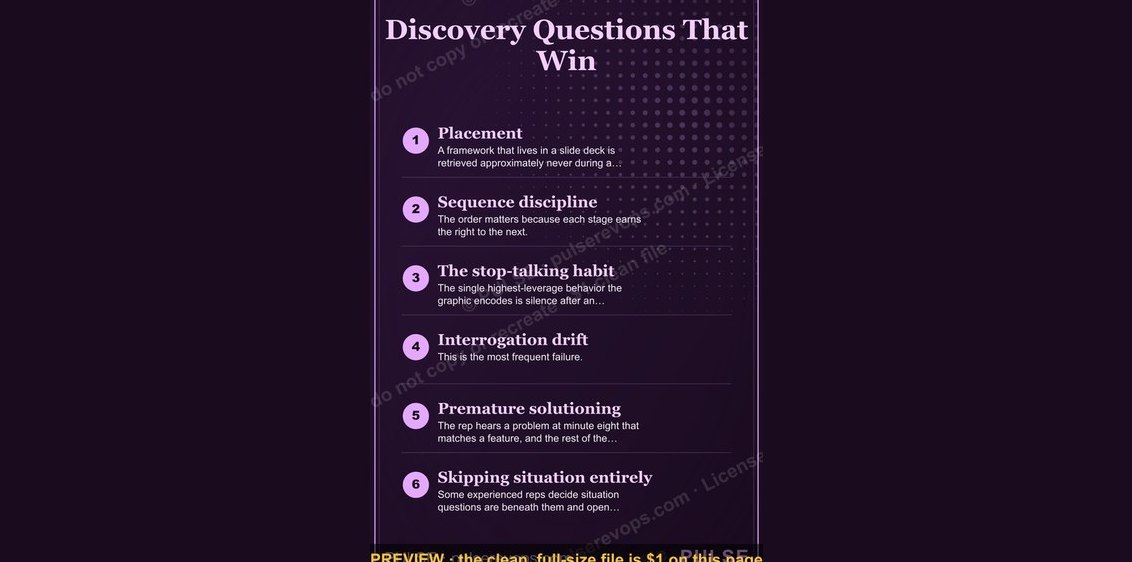 graphicDiscovery Questions That Win — Infographic
 graphic5 Stages of a Healthy Pipeline — Infographic
 graphicThe 30-60-90 Ramp — Infographic
 graphicThe Perfect Demo — Infographic
 graphicSPIN Selling — Infographic
 graphicPirate Metrics (AARRR) — Infographic
 graphicThe Lead Lifecycle — Infographic