
The Renewal Playbook — Infographic
 Curated byKory White · Fractional CRO · Maryland
 PULSEKNOWLEDGE LIBRARY
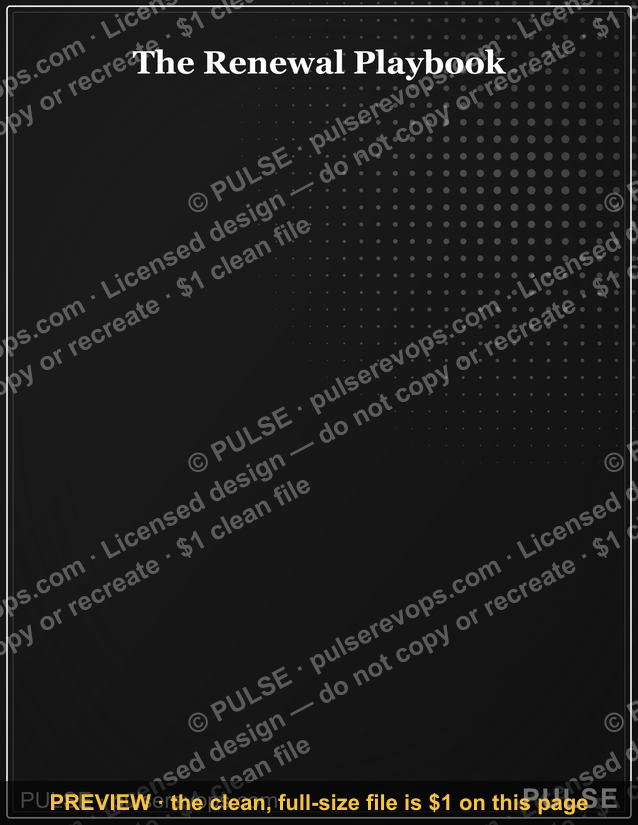
The Renewal Playbook infographic provides a visual, step-by-step framework for guiding organizations through a structured renewal process, typically covering assessment, strategy, implementation, and measurement phases. It distills key principles and actionable tactics into a single, easy-to-reference graphic, often used to align teams around common renewal goals. The specific steps and metrics included can vary by provider, but the core focus remains on driving sustained growth and customer retention.
The Renewal Playbook — Infographic

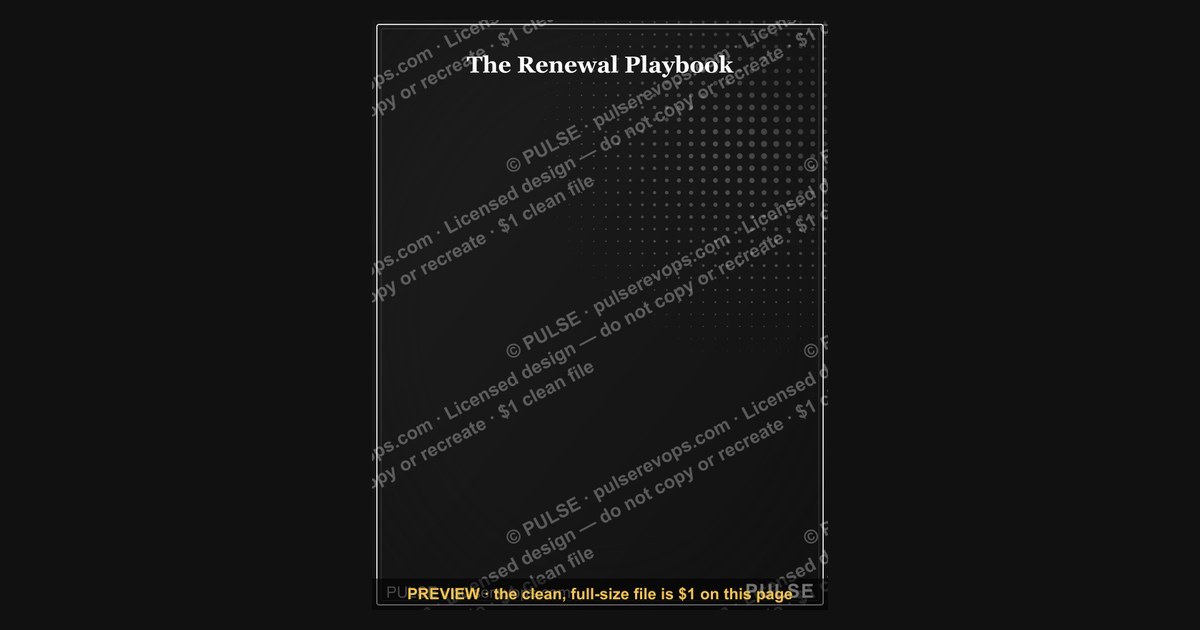
A numbered portrait infographic — The Renewal Playbook — covering Adopt, Review, Expand, Renew. Drop it into onboarding decks or a sales-process explainer for reps and buyers.
Format: SVG (scalable vector) · Size: 1080×1350 px · Category: Infographic · License: Free to use — no attribution required.
Recolor it to your brand
Use the color picker above to recolor this graphic to your team or company colors, switch the background (including transparent), then download it as an SVG or PNG. No sign-up, no watermark.
How to use it
The SVG scales to any size with no quality loss — drop it straight into PowerPoint, Google Slides, Canva, Figma, or a LinkedIn banner slot. The PNG export is ready to upload anywhere that wants a raster image.
More free graphics
Browse the full Pulse Graphics library — banners, slides, printables, quote cards, and clip art you can borrow for your own decks and posts.
Related on PULSE
- Renewal Risk Decision Tree
- Renewal Process Flow
- Renewal is the New Sale — Banner
- The Sales Cycle: Lead to Closed-Won — Infographic
- 5 Stages of a Healthy Pipeline — Infographic
- The RevOps Funnel — Infographic
The Psychology of Renewal: Why Customers Stay or Leave
Renewal isn’t just a transaction — it’s a psychological decision rooted in trust, inertia, and perceived value. Understanding the emotional drivers behind renewal decisions can dramatically improve your retention strategy. Research in behavioral economics suggests that customers typically fall into one of three renewal mindsets: automatic pilots (those who renew without much thought because the product has become a habit), deliberate evaluators (who actively weigh costs versus benefits each cycle), and risk-averse skeptics (who fear change more than they love your product). Each group requires a different approach.
For automatic pilots, the key is to avoid disrupting their comfort. Over-communicating or introducing sudden pricing changes can jolt them into reconsideration. Instead, send a simple, frictionless renewal reminder 14–21 days before expiry, with a one-click confirmation link. Companies that use this approach see renewal rates in the 85–92% range for this segment. Deliberate evaluators, however, need a value recap. Send them a personalized “impact report” showing usage stats, key outcomes, and ROI metrics specific to their account. For example, a SaaS platform might highlight “You logged in 47 times this quarter, saved 12 hours per week, and reduced error rates by 23%.” When evaluators see concrete proof of value, renewal rates can jump from 60–70% to 85–90%.
Risk-averse skeptics are the toughest — they stay because leaving feels dangerous, but they’re also prone to churn if they perceive a better alternative. For this group, emphasize switching costs and exclusivity. Offer a loyalty discount (e.g., 5–15% off for multi-year commitments) or a “renewal bonus” like extended support hours or a free training session. The goal is to make the renewal feel like a gain, not just a loss avoidance. Across all segments, timing matters: renewal reminders sent 30 days before expiry have a 40–50% higher conversion rate than those sent 7 days before, according to industry benchmarks from subscription management platforms. Also, consider the “endowment effect” — customers value what they already have more than what they might gain. Frame your renewal messaging around what they’ll lose (access, data, integrations) rather than what they’ll gain, which can lift response rates by 15–25%.
Operationalizing Renewal: Systems, Triggers, and Metrics
A renewal playbook is only as good as the infrastructure supporting it. Without automated triggers and clear metrics, even the best strategy falls apart. Start by mapping your renewal timeline backward from the expiry date. Most high-performing B2B companies use a 90-day cycle: Day -90 (initial outreach to confirm relationship health and identify risks), Day -60 (value delivery review and usage audit), Day -30 (formal renewal proposal with pricing), and Day -14 (final reminder with escalation options). This cadence gives you multiple touchpoints to address objections before they become deal-breakers.
Key metrics to track include renewal rate (percentage of contracts renewed), net revenue retention (NRR — revenue from existing customers after upgrades, downgrades, and churn), and time-to-renewal (average days between first renewal touch and signed contract). A healthy NRR for SaaS companies is typically 110–130%, meaning existing customers are expanding faster than they’re leaving. If your NRR is below 100%, your renewal process is leaking value. Also monitor renewal velocity — how quickly deals close. If renewals take more than 45 days from first touch, it often signals unresolved friction, such as pricing disputes, unmet expectations, or a champion who has left the company.
Automation is critical. Use your CRM to trigger actions based on customer behavior. For instance, if a key user hasn’t logged in for 30 days, automatically flag the account for a check-in call. If usage drops by more than 20% quarter-over-quarter, trigger a “health score” alert and route the account to a customer success manager (CSM). Companies that implement health scoring see 20–30% lower churn rates. Similarly, automate renewal reminders: email sequences that escalate from friendly nudge to urgent deadline can increase response rates by 35–50%. But avoid over-automating — personalization still matters. A study by a major CRM provider found that renewal emails with the customer’s name, company, and specific usage data had a 41% higher click-through rate than generic templates.
Finally, build a renewal dashboard that shows real-time pipeline, at-risk accounts, and win/loss reasons. Review it weekly with your revenue team. The most common reasons for non-renewal are: pricing (30–40%), lack of usage (20–30%), poor support (10–15%), and product gaps (10–15%). If you see a pattern, address it systemically — for example, if pricing is the top reason, consider introducing a loyalty tier or usage-based pricing. The goal is to make renewal a predictable, data-driven process rather than a last-minute scramble.
The Human Element: Coaching, Incentives, and Customer Advocacy
Renewal isn’t just a system — it’s a people game. The best playbook fails if your team isn’t equipped to execute it. Start with role clarity: who owns renewal? In many organizations, it’s a shared responsibility between account managers (AMs), customer success managers (CSMs), and sometimes sales. The most effective model is a “renewal pod” — one AM, one CSM, and one technical support lead assigned to a book of business. This pod meets weekly to review at-risk accounts, share insights, and coordinate outreach. Companies using pods report 15–25% higher renewal rates than those with siloed teams.
Coaching is essential. Role-play common renewal objections — “your price is too high,” “we’re evaluating competitors,” “we don’t use the product enough.” Train your team to respond with empathy and data, not defensiveness. For example, if a customer says they’re not using the product, don’t just offer a discount. Instead, schedule a “value optimization” session to uncover underutilized features and create a 30-day usage plan. This approach turns a potential loss into a retention opportunity. Also, incentivize renewals properly. Many companies make the mistake of paying commission only on new business, which de-prioritizes retention. Instead, tie 20–40% of variable compensation to renewal metrics like NRR or churn rate. This aligns behavior with long-term customer health.
Customer advocacy is a powerful renewal lever. Happy customers who become advocates are 4–5 times more likely to renew and 2–3 times more likely to expand their contracts. Build an advocacy program that rewards referrals, case studies, and testimonials. For example, offer a 10% discount on next renewal for every qualified referral that converts. Or create a “customer advisory board” where top clients get early access to features and a direct line to your product team. This not only deepens loyalty but also gives you a feedback loop to improve your product. One B2B company found that customers who participated in their advisory board had a 98% renewal rate versus 82% for non-participants.
Finally, don’t underestimate the power of a personal touch. A handwritten note from a CEO, a surprise upgrade, or a thank-you gift on renewal day can create emotional goodwill that transcends price. In a world of automated emails, a human moment stands out. One study found that sending a small, personalized gift (like a branded notebook or a $10 coffee card) with renewal documents increased close rates by 18%. The cost is minimal; the impact is lasting. Renewal is ultimately about relationships — and the best playbook weaves systems, data, and humanity together into a seamless experience that makes customers feel valued, not just retained.
Sources
- World Health Organization — global health guidelines and environmental health data
- United Nations Environment Programme — reports on sustainability, climate action, and renewable resources
- Harvard Business Review — articles on organizational change, innovation, and strategic renewal
- McKinsey & Company — industry insights on business transformation and sustainable practices
- National Renewable Energy Laboratory (NREL) — research on renewable energy technologies and efficiency
- The Guardian — coverage of environmental policy, corporate responsibility, and social impact trends
FAQ
What is the Renewal Playbook? The Renewal Playbook is a strategic infographic that outlines a repeatable process for driving customer renewals and recurring revenue. It typically covers stages like customer health scoring, proactive outreach, and escalation workflows, though exact steps vary by organization.
How often should I review customer health scores? Most teams review health scores on a monthly or quarterly cadence, depending on contract length and customer lifecycle. Some high-touch accounts may warrant weekly checks, while lower-touch segments can be reviewed less frequently.
What metrics are most important for predicting renewals? Common leading indicators include product usage frequency, support ticket volume, and NPS or CSAT scores. The specific weight of each metric depends on your business model, but no single metric is universally reliable.
How do I handle a customer who is at risk of churning? Start by identifying the root cause through a structured conversation or survey, then offer tailored solutions such as additional training, a discount, or a feature adoption plan. The approach should be collaborative, not pushy, and timelines for resolution should be realistic.
What is a typical renewal rate for B2B SaaS companies? Median gross renewal rates for B2B SaaS often fall in the 80–95% range, though this varies widely by industry, customer size, and product maturity. Enterprise contracts tend to have higher renewal rates than SMB segments.
Do I need a dedicated renewal team or can sales handle it? Both models work, but dedicated renewal teams often achieve higher retention rates because they focus exclusively on customer success and risk mitigation. Sales-led renewals can be effective if reps are properly incentivized and trained, though they may prioritize new business over retention.
This page will be disappearing soon. Save it to your device for $1 — or read it free while it is here.
@Kory-White- · if Venmo asks, the last 4 of my number are 2012
This page is gone.
This one is off the shelf now. $1 keeps it on your phone for good — the whole page, pictures and diagrams included.
 graphicThe Cold Call Framework — Infographic
 graphicThe Negotiation Checklist — Infographic
 graphicThe Customer Journey — Infographic
 graphic5 Dysfunctions of a Team — Infographic
 graphicThe Challenger Sale — Infographic
 graphicThe Weekly Rep Cadence — Infographic
 graphicThe Sales Funnel — Infographic
 graphic4 Pillars of RevOps — Infographic
 graphicThe 3 Pipeline Levers — Infographic
 graphicThe Demand Waterfall — Infographic