
“Your pipeline is your paycheck.” — Quote Card
 Curated byKory White · Fractional CRO · Maryland
 PULSEKNOWLEDGE LIBRARY
Quality
Certified
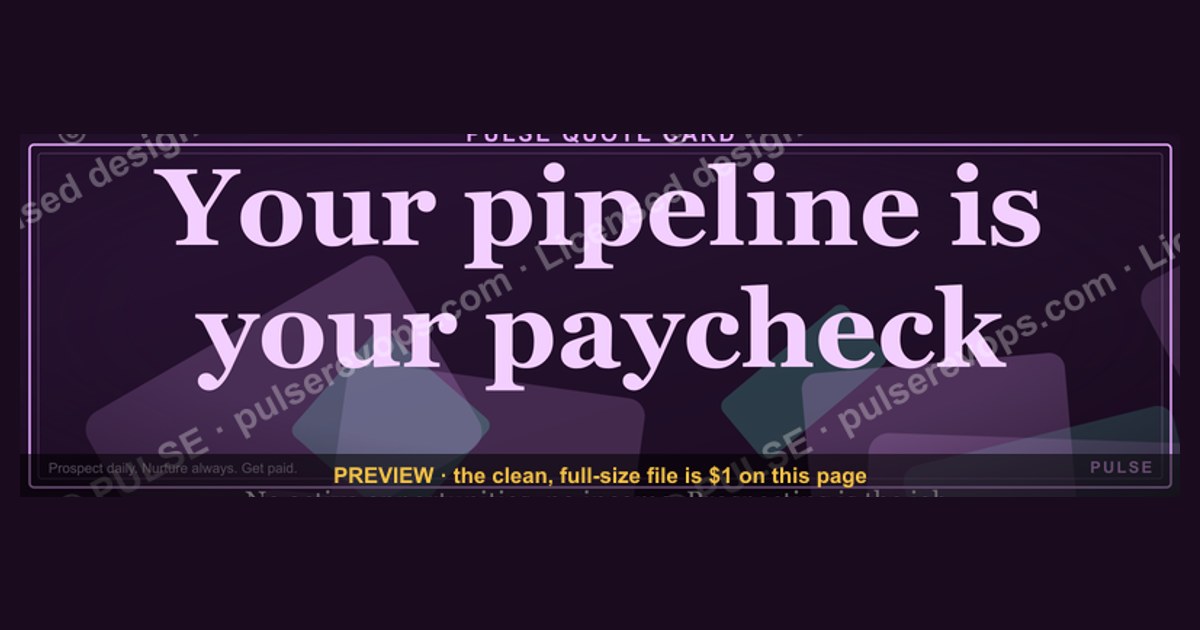

This is a 1600×500px banner that reads "Your pipeline is your paycheck." in bold gold serif type centered on a matte black background, framed like a Quote Card with a thin gold rule above and below the line. Download it free as a PNG from this page and drop it into a sales Slack channel, a CRM login screen, or a rep onboarding deck to reinforce that pipeline activity drives commission.
The outcome you should expect
Put this Quote Card where reps see it daily and you should expect a shift in what gets talked about first in pipeline reviews — not "did I make my calls" but "does my forecast cover my number." The banner carries exactly one line of text, "Your pipeline is your paycheck.", set in a serif display face (something in the Playfair or Georgia family reads correctly at this size) at roughly 92pt, kerned wide, in a warm gold (#D4AF37-range) against a near-black (#0B0B0C) field. Above and below the quote sit two thin horizontal gold rules, about 60% of the banner's width, centered — the visual grammar of a pull-quote lifted from a magazine, not a corporate slide. There is no logo lockup baked into the free version and no photography; it is typography and negative space, which is what makes it legible as a small Slack icon or a full-width LinkedIn cover alike.
The behavioral outcome managers report from this style of card is not a spike in booked meetings the day it goes up — it is a slower, cumulative effect on language. Reps start using "paycheck" and "pipeline" in the same sentence unprompted, in 1:1s, in deal reviews, in the way they explain a stalled deal to their manager. That reframing matters because commission plans are usually explained once, in a comp plan document nobody rereads, while pipeline hygiene is a daily habit. A visual reminder that sits in a channel header, a monitor wallpaper, or a slide that opens every Monday pipeline call does the job a comp plan PDF cannot: it recurs.

Expect three concrete, observable changes inside 30-60 days if you deploy it correctly: first, more voluntary pipeline updates outside of the mandated CRM hygiene cadence, because reps start self-policing stale opportunities once the phrase becomes a running joke or shorthand on the team ("that deal isn't paying your paycheck, it's dead weight"). Second, a modest uptick in coverage-ratio conversations in forecast calls — reps referencing their own multiple against quota unprompted. Third, and most reliably, adoption among sales leaders as a recurring visual in QBRs and kickoff decks, because the line does double duty as a section divider and a values statement. What you should not expect is a direct lift in win rate or average deal size — this card influences pipeline behavior, not deal execution, and treating it as a performance intervention rather than a cultural nudge is where teams overreach.
What drives that outcome
The mechanism is simple and worth naming plainly: compensation is abstract and pipeline is concrete, and this banner exists to collapse the distance between them. Most commission-based sales roles pay out weeks or months after the behavior that earned it — a deal worked in March pays in April or later once it closes and clears. That lag means the causal line from "I updated this opportunity today" to "I got paid" is invisible in the moment. A Quote Card posted where reps actually look — a Slack channel banner, a CRM dashboard header, the wall behind the sales floor monitor, a Zoom virtual background — re-inserts that causal line as a constant, low-friction visual cue rather than a once-a-quarter comp conversation.

This only works because of where and how it is placed, which is the second half of the mechanism. A banner buried in a shared drive folder changes nothing; a banner set as the pinned image in the #pipeline-review Slack channel, or as the header graphic on a CRM home dashboard reps open every morning, or as a slide reps see at the start of every forecast call, gets seen dozens of times a week without anyone having to remember to look at it. Placement frequency, not banner quality, is what converts a nice piece of design into a behavioral cue. Size and channel matter too: at 1600×500 the file scales cleanly to a LinkedIn banner slot (1584×396), a Twitter/X header (1500×500), a Slack channel header thumbnail, or a half-slide graphic in a deck — one export, four placements.
Benchmarks and realistic ranges
For the graphic itself: export as PNG at the full 1600×500px canvas for maximum flexibility, keep the file under roughly 500KB so it drops into Slack, email signatures, and slide decks without a compression prompt, and preserve at least 4.5:1 contrast between the gold text and black field so it stays readable on a projector or a compressed mobile preview — pure gold-on-black at the values above typically lands around 7:1, well past the WCAG AA minimum for large text. If you're placing it as a LinkedIn banner, crop centrally to 1584×396 rather than stretching, since the native banner aspect ratio is slightly wider and squatter than this canvas; for a Slack channel header or CRM dashboard tile, the full 1600×500 usually fits as-is or with minor letterboxing.

On the message side, the realistic range worth knowing is the pipeline-coverage heuristic this quote is implicitly gesturing at: most B2B sales organizations target somewhere between 3x and 4x pipeline coverage relative to quota, meaning a rep carrying a $500K quota should be sitting on roughly $1.5M-$2M in qualified, weighted pipeline at any given time to have a realistic shot at hitting number, accounting for typical close rates in the 20-35% range. That ratio is the practical, numeric version of "your pipeline is your paycheck" — below roughly 3x coverage, most forecasting methodologies flag a rep as at-risk regardless of how strong any individual deal looks. Reps and managers using this banner as a conversation-starter get more mileage out of it when they anchor it to that concrete multiple rather than leaving it as pure sentiment.
On adoption cadence, teams that roll a banner like this into a channel or dashboard and never refresh it see engagement with the message fade within 4-8 weeks — familiarity blindness sets in the same way it does with any static office signage. A realistic refresh range is swapping the placement (not necessarily the wording) every quarter: move it from the Slack header to the CRM dashboard, then to the kickoff deck, then to a QBR section divider, so the phrase resurfaces in a new context rather than going visually stale in the same spot.

Risks, edge cases, and failure modes
The most common failure mode is scope mismatch: posting "your pipeline is your paycheck" in a channel or team that includes salaried, non-commission roles — sales engineers, deal desk, customer success — where the line simply doesn't apply and can read as tone-deaf or exclusionary. Before placing it, confirm the channel or dashboard is scoped to quota-carrying reps, or adjust the wording for a mixed audience (a customizable variant is covered below).
A second real risk is over-indexing on activity over quality. If leadership uses this card as license to pressure volume-based pipeline padding — logging low-probability, poorly qualified opportunities just to inflate the coverage number — the phrase gets weaponized against the exact hygiene it's meant to encourage. The fix is pairing the banner with an explicit, spoken standard for what counts as real pipeline (a next step on the calendar, an economic buyer identified, a defined timeline) so "pipeline" in the slogan means qualified pipeline, not raw opportunity count. Teams that skip that pairing report the phrase becoming a punchline used sarcastically against management rather than a rallying line.

Accessibility and legibility are edge cases worth checking before wide deployment: gold serif type at small sizes (a Slack avatar-adjacent thumbnail, a mobile CRM notification) can lose legibility fast, so verify the banner still reads at the smallest size it will actually be displayed, not just at full resolution on a desktop monitor. Color-blind readers, particularly those with deuteranomaly, generally retain enough luminance contrast on a gold-on-black pairing to read it fine, but it's worth a quick check with a simulator rather than assuming.
Finally, there's a burnout-adjacent failure mode specific to hard-charging cultures: a constant visual tying identity and pay to pipeline volume can read as pressure rather than motivation for reps already anxious about quota attainment, particularly during a slow quarter or after a layoff round. In those environments, pairing the banner rollout with a manager conversation about what "healthy" pipeline looks like — not just "more" — prevents the card from becoming a source of dread rather than focus.

A practical rollout plan
Start narrow. Place the default PNG in one high-visibility, low-friction spot — most teams start with the Slack or Teams channel header for the core sales team, since that requires zero engineering work and reaches everyone daily. Give it two weeks before expanding, and watch informally for whether the phrase starts showing up in conversation unprompted; that's the signal it's landed rather than becoming wallpaper.
If you want to customize it for your team, the elements that are safe to swap without breaking the design are: the wording (swap "paycheck" for "quota," "number," or a team-specific term if commission isn't the operative lever for a mixed audience), the accent color (gold reads premium and works on black; a swap to your brand's primary accent works fine as long as contrast against the dark field stays above 4.5:1), and the sub-label if you add one (a second, smaller line under the main quote — team name, quarter, or a specific coverage-ratio target like "3x or better" — reads well at roughly 24-28pt directly beneath the gold rule). Keep the core serif-on-black Quote Card structure intact; that's what makes it read as a quote rather than an ad.

To swap it into a CRM dashboard, most platforms (Salesforce, HubSpot) accept a custom header image on a dashboard or app home page through their branding or theme settings — export the PNG at the platform's recommended header ratio if it differs from 1600×500, since most CRMs will letterbox rather than crop automatically. For a deck, drop the PNG as a full-bleed section-divider slide rather than shrinking it into a corner; the design is built for scale, and at small sizes the gold rules and wide kerning lose their effect.
Related questions
Where should I place a sales motivation banner for the best visibility?
Anywhere reps look daily without extra effort: a Slack/Teams channel header, a CRM dashboard home screen, or the first slide of a recurring meeting. Avoid shared drives or static office prints — visibility decays fast once it requires a deliberate look.
How do I customize this Quote Card for a non-commission team?
Swap "paycheck" for the operative lever — "quota," "renewal," or "retention" for CS — and keep the black-and-gold Quote Card structure, since the design, not just the wording, carries the message.
What size should I export this banner for LinkedIn?
Crop centrally to 1584×396 rather than stretching the 1600×500 canvas, since LinkedIn's native banner slot is a slightly different aspect ratio and stretching distorts the serif type.
Does a pipeline slogan like this actually change rep behavior?
On its own, rarely — the behavioral effect comes from repeated, high-frequency placement plus a manager who reinforces the phrase verbally in reviews, not from the graphic alone.
FAQ
What file format does this banner come in? A PNG, sized at 1600×500px, optimized to stay under roughly 500KB so it drops cleanly into Slack, email signatures, CRM dashboard headers, and slide decks without extra compression.
Can I edit the text on this Quote Card myself? The free download is a flattened PNG, so editing the line directly requires recreating it in a design tool (Canva or Figma both handle a black-background, gold-serif quote card easily) — match the roughly 92pt serif type, gold rule dividers, and 4.5:1-plus contrast if you customize it.
Is "your pipeline is your paycheck" accurate for salaried sales roles? Not literally — salaried reps' pay isn't directly tied to pipeline the way commission is. For mixed teams, swap the wording to reference quota or attainment instead of paycheck so the message stays true for everyone seeing it.
How often should I refresh or move this banner? Roughly every quarter. Engagement with any static visual fades within 4-8 weeks of exposure, so rotating its placement — Slack header one quarter, CRM dashboard the next — keeps the phrase from becoming invisible wallpaper.
Will this banner improve win rate or deal size? No — it's a cultural and behavioral nudge aimed at pipeline hygiene and coverage awareness, not a performance intervention. Expect changes in language and self-reported pipeline discipline, not a direct lift in close rates.
What pipeline coverage ratio does this quote imply I should be carrying? Most B2B sales orgs target roughly 3x to 4x quota in qualified, weighted pipeline at any given time, given typical 20-35% close rates. Below about 3x coverage, most forecasting methods flag a rep as at risk regardless of deal quality.
Sources
- https://www.gartner.com/en/sales/insights/sales-pipeline
- https://blog.hubspot.com/sales/sales-pipeline
- https://www.salesforce.com/resources/articles/sales-pipeline/
- https://www.w3.org/WAI/WCAG21/Understanding/contrast-minimum.html
- https://www.linkedin.com/help/linkedin/answer/a542685
- https://slack.com/help/articles/115004348811-Customize-your-channel-header
- https://www.canva.com/learn/linkedin-banner-size/
- https://www.gong.io/blog/sales-pipeline-coverage/
Related on PULSE
- Why pipeline coverage ratios matter more than deal count
- How to run a weekly pipeline review that actually changes behavior
- Designing sales floor visuals that reinforce comp plan structure
- Quote Cards for onboarding: setting rep expectations on day one
- When sales slogans backfire: activity metrics vs. quality metrics
- Sizing and exporting banner graphics for Slack, LinkedIn, and CRM dashboards
This page will be disappearing soon. Save it to your device for $1 — or read it free while it is here.
@Kory-White- · if Venmo asks, the last 4 of my number are 2012
This page is gone.
This one is off the shelf now. $1 keeps it on your phone for good — the whole page, pictures and diagrams included.
 graphic“Process scales. Heroics don't.” — Quote Card
 graphic“Don't pitch. Diagnose.” — Quote Card
 graphic“You can't shrink your way to growth.” — Quote Card
 graphic“The next call is the most important one.” — Quote Card
 graphic“Pipeline Cures All” — Quote Card
 graphic“Qualify hard. Close easy.” — Quote Card
 graphic“Listen more. Pitch less.” — Quote Card
 graphic“Be the signal, not the noise.” — Quote Card
 graphic“The best discovery feels like free therapy.” — Quote Card
 graphic“The riches are in the niches.” — Quote Card