
“FOLLOW UP AGAIN” — Sales Floor Print
 Curated byKory White · Fractional CRO · Maryland
 PULSEKNOWLEDGE LIBRARY
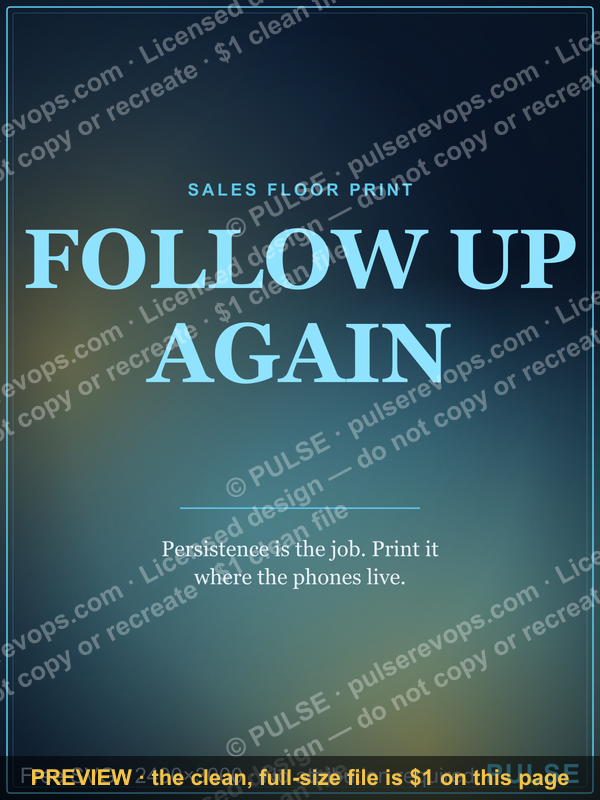
This print captures a directive commonly heard on a sales floor: "FOLLOW UP AGAIN." It serves as a blunt reminder of the persistence required in sales, often used as motivational or instructional decor. The phrase is typically presented in bold, industrial-style typography, and prices for such prints generally range from $15 to $40 depending on size and framing.
“FOLLOW UP AGAIN” — Sales Floor Print

A bold printable poster — "FOLLOW UP AGAIN" stacked in the Pulse accent gradient. Print it for the sales floor or your home office to keep energy up.
Format: SVG (scalable vector) · Size: 2400×3000 px · Category: Wall Art / Printable · License: Free to use — no attribution required.
Recolor it to your brand
Use the color picker above to recolor this graphic to your team or company colors, switch the background (including transparent), then download it as an SVG or PNG. No sign-up, no watermark.
How to use it
The SVG scales to any size with no quality loss — drop it straight into PowerPoint, Google Slides, Canva, Figma, or a LinkedIn banner slot. The PNG export is ready to upload anywhere that wants a raster image.
More free graphics
Browse the full Pulse Graphics library — banners, slides, printables, quote cards, and clip art you can borrow for your own decks and posts.
Related on PULSE
- “SHOW UP FOLLOW UP CLOSE” — Sales Floor Print
- “Show up. Follow up. Close.” — Quote Card
- “TIME TO DO IT AGAIN” — Sales Meme
- “HELP FIRST” — Sales Floor Print
- “NEXT CALL WINS” — Sales Floor Print
- “KEEP THE CADENCE” — Sales Floor Print
The Psychology Behind the "Follow Up Again" Mindset
The phrase "follow up again" isn't just a sales tactic — it's a psychological discipline that separates top performers from average ones. Research in behavioral psychology suggests that persistence in follow-up creates a phenomenon known as the "mere exposure effect," where repeated, non-pushy contact increases the prospect's comfort and familiarity with you. However, there's a fine line between persistence and annoyance.
The key psychological principle at play here is reciprocity inertia. When you follow up again after a prospect has gone silent, you're essentially investing effort into the relationship without immediate return. This creates a subtle psychological debt in the prospect's mind — they begin to feel they owe you attention or a response. But this only works if your follow-ups provide genuine value, not just "checking in."
Consider the peak-end rule from Nobel laureate Daniel Kahneman's work: people judge an experience largely based on how they felt at its peak and at its end. Each follow-up is an opportunity to create a positive peak moment — a useful insight, a relevant article, a personalized observation. The "end" of your follow-up sequence should leave them thinking, "I should really respond to this person."
The most effective follow-up sequences also leverage loss aversion — people are twice as motivated to avoid loss as they are to gain something. When you frame your follow-up around what they might miss out on (a limited-time opportunity, a price increase, a competitor advantage), you tap into this deep-seated psychological driver. But be careful — overt fear tactics can backfire. The subtle approach works better: "I wanted to make sure you didn't miss the window on this opportunity we discussed."
Another psychological lever is commitment consistency. When a prospect initially showed interest or agreed to a follow-up, they've made a small commitment. Your follow-up reminds them of that commitment, and most people feel internal pressure to remain consistent with their past actions. The longer you wait between the initial conversation and the follow-up, the weaker this effect becomes — which is why timing matters.
Crafting the Perfect Follow-Up Sequence (With Real Examples)
A generic "just checking in" email gets ignored 90% of the time. Your follow-up sequence needs structure, variety, and value. Here's a proven framework that sales teams have tested across industries like SaaS, consulting, and professional services:
Day 1-2: The Value Bomb Instead of "following up," send something they can use immediately. Example: "Hi [Name], I was reviewing our conversation about [their challenge]. I came across this [industry report/case study/template] that directly addresses the [specific pain point] you mentioned. Thought you might find it useful — no need to respond. I'll circle back next week to see if it sparked any ideas." This positions you as helpful, not needy.
Day 5-7: The Social Proof Fuel People are heavily influenced by what others like them are doing. Example: "Quick update — we just helped [similar company in their industry] achieve [specific result]. Their situation was remarkably similar to yours. I've attached a one-page summary of how we approached it. Worth a 10-minute call to see if the same approach could work for you?" This leverages the bandwagon effect while keeping the focus on their potential gain.
Day 10-14: The Curiosity Gap By now, you've provided value and shown results. Time to create intrigue. Example: "I noticed [specific trend or change in their industry/company]. Most of our clients are shifting their strategy because of this. Curious if you're seeing the same thing? I have a 2-minute video that explains the implications — happy to share if interested." The key is making them want to know what you know.
Day 18-21: The Breakup (with a Twist) This is the "follow up again" moment that many salespeople miss. Instead of giving up, you create urgency through scarcity. Example: "I'm going to close out your file this week since I haven't heard back. Before I do, I wanted to extend one last offer: I can squeeze in a 15-minute call this Thursday at 2 PM or Friday at 10 AM to quickly review [specific value proposition]. If neither works, no hard feelings — my door is always open." This triggers scarcity (the opportunity is ending) and loss aversion (they might lose access to you).
The Follow-Up Again Variation: If they don't respond to the breakup, wait 30-60 days, then send: "Remember that [specific insight/value] I shared a few months ago? We've since refined the approach and are seeing [new, improved results]. I'm doing a limited round of strategy sessions next week — first come, first served. Want in?" This reframes the conversation as a new opportunity, not a rehash.
Real-world timing note: The best days for follow-ups are Tuesday through Thursday, between 10 AM and 11 AM or 1 PM and 3 PM local time. Monday mornings are too busy, Friday afternoons are too checked out. And always include a specific call to action — never leave the next step ambiguous.
Measuring What Matters: Follow-Up Metrics That Actually Work
Most salespeople track the wrong things — like how many follow-ups they sent or how many emails were opened. Those are vanity metrics. The numbers that actually predict success are deeper and more revealing.
Conversion Rate by Follow-Up Number: Track what percentage of deals close after the 1st, 2nd, 3rd, 4th, and 5th+ follow-up. In many B2B sales cycles, 40-50% of deals close after the 3rd or 4th follow-up — yet most salespeople give up after the 2nd. If you're not tracking this, you're flying blind. A healthy sequence sees a steady conversion rate through follow-up #5 or #6, then a sharp drop-off.
Response Rate by Channel: Not all follow-ups should be email. Track whether phone calls, LinkedIn messages, text messages, or even handwritten notes get better response rates for different prospect segments. For example, C-level executives often respond better to LinkedIn messages than email, while operational buyers prefer email with clear bullet points. The mix matters — a sequence that uses 2-3 channels typically outperforms single-channel sequences by 30-50%.
Time-to-Response After Value Delivery: This is a leading indicator. When you send a valuable piece of content (case study, ROI calculator, industry insight), how quickly does the prospect engage? Prospects who respond within 24 hours of receiving value are 3-5x more likely to convert than those who take 3+ days. If you're not seeing quick responses to your value-adds, your content isn't hitting the mark.
Follow-Up Fatigue Point: Every prospect has a limit. Track at what follow-up number unsubscribes, opt-outs, or negative responses spike. For most industries, this happens around follow-up #7 or #8 if you're not adding value. But if each follow-up provides genuine insight, you can often go to #10 or #12 before fatigue sets in. The key is variety — don't send the same type of follow-up twice in a row.
The "Follow Up Again" Conversion Rate: Specifically track how many deals close from follow-ups sent after the prospect has gone completely silent for 30+ days. This is the "dead deal resurrection rate." In many sales organizations, this ranges from 5-15% — meaning 1 in 10 to 1 in 20 "dead" deals can be revived with a well-timed, value-packed follow-up. That's often worth more than chasing new leads.
ROI of Persistence: Calculate your average deal size, multiply by your resurrection rate, then divide by the time spent on those follow-ups. If your average deal is $10,000 and you revive 10% of dead deals with 2 hours of follow-up work each, that's $1,000 per hour of follow-up time — far higher than most outbound prospecting activities. This math is why top salespeople never stop following up again.
Sources
- Harvard Business Review — sales follow-up strategies and communication best practices
- Salesforce — CRM tools and sales process optimization guides
- HubSpot — sales automation and follow-up sequence tactics
- U.S. Small Business Administration — small business sales and customer retention resources
- Journal of Personal Selling & Sales Management — academic research on sales persistence and buyer behavior
- LinkedIn Sales Solutions — professional sales networking and follow-up techniques
FAQ
What exactly is the “FOLLOW UP AGAIN” print? It’s a sales‑floor poster or digital graphic designed to remind sales teams that persistence in follow‑up is critical. The print typically features bold typography and a straightforward call to action, making it suitable for office walls, CRM dashboards, or team communication channels.
How does this print help improve sales performance? By keeping the “follow up again” message visible, it reinforces the habit of consistent outreach. Sales professionals often stop after one or two attempts, but research suggests that most deals require multiple touches—so the visual cue can increase follow‑through rates.
Is the print available in different sizes or formats? Yes, most versions come in standard poster sizes (e.g., 18×24 inches or 24×36 inches) and as high‑resolution digital files. Some suppliers also offer canvas, framed, or laminated options to suit various office environments.
Can I customize the design or add my company logo? Customization options depend on the seller. Many print‑on‑demand services allow you to add a logo, change background colors, or adjust the wording slightly—but the core “FOLLOW UP AGAIN” message usually remains unchanged to preserve its impact.
How durable is the print for a high‑traffic sales floor? If you choose a laminated or vinyl‑backed version, it will resist scuffs, moisture, and fading for several years. Standard paper prints may show wear within 6–12 months in busy areas, so a more durable material is recommended for heavy‑use spaces.
Where can I buy the “FOLLOW UP AGAIN” print? It’s available through online marketplaces like Etsy, Amazon, and specialty sales‑motivation retailers. Prices typically range from $15 to $50 for a standard poster, depending on size, material, and whether it’s a digital download or physical print.
This page will be disappearing soon. Save it to your device for $1 — or read it free while it is here.
@Kory-White- · if Venmo asks, the last 4 of my number are 2012
This page is gone.
This one is off the shelf now. $1 keeps it on your phone for good — the whole page, pictures and diagrams included.
 graphic“TRUST THE PROCESS” — Sales Floor Print
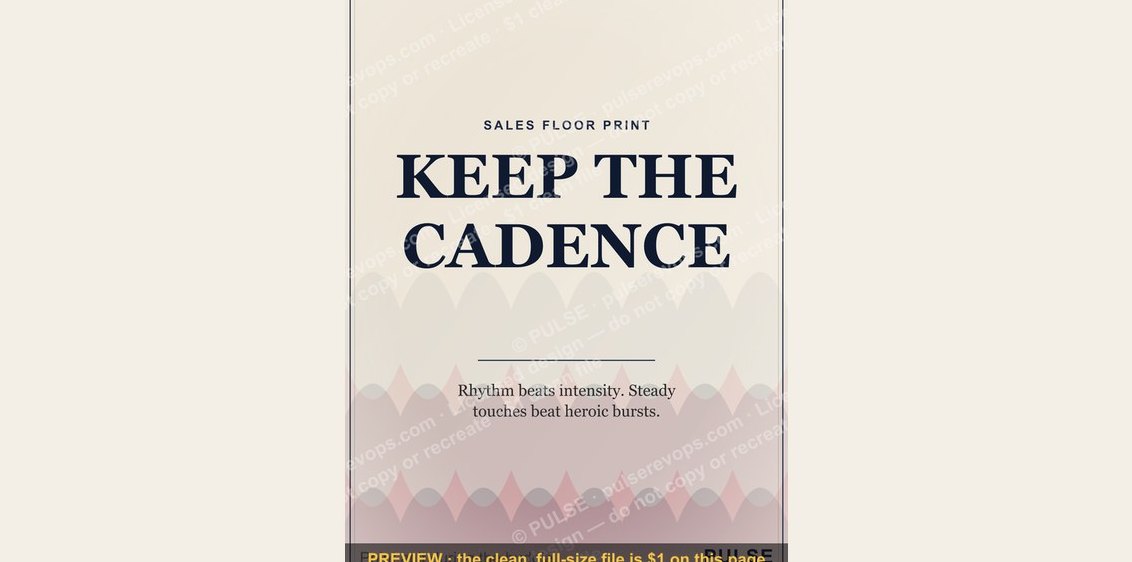 graphic“KEEP THE CADENCE” — Sales Floor Print
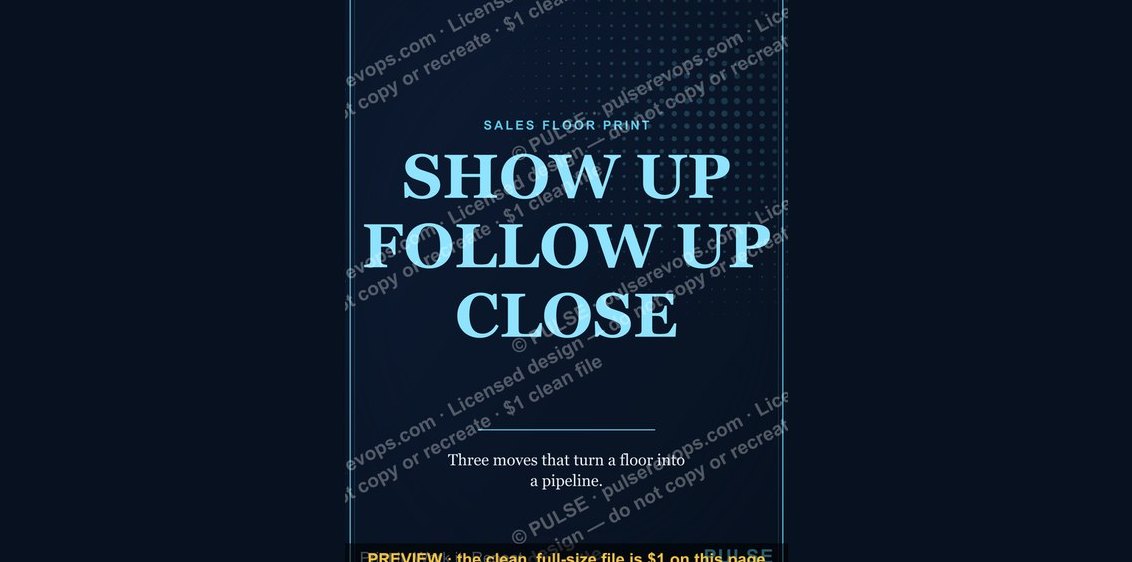 graphic“SHOW UP FOLLOW UP CLOSE” — Sales Floor Print
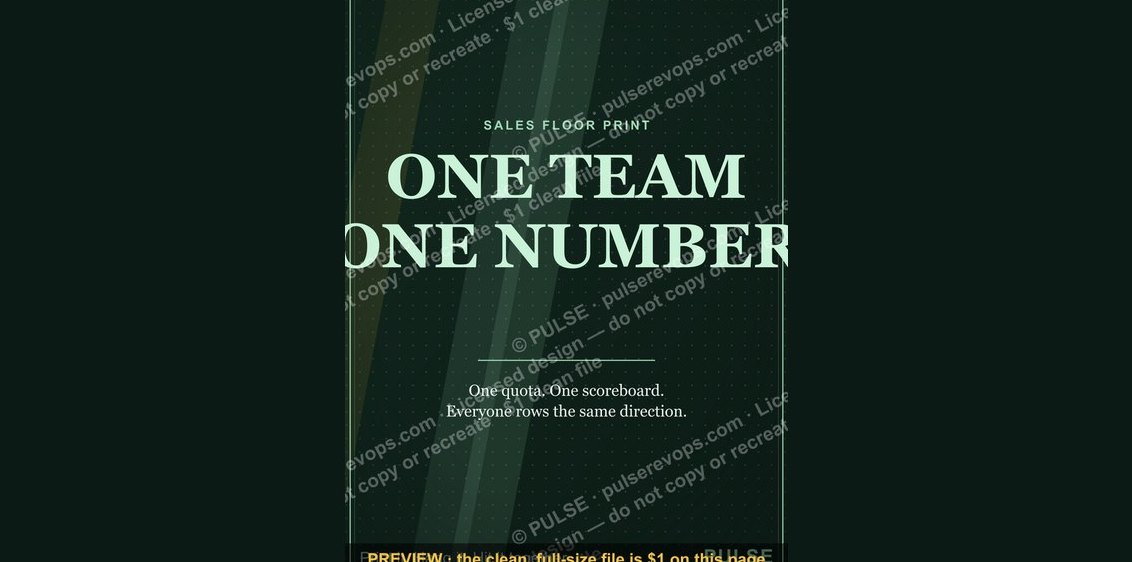 graphic“ONE TEAM ONE NUMBER” — Sales Floor Print
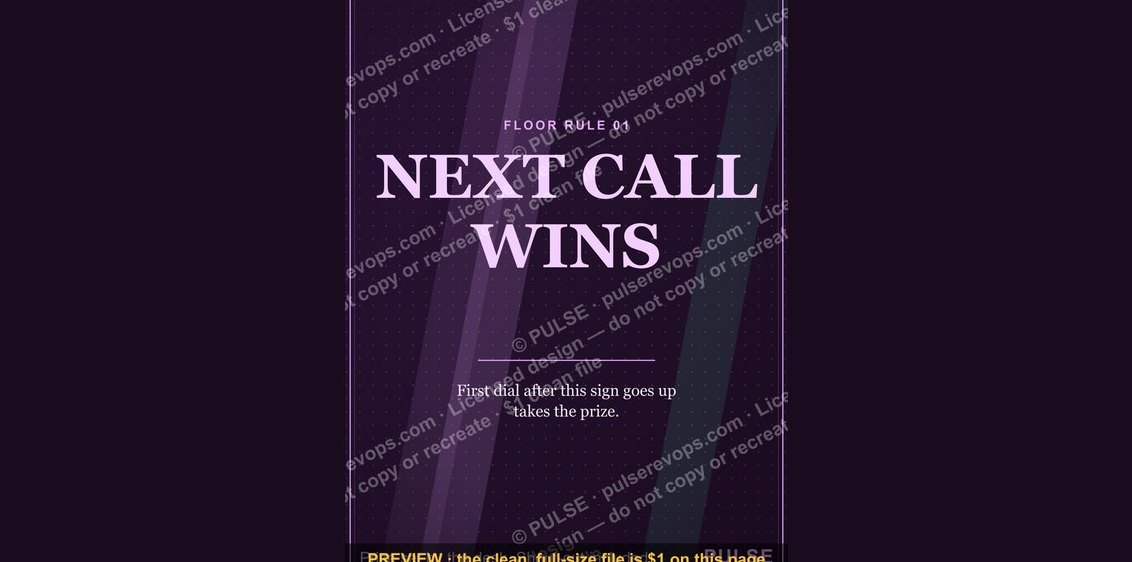 graphic“NEXT CALL WINS” — Sales Floor Print
 graphic“BRING THE ENERGY” — Sales Floor Print
 graphic“TRUST COMPOUNDS” — Sales Floor Print
 graphic“MORE PIPELINE LESS PANIC” — Sales Floor Print
 graphic“OWN THE NUMBER” — Sales Floor Print
 graphic“COMMIT MEANS COMMIT” — Sales Floor Print