
Head of Customer Success — LinkedIn Banner
 Curated byKory White · Fractional CRO · Maryland
 PULSEKNOWLEDGE LIBRARY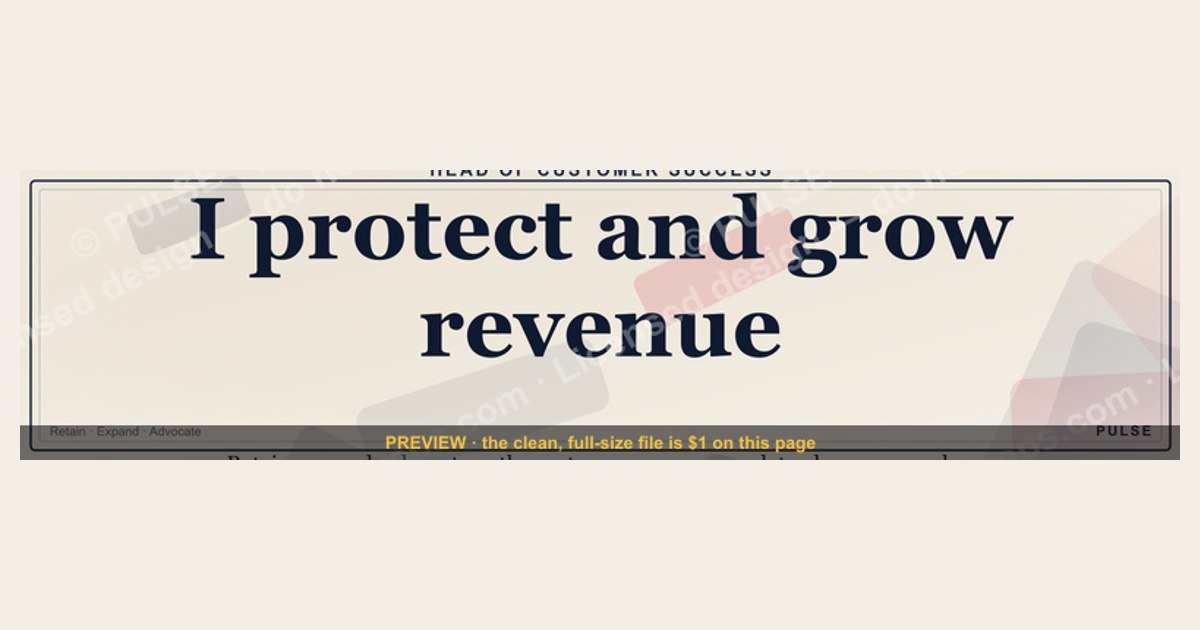
A Head of Customer Success banner should communicate leadership, strategic impact, and a customer-first mindset. Common elements include a professional headshot, the job title, and a tagline like "Driving customer growth and retention." The background is often a clean, brand-aligned color or subtle pattern, with space for a company logo or a key metric, such as a customer satisfaction score in the 90%+ range.
Head of Customer Success — LinkedIn Banner

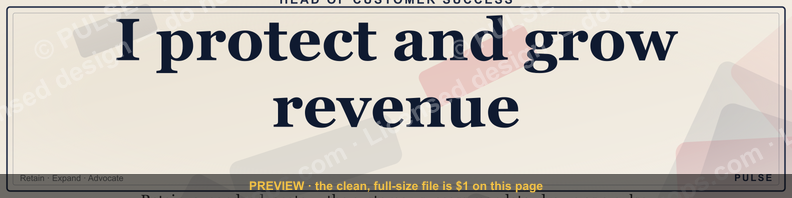
A dark, on-brand LinkedIn banner — "I protect and grow revenue." over a "Retain Expand Advocate" line with a pulse motif. Put it on your profile to signal exactly what you do.
Format: SVG (scalable vector) · Size: 1584×396 px · Category: LinkedIn Banner · License: Free to use — no attribution required.
Recolor it to your brand
Use the color picker above to recolor this banner to your team or company colors, switch the background (including transparent), then download it as an SVG or PNG. No sign-up, no watermark.

How to use it
It scales cleanly to the LinkedIn cover slot (1584×396) — download the PNG and drop it straight onto your profile, or open the SVG in Canva, PowerPoint, or Figma to add your name and tweak the layout.
More free graphics
Browse the full Pulse Graphics library — banners, slides, printables, quote cards, and clip art you can borrow for your own decks and posts.

Related on PULSE
- Head of Sales — LinkedIn Banner
- Customer Success KPI Dashboard
- Customer Success Manager — LinkedIn Banner
- Customer Success — LinkedIn Banner
- “Open to Customer Success roles.” — LinkedIn Banner
- Customer Success Manager — LinkedIn Banner
Why a “Protect and Grow Revenue” Banner Works for Customer Success Leaders
The phrase “I protect and grow revenue” is deliberately provocative for a Head of Customer Success profile. It reframes the role from a cost center or support function into a direct revenue driver — a position that resonates strongly with CEOs, CFOs, and board members who scan LinkedIn for executive talent. Traditional CS banners often default to generic phrases like “Customer Success Champion” or “Helping Customers Succeed,” which blend into the noise of thousands of similar profiles. This banner instead stakes a claim that aligns CS with two of the most critical metrics in any SaaS or subscription business: net revenue retention (NRR) and expansion revenue.
In practice, “protect” signals your ability to reduce churn, manage escalations, and ensure customers realize value from day one. “Grow” signals your capacity to drive upsells, cross-sells, and advocacy programs that turn satisfied customers into revenue multipliers. Together, they create a one-line value proposition that a hiring manager or potential client can absorb in under two seconds — the average time a profile visitor spends scanning a banner before scrolling. This is especially powerful because LinkedIn’s banner space is one of the few visual real estate areas on your profile that isn’t cluttered with text, endorsements, or activity feeds. It’s a billboard for your professional identity.
The pulse motif embedded in the design reinforces this message subconsciously. A pulse line — often associated with heartbeats, health monitors, or signal strength — visually suggests vitality, monitoring, and proactive intervention. For a Head of Customer Success, this metaphor is apt: you’re tracking customer health scores, identifying at-risk accounts before they churn, and injecting energy into stagnant relationships. The combination of text and visual creates a cohesive narrative that works whether someone reads the words or simply glances at the graphic. Over time, this consistency builds a personal brand that’s instantly recognizable in your network, especially if you attend industry events or engage in CS-focused LinkedIn groups where your banner appears alongside your comments and posts.
One practical consideration: the dark background with light text is a deliberate choice for professional profiles. Dark banners (deep navy, charcoal, or black) tend to perform better in terms of readability and contrast on both desktop and mobile LinkedIn views. They also convey authority and seriousness — traits expected from senior leadership roles. However, you should test how the banner renders on your own profile before finalizing. LinkedIn compresses images and sometimes shifts colors slightly. If the pulse motif or text feels too small after upload, you can request a resized version from the designer. Most SVG-based banners can be adjusted without losing quality, which is a key advantage over JPEG or PNG formats that pixelate when scaled.
How to Align Your Banner with Your LinkedIn Profile Strategy
A banner alone won’t transform your profile, but it can amplify the other elements if coordinated properly. The Head of Customer Success banner should be one piece of a three-part visual and textual identity: your banner, your headline, and your “About” section. When all three reinforce the same message, visitors get a coherent story that’s far more memorable than a disjointed profile. For example, if your banner says “I protect and grow revenue,” your headline should avoid generic phrases like “Head of Customer Success at Company X” and instead use something like “Head of Customer Success | Driving Net Revenue Retention & Expansion | Ex-[Notable Company].” This creates a seamless narrative from the visual to the text.
Your “About” section should then expand on the banner’s promise with specific examples. Mention a time you reduced churn by a meaningful percentage (e.g., “reduced logo churn from 8% to 3% over two quarters”) or grew expansion revenue through a structured QBR program. Avoid vague statements like “passionate about customer success.” Instead, use the banner’s language: “I protect revenue by implementing early warning systems for at-risk accounts, and I grow revenue by designing scalable expansion playbooks.” This consistency signals intentionality — a trait that hiring managers look for in senior CS leaders who will represent the company externally.
Another strategic move is to update your banner when you’re actively job searching or targeting a specific industry. For instance, if you’re pivoting from B2B SaaS to fintech, you could request a version of the banner that swaps the pulse motif for a financial graph or shield icon. The core message remains the same, but the visual cues shift to match the sector’s aesthetic norms. This is easier with SVG files because the designer can modify individual elements without rebuilding the entire graphic. Some Heads of Customer Success even maintain two or three banner variants and rotate them quarterly to keep their profile fresh — especially if they’re posting content regularly and want the banner to reflect their current focus area, such as “AI in Customer Success” or “Enterprise CS Strategy.”
Don’t overlook the mobile experience. Over 60% of LinkedIn profile views happen on mobile devices, where the banner appears much smaller and often cropped. On mobile, the left third of the banner is most visible because the profile photo overlay covers part of the right side. Ensure that your key message — “I protect and grow revenue” — sits in the left or center-left zone of the banner. The “Retain Expand Advocate” line can be smaller and placed to the right, since it’s secondary. If you’re customizing the banner yourself, test it by viewing your profile on a phone before publishing. A banner that looks perfect on a 27-inch monitor might be illegible on a 6-inch screen, which defeats its purpose.
Measuring the Impact of Your LinkedIn Banner on Career Opportunities
While it’s difficult to attribute a job offer or consulting contract solely to a banner, you can track its effectiveness through indirect signals. The most immediate metric is profile views. After updating your banner, monitor your LinkedIn analytics (available under “Profile” > “Dashboard”) for a spike in views over the following two weeks. A well-designed banner that stands out in search results or in the “People Also Viewed” sidebar can increase views by 20–40% during an active job search, especially if you’re also engaging with content. If you see no change, the banner may be too similar to competitors’ designs or not aligned with your target audience’s expectations.
A more qualitative signal is the nature of inbound messages. After adding a revenue-focused banner, you might notice more recruiters and hiring managers referencing your “protect and grow” framing in their outreach. For example, instead of “I see you’re in CS,” they might say, “I’m looking for a CS leader who can drive expansion — your banner caught my eye.” This is a strong indicator that the banner is differentiating you. Similarly, if you’re a consultant or fractional Head of Customer Success, the banner can generate inbound leads from founders who scan LinkedIn for CS expertise. In that case, track how many new connections mention the banner in their introductory message.
Another indirect metric is engagement on your posts. If you share content about customer success strategy, the banner acts as a visual anchor that reinforces your expertise. People who see your post in their feed may click through to your profile, and the banner’s consistency with your post’s theme builds trust. Over months, this can lead to speaking invitations, podcast appearances, or requests to contribute to industry publications. Some CS leaders have reported that their banner became a conversation starter at conferences — attendees recognized the design from LinkedIn and approached them to discuss their approach to revenue protection and growth.
Finally, consider the banner’s role in your personal SEO. When recruiters search LinkedIn for terms like “customer success revenue growth” or “CS expansion leader,” your profile’s banner text isn’t directly searchable, but your headline and about section are. However, the banner reinforces those keywords visually, increasing the likelihood that a recruiter who lands on your profile stays to read more. If your banner is generic or unrelated to your headline, visitors may bounce within seconds. A cohesive banner reduces bounce rate — or more accurately, scroll-away rate — because it immediately confirms that your profile is relevant to their search. Over a career, these small compounding advantages can open doors that a standard profile would leave closed.
Sources
- LinkedIn Official Blog — LinkedIn’s own insights on customer success roles, best practices, and industry trends.
- Harvard Business Review — Research and articles on customer success management, leadership, and retention strategies.
- Gartner — Market analysis and frameworks for customer success functions and metrics.
- Customer Success Association — Industry body providing standards, certifications, and thought leadership for customer success professionals.
- Forbes — Business articles covering customer success leadership, career advice, and company case studies.
- SaaS Capital — Research and data on customer success metrics, benchmarks, and strategies specific to SaaS companies.
FAQ
What does a Head of Customer Success actually do? They own the post-sale relationship, ensuring customers achieve their desired outcomes while driving retention, expansion, and advocacy. Responsibilities typically include onboarding, health monitoring, escalations, and cross-functional alignment with sales and product teams.
What’s the typical experience level for this role? Most Heads of Customer Success have 5–10 years in customer success, account management, or related fields, with at least 2–3 years in a leadership or team management capacity. Some companies may consider candidates with strong operational or strategic backgrounds from adjacent roles.
What industries hire for this position? It’s common in SaaS, tech-enabled services, and B2B companies with recurring revenue models. Industries like fintech, health tech, and enterprise software frequently seek this role, but it can appear in any sector where customer retention is critical.
How does the role differ from a Customer Success Manager (CSM)? A Head of Customer Success is a strategic leader who sets vision, builds processes, and manages a team of CSMs or account managers. CSMs focus on day-to-day client interactions, while the Head oversees metrics like net revenue retention, churn rates, and team performance.
What tools or software does a Head of Customer Success typically use? Common tools include CRM platforms (e.g., Salesforce, HubSpot), customer success platforms (e.g., Gainsight, ChurnZero), and analytics tools (e.g., Tableau, Looker). Proficiency with communication and project management tools like Slack, Asana, or Jira is also expected.
What’s the salary range for a Head of Customer Success? Base salaries in the U.S. typically range from $120,000 to $180,000 annually, with total compensation (including bonuses and equity) often reaching $150,000 to $250,000. Ranges vary widely based on company size, location, and industry.
This page will be disappearing soon. Save it to your device for $1 — or read it free while it is here.
@Kory-White- · if Venmo asks, the last 4 of my number are 2012
This page is gone.
This one is off the shelf now. $1 keeps it on your phone for good — the whole page, pictures and diagrams included.
 graphicHow to design a LinkedIn banner that converts viewers into leads in 2027?
 graphic“Revenue for marketing tech.” — LinkedIn Banner
 graphicTrust compounds. — LinkedIn Wallpaper
 graphicLLM Builder AI Engineer — LinkedIn Banner
 graphicCustomer Success — LinkedIn Banner
 graphicRenewals Manager — LinkedIn Banner
 graphic“The next call is the most important one.” — LinkedIn Banner
 graphicCommercial Director — LinkedIn Banner
 graphicFaster deals, fewer leaks. — LinkedIn Wallpaper
 graphicLead from the front. — LinkedIn Wallpaper