
“Sell the future, not the feature.” — LinkedIn Banner
 Curated byKory White · Fractional CRO · Maryland
 PULSEKNOWLEDGE LIBRARY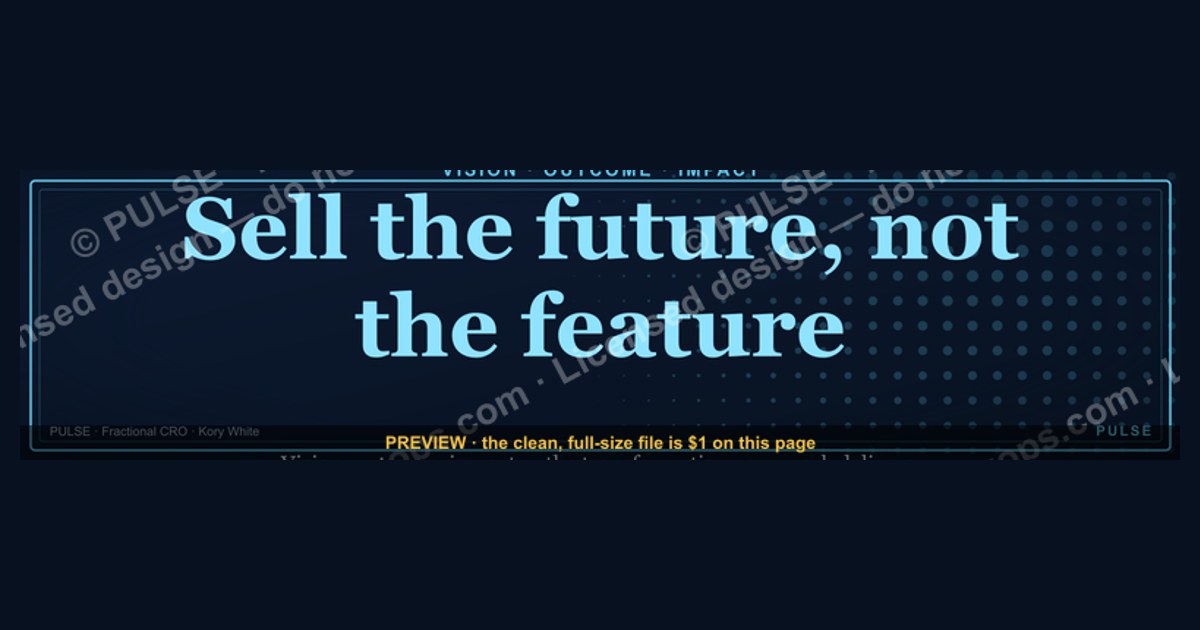

This quote means your LinkedIn banner should highlight the transformation or outcome your work delivers, not just list what you do or the tools you use. Instead of stating a feature like "I write code," sell the future benefit such as "I help businesses automate growth." Focus your banner on the result a client or employer will experience, making your value immediately clear.
“Sell the future, not the feature.” — LinkedIn Banner

A dark, on-brand LinkedIn banner — "Sell the future, not the feature." over a "Vision Outcome Impact" line with a pulse motif. Put it on your profile to signal exactly what you do.
Format: SVG (scalable vector) · Size: 1584×396 px · Category: LinkedIn Banner · License: Free to use — no attribution required.
[⬇ Download this graphic](/graphics/assets/gb0322.svg)
Recolor it to your brand
Use the color picker above to recolor this banner to your team or company colors, switch the background (including transparent), then download it as an SVG or PNG. No sign-up, no watermark.

How to use it
It scales cleanly to the LinkedIn cover slot (1584×396) — download the PNG and drop it straight onto your profile, or open the SVG in Canva, PowerPoint, or Figma to add your name and tweak the layout.
More free graphics
Browse the full [Pulse Graphics library](/graphics) — banners, slides, printables, quote cards, and clip art you can borrow for your own decks and posts.

Related on PULSE
- [Sell the future. — LinkedIn Wallpaper](/knowledge/gb0412)
- [“Sell the Problem, Not the Product” — Quote Card](/knowledge/gb0014)
- [“Sell the meeting, not the demo.” — Quote Card](/knowledge/gb0144)
- [“Champions sell when you're not in the room.” — Quote Card](/knowledge/gb0133)
- [“Sell the problem, not the product.” — Quote Card](/knowledge/gb0126)
- [Sell outcomes, not features. — LinkedIn Wallpaper](/knowledge/gb0388)
The Psychology of Future-Selling: Why Prospects Buy Vision, Not Specs
The phrase “sell the future, not the feature” taps into a fundamental truth about human decision-making: people are wired to buy outcomes, not inputs. When you lead with a feature—say, “our software has 99.9% uptime”—you’re asking the prospect to do the cognitive work of translating that spec into a meaningful benefit. But when you sell the future—“imagine never losing a single customer due to downtime”—you’re painting a picture of a world they want to live in. This isn’t just marketing fluff; it’s rooted in behavioral economics and neuroscience.
Research in decision psychology shows that the brain’s limbic system, which processes emotions and long-term rewards, often overrules the prefrontal cortex’s rational analysis during purchasing decisions. A feature list appeals to the analytical mind, but it rarely triggers the emotional “aha” that leads to a signature. Selling the future activates what’s called the “prospection” neural network—the same circuitry that fires when you daydream about a vacation or plan a career move. By describing a specific, desirable future state, you’re essentially giving the prospect a mental prototype of success. They can see themselves in that story, and that emotional resonance is what drives commitment.
Consider how this plays out in B2B sales. A SaaS company selling a project management tool might say, “Our platform has Gantt charts, resource leveling, and automated reporting.” That’s a feature dump. A future-seller says, “Picture your team hitting every quarterly deadline without last-minute fire drills. Your PMs spend their time on strategy, not chasing status updates. Your leadership sees real-time progress dashboards that make board meetings a breeze.” The second version doesn’t just list what the tool does—it describes a transformed work life. The prospect’s brain starts imagining the relief of fewer stressful evenings, the pride of a flawless project delivery, and the career boost from being the person who made that happen.
The key is specificity without fabrication. You don’t need to promise “10x revenue growth” (which sounds like hype). Instead, ground your future vision in plausible, relatable outcomes. For a marketing agency, that might be: “Imagine your CEO forwarding your campaign report to the board with a note that says, ‘This is how we should be marketing.’” That’s a future that feels achievable and desirable. It’s not a guarantee—it’s a north star. And because the prospect co-creates that vision in their mind, they become emotionally invested in making it real.
To practice this, try the “future first” exercise. Before any pitch, write down three specific futures your ideal customer would love to experience. They should be vivid enough that you could film a 30-second scene of that future. Then, for each feature you plan to mention, ask: “Does this help me paint that future, or does it distract?” If it’s a distraction, cut it. Your job isn’t to be comprehensive—it’s to be compelling. The most effective sellers I’ve coached spend 80% of their time on the future vision and only 20% on proof points (case studies, specs, testimonials). That ratio feels counterintuitive, but it works because the proof only matters once the prospect already wants the future you’ve described.
Future-Selling in Practice: Real-World Examples and Frameworks
Theory is useful, but execution is where most sellers stumble. Let’s look at how future-selling plays out across different industries and roles, and then break down a repeatable framework you can use tomorrow.
Example 1: The Enterprise SaaS Sale A sales rep for a data analytics platform is pitching to a VP of Marketing. The feature approach: “Our tool ingests data from 200+ sources and has a drag-and-drop dashboard builder.” The future approach: “Imagine walking into your CMO’s office next Monday with a single dashboard that shows exactly which campaign drove the highest LTV customer last quarter—and why. You can spot the pattern in 30 seconds and reallocate budget before your competitors even know they’re losing share. Your team stops arguing over attribution models and starts optimizing what actually works.” Notice the shift: the rep isn’t selling data ingestion; they’re selling clarity, speed, and political capital. The VP of Marketing doesn’t care about connectors—they care about looking brilliant in front of their boss and having more time for strategic work.
Example 2: The Consulting Engagement A fractional CFO is pitching to a founder-led startup. Feature sell: “I have 15 years of experience and specialize in SaaS metrics.” Future sell: “Picture your next board meeting. Instead of scrambling to pull together last-minute numbers, you walk in with a three-statement model that shows exactly when you’ll hit breakeven, what levers affect cash flow, and a clear plan for the next fundraise. The board sees you as the CEO who has everything under control. You sleep better because you’re not worried about missing payroll. And you get back 10 hours a week to focus on product and customers.” The future here is about peace of mind and credibility—not just financial modeling.
Example 3: The Physical Product A premium kitchen knife brand could sell features: “German stainless steel, 58 Rockwell hardness, ergonomic handle.” Or they could sell the future: “Imagine Sunday meal prep where your knife glides through a butternut squash like it’s butter. No slipping, no crushed ingredients, no bruised knuckles. You actually enjoy cooking because the tools don’t fight you. Your family notices the difference in every meal—and you feel like a professional chef in your own kitchen.” The future is about joy, confidence, and family connection—not metallurgy.
The “Future-Feature-Bridge” Framework To make future-selling repeatable, use this three-step structure:
- Paint the Future (80% of your message): Describe the specific, desirable outcome your prospect will experience. Use sensory language—what they’ll see, feel, hear, or even smell. For a cleaning service: “Imagine walking into your home after a long week. The air smells like lemon and linen. Every surface is spotless. You can actually relax because there’s nothing on your to-do list.”
- Bridge with the Feature (10%): Briefly connect that future to your product. “We achieve that with our proprietary enzyme-based cleaner that breaks down grime without harsh chemicals.” Keep it short—the feature is just the proof that the future is possible.
- Close with the Future Again (10%): Reinforce the vision. “So you get that feeling of coming home to a sanctuary, every single week.” This bookending ensures the prospect leaves the conversation dreaming, not debating specs.
Common Pitfall: The “Future That’s Too Vague” A future like “we’ll help you grow” is too generic. It doesn’t create a mental movie. The most effective futures are specific enough that the prospect can almost feel them. For a cybersecurity firm, “you won’t get hacked” is weaker than “imagine your IT team sleeping through the night because they know every endpoint is monitored, and the last time you had a false alarm, the system resolved it before anyone even noticed.” Specificity builds credibility and emotional impact.
How to Test Your Future-Selling Record yourself pitching and then transcribe it. Highlight every sentence that describes a future state (e.g., “you’ll have more time,” “your team will feel,” “imagine when”). If less than 60% of your pitch is future-focused, you’re likely over-featuring. Then, ask a trusted colleague: “If you heard this pitch, what would you be daydreaming about?” If they can’t describe a vivid picture, go back to the drawing board.
Why Most Sellers Fail at Future-Selling (And How to Fix It)
Despite the obvious power of selling the future, most salespeople default to features. Why? Because features are safe. They’re concrete, easy to list, and don’t require the seller to be vulnerable or creative. But the real reason is deeper: many sellers don’t truly understand the future their customer wants—they assume they do. This assumption gap is where future-selling breaks down.
The Assumption Trap A SaaS founder might assume their customer’s future is “more revenue.” But a VP of Sales might actually want “fewer meetings with their CEO about pipeline gaps.” A marketing director might want “their team to stop blaming the tools for poor results.” If you sell the wrong future, you sound like every other vendor. The fix is simple but uncomfortable: ask more discovery questions about the customer’s ideal state, not just their current pain. Instead of “What’s your biggest challenge?” try “If you could wave a magic wand and change one thing about your work life six months from now, what would it be?” That question forces them to articulate a future, which you can then mirror back.
The Credibility Gap Another reason sellers shy away from future-selling is fear of overpromising. “What if I paint a future and can’t deliver?” This is valid, but the solution isn’t to retreat to features—it’s to make your future vision conditional and honest. Use phrases like: “Based on what we’ve seen with similar companies, a realistic outcome is…” or “If we can get your team to adopt this process, a common result is…” This frames the future as a possibility, not a guarantee. Customers actually respect this honesty more than vague promises.
The “Too Early” Mistake Many sellers try to sell the future before they’ve earned the right. If you open a cold call with “Imagine your team never missing a deadline,” the prospect thinks, “Who is this person?” You need to first establish that you understand their world. A better sequence: 30 seconds of empathy (“I know that in your role, you’re juggling three priorities and a surprise fire drill every week”), then 15 seconds of future (“That’s why we help leaders like you get to a place where your team is proactive, not reactive”), then ask a question. The future lands harder when it’s preceded by proof that you see their reality.
The “Feature as Crutch” Habit When nervous or under pressure
Sources
- Harvard Business Review — articles on product marketing and value proposition strategy
- LinkedIn Sales Solutions — resources on consultative selling and buyer psychology
- Nielsen Norman Group — research on user experience and feature communication
- American Marketing Association — insights on marketing messaging and consumer behavior
- Stanford Graduate School of Business — case studies on innovation and market positioning
- Forrester Research — reports on customer-centric selling and technology adoption trends
FAQ
What does “sell the future, not the feature” actually mean? It means focusing your pitch on the outcome or transformation a customer will experience, rather than listing technical specs or product functions. Instead of saying “our software has real-time analytics,” you say “you’ll finally know which campaigns are profitable before your budget runs out.” The future is the emotional or financial result; the feature is just the tool.
How do I identify the “future” for my specific product? Start by asking your best customers what changed for them after they started using your solution. Common themes are saved time, reduced risk, increased revenue, or eliminated frustration. That single, repeatable benefit—stated as a before-and-after—is your future. Avoid guessing; use real conversations to find the pattern.
Can this approach work for B2B technical or enterprise sales? Yes, and it’s especially powerful there because buyers are risk-averse and results-driven. A technical buyer still cares about uptime, but they care more about “no more weekend fire drills” or “audits that pass in hours instead of weeks.” The future is still the outcome—it just needs to be framed in their operational language.
What if my product has many features—should I pick just one future? Pick one primary future that matches your ideal customer’s biggest pain point. Trying to sell multiple futures at once dilutes the message and confuses the buyer. You can layer in secondary benefits later, but the headline—the banner, the first sentence, the LinkedIn post—must promise one clear, compelling future.
How do I avoid sounding like I’m exaggerating or making empty promises? Anchor your future in a specific, believable time frame and use language like “most clients see…” or “within the first 30 days, typical results include….” Avoid absolutes like “guaranteed 10x.” Honest ranges—e.g., “20–40% faster close times”—build trust and still paint a vivid future without overpromising.
Does this mean I should never mention features at all? No—features are still necessary, but they come second. Use features to prove the future is achievable. For example: “You’ll stop losing deals to price objections (future) because our modular pricing lets you unbundle exactly what they need (feature).” The feature is the evidence, not the headline.
This page will be disappearing soon. Save it to your device for $1 — or read it free while it is here.
@Kory-White- · if Venmo asks, the last 4 of my number are 2012
 graphicTrust compounds. — LinkedIn Wallpaper
 graphicSales Enablement — LinkedIn Banner
 graphic"Win the quarter." — LinkedIn Banner
 graphicSales Recruiter — LinkedIn Banner
 graphic“Process over pressure.” — LinkedIn Banner
 graphicHow to find champions before the first call in 2027
 graphicPipeline Conversion Rate Funnel — Infographic in 2027
 graphicAccount Executive — LinkedIn Banner
 graphicWhat do top-performing graphic designers do differently in 2027?
 graphicCalm closers win. — LinkedIn Wallpaper