


Never Split the Difference by Chris Voss — Cliff Notes & Chapter-by-Chapter Summary
Quality
Certified
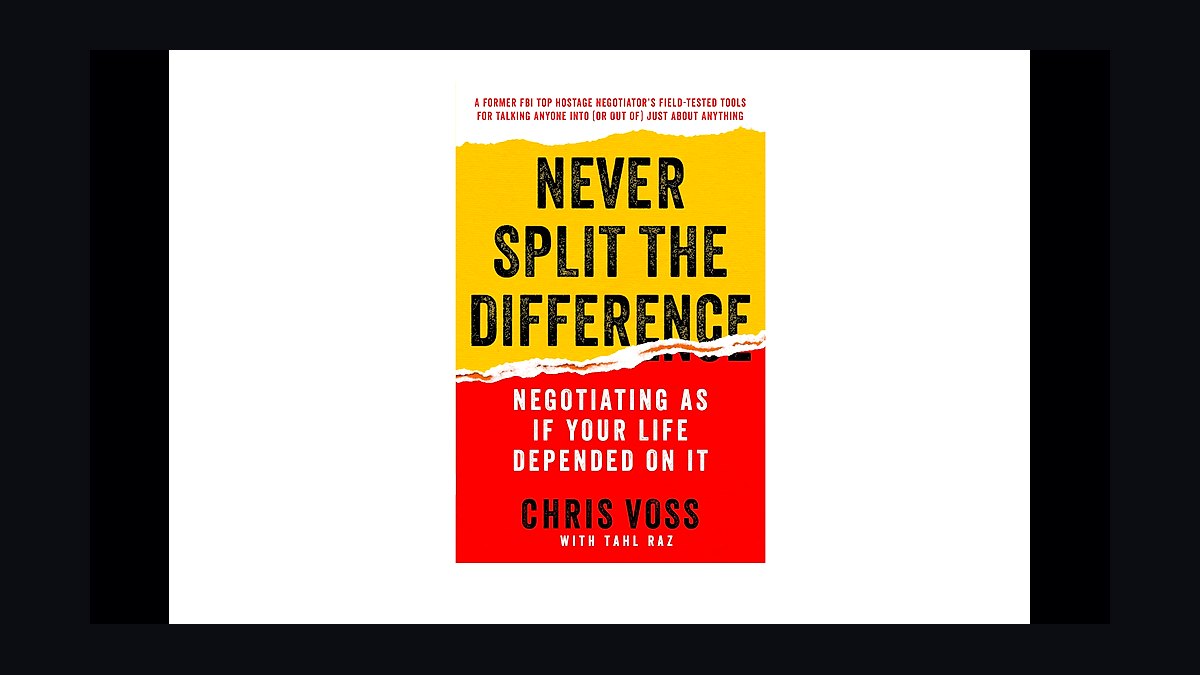
*Never Split the Difference* by Chris Voss is a negotiation playbook built from 24 years of FBI hostage work. Its core claim: negotiation is emotional, not logical, and compromise usually produces an outcome nobody wants. The system runs on tactical empathy — mirroring, labeling, calibrated questions, and the strategic use of "no" and "that's right."
The outcome you should expect from working the method
Read cover to cover, the book takes most people four to six hours. Applying it is a different timeline entirely, and setting the expectation correctly matters more than memorizing the chapter list. The two mechanical techniques — mirroring and labeling — transfer almost immediately. A seller who learns to repeat the last three words of an objection as a question will notice a behavioral change in the very next discovery call, because the technique works on the other person's reflexes, not on their goodwill. Labels take slightly longer, maybe a week or two of conscious use, because you have to develop the habit of watching for emotion instead of listening only for content.
The harder skills compound over months. Triggering "that's right" requires you to build an accurate summary of someone else's worldview on the fly, and most people's first ten attempts land as "you're right" instead — the polite dismissal that means *stop talking*. The Ackerman bargaining sequence requires you to hold a position across multiple rounds without flinching, which is a discipline problem more than a knowledge problem. Voss himself is candid that the Black Swan Group trains practitioners over sustained programs rather than single sessions, because the gap between understanding a tactic and executing it under pressure is wide.
What you should not expect is a magic close rate. The book is not a conversion-rate hack. What it reliably delivers is better information: buyers who tell you the real objection instead of the polite one, deals where you learn about the internal political constraint before the contract stalls, and negotiations where you stop discounting reflexively because you have a structured alternative to splitting the difference. In pipeline terms, the effect shows up as fewer late-stage surprises and less unnecessary concession, not as a sudden doubling of win rate. Sellers who already work SPIN or Challenger frameworks find Voss slots underneath both — those systems govern what you ask about, Voss governs how the conversation feels while you ask.

One more expectation to set: the method is slower in the moment. Mirroring adds silence. Labels add a beat where you observe before you speak. Sellers trained to fill every gap with product talk find this genuinely uncomfortable for the first few weeks. The discomfort is the point — the space is where the other side reveals things.
What drives the outcome — the mechanics chapter by chapter
The book's spine runs from emotional groundwork through hard bargaining, and each chapter installs one component.
Chapter 1 — The New Rules. Voss opens with a Harvard negotiation seminar where he, an FBI practitioner, was set against a law professor working the classic *Getting to Yes* playbook: find common interests, seek win-win, stay rational. Voss used mirrors and labels instead — naming what the professor seemed to be worried about — and the professor ended up defensive and conceding ground he had not planned to give. The lesson is that academic negotiation theory systematically underweights emotion. Voss introduces tactical empathy: recognizing the other side's emotional state, naming it aloud, and using that recognition to shape the outcome. It is explicitly not sympathy. You do not have to agree with someone to name what they feel.
Chapter 2 — Be a Mirror. The highest-leverage and simplest tactic in the book. A mirror is the last one to three words of what the other person just said, repeated back as a question. Buyer: "We're worried this won't integrate with our existing CRM." Seller: "Won't integrate with your existing CRM?" The buyer almost always elaborates, because a mirror makes them feel heard without feeling agreed with. Paired with what Voss calls the late-night FM DJ voice — slow, calm, downward-inflecting — the mirror lowers the temperature of a tense exchange fast. Voss documents using this to work a Brooklyn bank robbery hostage situation in 1993.
Chapter 3 — Don't Feel Their Pain, Label It. Mirrors work on words; labels work on emotions. The openers are near-verbatim: *"It seems like…"*, *"It sounds like…"*, *"It looks like…"* A buyer goes silent after a price reveal; the seller says, "It seems like that number is bigger than you expected." The label forces the seller to observe, makes the buyer feel understood, and surfaces the unspoken objection so it can actually be handled. Voss cites Matthew Lieberman's UCLA fMRI work showing that putting a feeling into words shifts activity away from the amygdala toward the prefrontal cortex — naming a negative emotion diffuses it. The chapter's most aggressive application is the accusation audit: list every negative thing the other side might be thinking about you and say it first. *"You're going to think I haven't done my homework. You're going to think we don't understand your business."* They cannot accuse you of what you have already self-accused.
Chapter 4 — Beware "Yes," Master "No." The most counterintuitive chapter, and the one most directly at odds with conventional sales training. Stacking small yeses builds no real momentum; an early yes is commitment-free. What you want is a "no," because "no" is a declaration of autonomy — once someone has established they are in control, they engage honestly. Practically: replace "Do you have a few minutes?" with "Is now a bad time to talk?" Replace "Will you sign by Friday?" with "Is it ridiculous to think you could sign by Friday?" The no they reach for lands on your hyperbole, not on your actual ask.
Chapter 5 — Trigger "That's Right." The two words that signal deep alignment. You earn them by delivering a summary so accurate the other side has to agree: labels and mirrors stacked into a paragraph that describes their situation better than they just described it. *"It sounds like you've been burned by vendors who promised the world and disappeared, you lost internal credibility over it, and you can't afford another miss this quarter — which is why you want to see the customer-success staffing plan before we talk demo."* When they say "that's right," the rest of the negotiation runs on your map. "You're right," by contrast, is a brush-off.
Chapter 6 — Bend Their Reality. The anchoring and framing chapter. Loss aversion runs stronger than gain pursuit, so frame value around what gets lost by not acting. Anchor before the buyer does, and anchor high. Use precise, non-round numbers — $337,500 reads as researched and defensible in a way $340K does not. After a hard anchor, offer a small unexpected concession (early access, an extra workshop) to trigger reciprocity.
Chapter 7 — Create the Illusion of Control. Calibrated questions: open-ended "how" and "what" questions that hand the problem back. The two workhorses are *"How am I supposed to do that?"* when facing an impossible demand, and *"What about this is important to you?"* to surface the driver behind a stated position. The hard rule: never ask "why." Why sounds accusatory; how and what sound curious.
Chapter 8 — Guarantee Execution. Yes is not done. Voss teaches the rule of three: get agreement three different ways in one conversation — an initial commitment ("yes, we'll move forward"), a summary commitment ("so we're agreed on signing the 15th and onboarding the 16th?"), and a behavioral commitment ("what does your calendar look like for kickoff?"). One yes evaporates after the call; three hold. The chapter also invokes Mehrabian's 7-38-55 framing — words, tone, body language — with the practical instruction to listen for tone shifts. A yes delivered in a different register than the previous three is a signal something changed.
Chapter 9 — Bargain Hard. The money chapter, built on the Ackerman model: set your target, open at 65% of it, then counter at 85%, 95%, and 100%, using precise non-round numbers throughout, and attach a small non-monetary item to the final number to signal you have hit the wall. Target $50K means opening at $32,500, then $42,500, then $47,500, then $50,000 plus a custom workshop. The shrinking increments do the persuading — the other side infers you are near your floor and stops pushing.
Chapter 10 — Find the Black Swan. The title concept. Black Swans are the unknown unknowns: facts that would reshape the negotiation entirely but that you do not even know to ask about. Voss sorts information into known knowns, known unknowns, and these unknown unknowns, and argues they surface through tactical empathy, calibrated questions, and face-to-face contact — rarely over email. The most common Black Swans are non-monetary: someone's career security, an internal political win, a board-meeting date, a personal number they are chasing.
Benchmarks, ranges, and how to judge whether it's working
The book gives a handful of concrete numeric anchors, and it is worth separating the ones that are genuine mechanics from the ones that are heuristics.
The Ackerman ladder — 65 / 85 / 95 / 100. This is the most literal, most copyable number set in the book. It is a sequence of offers as a percentage of your target, with each increment smaller than the last. The precision matters less than the shape: what persuades is the deceleration. If your increments stay flat, the other side reads you as having plenty of room left.
Odd-number pricing. No specific ratio is claimed here — the mechanic is qualitative. Round numbers read as placeholders and invite counters; specific numbers read as the output of a model. In practice this means quoting $47,500 rather than "about fifty," and being ready to say what drives the figure if asked.
7-38-55. Voss cites Mehrabian's decomposition of emotional communication into 7% words, 38% tone, 55% body language. Worth knowing the caveat: Mehrabian's original studies were narrow, and the numbers are routinely over-generalized in popular business writing. Treat the ratio as a directional reminder that delivery carries most of the signal, not as a measured constant you can apply to any conversation.
The rule of three. Three commitments in three forms. This one is cheap to test and easy to audit after the fact — go back through your last ten closed-won deals and check how many had all three, versus how many had a single verbal yes followed by a slipped start date.
For self-assessment, the useful benchmarks are behavioral rather than numeric. Count how often you hear the literal phrase "that's right" in a month of calls — if it is zero, your summaries are not landing. Track how many discovery calls end with you knowing at least one non-obvious constraint (a board date, a competing internal project, a headcount freeze) that was not in the CRM beforehand; that is your Black Swan hit rate. Track discount depth before and after; the honest test of "never split the difference" is whether your average concession shrank. And watch talk ratio — Voss's method mechanically drives your share of airtime down, so if you are still talking 70% of the call, you are not actually running the system.
A realistic timeline: mirrors within days, labels within two to three weeks, accusation audits within a month or two once you are willing to feel awkward, "that's right" summaries over a quarter of deliberate practice, and Ackerman discipline only once you have management backing for holding a number.
Risks, edge cases, and where the method breaks
The techniques are not universally safe to deploy, and the honest failure modes are worth naming.
Detection. Mirroring is conspicuous when overused. Repeat three words back four times in one call and you sound like a chatbot; the other side will notice, and the trust you were building inverts. The rule of thumb practitioners settle on is sparing use at moments of genuine emotional charge, not as a metronome. Labels have the same problem — "it seems like" every third sentence reads as a script.
Cultural and contextual mismatch. The book is grounded in American law-enforcement and American business contexts. Direct emotional labeling reads differently in cultures with higher indirectness norms, and in some professional settings — legal, medical, regulated procurement — naming someone's emotional state is a category error that damages credibility. The underlying instruction (observe, then adapt) survives; the verbatim scripts do not always travel.
The ethics question. The most common objection is that this is manipulation dressed as empathy. Voss's defense is that tactical empathy is about accurate understanding, not deception, and that a negotiation where both sides' actual constraints surface tends to produce a more durable agreement than one where they stay hidden. That defense holds when you are using the techniques to find a real deal and collapses when you are using them to push someone past their interests. The practical guardrail: if the technique only works because the other person does not know their own constraint, you are on the wrong side of the line.
Organizational friction. Ackerman assumes you control your pricing. Most sellers do not. If your deal desk auto-approves 20% discounts, the ladder is theater — the buyer's procurement team already knows the floor, often better than you do. Running Voss against a professional procurement function that has seen every negotiation book is a different game; they will recognize the accusation audit and may say so. The counter is that the techniques still work when named, because they operate on how information surfaces, not on concealment.

Email and asynchronous channels. Voss is explicit that Black Swans surface face to face. Mirrors lose most of their power in text — without tone, a repeated phrase reads as sarcasm or as a lazy reply. Labels transfer better in writing than mirrors do, because the sentence structure carries itself. Calibrated questions survive intact. If your sales motion is heavily email-based, expect maybe half the toolkit to travel.
Over-indexing on "no." The autonomy framing is real, but "is now a bad time" used on every touch becomes its own tic, and some buyers simply take the exit you offered them. The technique is for lowering the stakes of engagement, not a universal opener.
The single-conversation trap. Voss's original context was one-shot, high-stakes, no-relationship negotiation. Enterprise selling is repeated-game: you will renegotiate with the same person at renewal, and again at expansion. Tactics that win a single round at the cost of goodwill are net-negative across a three-year account. This is where Voss reads best in combination with account-management thinking rather than as a standalone strategy.
A practical rollout plan for a team
Rolling this out across a sales floor works better as a staged install than as a one-day workshop.
Week one — install mirrors only. Give the team a single instruction: when you hear an objection, repeat the last three words as a question, then stop talking. Nothing else changes. Record calls and review three per rep. The point of restricting scope is that mirrors are cheap to learn and produce visible wins fast, which buys credibility for the harder pieces.
Week two — add labels. Three openers, nothing more: it seems like, it sounds like, it looks like. Have reps write down one label per call in the CRM notes field — the writing forces observation. Expect the first week's labels to be wrong about half the time, which is fine; a mislabeled emotion gets corrected by the buyer, and the correction is itself useful information.

Weeks three and four — accusation audits on stalled deals. Pick the deals sitting in a stage past their average cycle time and have the rep open the next call by naming what the buyer is probably thinking. This is where managers see the most resistance, because it feels like handing the buyer ammunition. Run it as a paired exercise: manager and rep draft the audit together before the call.
Month two — summaries and "that's right." This is the coaching-heavy phase. Have reps write a five-sentence summary of a buyer's situation before each call, then compare it to what the buyer actually says. Score the summaries, not the calls. The skill being built is accuracy of model, and it is genuinely hard.
Month three — Ackerman, but only with deal-desk alignment. Before any rep runs the ladder, leadership has to define the target and the floor and commit to not undercutting it mid-deal. Otherwise the first time a rep holds at 95% and a VP approves 70% to save the quarter, the method is dead on the floor.
Ongoing — call review as the enforcement layer. None of this survives without listening to recordings. Pick two calls per rep per week, score for the specific behaviors, and coach on one thing at a time. Pair the review with the neighboring frameworks your team already uses: MEDDIC or SPIN for what you need to learn, Challenger for how you frame insight, Voss for how the conversation feels while you do it. They stack cleanly.
Related questions
Is the book worth reading if I've already read *Getting to Yes*?
Yes — Voss wrote it partly as a rebuttal. *Getting to Yes* optimizes for rational interest-based bargaining; Voss argues that framing fails under emotional pressure. Reading both gives you the analytical structure and the behavioral toolkit, and the disagreement between them is itself instructive.
Which techniques should a new seller learn first?

Mirrors, labels, and calibrated questions, in that order. All three are low-risk, work in the first conversation, and require no pricing authority. Save the Ackerman model and accusation audits until you have manager backing and enough call reps to stay composed under pushback.
Does "never split the difference" mean never compromise?
No. It means never reflexively meet in the middle, because splitting produces an outcome neither side actually wanted. Voss's alternative is to keep trading information until a structurally better deal appears — which sometimes still involves concession, just a deliberate one.
How does this fit with methodologies like MEDDIC or Challenger?
They operate at different layers. MEDDIC governs what you must learn about a deal; Challenger governs how you frame commercial insight; Voss governs conversational mechanics. Running all three is not redundant — Voss is the delivery layer beneath the qualification and messaging frameworks.
Can these techniques work in internal negotiations, not just sales?
Yes, and often better. Budget requests, headcount fights, and cross-functional scope arguments are high-emotion, low-formality settings where labels and calibrated questions defuse conflict quickly. The accusation audit is especially effective when you know a stakeholder already thinks your team over-promises.
FAQ
Is this book only for professional negotiators?
No. Voss wrote it for anyone who negotiates, which is effectively everyone — salary conversations, vendor contracts, car purchases, disagreements at home. The FBI stories are the illustration, not the audience. The tactics are designed to work in ordinary conversations with no special authority behind them.

Are the cliff notes enough, or do I need the full book?
A summary gives you the tactics and the sequence, which is genuinely useful as a reference. What it cannot give you is the case detail — the hostage negotiations, the failed deals, the transcripts — and that detail is where you learn what each technique sounds like when it is going wrong. Read the summary first if you need something actionable today, then read the book.
Are these techniques manipulative?
Tactical empathy means understanding someone's position accurately, not deceiving them. The practical test is whether the technique would still work if the other person knew you were using it. Mirrors, labels, and calibrated questions largely do. If a tactic only works through concealment, you have drifted from the method into something else.
Do they work if I'm not naturally assertive?
Often better. The core skills are listening, observing, and asking — not dominating. Quieter people tend to find mirroring and calibrated questions more natural than aggressive positional bargaining, and the late-night FM DJ voice rewards calm delivery over volume.
Does any of this survive over email?
Partially. Calibrated questions transfer intact, labels transfer reasonably well because the sentence carries its own tone, and mirrors mostly fail — a repeated phrase in text reads as sarcasm. Voss is explicit that face-to-face contact is where the unknown unknowns surface, so push high-stakes moments to a live channel.
What's the single highest-leverage habit to build?
Talk less and summarize better. If you install only one thing, make it the summary that earns "that's right" — it forces you to actually understand the other side's situation, and everything else in the book gets easier once that habit exists.
Sources
- https://www.blackswanltd.com/never-split-the-difference
- https://www.harpercollins.com/products/never-split-the-difference-chris-voss
- https://www.scn.ucla.edu/pdf/AL(2007).pdf
- https://www.pon.harvard.edu/daily/negotiation-skills-daily/negotiation-tactics-from-the-fbi/
- https://www.nytimes.com/2016/05/22/business/never-split-the-difference-chris-voss.html
- https://www.pon.harvard.edu/daily/negotiation-skills-daily/anchoring-in-negotiation/
- https://www.nobelprize.org/prizes/economic-sciences/2002/kahneman/facts/
- https://www.penguinrandomhouse.com/books/321339/getting-to-yes-by-roger-fisher-and-william-ury/
Related on PULSE
- Never Split the Difference by Chris Voss: Summary, Key Lessons, and RevOps Takeaways
- Never Split the Difference — Cliff Notes Summary
- Never Lose a Customer Again by Joey Coleman — Cliff Notes Summary for Sellers
- The Sales Acceleration Formula by Mark Roberge — Cliff Notes & Chapter-by-Chapter Summary
- The Psychology of Selling by Brian Tracy — Cliff Notes & Chapter-by-Chapter Summary
- How to Win Friends and Influence People by Dale Carnegie — Cliff Notes & Chapter-by-Chapter Summary
This page will be disappearing soon. Save it to your device for $1 — or read it free while it is here.
@Kory-White- · if Venmo asks, the last 4 of my number are 2012
This page is gone.
This one is off the shelf now. $1 keeps it on your phone for good — the whole page, pictures and diagrams included.
 book-summaryNever Split the Difference by Chris Voss: Summary, Key Lessons, and RevOps Takeaways
 pulse-recentHow do you implement the Sandler Rules by David Mattson in your first 30 days as a new sales manager in 2027?
 pulse-recentThe Greatest Salesman in the World by Og Mandino — Top 10 Key Takeaways for Sales Leaders in 2027
 pulse-recentThe Challenger Customer by Brent Adamson — Top 10 Key Takeaways for Sales Leaders in 2027
 pulse-recentSales Engagement by Manny Medina — Top 10 Key Takeaways for Sales Leaders in 2027
 book-summaryMajor Account Sales Strategy by Neil Rackham: Summary, Key Lessons, and RevOps Takeaways
 pulse-recentThe Sales Acceleration Formula by Mark Roberge — Top 10 Key Takeaways for Sales Leaders in 2027
 pulse-recentThe Collaborative Sale by Keith Eades — Top 10 Key Takeaways for Sales Leaders in 2027
 pulse-recentSelling Above and Below the Line by Skip Miller — Top 10 Key Takeaways for Sales Leaders in 2027
 pulse-recentNever Split the Difference by Chris Voss — Top 10 Key Takeaways for Sales Leaders in 2027