


Never Split the Difference — Cliff Notes Summary
Quality
Certified
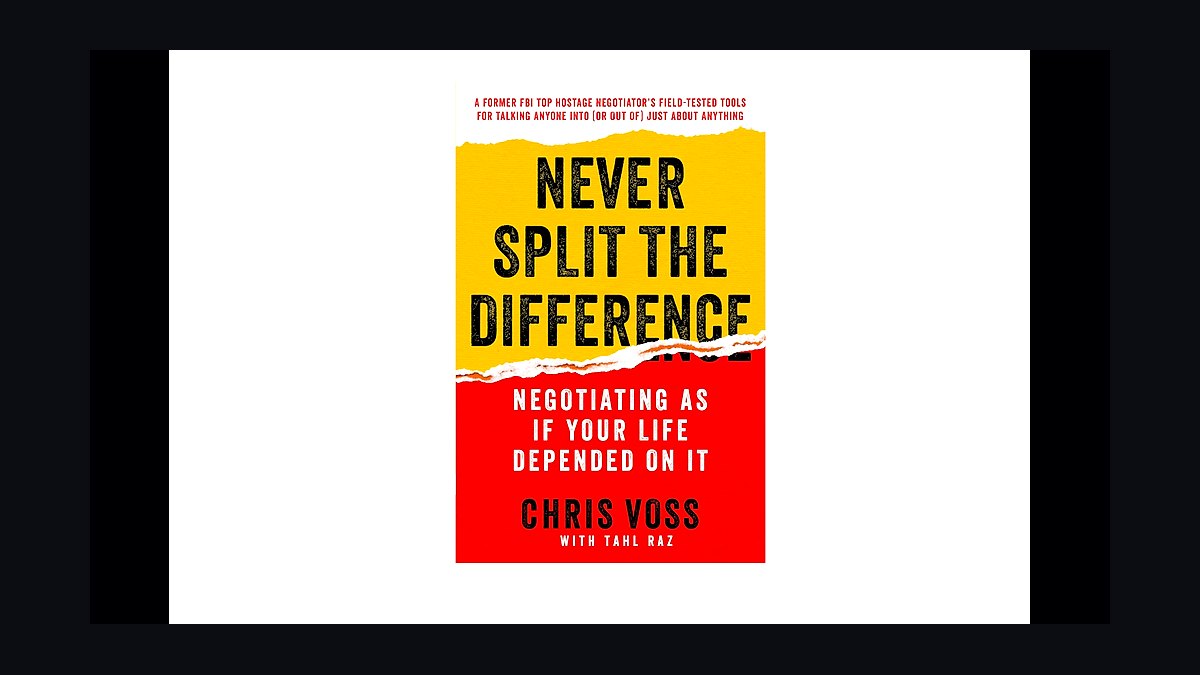
Never Split the Difference is Chris Voss's 2016 negotiation book distilling his years as the FBI's lead international kidnapping negotiator. Its core strategy rejects compromise in favor of tactical empathy — mirroring, labeling, calibrated questions, and hunting for hidden information — so you uncover what the other side actually values instead of meeting halfway.
The renewal call that splitting the difference would have ruined
Picture a common revenue scenario. A $180,000 annual contract comes up for renewal. The customer's new VP of Procurement opens the call by saying the number has to come down 30% or they're going to competitive bid. Your list renewal is $198,000 after a standard uplift. The instinctive move — the one most reps make within ninety seconds — is to counter at 15% off and call it fair. Meet in the middle. Everybody wins.
Voss's argument, and the reason the book is titled what it is titled, is that this instinct is the single most expensive habit in professional negotiation. He opens the book with the image of a pair of shoes: your wife wants you to wear the black ones, you want the brown ones, so you split the difference and wear one of each. The compromise is not a good outcome that nobody loves. It is a bad outcome that nobody wanted. In the renewal scenario, the 15% concession costs roughly $30,000 of annual recurring revenue, resets the customer's expectation that pressure produces discounts, and — critically — you still have no idea why the procurement VP asked for 30%.
That last point is the whole book. The 30% ask is a number, not a reason. It could be a departmental budget cut that landed in March. It could be a new CFO mandate to renegotiate every vendor above $150,000. It could be a competitor quote the VP is using as leverage without any intention of switching. It could be that the VP is new, needs a visible win in their first quarter, and would take a 12% reduction plus a press-release-worthy concession on payment terms. Each of those situations has a completely different optimal response, and splitting the difference answers none of them.
Voss's alternative in this scenario is a sequence, not a comeback. You mirror — "Thirty percent?" — and then you stop talking. You label the emotion you're picking up: "It sounds like there's pressure coming down on you from somewhere that has nothing to do with us." You run an accusation audit before they can: "You're probably thinking our price went up twice, our support got slower after the reorg, and we've been coasting on the relationship." And then you ask the calibrated question that hands them your constraint: "How am I supposed to do that?"

Each of those moves does one job. The mirror buys information. The label lowers the temperature. The accusation audit disarms the grievances by naming them first. The calibrated question makes the other side solve your problem. None of them concede a dollar, and by the time you've run all four you usually know whether you're dealing with a budget cut, a mandate, a bluff, or a new VP who needs a trophy. That is the difference between negotiating and haggling, and it is why the book has stayed on sales-leadership reading lists for the better part of a decade.
The scenario generalizes well beyond renewals. A founder negotiating a term sheet, a candidate negotiating a comp package, a CS leader defending against a downgrade, a procurement lead squeezing a vendor — all of them face the same structural trap. Someone names a number, the number feels like the negotiation, and the midpoint feels like fairness. Voss's entire method is a set of techniques for refusing to accept the number as the subject of the conversation.
How tactical empathy actually changes the conversation
The mechanism underneath every technique in the book is what Voss calls tactical empathy: recognizing the other side's perspective and emotional state, and then verbalizing it out loud. Not agreeing with it. Not sympathizing with it. Naming it accurately enough that they feel understood.

This is the point where readers coming from Getting to Yes — the Fisher and Ury classic that dominated negotiation teaching for decades — hit friction. That tradition tells you to separate the people from the problem and negotiate over interests rather than positions. Voss's counterargument, drawn from the FBI's shift toward behavioral negotiation after the crisis-response failures of the early 1990s, is that in high-stakes situations the people *are* the problem. Nobody in a genuinely difficult negotiation is operating as a rational actor optimizing a utility function. They're protecting status, autonomy, a job, a budget, a reputation, or a sense of not being taken advantage of. If your method has no way to address any of that, your method breaks exactly when you need it.
The mechanical toolkit runs in a rough order:
Mirroring is repeating the last one to three words your counterpart said, with a slight upward inflection, and then going silent for at least four seconds. It sounds absurdly simple and it works because it triggers an almost involuntary elaboration. The counterpart hears their own words come back, feels the implicit question, and expands. What you get back in that expansion is frequently the real objection sitting behind the stated one.
Labeling is a sentence that begins "It seems like…," "It sounds like…," or "It looks like…," followed by a description of what they're feeling. Voss is specific about the construction: no "I" at the front. "I'm hearing that you're frustrated" makes it about you and invites pushback. "It sounds like this renewal landed at the worst possible moment for your budget cycle" makes it about them and invites confirmation or correction — and a correction is information too.
The accusation audit is the pre-emptive version of labeling. Before the call, you list every negative thing your counterpart might be thinking about you, and then you say those things out loud first, in their harshest form. The counterpart's near-universal reaction is to soften them: "It's not that bad." You've converted their ammunition into your opening.
Calibrated questions are open-ended "how" and "what" questions engineered to hand a problem back. "How am I supposed to do that?" is the load-bearing one. "What about this is important to you?" is the discovery one. Voss is emphatic about eliminating "why" — in nearly every language and culture, "why" reads as accusation and triggers defense.

"That's right" is the target state. Voss draws a hard line between "you're right" — which is what people say to make you go away — and "that's right," which is what they say when they feel genuinely and completely understood. You get there by summarizing: paraphrase their content, label their emotion, then pause. When the summary lands, they exhale and say "that's right," and the conversation changes character. That moment, in Voss's framing, is when they give you permission to influence them.
The sequencing matters more than any individual move. Reps who learn labeling but skip mirroring end up guessing at emotions they never gathered evidence for, and a wrong label is worse than no label. Reps who learn calibrated questions but skip the empathy work end up sounding like an interrogation. The techniques are stacked deliberately: mirror to gather, label to defuse, summarize to confirm, calibrate to move.
The specific numbers, ratios, and sequences in the book
Voss is unusually concrete for a business author, which is a large part of why the book gets operationalized rather than just read. The numbers worth memorizing:
The four-second rule. After a mirror, stay silent for at least four seconds. This is the hardest instruction in the book to actually execute, because four seconds of silence on a live call feels like thirty. Voss's position is that the discomfort is the mechanism — the counterpart fills the silence, and what they fill it with is the thing you couldn't have asked for directly.
The Ackerman bargaining model, which Voss learned from a former intelligence officer, is a fixed four-step price sequence:

- Set your target price — the number you actually want.
- Open at 65% of that target.
- Plan three escalating offers at 85%, 95%, and 100% of target.
- Between every raise, use empathy and calibrated questions — especially "How am I supposed to do that?" — to make them bid against themselves. On the final number, use a precise, non-round figure and add a non-monetary throw-in.
The math is doing something deliberate: the increments shrink from 20 points to 10 to 5, and a shrinking concession pattern signals to the other side that you're approaching a hard floor. If you concede $10,000, then $10,000, then $10,000, you've taught them there's another $10,000 behind the door. If you concede $10,000, then $5,000, then $2,000, the shape of the pattern says you're done before your words do.
Non-round numbers. A final offer of $37,893 reads as calculated — as though it came out of a spreadsheet with real constraints behind it. $38,000 reads as a placeholder someone picked and can therefore un-pick. Voss cites research on precise versus round anchors showing that precise numbers hold their value better through the back-and-forth. In practice this is the cheapest single change most sales teams can make: stop rounding your floors.
The 7-38-55 rule. Voss surfaces Albert Mehrabian's much-cited finding that 7% of a message's emotional content comes from words, 38% from tone, and 55% from body language. The rule's universality is genuinely contested among researchers and Voss treats it as a heuristic rather than a law. The operational takeaway survives the controversy: if most of the signal is in tone and body, then email and chat strip out the majority of what you need to read, and a negotiation that matters should not be conducted in writing if you can avoid it.
The talk ratio. Voss's guidance is that the negotiator should be talking roughly a third of the time and listening the rest. The enforcement mechanism is the label-plus-calibrated-question-plus-silence loop; it is structurally difficult to dominate a conversation while running it. Call-recording platforms have made this measurable, and buyer-heavy talk ratios in discovery are one of the more durable correlates of deal progression in the revenue-intelligence research that's been published over the last several years.

The Rule of Three. Get your counterpart to agree to the same commitment three separate times in three different framings within one conversation — the direct agreement, then a summary they confirm, then a calibrated question that makes them articulate it themselves. If the commitment is soft, it collapses somewhere in the second or third pass. This is Voss's countermeasure to the counterfeit yes.
The three yeses. Voss separates commitment yes (rare, binding), confirmation yes (a factual acknowledgment), and counterfeit yes (a brush-off to end the conversation). Reps who chase "does that make sense?" all call are harvesting confirmation yeses and mistaking them for commitment.
The "no" reframe. Instead of "Do you have a few minutes to talk?" ask "Is now a bad time to talk?" The answer you're inviting is "no" — and "no" preserves the counterpart's sense of autonomy, which is precisely what makes them willing to keep talking. The same reframe applies to asks: "Is it ridiculous to ask for net-60?" invites a comfortable "no, it's not ridiculous" and opens the space rather than forcing a defense.
The negotiation one-sheet. The appendix contains Voss's prep template, with five fields: the goal, a summary of the situation as the counterpart would describe it, three to five labels, three to five calibrated questions, and three to five non-cash offers. Teams that operationalize the book usually operationalize this artifact first — it maps cleanly onto a deal-desk prep doc or a CRM custom object, and it forces reps to write the buyer's version of the story before the call.
What the method costs you, and when a different strategy fits better
Never Split the Difference is not a universal negotiation operating system, and treating it as one produces predictable failures.
The time cost is real. Tactical empathy takes conversational turns. Mirroring, labeling, summarizing to a "that's right," running an Ackerman ladder with calibrated questions between each raise — that is a multi-call motion, not a single-email motion. On a transactional deal with a two-week cycle and a $9,000 ACV, the fully-loaded cost of the extra calls can exceed the margin you're defending. The book is built for negotiations where the stakes justify the process: high-value contracts, multi-stakeholder enterprise deals, comp packages, term sheets, partnerships, escalations where the relationship is the asset.

It is a two-party, high-emotion method. Where Voss's approach is strongest is where a human counterpart has emotions, autonomy, and discretion. Where it weakens is structured, rules-bound procurement: sealed-bid RFPs, reverse auctions, mandated vendor scorecards, public-sector purchasing with legally constrained evaluation criteria. In those settings there is often no one on the other side with the authority to be influenced, and the winning strategy is different — it's about scoring criteria, compliance, and positioning before the process opens, not about labeling during it.
Interest-based bargaining is still the better fit for genuinely collaborative, repeated negotiations. In a long-running partnership where both sides have durable incentives to expand the pie — a co-sell agreement, a joint product roadmap, a multi-year strategic alliance — the Getting to Yes machinery of separating people from problems, inventing options for mutual gain, and using objective criteria is often cleaner. Voss's method excels at claiming value under adversarial pressure; principled negotiation excels at creating value under cooperation. Practitioners who read the book as a repudiation of Fisher and Ury tend to over-apply hard-bargaining tactics inside relationships that would have produced more total value with a collaborative frame.
It requires practice to not sound like a script. A badly executed label — wrong emotion, wrong timing, delivered in a flat recitation voice — is actively worse than saying nothing. Counterparts who've also read the book will recognize a mirror the moment it lands, and a recognized technique deployed without genuine curiosity reads as manipulation. Voss's own framing is that tactical empathy has to be actual empathy in service of a tactical goal, not a performance of empathy. The teams that get value out of this are the ones that role-play it before running it on live pipeline.

Some claims deserve skepticism. The 7-38-55 rule is widely disputed in its strong form; Mehrabian's original research was narrow and has been over-extended for decades. The deception-detection material — pronoun patterns, word counts, the physical tells — sits in a field where replication has been genuinely rough. These are useful as hypotheses to test in a specific conversation, not as reliable classifiers. Reading the book uncritically produces negotiators who are overconfident about detecting lies.
Where readers get this wrong
The book has been summarized enough times that a set of predictable misreadings has calcified. Worth naming each, because each one costs money.
Treating "never split the difference" as "never concede." The title is about the *reflex* to meet in the middle before you understand the situation, not about refusing to move. The Ackerman model is literally a structured sequence of concessions. What Voss objects to is symmetric, unexamined, midpoint-seeking concession — conceding because it feels fair rather than because it buys something.
Mirroring like a parrot. The mirror is one to three words, delivered with genuine curiosity and upward inflection, then silence. Reps who mirror every sentence, or who mirror a full clause, or who mirror and then immediately keep talking, get nothing from it and make the counterpart uncomfortable. Use it at the moments that matter — when a number lands, when an objection surfaces, when something in their tone shifts.
Labeling emotions you haven't evidence for. "It sounds like you're frustrated" to someone who is calm and businesslike is a miss, and it costs credibility. The correct fallback when you can't read the emotion is a calibrated question, not a guessed label. And when a label misses, don't defend it — take the correction as data and re-label.
Skipping straight to Ackerman. The bargaining ladder is chapter nine for a reason. Running a 65% opening anchor on someone who has not yet felt understood reads as an insult and frequently ends the conversation. Every dollar-level tactic in the book assumes the empathy work has already been done. Teams that pull only the Ackerman numbers out of the book — because numbers are the easiest thing to put in a playbook — reliably get worse results than teams that pull only the labeling.

Using "why" questions. This is the most common relapse. "Why is the budget being cut?" reads as a challenge. "What changed on your side this quarter?" gets the same information without the defensive spike. Rewriting every "why" into a "what" or "how" is a mechanical habit that takes a few weeks and doesn't ever stop paying.
Conducting the negotiation over email. The information that reshapes a deal — the constraint nobody wrote down, the internal politics, the deadline behind the deadline — surfaces in unstructured conversation, in the minutes before and after the formal agenda. Email suppresses all of it. If a deal matters, get on a call with video, and protect the loose time at the edges of the meeting where the useful things get said.
Treating the one-sheet as optional. Voss's clients prep. Reps who read the book and don't build a prep artifact retain the vocabulary and lose the method, because in the pressure of a live call you revert to whatever you did last time. Writing three labels and three calibrated questions before the call is fifteen minutes of work and it's the difference between running the method and remembering that the method exists.
Assuming the counterpart hasn't read it. In B2B, they probably have. Procurement organizations train on hard-bargaining methods and specifically on starving sellers of commitments to control pace. When both sides are running the same playbook, the advantage shifts back to preparation, information, and genuine curiosity — which is, not coincidentally, exactly where Voss says it lives anyway.
Related questions
Does the book replace Getting to Yes?

No. It's a counterweight. Getting to Yes is stronger for collaborative, repeated, value-creating negotiations with objective criteria available. Never Split the Difference is stronger for adversarial, emotional, deadline-driven value-claiming. Experienced negotiators carry both and choose based on the counterpart and the stakes.
Which chapters should a new AE read first?
The mirroring, labeling, and calibrated-questions chapters — roughly chapters two, three, and seven. Those three cover most of what a rep uses weekly. The Ackerman bargaining and hidden-information chapters reward a second pass after you've run the basics on three real deals.
Can these techniques be used ethically?
Yes, and Voss argues they only work when they are. Tactical empathy requires actually understanding the other side's position; a performed version is detectable and backfires. The techniques surface information and reduce friction — they don't create leverage that doesn't exist.
How long does it take to get competent?
Most people can execute mirroring and labeling passably after a few hours of role-play, and reliably after a dozen or so live conversations. Calibrated questions take longer because eliminating "why" is a deeply grooved habit. The full Ackerman sequence typically needs supervised practice before it's used on real revenue.
Is the book useful outside sales?
Yes. The method is designed for salary negotiations, vendor contracts, internal resourcing fights, customer escalations, and personal-life disagreements. No law-enforcement background is required, and Voss deliberately writes the examples so they transfer from hostage scenarios to ordinary business situations.
FAQ

What is the single core idea of Never Split the Difference?
That compromise is usually a failure of understanding rather than a fair outcome. Instead of moving toward the midpoint, you use tactical empathy — mirroring, labeling, and calibrated questions — to discover what the other side actually needs, which is frequently different from and cheaper than what they asked for.
What's the difference between "that's right" and "you're right"?
"You're right" is what people say to end a conversation and make you go away; it signals compliance, not agreement. "That's right" is what they say when a summary you've offered captures both their facts and their feelings accurately. Voss treats "that's right" as the moment real influence becomes possible.
Why does Voss want you to get a "no"?
Because "no" protects autonomy, and people who feel they still have control keep talking. A quick "yes" is often a counterfeit meant to end pressure. Framing questions to invite "no" — "Is now a bad time?" — lowers the counterpart's defenses and produces more honest engagement than pushing for premature agreement.
Is the Ackerman model safe to use on customers?
It's designed for price negotiations where you have room and the relationship can absorb an aggressive opening. It's poorly suited to renewals with long-standing customers, regulated procurement, or any situation where a 65% opening anchor would read as bad faith. Use judgment; a broken relationship costs more than a discount.
Does the 7-38-55 rule hold up?
Not in its strong form. Mehrabian's original research was narrow and has been over-generalized for decades, and Voss himself uses it as a heuristic. The defensible takeaway is that tone and body language carry real signal, so high-stakes negotiations should happen on video or in person rather than over email.
What should a team operationalize first?
The one-sheet. Making reps write the goal, a buyer's-eye summary, three labels, three calibrated questions, and three non-cash concessions before every significant negotiation converts the book from vocabulary into process. It fits in a deal-desk template and takes fifteen minutes per deal.
Sources
- Never Split the Difference — HarperCollins publisher page
- The Black Swan Group — Chris Voss's negotiation training company
- Chris Voss MasterClass: The Art of Negotiation
- Harvard Program on Negotiation — Getting to Yes and principled negotiation
- FBI Crisis Negotiation Unit overview
- Gartner — B2B buying journey research
- Gong Labs — revenue intelligence and sales conversation research
- Nobel Prize — Daniel Kahneman and prospect theory
- Amazon — Never Split the Difference book listing
Related on PULSE
- Getting to Yes by Fisher and Ury — Cliff Notes Summary
- Never Lose a Customer Again by Joey Coleman — Cliff Notes Summary for Sellers
- How to handle a procurement-led renewal negotiation
- Calibrated questions every AE should have in the one-sheet
- Discovery call talk ratios and what they predict about win rates
This page will be disappearing soon. Save it to your device for $1 — or read it free while it is here.
@Kory-White- · if Venmo asks, the last 4 of my number are 2012
This page is gone.
This one is off the shelf now. $1 keeps it on your phone for good — the whole page, pictures and diagrams included.
 pulse-recentThe Sales Acceleration Formula by Mark Roberge — Top 10 Key Takeaways for Sales Leaders in 2027
 pulse-recentThe Greatest Salesman in the World by Og Mandino — Top 10 Key Takeaways for Sales Leaders in 2027
 pulse-recentHow to Apply Strategic Selling — Step-by-Step Playbook in 2027
 pulse-recentNever Lose a Customer Again by Joey Coleman — Top 10 Key Takeaways for Sales Leaders in 2027
 pulse-recentSnap Selling by Jill Konrath — Top 10 Key Takeaways for Sales Leaders in 2027
 pulse-recentHow does *The New Strategic Selling* define the first step in qualifying an opportunity in 2027?
 pulse-recentSales Engagement by Manny Medina — Top 10 Key Takeaways for Sales Leaders in 2027
 pulse-recentSales EQ by Jeb Blount — Top 10 Key Takeaways for Sales Leaders in 2027
 pulse-recentSPIN Selling by Neil Rackham — Top 10 Key Takeaways for Sales Leaders in 2027
 pulse-recentWhat is the most actionable step in The Sandler Rules for Sales Leaders by David Mattson to improve discovery in 2027?