


Hooked by Nir Eyal — Cliff Notes Summary for Sellers
Quality
Certified
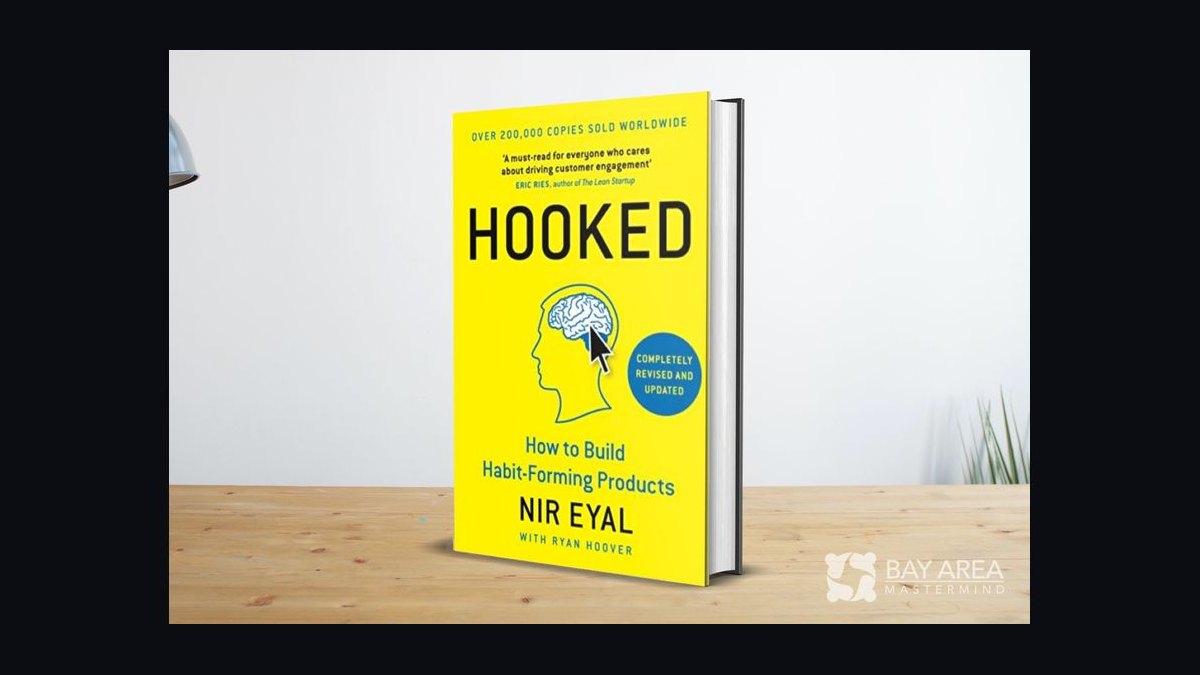
*Hooked* (Nir Eyal with Ryan Hoover, 2014) argues products become habits through a four-phase loop: Trigger, Action, Variable Reward, Investment. External triggers onboard users; internal triggers — boredom, anxiety, FOMO — retain them. For sellers, it explains why some trials convert and stick while others quietly churn after week one.
The two competing reads of the book
There are two honest ways to pick up *Hooked*, and which one you choose changes what you do on Monday. The first read treats it as a consumer engagement manual — the Instagram-and-TikTok read. Under this lens, the Hook Model explains why people scroll, why notifications work, why streaks matter, and why attention has become the scarcest commodity in the economy. This is the read most people arrive with, largely because the book's most-cited examples (Facebook likes, Pinterest infinite scroll, Twitter's 140-character constraint) are consumer apps, and because the ethical backlash that followed — Tristan Harris, the Center for Humane Technology, *The Social Dilemma* — framed the book as an attention-economy artifact.
The second read treats it as a B2B activation and retention manual. Under this lens, the Hook Model is a diagnostic tool for the exact gap most revenue teams cannot close: the distance between "signed up" and "opens it without being asked." Every phase maps onto something a RevOps, CS, or growth team already owns. Trigger maps to lifecycle email, in-app nudges, and Slack/Teams integration. Action maps to onboarding friction — SSO versus a 14-field signup form. Variable Reward maps to the aha moment and the recurring value delivery after it. Investment maps to workspace configuration, data import, integrations, and teammate invites — the things that make switching expensive.

The trade-off between the two reads is real, not academic. If you read *Hooked* as a consumer book, you will come away with tactics that misfire in B2B: gamification badges nobody wants, push notifications that get muted in week two, and streak mechanics that feel juvenile on an enterprise account. If you read it as a B2B activation book, you get a framework that maps cleanly onto funnel stages you already instrument — but you have to do the translation work yourself, because Eyal mostly did not. The book names Slack and enterprise email in passing; the heavy examples are consumer.
There is a third option worth naming, which is not reading the book at all and instead absorbing the model secondhand. The Hook Model is short enough to summarize in a diagram, and thousands of decks have. What you lose by skipping the book is the mechanism: *why* variable rewards outperform fixed ones (Skinner's operant conditioning; Wolfram Schultz's dopamine research on anticipation rather than receipt), *why* Ability beats Motivation as a lever (BJ Fogg's Behavior Model, B = MAT, and the six elements of simplicity — time, money, physical effort, brain cycles, social deviance, non-routine), and *why* Investment is structurally different from Action. Teams that only absorb the diagram consistently build the first two phases and skip the last two. That is the single most common failure pattern this Cliff Notes summary exists to prevent.
How to decide which read applies to your motion

The decision is not about taste; it is about the shape of your revenue motion. A sales-led enterprise motion with a nine-month cycle and a procurement gate does not need habit formation to close the first deal — it needs multi-threading, a business case, and a champion. Habit formation matters at *renewal*, where a product nobody opens is a product nobody defends in a budget review. A product-led motion inverts this: habit formation *is* the sales motion, because the free-tier behavior is what qualifies the account.
Between those poles sits the hybrid motion most B2B companies actually run — free trial or freemium at the top, a sales-assist layer in the middle, an expansion motion at the bottom. Here the Hook Model is most useful as a stage-specific diagnostic rather than a whole-funnel strategy. Run it against activation only, and leave the rest of the funnel to the frameworks that own it.
Three practical decision rules fall out of that diagram. First, natural frequency is a hard constraint you cannot design around. If the underlying job is monthly — closing the books, running payroll, filing a quarterly board deck — no amount of Hook engineering makes it daily. Trying to force it produces notification fatigue and mute rates that damage the channel you will need at renewal. Second, a large gap between provisioned seats and weekly-active seats is almost always an Investment failure, not a Trigger failure. Users who never configured anything have nothing pulling them back. Third, if activation is strong and week-four retention collapses, the loop is not closing — the reward is arriving once and never recurring.

The neighboring use-case worth borrowing here comes from customer success rather than growth. CS teams have long tracked "depth of deployment" — integrations connected, custom fields configured, reports saved, users invited. That metric is the Investment phase under a different name, invented independently by people who never read the book. If your CS org already scores accounts on depth of deployment, you have half of the Hook Model instrumented and can skip straight to the Trigger and Variable Reward audits.
The concrete numbers behind each phase
Eyal is deliberately light on universal benchmarks, and that restraint is correct — habit formation timelines vary enormously by product and context, and the popular "21 days to a habit" claim is folklore rather than research. What the book does commit to are *directional* economics, and those hold up. Habit-forming products enjoy higher customer lifetime value, greater pricing flexibility, faster organic growth, and a stronger competitive moat, because a user who opens the product without deliberating never re-enters the rational-comparison process where your competitor's feature list lives.
For the Trigger phase, the number that matters is the ratio of external to internal triggers over time. Instrument it directly: tag every session as prompted (arrived via email, push, Slack link, calendar reminder) or unprompted (direct navigation, bookmark, app icon, muscle-memory URL). A healthy habit-forming product shows the unprompted share climbing month over month within a cohort. A product where the unprompted share stays flat is renting attention, not owning it — and the moment you pause lifecycle marketing, usage falls off a cliff. That single ratio is more diagnostic than any composite engagement score, and most teams have never computed it.

For the Action phase, the lever is friction, and friction is countable. Count the discrete steps between "clicked the signup link" and "saw the first valuable output." Count form fields. Count required decisions before value. Fogg's six elements of simplicity give you the audit categories: time (how many seconds), money (is a credit card required before value), physical effort (typing, uploading, clicking), brain cycles (how much must the user learn or decide), social deviance (does using it make them look odd to colleagues), and non-routine (how far outside their normal workflow does it sit). Every one of those is a removable cost. Eyal's argument — that Ability is nearly always cheaper to engineer than Motivation — is the most operationally useful claim in the book, because motivation campaigns are expensive and decay while removed friction is permanent.
For the Variable Reward phase, the relevant structure is the three reward classes, and the useful number is how many of them your product delivers. Rewards of the Tribe are social: validation, status, acceptance — likes, endorsements, emoji reactions, @mentions. Rewards of the Hunt are the search for resources or information — a feed, a results page, a recommendation algorithm, a dashboard that surfaces something you did not expect. Rewards of the Self are mastery and completion — a cleared inbox, a finished streak, a closed set of rings, a report that finally balances. Products that stack all three are the stickiest; Instagram delivers Tribe (likes), Hunt (feed), and Self (the satisfaction of posting well). Most B2B tools deliver exactly one — usually Self — and wonder why engagement is thin. Adding a Tribe reward to a B2B tool is often as simple as making one person's work visible to their team.

For the Investment phase, the useful count is artifacts created per account in the first 30 days: integrations connected, records imported, dashboards saved, templates built, teammates invited. This is where the IKEA effect does the work — users systematically overvalue what they built themselves. Every Notion page written, every Linear ticket filed, every Figma frame designed raises the switching cost and improves the next visit. The critical distinction Eyal draws, which most summaries flatten: Action is the simple behavior taken to get the immediate reward; Investment is the work done after the reward that loads the next trigger. A Pinterest repin trains the algorithm, so the next Hunt reward is better. A Slack invite guarantees a Tribe reward later that day. If your onboarding has no step where the user does work whose payoff arrives *later*, you have no Investment phase, and the loop does not close.
Implementation and sequencing for a revenue team
The sequencing matters more than the tactics. Teams that try to build all four phases at once ship a Frankenstein onboarding that is longer, not better. The order below front-loads the cheapest, highest-leverage work and defers the expensive parts until you have evidence they are needed.
Start with Habit Testing, Eyal's own operating cadence: Identify, Codify, Modify. Identify your habitual users through cohort analysis — the accounts that return without prompting. Codify what those users did that others did not, in the first session and the first week. Modify onboarding to route new users through those same behaviors. This is the original blueprint for what product analytics tools later packaged as activation-event analysis, and it costs nothing but query time. Do this before you build anything.

Then strip Action friction, because it is the cheapest win and the fastest to measure. Single-sign-on instead of password creation. Defer the credit card until after first value. Prefill everything you can infer from the email domain. Cut the onboarding survey to the fields that actually route the experience, and move the rest to a later prompt. Every removed click compounds across every future signup, which is why Eyal argues it beats any motivational campaign — a removed step keeps paying forever while a campaign decays the day you stop funding it.
Only then build the Investment step, because it is the most expensive and the most commonly skipped. The pattern that works in B2B onboarding: after the user sees first value, ask for one piece of work whose payoff is deferred — connect the CRM, import a real dataset, save a view, invite the colleague who owns the adjacent process. That teammate invite is the highest-leverage single Investment in B2B software, because it manufactures an external trigger you do not control and do not pay for: tomorrow that colleague @mentions the user, which is both a Trigger and a Reward of the Tribe in one event.
Wire return triggers last, and wire them to real events rather than schedules. A digest that fires whether or not anything happened trains users to ignore it. An alert on a saved view that only fires when the view changes preserves signal. This is where a lot of B2B teams get the Hook Model backwards — they build the notification layer first because it is the most visible, then wonder why mute rates climb.
Two adjacent workflows deserve a mention because they inherit this sequencing directly. Sales-assisted trials: the AE's job during a trial is to manually supply the Investment phase the product has not yet automated — sitting with the champion to configure the workspace, import the real data, and invite the team. That is not hand-holding; it is loop-closing, and it is why assisted trials convert better than unassisted ones. Renewal risk scoring: the same four phases make a better health score than seat count. An account with heavy Investment (many integrations, much configured data) and rising unprompted sessions renews. An account with provisioned seats and no artifacts churns, whatever the NPS says.
What holds up, what has aged, and the ethical floor

The Hook Model itself has held up better than almost any 2014 product framework. The Trigger → Action → Variable Reward → Investment sequence is now table stakes for growth teams, embedded in the onboarding of essentially every modern product-led tool whether or not the team has read the book. The Ability-over-Motivation argument has aged especially well; a decade of onboarding-friction work has consistently confirmed that removing steps outperforms adding persuasion.
What has been refined is the ethics. Eyal published the Manipulation Matrix in the book's final chapter as a builder's gate, built on two questions: *Would I use it myself?* and *Does it materially improve users' lives?* Yes/Yes makes you a Facilitator — build it. Yes/No makes you an Entertainer — proceed carefully. No/Yes makes you a Peddler — usually a sign you are rationalizing. No/No makes you a Dealer, and the instruction is unambiguous: do not build this product. Eyal's 2019 follow-up *Indistractable* became the consumer-side counterweight, giving users the defensive playbook against products built with the offensive one. The broader critique — Tristan Harris, the Center for Humane Technology, *The Social Dilemma* — pushed the field toward designed-in friction, screen-time reporting, and ethical review. The Manipulation Matrix is now correctly treated as a floor, not a ceiling.

What has intensified is the mechanism. In 2014, variable rewards were selected from a fixed catalog — a feed of posts that existed, a set of search results. Modern recommendation and generative systems produce variable rewards on demand, tuned per user in real time. That is a materially different animal from what the book describes, and it is the chapter Eyal could not have written. For a seller, the practical implication is narrower than the cultural one: if your product includes any AI-generated output, you have a variable reward whether you designed it or not, and you should decide deliberately whether it is delivering genuine value or just novelty.
The honest limitation for a B2B audience: *Hooked* is a consumer-first book applied to a B2B problem, and the translation is on you. Buying committees, procurement gates, admin-provisioned seats, and champion turnover are absent from the text. The model still applies — but it applies to the *user*, and in B2B the user and the buyer are frequently different people. A habit-forming product with no economic buyer relationship still loses the renewal; a beloved tool can get consolidated out in a vendor-rationalization exercise regardless of DAU. Treat the Hook Model as the retention half of a strategy whose other half is commercial, and pair it with whatever framework your team uses for the buying side.
Related questions
Is Hooked worth reading if I already know the four-phase loop?
Yes, for the mechanism rather than the diagram. The book's value is in *why* each phase works — Fogg's B = MAT, Skinner's variable reinforcement, the IKEA effect — which is what lets you diagnose a broken loop rather than just rebuild it.
Which phase do B2B teams most commonly skip?

Investment. Strong week-one usage with weak week-four retention is the signature. Users got value once but never did work whose payoff arrived later, so nothing pulls them back and no switching cost accumulates.
How does Hooked relate to Jobs to Be Done?
They are complementary. JTBD identifies the job and the struggling moment that prompts a switch; Hooked describes what happens after adoption to make the behavior automatic. JTBD explains acquisition; Hooked explains retention.
Should I pair Hooked with Indistractable?
If your team is building engagement mechanics, yes. *Indistractable* is the defensive playbook against Hook-style design, and reading both prevents the common mistake of shipping tactics your own team would mute within a week.
Does the Hook Model work for low-frequency products?
Partially. Natural frequency is a hard constraint — a quarterly workflow will never become daily. For low-frequency tools, focus on the Investment phase to build switching cost and on event-based triggers rather than habit formation.
FAQ
What is the Hook Model in one sentence?
A four-phase loop — Trigger, Action, Variable Reward, Investment — that converts sporadic product use into automatic behavior, with each cycle strengthening the association between an internal emotional cue and opening your product.
What is the difference between Action and Investment?

Action is the simplest behavior a user takes to get an immediate reward. Investment is the work they do *after* the reward, whose payoff arrives on a later visit — configuring a workspace, importing data, inviting a teammate. Investment is what loads the next trigger and raises switching cost.
Why do variable rewards work better than predictable ones?
Predictable rewards habituate; the brain stops attending once the outcome is known. Variable rewards sustain anticipation, which is the mechanism underlying Skinner's operant-conditioning work and later dopamine research showing that anticipation, not receipt, drives the response.
Can the Hook Model be applied to sales and customer success?
Yes, and this is its most underused application. Onboarding and renewal are both habit problems. A trial reminder is a trigger, a first dashboard setup is an action, an unexpected insight is a variable reward, and a saved template is an investment. Depth-of-deployment scoring is the Investment phase under a different name.
Is Hooked a manual for manipulation?
The framework itself is neutral; the ethics live in the Manipulation Matrix, which asks whether you would use the product yourself and whether it materially improves users' lives. Eyal's *Indistractable* was written as the consumer-side counterweight once readers saw how strong the original framework was.
What is the fastest way to audit my product against the book?
Run Habit Testing: identify habitual users via cohort analysis, codify the behaviors they share, modify onboarding to route new users through those behaviors. Then tag sessions as prompted versus unprompted and watch whether the unprompted share climbs by cohort.
Sources
- https://www.nirandfar.com/
- https://www.penguinrandomhouse.com/books/315544/hooked-by-nir-eyal-with-ryan-hoover/
- https://behaviormodel.org/
- https://www.gsb.stanford.edu/
- https://www.humanetech.com/
- https://en.wikipedia.org/wiki/Operant_conditioning
- https://www.thesocialdilemma.com/
- https://productled.com/
- https://www.christenseninstitute.org/jobs-to-be-done/
- https://hbr.org/2016/09/know-your-customers-jobs-to-be-done
Related on PULSE
- Indistractable by Nir Eyal — Cliff Notes Summary for Sellers
- Contagious by Jonah Berger — Cliff Notes Summary for Sellers
- The Tipping Point by Malcolm Gladwell — Cliff Notes Summary for Sellers
- The 12 Week Year by Brian Moran and Michael Lennington — Cliff Notes Summary for Sellers
- Exactly What to Say by Phil M. Jones — Cliff Notes Summary for Sellers
- Antifragile by Nassim Taleb — Cliff Notes Summary for Sellers
This page will be disappearing soon. Save it to your device for $1 — or read it free while it is here.
@Kory-White- · if Venmo asks, the last 4 of my number are 2012
This page is gone.
This one is off the shelf now. $1 keeps it on your phone for good — the whole page, pictures and diagrams included.
 book-summaryIndistractable by Nir Eyal — Cliff Notes Summary for Sellers
 pulse-recentHow to Apply Strategic Selling — Step-by-Step Playbook in 2027
 pulse-recentWhat is the first concrete step in Sandler Rule #4 for a sales leader to implement in 2027?
 book-summaryWhat factors drive the price of Book Summaries up or down in 2027?
 pulse-booksRework by Jason Fried and David Heinemeier Hansson — Cliff Notes Summary
 pulse-recentProActive Selling by Skip Miller — Top 10 Key Takeaways for Sales Leaders in 2027
 pulse-recentSales Engagement by Manny Medina — Top 10 Key Takeaways for Sales Leaders in 2027
 pulse-recentGetting to Yes by Roger Fisher and William Ury — Top 10 Key Takeaways for Sales Leaders in 2027
 pulse-recentThe Sales Acceleration Formula by Mark Roberge — Top 10 Key Takeaways for Sales Leaders in 2027
 pulse-booksWhat are the most common mistakes in Book Summaries in 2027?