


The New Strategic Selling — Cliff Notes Summary
Quality
Certified

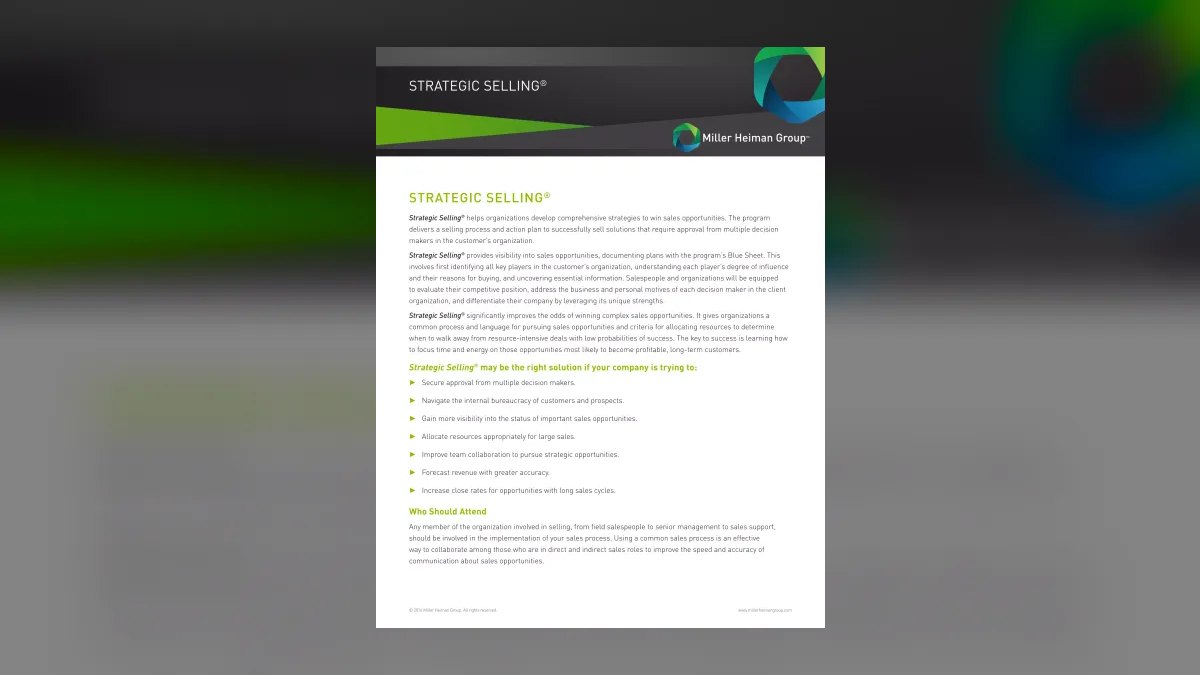
*The New Strategic Selling* by Robert B. Miller, Stephen E. Heiman, and Tad Tuleja is the classic playbook for complex B2B deals. Its core idea: map every Buying Influence — Economic, User, Technical, Coach — find each one's personal Win alongside the business Result, log gaps as Red Flags, and drive one Single Sales Objective per Blue Sheet.
The deal that looked won and died in procurement
Picture a rep three weeks from quarter close. The demo went beautifully. The VP of Operations who requested the evaluation said the words every seller wants to hear: "This is exactly what we need." The forecast entry moves to Commit at 90%. Then nothing happens for eleven days, an email goes unanswered, and the deal reappears in February as "budget reallocated."
This is the scenario the book opens against, and it is the reason the methodology exists at all. Miller and Heiman's diagnosis is unglamorous: the rep ran a good tactical call and no strategy whatsoever. A tactic is what you do inside the meeting — the discovery question, the objection handled, the pricing frame. Strategy is the thinking that happens before you ever book the meeting: who has to say yes, who can say no, what each of those people personally gets if this goes through, and what you do not yet know about any of them.
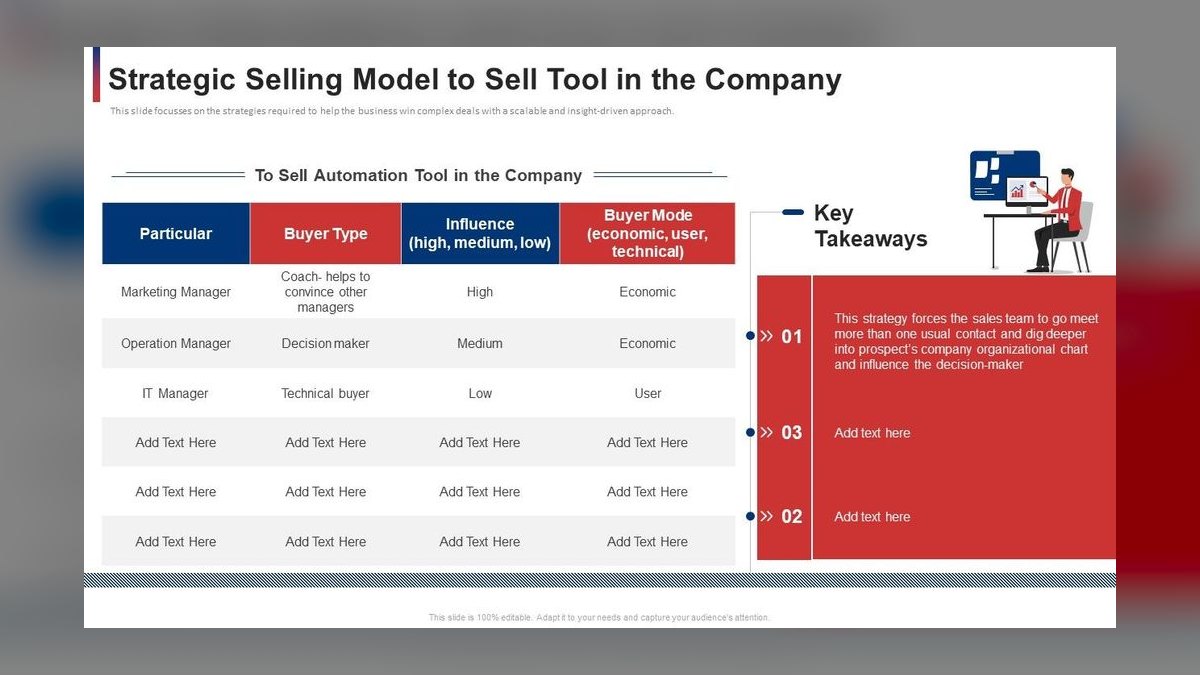
The VP of Operations, in the book's vocabulary, was almost certainly a User Buyer with strong influence and no budget authority. Nobody had spoken to whoever actually releases funds. Nobody had been through security review. Nobody knew procurement had a standing policy requiring three bids over a certain threshold. Each of those was a knowable, mappable gap, and each of them was invisible because the rep was measuring deal health by enthusiasm rather than by coverage.

The book's sharpest single line about this scenario is the asymmetry it exposes: in a complex sale, one yes does not close the deal, but one no can kill it. Enthusiasm from a single champion is not evidence of anything except that one person likes you. That asymmetry is what makes committee selling structurally different from transactional selling, and it is why a framework built in the 1980s keeps getting rediscovered every time a market shifts toward multi-stakeholder buying.
The scenario generalizes well beyond software. A commercial HVAC retrofit, an ERP migration, a managed-services contract, a hospital equipment purchase, an agency of record decision — anything where the check is large enough that the organization builds a process around it — produces the same failure mode. The rep talks to the person who is excited. The organization decides through people who were never in the room.
How the six elements actually work together
The methodology is not a list of tips. It is a loop, and the sections of the book map to the sections of the working document, the Blue Sheet, in the same order you would actually think through a deal.
You start with a Single Sales Objective. This is the discipline most teams skip and the one that makes everything downstream coherent. An SSO is one specific, measurable, time-bound outcome — not "grow the Acme account" but something closer to "secure a signed 250-seat agreement for the core platform with Acme's operations division by the end of Q3." The book is emphatic that you cannot run strategy against an account. Accounts do not make decisions; specific objectives inside accounts get decided. If you have three separate initiatives running at one customer, you have three Blue Sheets, three sets of Buying Influences, and three sets of Red Flags. Collapsing them into one "account plan" is how reps lose track of which stakeholder is blocking which thing.

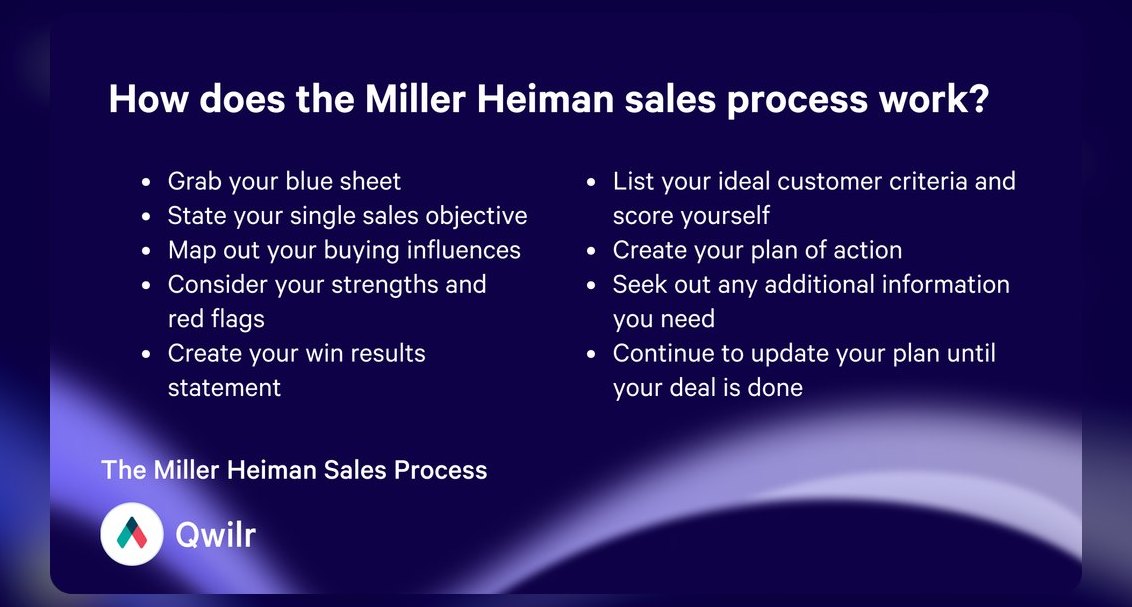
From the SSO you derive the Buying Influences — the four roles that must be covered for that specific objective. Then you assess each one's Response Mode, the psychological state that determines whether they are sellable right now. Then you articulate Win-Results for each: what the company gets and what the person gets. Every gap you find in that process becomes a Red Flag, and every Red Flag gets paired with a Strength you already hold. Those pairings generate the Action Plan. Zoom out one level and the same logic applies to your whole book of business through the Ideal Customer Profile and the Sales Funnel.
The four roles deserve precision, because most teams garble them. Economic Buyer: the single person who can release the funds and say final yes. There is exactly one per SSO, even when a committee formally signs — somebody owns the money. User Buyers: the people who will use or supervise use of what you sell, usually several, whose question is always some version of "does this make my job better or worse?" Technical Buyers: the gatekeepers who screen on fit against the organization's standards. This is the role teams shrink too small — it is not just IT. It is legal, procurement, security review, compliance, accessibility, data governance, and increasingly whoever signs off on AI and data-residency questions. Technical Buyers cannot say yes. They can only say no, and their no is final. Coach: the only role you develop rather than discover, defined by three tests — the person has credibility inside the customer organization, has credibility with you, and wants you to win this particular objective. Note that Coaches need not be senior. A program manager who sits in every steering meeting is often worth more than a friendly executive who sees the project once a quarter.
Roles are not people. One person can hold two roles; one role can be spread across five people. A CFO who will also use the reporting is both Economic and User. A three-person security committee is one Technical Buyer role held jointly.
Response Modes are the fastest diagnostic in the book, and the least used. Each influence sits in one of four states. Growth: they see a gap between current results and desired results and want to close it upward — their language is more, faster, scale, expand. Trouble: they see a gap and something is actively breaking — a missed number, an audit finding, a churn spike, a system going end-of-life. Trouble buyers move fastest and negotiate least. Even Keel: they perceive no gap at all; reality matches expectation. The book's guidance here is genuinely counterintuitive and worth taking seriously — do not sell to an Even Keel buyer. Selling harder produces resistance, not movement. Find a different influence, change the frame so a real gap becomes visible, or wait for conditions to change. Overconfident: they believe results are better than they actually are. Selling here requires puncturing an illusion, which usually costs you the relationship before it earns you the deal.
Run that assessment across five stakeholders and stalled deals stop being mysterious. A deal where the champion is in Trouble mode and the Economic Buyer is Even Keel is not a deal that needs better follow-up. It is a deal that needs a different route to the money.
What the numbers say about committees, coverage, and cycle math
The book predates most of the data that now supports it, so the honest framing is directional rather than precise. Buying committees have grown. Industry buying studies across the last decade consistently report average B2B buying groups in the high single digits to low double digits for enterprise purchases, up meaningfully from earlier benchmarks — and the growth is concentrated in exactly the Technical Buyer bucket the book warned about: security, privacy, procurement, and now AI governance functions that did not exist as separate reviewers ten years ago.
Some ranges worth holding, with the caveat that they vary enormously by segment and you should measure your own:
Deal size threshold. The methodology earns its overhead somewhere around the point where a purchase triggers formal process at the customer. In practice that is often the five-figure range and up, and it becomes close to mandatory once a deal requires legal redlines, a security questionnaire, or a budget line that did not previously exist. Below that threshold — self-serve, single-owner, corporate-card purchases — the full Blue Sheet is genuinely overkill, though the habit of asking "who else has to be okay with this?" costs nothing.
Coverage ratio. Count named, contacted Buying Influences divided by identified Buying Influences. This is the single most useful number a manager can pull from Blue Sheets across a team. A deal at 40% coverage in the final third of its cycle is not a Commit deal regardless of what the champion says. Many teams find that late-stage slippage correlates far more tightly with coverage than with any activity metric.
Blank-cell count. In the Win-Result matrix, count cells you cannot fill from something a person actually told you — inference does not count. Each blank is a Red Flag. A late-stage deal should be approaching zero. Deals that die as "no decision" tend to have blanks concentrated in the Win column: the business case was fine, but nobody stood to gain anything personally from the change, so nobody spent political capital pushing it.
Time allocation. The book's chapter on time, territory, and money argues that time is the only truly non-renewable resource in selling, and that reps should allocate it by the strategic value of a deal's funnel position rather than by whoever is making the most noise. The practical rule: your Best Few deals get calendar time first, and the loudest existing customer does not automatically outrank a quiet deal that is one meeting from a signature. Modern forecasting and revenue-intelligence tooling essentially automates this ranking, but the underlying judgment is the same one the book asked reps to make on paper.
Funnel stages. Only three: Above the Funnel (suspects, unqualified), In the Funnel (qualified, has an SSO and identified influences), and Best Few (actively closing, high coverage, clear path). The simplicity is deliberate. Miller and Heiman argue that granular CRM stage models invite reps to lie — a fourteen-stage pipeline produces fourteen opportunities to place a deal one stage further along than it belongs. Three coarse buckets tied to hard entry criteria resist that.
Cycle asymmetry. The typical pattern in committee deals is that the technical and user evaluation moves quickly and the last mile — legal, security, procurement, signature routing — consumes a disproportionate share of elapsed time. Reps who map Technical Buyers early and start those reviews in parallel rather than sequentially routinely compress total cycle time substantially, without changing anything about how they sell. That is a pure strategy win with zero tactical improvement.
Where it fits, what it costs, and what else you could run

No methodology is free. The Blue Sheet has real overhead, and being honest about the trade-offs is more useful than evangelism.
The cost side. Filling out a Blue Sheet properly for a large deal takes meaningful time, and updating it every time the deal moves takes more. Reps resist it, and their resistance is not irrational — historically the document got filled in retroactively before a deal review, to look organized, which converts a strategy tool into a compliance chore that produces no value at all. Any team adopting this needs to decide whether the sheet is a planning artifact used before calls or a reporting artifact filled in after them. Only the first version works.
Where it genuinely does not apply. Transactional sales with one decision-maker. Self-serve and product-led motions where usage precedes any conversation and the "committee" forms only at the point of consolidating spend. Very high-velocity SMB where the entire cycle is shorter than the time it would take to map five influences. The book was written before product-led growth existed and it shows — there is no bottoms-up chapter, and the assumption throughout is that a seller initiates and orchestrates the entire process.
What has aged. The role-play dialogue reads as period piece: pre-internet, pre-LinkedIn, pre-async-everything. Some competitive positioning language assumes a single-product world rather than platform vendors selling overlapping suites. The funnel mechanics are coarse next to modern qualification frameworks. And the book's implicit model of information asymmetry — the seller knows things the buyer cannot easily find out — has been inverted by a decade of public review sites, community forums, and buyers who arrive at first contact having already read your documentation.

What has aged extremely well. The Buying Influence taxonomy, the Win versus Result distinction, the treatment of missing information as an actionable Red Flag rather than an acceptable unknown, and the SSO discipline. These have gotten more relevant, not less, because committee size and internal review burden have both increased.
The alternatives, honestly compared. MEDDIC and its extended variants are qualification frameworks — they tell you whether a deal is real and worth your time, with explicit slots for metrics, economic buyer, decision criteria, decision process, pain, and champion. They overlap with this book on stakeholders but go deeper on process and criteria. Challenger-style approaches are about the content and posture of the conversation — teaching the buyer something, tailoring to the individual, taking control of the discussion. SPIN and consultative-questioning frameworks govern discovery mechanics. Value-messaging frameworks govern narrative consistency.
The important point is that these are not substitutes for each other. They operate at different layers. Stakeholder orchestration, deal qualification, conversation content, and discovery technique are four separate problems, and a mature enterprise team typically runs one framework per layer rather than picking a single winner. The failure mode is adopting three overlapping methodologies at the same layer and forcing reps to maintain three documents that say the same thing in different vocabularies.
Adjacent uses worth knowing. The same mapping works outside net-new sales. Renewal and expansion motions benefit enormously, because the Buying Influence set changes between the original purchase and the renewal — the executive sponsor who bought it has often moved on, and the person now holding the budget has no memory of why the decision was made. Customer success teams that run a lightweight influence map at renewal minus 180 days catch sponsor churn before it becomes a surprise non-renewal. Partner and channel motions have a doubled version of the problem: you have influences at the partner and influences at the end customer, and the Coach test applies at both. Internal initiatives work too — an operations leader trying to fund a systems migration is running exactly this play against their own executive team.
The pitfalls that quietly break this in practice
Treating the Coach as "a friend." The three-part test is credibility inside the org, credibility with you, and wanting you to win this specific objective. A friendly contact who nobody internally listens to fails test one. A senior sponsor who likes your category but is neutral between you and a competitor fails test three. Both get logged as Coaches by optimistic reps, and both produce false confidence. When a deal dies unexpectedly, retrospectively checking the Coach against all three tests explains it more often than not.
Confusing the Economic Buyer with the highest title. The person with the biggest title is often a rubber stamp; the person who actually controls whether the money moves may be two levels down and running the budget. Conversely, reps sometimes assume their departmental champion holds the money when the actual release requires a committee they have never met. The reliable test is not seniority — it is asking directly what happens to this specific expenditure between agreement and signature, and listening for names.
Filling the Win column with inference. A Result is what the organization gets — reduced cycle time, lower cost per transaction, fewer compliance exceptions. A Win is what the individual gets — visible credit, a promotion path, a workload that stops eating weekends, a risk that stops keeping them up at night. Wins cannot be deduced from a job title. They come from people telling you, usually indirectly and usually after enough trust to say something slightly self-interested out loud. A Win column filled from imagination is worse than a blank one, because a blank one is a Red Flag that triggers action and a fabricated one triggers nothing.
Addressing Red Flags in isolation. The book's countermove is called Leverage from Strength for a reason. For every Red Flag, you locate an existing Strength — a Coach who can make an introduction, a Win already secured with an influence who carries weight, a reference customer in the same vertical, a pilot result nobody can argue with — and you use it to neutralize the flag. Attacking a Red Flag with no Strength behind it usually means cold-emailing a stranger in the org chart, which is exactly the move that gets a champion annoyed at you for going around them. The test for every Action Plan item is simple: does this capitalize on a Strength, eliminate a Red Flag, or both? If neither, it is busywork and it comes off the plan.

Letting the map go stale. Four conditions demand an immediate Red Flag with no exceptions: missing information about any influence, any influence you have not personally contacted, any new influence appearing, and any reorganization at the customer. That last one is the killer. A reorg does not just add a name — it resets Response Modes across the board, because everyone's definition of a gap between current and desired results just changed. A Blue Sheet built before a reorg and not revisited after it is actively misleading, and it will read as confident right up until the deal disappears.
Running one Blue Sheet for a whole account. Three initiatives, three SSOs, three sheets. Merging them produces a document where a stakeholder is simultaneously supportive and blocking, which means the sheet has stopped describing reality.
Using it as a deal-review theater prop. The tell is that the document is created the night before a pipeline review and never opened again. The fix is structural rather than motivational: review the sheet before calls, not before forecast meetings, and have managers ask coverage and blank-cell questions rather than asking reps to walk through the whole document. Modern tooling helps here — conversation-intelligence products can pre-populate names and roles heard on calls, which removes the transcription drudgery and leaves the rep doing the part that requires judgment. But no tool infers a personal Win. That still requires a human being asking a person what they actually want.
Related questions
Who is the Economic Buyer if a committee signs off?
One person still owns the release of funds, even when a committee formally approves. Find them by asking what happens to this specific expenditure between verbal agreement and signature, and listening for names rather than titles. Committees ratify; individuals release.
What is the difference between a Win and a Result?

A Result is organizational and measurable — lower cost per ticket, shorter close cycle, fewer audit findings. A Win is personal — credit, promotion, reduced risk, reclaimed weekends. Both must exist for every Buying Influence, or the deal has no one willing to spend political capital on it.
Should I use this or MEDDIC?
Both, at different layers. This book governs stakeholder orchestration — who matters, what they each get, what you do not know. MEDDIC-family frameworks govern qualification — whether the deal is real, funded, and worth your quarter. They overlap on the economic buyer and complement everywhere else.
Is the Blue Sheet worth it for smaller deals?
Below the threshold where a purchase triggers formal internal process, the full sheet is overhead. Keep the two cheapest habits: name every person who has to be okay with this, and ask each one what they personally get. That covers most of the value at almost no cost.
What do I do with an Even Keel stakeholder?
Do not sell harder. An Even Keel buyer perceives no gap between current and desired results, so persuasion reads as pressure. Either surface a gap they genuinely had not seen using data from their own environment, route around them to another influence, or wait for conditions to change.
FAQ
What is the Blue Sheet?
The Blue Sheet is the one-page working document that makes the methodology operational. It holds the Single Sales Objective, every Buying Influence by name with their role, degree of influence and Response Mode, the Win and Result for each, your Red Flags and Strengths, competitive position, and an Action Plan with owners and dates. Its value is that it converts a vague feeling that a deal is going well into a structured claim that can be checked and found wrong. The name is simply a color — it was printed on blue paper.
How many Buying Influences should I expect in a typical enterprise deal?

Four roles, but frequently more people than roles. Enterprise purchases commonly involve high single digits to low double digits of individuals once you count everyone who reviews, approves, or can block — and the growth over the last decade has been concentrated in the Technical Buyer category, where security, privacy, procurement, accessibility, and data-governance reviewers each hold an independent veto. Count roles for structure and people for coverage.
Can one person hold more than one Buying Influence role?
Yes, routinely. A finance director who controls the budget and will personally live in the reporting is both Economic and User. A CTO at a small company may be Economic, Technical, and Coach simultaneously. The reverse also happens — a single Technical Buyer role held jointly by a security committee. What matters is that every role is covered, not that every role has exactly one name against it.
Does this methodology still apply to modern SaaS?
For anything with a committee, yes — arguably more than when it was written, since committee size and internal review burden have both grown. It applies poorly to self-serve and product-led motions where usage precedes any seller conversation, though even there the framework becomes relevant at the moment individual team subscriptions get consolidated into a company-wide contract and a real approval process appears.
What is the most common mistake teams make adopting it?
Filling in the Blue Sheet after the fact, as evidence of diligence rather than as a plan. The document only produces value if it is opened before a call and used to decide what that call is for. The second most common mistake is treating role assignments as permanent — influences shift as deals progress, people change jobs, and a reorg invalidates the entire map at once.
How does this relate to the authors' other work?
Miller, Heiman, and Tuleja also wrote a companion volume covering the individual sales call — the conversation-level counterpart to this book's deal-level strategy. The two are designed to interlock: this one tells you who to see and what each of them needs, the companion tells you how to run the meeting once you are in the room. Reading only one leaves an obvious gap.
Sources
- The New Strategic Selling — Kogan Page publisher page
- Goodreads — The New Strategic Selling
- Korn Ferry — Miller Heiman sales methodology and training
- Close.com — Miller Heiman sales process for enterprise sales
- Gartner — B2B buying journey research
- Harvard Business Review — The End of Solution Sales
- Inflexion-Point — Spotlight on Strategic Selling
- Britannica Money — sales and marketing management overview
Related on PULSE
- Strategic Selling — Cliff Notes Summary
- The New Conceptual Selling by Miller, Heiman & Tuleja — Cliff Notes Summary
- The New Strategic Selling by Miller & Heiman — Cliff Notes Summary & Key Takeaways
- New Sales. Simplified. by Mike Weinberg — Cliff Notes Summary for AEs
- Influence (New and Expanded) by Robert Cialdini — Cliff Notes Summary
This page will be disappearing soon. Save it to your device for $1 — or read it free while it is here.
@Kory-White- · if Venmo asks, the last 4 of my number are 2012
This page is gone.
This one is off the shelf now. $1 keeps it on your phone for good — the whole page, pictures and diagrams included.
 pulse-recentWhat are the concrete steps in Sandler Rule #7 for handling a prospect's budget objection in 2027?
 pulse-recentWhat is the step-by-step process for Strategic Selling by Miller Heiman in 2027?
 pulse-recentSnap Selling by Jill Konrath — Top 10 Key Takeaways for Sales Leaders in 2027
 pulse-recentWhat are the concrete steps to implement the Sandler Rules for Sales Leaders by David Mattson in 2027?
 pulse-recentHyper Sales Growth by Jack Daly — Top 10 Key Takeaways for Sales Leaders in 2027
 pulse-recentTraction by Gabriel Weinberg and Justin Mares — Top 10 Key Takeaways for Sales Leaders in 2027
 pulse-recentThe Sandler Rules by David Sandler — Top 10 Key Takeaways for Sales Leaders in 2027
 pulse-recentStrategic Selling by Robert Miller and Stephen Heiman — Top 10 Key Takeaways for Sales Leaders in 2027
 pulse-recentCoaching Salespeople into Sales Champions by Keith Rosen — Top 10 Key Takeaways for Sales Leaders in 2027
 pulse-recentThe Transparency Sale by Todd Caponi — Top 10 Key Takeaways for Sales Leaders in 2027