


How to Get a Meeting with Anyone — Cliff Notes Summary
Quality
Certified
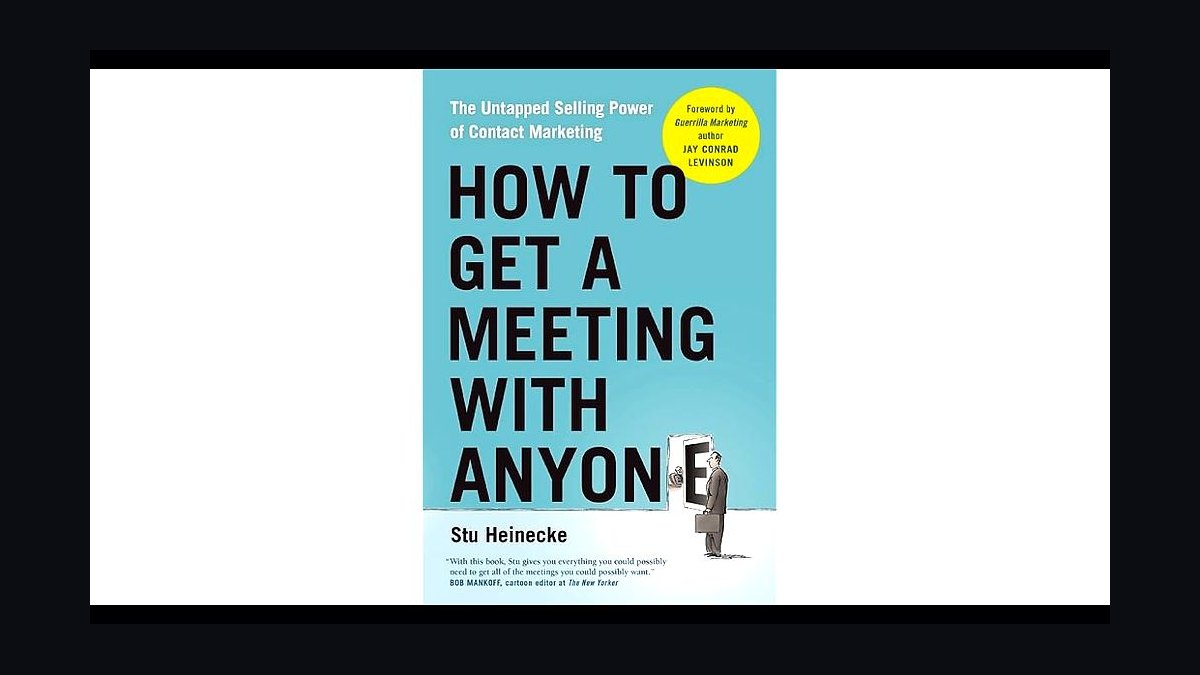
Stu Heinecke's *How to Get a Meeting with Anyone* argues that unreachable executives become reachable when you shrink your list and inflate your spend per name. Instead of blasting thousands, you run "Contact Campaigns" — hyper-personalized, often physical outreach to 10–100 named targets, budgeting $50–$500 each, chasing response rates volume can never buy.
The seller who has eight names and no way in
Picture a fractional CRO carrying a territory of eleven named accounts. Not eleven thousand — eleven. Each one, if closed, is worth roughly $1.4M in lifetime contract value. She has already done the obvious things: a six-touch Outreach sequence, a LinkedIn connection request with a note, two cold calls that died at reception. Three months in, she has zero meetings and a pipeline coverage number her board is starting to ask about.
This is the exact person Heinecke wrote the book for. Her problem is not that her messaging is weak; it is that her *channel economics* are inverted. She is using tools designed to reach 5,000 people cheaply to reach eleven people who are individually worth six figures apiece. Every dollar of efficiency she gains is a dollar of distinctiveness she loses. The 43-second voicemail she leaves is indistinguishable from the eleven other 43-second voicemails that VP got that week, and the AI-drafted email she sends is, structurally, the same email every other vendor sends.
Heinecke's origin story reframes the whole problem. Early in his career as a *Wall Street Journal* cartoonist, he sent personalized cartoon-letters to 24 VPs of Circulation at Manhattan magazine publishers — a campaign that cost him somewhere around $100 total. He reports a 100% response rate and millions in resulting business. The number that matters there is not 100%. It is 24. A list small enough that a human being could genuinely think about each name, one at a time, and produce something that could only have been made for that one person.
The frame the book installs is this: your outreach is not competing against other outreach for *quality*. It is competing for *attention against a filter*. Executive attention is rationed by gatekeepers — human assistants, spam classifiers, LinkedIn's connection throttles, and now AI summarizers that compress your carefully written paragraph into a bullet the exec skims in 0.4 seconds. Anything that survives that filter has to be structurally un-summarizable. A box on a desk is un-summarizable. A framed cartoon with the recipient's name in the punchline is un-summarizable. A well-written email is not.

The adjacent lesson, and the one most readers miss, is that this is not exclusively a sales technique. Recruiters chasing a single passive candidate, founders chasing one specific angel, journalists chasing a source who ignores press requests, and partnership leads chasing a single integration deal are running the identical math — high value per contact, tiny list, hostile filter. The Contact Campaign is a general-purpose tool for any situation where one yes is worth more than a hundred maybes.
How a Contact Campaign actually works, step by step
The mechanism has more structure than the "send weird stuff in the mail" caricature suggests. Heinecke's method runs in a defined sequence, and skipping steps is where most attempts fail.
Step one: name the list, and keep it small. Ten to one hundred targets, and Heinecke pushes hard toward the low end for a first campaign. The constraint is not budget — it is research capacity. If you cannot spend two to four hours per target building a profile, your list is too long. Cut it.
Step two: compute the per-target budget from value, not from a marketing line item. Take the account's realistic lifetime value, multiply by your first-meeting-to-close rate, and you have the value of a single meeting. If a logo is worth $2M and you close one in ten first meetings, a meeting is worth $200,000. Against that number, a $300 hand-delivered package is a rounding error — roughly 0.15% of the prize.

Step three: build the deep profile. Career arc, recent press, the last three things they posted publicly, board seats, alma mater, publicly stated hobbies, charitable causes they've named themselves, and — critically — the executive assistant's name and how long they've held the seat. Modern research stack: LinkedIn Sales Navigator for the org chart and tenure, Crunchbase for funding history, ZoomInfo or Apollo for contact data, Owler or Google Alerts for news triggers, and the company's own earnings call transcripts if public.
Step four: map allies. Heinecke wants three to five people in the target's circle of influence identified before anything ships — a board member, a former boss, an existing vendor, an executive coach, the EA. The ally does not need to endorse you. They only need to *not deflect* when the target asks "have you heard of these people?" Neutral recognition beats cold introduction.
Step five: choose a category and build the artifact. This is where the twenty categories come in, covered below.
Step six: run the cadence. The package is the knock; the cadence is what opens the door. Heinecke's rhythm runs roughly: Day 1, confirm delivery via tracking. Day 2, call the EA — not to pitch, to confirm it arrived and ask when the exec typically reviews mail. Day 3, email the target referencing the physical object by name. Day 5, LinkedIn voice note. Day 8, escalate to a mapped ally. The object gives you a legitimate, non-annoying reason to make five touches instead of one.
The categories themselves span cheap-and-digital to theatrical-and-physical. The recurring ones: personalized cartoons with the prospect named in the punchline; dimensional mail (a single shoe with "now that I have my foot in the door," a falconry glove for a target who publicly falcons, a remote-control car with the note taped to the windshield); single-prospect print ads; PR-as-outreach, where you get quoted alongside the target in a trade publication and then send them the article; giving a book you actually wrote about their problem; trigger-tied LinkedIn video and voice campaigns; and cause-based gifts donated in the target's name to a charity they've publicly supported.

Underneath all twenty sits one non-negotiable rule: the artifact must be useless to anyone but the named target. A cartoon with their name in the punchline cannot be re-gifted. A falconry glove only works because someone did the research. The moment a package could plausibly have been sent to fifty people, it becomes a swag item, and swag items go in the drawer.
The trigger-event overlay is what separates a good campaign from an un-ignorable one. Heinecke has readers maintain a rolling calendar of funding rounds, executive hires, earnings dates, acquisitions, and leadership departures across the target list. A cold cartoon is charming. A cartoon referencing yesterday's Series C announcement is a conversation the exec wants to have.
The numbers: what to spend, what to expect, where the math breaks
Heinecke documents response rates in the 60% to 100% range for well-constructed campaigns, and he is careful to bound the claim: those numbers describe fully-researched, fully-personalized, hand-delivered campaigns aimed at lists of ten to fifty. They are not what happens when you mail 400 branded water bottles.
Set that against the baseline everyone actually lives in. Cold email reply rates in competitive B2B categories generally sit in the low single digits — often under 1% for genuinely cold, unsegmented sends. Cold call connect rates hover in the low single digits per dial. A 60% response rate is not a 2x improvement over that; it is an order-of-magnitude shift, and it is bought entirely with research hours and per-unit spend.

Per-target spend. The practical band is $50 to $500. Under $50 you are usually in digital-plus-handwritten-note territory, which still works but has thinner cut-through. The $200–$500 band buys a custom illustration, framing, and expedited shipping. Above $500 you are into stunt territory, and the returns get erratic fast.
Custom cartoon production. Commissioning a genuine cartoonist — through the National Cartoonists Society, CartoonStock, or a direct hire — historically lands in the $200 to $1,500 range depending on the artist's profile and turnaround. Framing and shipping add meaningfully on top. AI illustration tools have collapsed the cost floor, but Heinecke's updated edition warns that AI-generated cartoons read as generic, and that buyers can tell. The whole value of the artifact is the signal "a human spent time on me specifically" — an artifact that undermines that signal is worse than no artifact.
The time cost, which is the real cost. Two to four hours of research per target. On a 25-target campaign that is 50–100 hours of work — one to two-and-a-half full weeks of a senior seller's time before a single package ships. Most failed attempts fail here, not at the creative step: someone budgets the dollars and not the hours, does twenty minutes of LinkedIn skimming per name, and produces packages that are expensive *and* generic — the worst quadrant.
Where the math breaks. The method requires a meeting to be worth roughly $100K+ in pipeline. Below that, the arithmetic inverts. A $300 package against a $12,000 ACV and a 15% close rate produces $1,800 in expected value per meeting — you cannot spend 17% of expected value on a door-knock. For SMB and mid-market motions with sub-$25K deals, the correct answer remains volume with tight segmentation, not Contact Campaigns.
Campaign duration. Four to eight weeks per wave, with three to five touches per target. If a target has not responded after roughly six weeks of a properly executed cadence, retire them from this wave rather than escalating — and re-approach on the next genuine trigger event rather than on a calendar reminder.

A note on cited benchmarks. Treat externally quoted lift figures for dimensional mail as directional. Vendors who sell dimensional mail publish the flattering numbers; the underlying variable is almost never "physical vs. digital" in isolation, but list size and research depth, which correlate with the channel choice. The honest claim is narrower and more useful: personalization depth drives response, and physical formats are simply the easiest place to *demonstrate* depth.
What you give up, and when to use something else
Every strength here has a matching cost, and the book is more candid about this than its reputation suggests.
You give up scale, permanently. A Contact Campaign cannot be scaled without becoming something else. The instant you templatize the artifact to hit 300 targets, you have built a swag program. There is no growth path from 25 targets to 2,500 that preserves the mechanism. This is a feature — the constraint is the moat — but it means Contact Campaigns can never be your only motion. They sit on top of a demand engine; they do not replace one.
You give up attribution cleanliness. Marketing ops will ask for cost-per-meeting and a channel dashboard. With a 25-target campaign, your sample is far too small for statistical confidence, and the response is entangled with the trigger event, the ally, and the follow-up calls. You will be defending a program on qualitative evidence and a handful of logos. Decide in advance who the internal sponsor is.
You give up deniability. A weird package is a bet with your name on it. It occasionally lands wrong — a joke that misreads the culture, a gift that trips a procurement policy, a stunt that reads as invasive. Enterprise buyers in regulated sectors (public companies near earnings, government, healthcare, financial services) frequently have gift-value limits, sometimes as low as $25 or a flat no-gifts policy. Sending a $400 framed piece into that environment can create a compliance problem for the recipient — the fastest possible way to lose a deal you never started.

The alternatives, and when each beats a Contact Campaign:
Referral beats everything. If a genuine warm path exists, use it. A Contact Campaign is what you run when the warm path does not exist or has gone cold — and it is often the best way to *manufacture* a warm path for next quarter.
Programmatic ABM beats it in the 100–1,000 account band. Intent data, account-matched advertising, and 1-to-few content still allow meaningful personalization at a scale where 1-to-1 research is impossible. Many teams run both: programmatic for the broad tier, Contact Campaigns for the top ten or twenty.
PR-as-outreach is the compliance-safe substitute. Getting quoted alongside the target in a trade publication, or writing something genuinely useful about their specific problem, delivers the same "this person did work about me" signal without any object changing hands. It is slower and less certain, but it clears procurement policies that a gift never will. This is the strategy of choice for regulated buyers.
Authored content and speaking are the compounding version. Heinecke's own path — becoming known for a thing, then having targets recognize the name — is slower than any campaign but reduces the cost of every future campaign. Adjacent industries have figured this out independently: this is exactly why boutique consultancies write books that never sell well and still pay for themselves.
Where these campaigns fail, and how to avoid it

The failure modes are consistent enough to list.
Generic dressed as personal. The single most common failure. A branded box with a printed card that says "Hi [First Name], I noticed you're in [Industry]" is worse than a plain email, because it announces that money was spent without care. The test: could this exact package have gone to anyone else on your list? If yes, do not send it. Rebuild it around something only that person's profile could have produced.
No cadence behind the object. Reps ship the package, feel accomplished, and then wait. Roughly half the value sits in the follow-up, because the object's real function is to give you a legitimate reason to call. Without Day 2 through Day 8, you have bought an expensive coaster.
Treating the EA as an obstacle. Heinecke devotes real space to rebranding executive assistants as the most underrated allies in enterprise sales, and this is the most immediately actionable idea in the book. The EA is not a wall in front of the decision-maker — the EA *is* a decision-maker, with genuine authority over the calendar and often real influence on vendor perception. Call them by name, tell them exactly what you sent and why, ask what format the exec prefers, and ask when is genuinely a bad week. Reps who do this get scheduled; reps who try to route around them get filtered permanently.
Wrong list. Aiming a Contact Campaign at people who are not actually in the buying seat wastes the entire budget. Do the org research first: who owns the problem, who owns the budget, who has veto. A perfect campaign to a director who cannot sign is a perfect waste.
The vague ask. After all that work, the letter says "would love to connect sometime." Heinecke's letter template runs three sentences: why I am contacting *you specifically*, the one outcome I can produce for your business, and the ask with a concrete time window — twenty minutes Tuesday at 3pm Eastern, not "a quick chat." A specific ask is a decision the brain can make immediately. A vague ask is homework.

Ignoring compliance and taste. Check gift policies before shipping, especially into public companies, government, healthcare, and financial services. Avoid anything that references family details, health, or anything obtained in a way the recipient would find unsettling. The line the book implies and every practitioner should hold explicitly: use only what the target has chosen to make public. Research that feels like surveillance destroys trust instantly and permanently.
Over-indexing on the cartoon. Heinecke is a cartoonist, so cartoons dominate the examples. They are one category of twenty. If you cannot draw and cannot commission well, the underlying principle — an artifact that could only exist for this one person — survives fine in a hand-annotated copy of a relevant book, a custom teardown of their public pricing page, or a short video shot on their own product.
Stunt inflation. The full-page newspaper ad aimed at one prospect was always the extreme end of the catalog, and at $50K+ it is difficult to justify against a targeted campaign reaching the same buyer for a fraction. Drone-delivery stunts carry regulatory and operational risk that rarely pencils. Budget discipline is part of the strategy, not a compromise of it.
Not scoring. Track response rate per target and per category. Twenty-five targets is a small sample, but patterns emerge across waves — one category will consistently outperform for your specific buyer persona. Retire what does not land. The 2024 updated edition adds material on AI-personalization tooling, LinkedIn's algorithmic discovery, and "Pocket Campaigns," and its central admission is worth internalizing: email and LinkedIn are no longer the open channels they were in 2016, which pushes the weight of the method further toward physical mail and earned-media approaches.
Related questions
Does this work for job seekers, not just sellers?
Yes, and arguably better. A job seeker has a list of one to five target companies and a hiring manager worth an entire career move. Same math, smaller budget. A tailored teardown of the company's actual problem, sent directly to the hiring manager, routinely outperforms a portal application.
Is a $300 package legal to send to an enterprise buyer?

Often, but check first. Public companies, government agencies, healthcare, and financial services frequently cap gift value — sometimes at $25 — or prohibit gifts outright. Sending over the limit creates a disclosure problem for the recipient. When in doubt, send information rather than objects.
How does this differ from ABM?
Scale and unit of work. ABM operates at 100–1,000 accounts with 1-to-few content and account-matched advertising. Contact Campaigns operate at 10–100 *named individuals* with artifacts built for one person. Most mature teams run programmatic ABM broadly and Contact Campaigns on the top tier.
Should I use AI to generate the personalization?
Use AI for research synthesis and drafting speed; do not let it produce the artifact. The entire signal is "a human spent hours on me." AI-generated cartoons and obviously AI-written notes destroy that signal, and buyers have gotten fast at detecting both.
FAQ
Is this book only for salespeople?
No. The Contact Campaign method works for anyone who needs a meeting with a hard-to-reach person — founders raising capital, recruiters chasing one passive candidate, journalists working a source, partnership leads, and job seekers. The requirement is not a sales title; it is that one meeting carries outsized value and the normal channels are saturated.
How much should I spend per target?

Between $50 and $500, scaled to expected value rather than to a fixed marketing budget. A rough anchor: roughly 0.1% of the account's lifetime value. For a seven-figure logo, $200–$500 is defensible. If the arithmetic pushes you under $50, you are probably in the wrong motion and should be sequencing at volume instead.
Do I have to send physical mail?
No, but physical formats are the easiest way to demonstrate effort, which is the actual mechanism. Digital-only campaigns work when they are equally researched — a trigger-tied video referencing something only a careful reader would know, or a written teardown of the target's own public materials. The requirement is demonstrated effort, not postage.
How many targets should be on my list?
Ten to one hundred, and closer to ten for a first attempt. The binding constraint is research capacity at two to four hours per target: fifty targets means 100–200 hours before anything ships. Twenty to fifty is the common working range for an experienced team with dedicated research support.
What if my product is boring or technical?
Boring products are an advantage here, because your competitors' outreach is equally boring and nobody expects creativity. The artifact does not need to be funny — it needs to be undeniably specific. A precise teardown of the prospect's public pricing page, or a small physical model of the thing you fix, works fine for industrial and infrastructure sales.
How long should a campaign run before I move on?
Four to eight weeks per wave, with three to five touches. If a properly executed cadence has produced nothing after six weeks, retire that target from the wave and re-approach on the next genuine trigger event — a funding round, a new hire, an acquisition — rather than on a calendar reminder. Repeated contact without a new reason is how a memorable campaign becomes a nuisance.
Sources
- How to Get a Meeting with Anyone — BenBella Books publisher page
- How to Get a Meeting with Anyone, Updated Edition — Simon & Schuster
- Get the Meeting! (companion volume) — Simon & Schuster
- Stu Heinecke — official site and Contact Marketing overview
- How to Get a Meeting with Anyone — Goodreads reader reviews
- Getting Meetings with Unreachable People with Stu Heinecke — How to Be Awesome at Your Job podcast
- Contact Marketing — Let's Talk ABM video series, strategicabm
- National Cartoonists Society — professional cartoonist directory
- CartoonStock — licensed and commissioned cartoon marketplace
Related on PULSE
This page will be disappearing soon. Save it to your device for $1 — or read it free while it is here.
@Kory-White- · if Venmo asks, the last 4 of my number are 2012
This page is gone.
This one is off the shelf now. $1 keeps it on your phone for good — the whole page, pictures and diagrams included.
 pulse-recentGetting to Yes by Roger Fisher and William Ury — Top 10 Key Takeaways for Sales Leaders in 2027
 pulse-recentWhat is the first concrete step in The Sandler Rules by David Mattson for building a sales plan in 2027?
 pulse-recentWhat are the concrete steps in Sandler Rule #7 for handling a prospect's budget objection in 2027?
 pulse-recentWhat is the second concrete step in Strategic Selling by Miller Heiman for identifying a sales coach in 2027?
 pulse-recentBlueprints for a SaaS Sales Organization by Jacco van der Kooij — Top 10 Key Takeaways for Sales Leaders in 2027
 pulse-recentWhat is the step-by-step process for Strategic Selling by Miller Heiman in 2027?
 book-summaryMajor Account Sales Strategy by Neil Rackham: Summary, Key Lessons, and RevOps Takeaways
 pulse-recentStrategic Selling by Robert Miller and Stephen Heiman — Top 10 Key Takeaways for Sales Leaders in 2027
 pulse-recentThe Customer Success Professional’s Handbook by Ashvin Vaidyanathan — Top 10 Key Takeaways for Sales Leaders in 2027
 pulse-recentHigh-Profit Prospecting by Mark Hunter — Top 10 Key Takeaways for Sales Leaders in 2027