
How does *The Sales Acceleration Formula* define the ideal sales profile for 2027?
 Curated byKory White · Fractional CRO · Maryland
 PULSEKNOWLEDGE LIBRARY
*The Sales Acceleration Formula* does not define one ideal sales profile as a fixed job description — it defines a repeatable hiring, training, and management strategy built on data instead of instinct. Applied to 2027, the resulting profile is a coachable, curious rep who treats their own pipeline as an experiment, pairs human judgment with AI tooling, and can be measured, scored, and improved like any other system.
The outcome you should expect
When a sales organization builds hiring, training, and management around Mark Roberge's original framework, the practical outcome is a team that looks less like a collection of individual "hunters" and more like a coached, standardized unit. Roberge's central claim — proven while he scaled HubSpot from roughly zero to over $100 million in recurring revenue as its CRO — is that sales performance can be engineered the way a product or an engineering process is engineered: define the inputs, measure the outputs, and iterate. Extended to 2027, the expected outcome is a rep who is evaluated less on charisma and more on a documented ability to learn quickly, follow a structured methodology, and use data at every stage of the deal cycle.
Concretely, this shows up in three measurable shifts. First, ramp time becomes a tracked metric rather than an assumption — organizations following this playbook typically define ramp as the 60- to 120-day window in which a new rep hits 80% or more of full quota productivity, and they instrument every week of that window. Second, quota attainment becomes more evenly distributed across the team, because the hiring scorecard filters for the same four or five traits every time rather than letting attainment cluster around a handful of "naturals." Third, forecast accuracy improves, because reps are trained to report pipeline stage and probability using consistent, data-backed definitions instead of gut-feel confidence levels. The organizations that get the most out of this strategy are ones willing to hold themselves to it for a full sales cycle or two — Roberge is explicit that the formula is a compounding system, not a one-quarter fix.

The profile that emerges from this outcome is someone who is comfortable being measured. That single behavioral trait — willingness to be scored, coached, and re-scored — is what separates reps who thrive under this model from reps who plateau or leave within the first year.
What drives that outcome (mermaid)
Four interlocking mechanisms drive the outcome described above, and they map directly onto the four "formulas" that give the book its structure: a hiring formula, a training formula, a management formula, and a demand-generation formula (the book's fourth section, focused on inbound lead generation, is less relevant to the individual sales profile but still shapes what a rep is expected to sell into).

The hiring formula is the foundation. Roberge scores every candidate on a small, fixed set of attributes — coachability, curiosity, prior track record of success (in any domain, not just sales), intelligence, and enough grit to survive a long ramp — using a structured interview with a numeric rubric rather than an unstructured conversation. This matters for 2027 because it means the profile is portable: the same scorecard that filtered for adaptability in 2015 filters for AI-tool adoption today, since the underlying trait being tested (does this person change their behavior when given new information?) hasn't changed even though the tools have.
The training formula builds on top of that hire. Roberge's version of the Challenger-style method — teach the customer something new, tailor the message to their specific situation, and take control of the buying process, including the budget conversation — is taught as a documented methodology with call scripts, objection-handling libraries, and a shared playbook that the whole team edits over time, not a single onboarding deck a rep sees once.

The management formula is what keeps both of the first two formulas honest. Managers are expected to spend the bulk of one-on-one time on call coaching and pipeline review rather than status reporting, and forecasts are built bottom-up from stage-by-stage conversion data rather than top-down from a quota target.
Benchmarks and realistic ranges
Because the book's whole argument rests on measurement, it's worth being specific about the ranges that a team following this strategy typically tracks, while being clear that these are general sales-operations benchmarks rather than numbers pulled from a single named study.

On hiring, teams using a structured scorecard modeled on Roberge's four-trait rubric commonly score each candidate on a 1-to-4 scale per trait across two or three interview rounds, then set a minimum combined threshold before an offer goes out — the point isn't the exact cutoff, it's that there is a documented cutoff at all, applied the same way to every candidate. On ramp, a realistic range for a mid-complexity B2B sales role is 60 to 120 days to reach full productivity, with the first 30 days spent almost entirely on product and methodology certification before a rep is allowed to run a live discovery call unsupervised. On coaching cadence, managers following this model typically hold a weekly one-on-one of 30 to 60 minutes built around two or three recorded or shadowed calls, rather than a status-update meeting.
On the technology side, by 2027 the realistic expectation is that a rep touches three to five categories of tooling as part of a normal day: a CRM system of record, a conversation-intelligence tool that reviews call recordings for talk-to-listen ratio and objection patterns, an AI-assisted prospecting or research tool, and a forecasting or pipeline-analytics layer. The specific vendors change — the book predates most of today's AI tooling — but the category count and the expectation that a rep can operate all of them without hand-holding is a direct extension of Roberge's "technology formula" chapters, which already assumed reps would be evaluated on tool fluency, not just call skill.

On compensation, organizations extending this strategy toward 2027 tend to shift a larger share of on-target earnings into base pay relative to the aggressive commission-heavy plans common a decade ago, while tying a portion of variable pay to pipeline-quality metrics (stage progression, forecast accuracy, deal-desk hygiene) rather than closed revenue alone. None of these ranges are universal law — they vary by deal size, sales motion, and industry — but they represent the realistic band a team should expect if it is genuinely implementing the formula rather than just referencing it.
Risks, edge cases, and failure modes
The most common failure mode is applying the hiring formula without applying the management formula behind it. A team that scores candidates on coachability and curiosity but then drops them into an unmanaged, script-free environment gets none of the benefit — the scorecard filters for people who *would* improve given real coaching, but improvement never happens without the coaching loop actually running. Roberge is explicit that the four formulas reinforce each other; skipping the training and management pieces while keeping only the interview rubric produces a team that looks good on paper and underperforms in practice.

A second failure mode is over-indexing on prior, unrelated "success" as a hiring signal without controlling for what that success actually predicts. Roberge's own data was drawn from a specific context — an early-stage inbound SaaS motion at HubSpot — and applying the same weighting to a long-cycle enterprise sale or a transactional, high-volume motion without re-validating the scorecard against outcomes in that specific environment can quietly bias hiring toward the wrong traits.
A third, more 2027-specific risk is mistaking AI-tool fluency for genuine curiosity and coachability. A candidate who is fluent with an AI copilot can look highly productive in a structured interview simulation without actually possessing the underlying trait the simulation was designed to test — the tool can mask a lack of independent judgment rather than reveal an aptitude for it. Teams that lean too heavily on simulation-based interviews risk selecting for tool literacy rather than the deeper adaptability the formula was originally built to find.

A fourth failure mode is transparency without psychological safety. Roberge's "culture of data" chapter argues for openly sharing conversion rates, win rates, and performance data across the team, but that only produces peer learning if the culture treats a low number as a coaching opportunity rather than a public shaming. Organizations that adopt the data-sharing mechanic without the coaching-first management layer around it tend to see increased turnover among mid-performing reps rather than the intended collaborative lift.
Finally, there's a scale-mismatch risk: everything in the book was proven at a company moving from zero to $100 million in a specific inbound-heavy B2B SaaS category. A team applying the same rigid structure to a very early-stage startup, where a rep's job is closer to exploratory market discovery than repeatable execution, can find that too much process too early actually slows the team's ability to learn what's working.

A practical rollout plan (mermaid)
A realistic rollout sequence for a team trying to implement this strategy heading into 2027 follows the same order Roberge used at HubSpot, compressed into roughly two to three quarters rather than several years.
In the first 30 days, build and validate the hiring scorecard: pick the four or five traits that matter most for the specific sales motion, write behavioral interview questions for each, and run it against both existing top performers and existing underperformers to confirm it actually separates the two groups before using it on new candidates.

In the next 30 to 60 days, document the sales methodology as a living playbook rather than a static deck — capture the specific "teach, tailor, take control" moves that top reps already use, write them down with real call examples, and assign an owner responsible for updating the playbook monthly based on win/loss review.
In parallel, stand up the management cadence: weekly one-on-ones anchored on recorded calls, a coaching rubric that scores talk-to-listen ratio and discovery-question quality, and a bottom-up forecasting process where each rep's number is built from stage-conversion math rather than asserted from the top down.

By the second quarter, layer in the technology stack — CRM hygiene rules, a conversation-intelligence tool, and an AI research or prospecting assistant — and retrain the hiring scorecard's "intelligence" and "curiosity" questions to include a short simulation where the candidate uses one of these tools live, so the interview process itself starts screening for the 2027 version of the profile rather than the 2015 version.
Related questions
Does the book name specific AI tools reps will use in 2027?
No. The book predates today's AI sales tooling. Any mapping to specific 2027 tools is an extrapolation of its hiring and technology principles, not a claim made in the original text.
Is prior sales experience disqualifying under this framework?
No — it's simply not weighted heavily. The scorecard treats prior success in any domain as a stronger signal than years of sales tenure specifically.
Can this framework work for a small, early-stage team?
Partially. The hiring scorecard scales down easily; the full management and forecasting infrastructure generally needs a team of several reps before it pays for itself.
How is this different from the Challenger Sale methodology?
It builds on Challenger's teach-tailor-take-control model but wraps it in a measurement layer — hiring scorecards, coaching cadences, and forecasting discipline — that Challenger itself doesn't prescribe.
FAQ
**What does *The Sales Acceleration Formula* actually mean by "the ideal sales profile"?** It means a rep selected and developed through a repeatable, data-backed process rather than a fixed personality type — someone who scores well on coachability, curiosity, prior success, and intelligence, and who continues to improve under structured coaching.
Who wrote the book and what is his background? Mark Roberge wrote it after serving as HubSpot's Chief Revenue Officer, where he built the sales organization from its earliest stage through roughly $100 million in recurring revenue.
Does the strategy assume a specific sales motion, like inbound SaaS? Largely, yes. Its data and examples come from an inbound-heavy B2B SaaS environment, so applying it to long-cycle enterprise or transactional retail sales requires re-validating the scorecard and playbook against that different context.
Why does the book emphasize coachability over closing skill? Because closing skill is hard to teach quickly, while coachability predicts how fast a rep will absorb whatever training and tooling the organization puts in front of them — which matters more as tools and buyer behavior keep changing.
What is the biggest mistake teams make when adopting this framework? Implementing the hiring scorecard alone without building the coaching and management cadence behind it, which strips out the mechanism that makes the selected traits actually translate into performance.
How does compensation fit into the 2027 version of this profile? Compensation shifts toward a higher base salary with variable pay tied to pipeline-quality metrics and team outcomes, rather than commission tied solely to closed revenue.
Sources
- https://www.wiley.com/en-us/The+Sales+Acceleration+Formula-p-9781119047058
- https://hbr.org/topic/sales
- https://www.gartner.com/en/sales
- https://www.salesforce.com/resources/research-reports/
- https://www.gong.io/resources/
- https://business.linkedin.com/sales-solutions/resources
- https://www.forbes.com/sales/
Related on PULSE
- [How does *The Sales Acceleration Formula* define the perfect onboarding process for new reps in 2027?](/knowledge/bs0407)
- [How can *The Sales Acceleration Formula* help you forecast revenue more accurately for a new product launch in 2027?](/knowledge/bs0415)
- [How does *The Sales Acceleration Formula* use data to predict which new hires will succeed in 2027?](/knowledge/bs0393)
- [How does *The Sales Acceleration Formula* calculate the right compensation plan for reps in 2027?](/knowledge/bs0377)
- [How does *The Sales Acceleration Formula* solve the ramp-up problem for new hires?](/knowledge/bs0342)
@Kory-White- · if Venmo asks, the last 4 of my number are 2012
 bsWhat are the key lessons from *Never Split the Difference* for negotiating a raise in 2027?
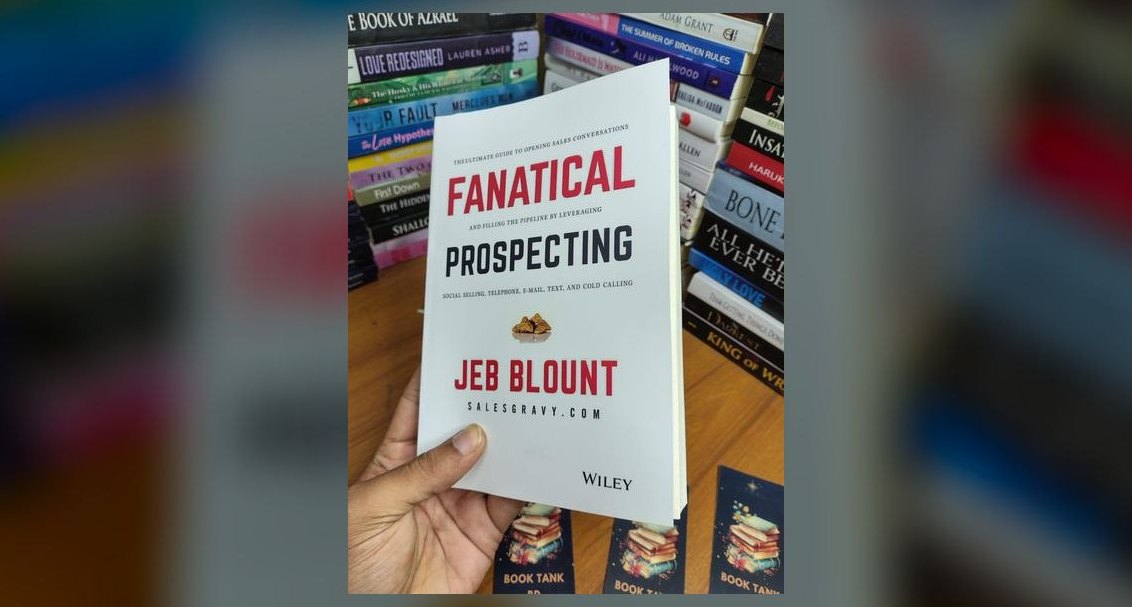 bsHow do you apply *Fanatical Prospecting* to LinkedIn outreach in 2027?
 bsHow does *Gap Selling* help you close more deals in a recession in 2027?
 bsWhat sales script does *New Sales. Simplified.* recommend for cold calls in 2027?
 bsDoes *The Psychology of Selling* still hold up for modern sales techniques in 2027?
 bsWhat’s the most actionable principle from *How to Win Friends and Influence People* for remote work in 2027?
 bsWhat’s the biggest mistake *SPIN Selling* warns against in complex B2B sales?
 bsHow does *Fanatical Prospecting* change your daily routine for outbound sales?
 bsWhat’s the most persuasive technique from *Pitch Anything* for investor pitches?
 bsWhat’s the key insight from *The Challenger Sale* for leading a sales team in 2027?