


Bargaining for Advantage by G. Richard Shell — Top 10 Key Takeaways for Sales Leaders in 2027
Quality
Certified
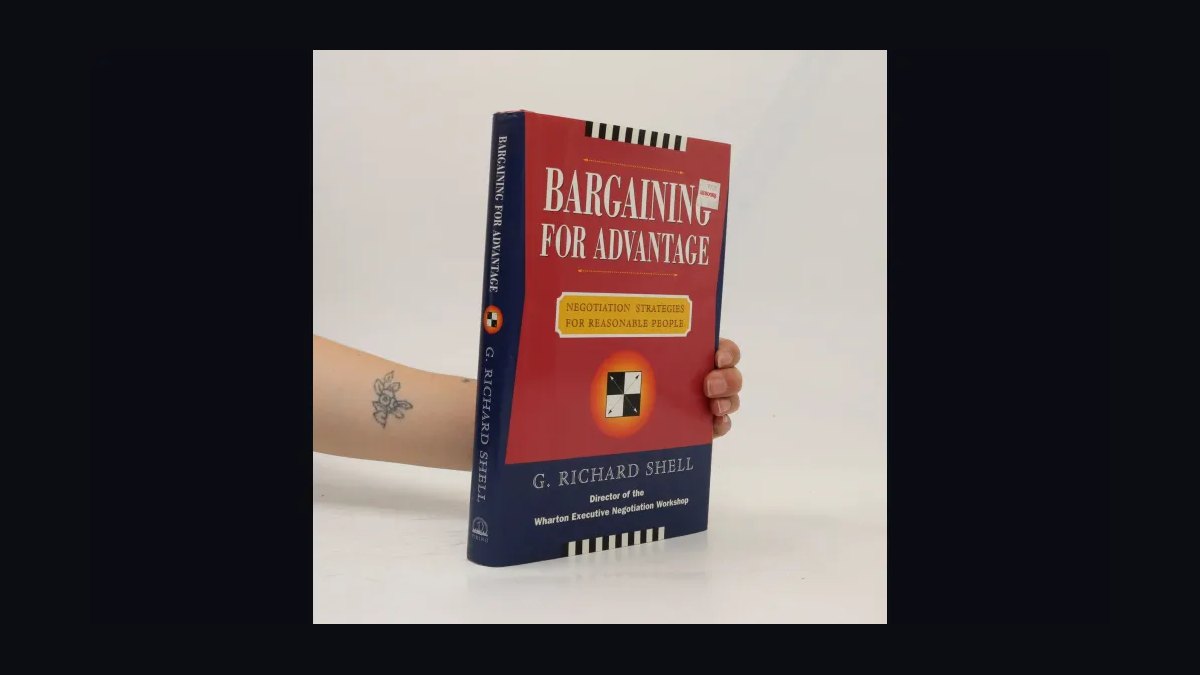
G. Richard Shell's *Bargaining for Advantage* gives sales leaders a repeatable negotiation strategy built on six foundations — style, goals, standards, relationships, the other side's interests, and leverage — plus a four-stage process for running any deal. The top takeaway for 2027 sales leaders: stop treating negotiation as a personality trait and start coaching it as a process with concrete goals, documented standards, and disciplined concession sequencing.
Two Ways to Read the Book's Advantage: Leverage-First vs. Standards-First
Shell's central contribution isn't a single trick — it's a framework built around six foundations of effective negotiation, and sales leaders who apply it tend to gravitate toward one of two dominant postures depending on their market position and deal complexity. Understanding both, and knowing when each wins, is the real strategic choice a VP of Sales makes before every quarter.
Leverage-first bargaining treats the deal as a contest of who needs the outcome more. Shell defines leverage as positive (what you can offer that the other side wants) and negative (what you can withhold or threaten to walk away from). A sales leader running leverage-first deals trains reps to diagnose the buyer's alternatives early — is there a competing vendor in the room, a hard deadline, a budget-use-it-or-lose-it clock — and to protect their own walk-away position rather than revealing it. This posture borrows from what Shell calls the "poker school" of negotiation: information is guarded, opening positions are aggressive relative to target, and concessions are earned rather than given. It performs best in commodity or multi-vendor competitive deals, renewal negotiations against a captive buyer, and any situation where the relationship has a defined end point (a one-time capital purchase, a legal settlement, a single enterprise contract with no follow-on expectation).
Standards-and-relationship-first bargaining is the posture Shell spends more of the book building toward, because he argues it produces better long-run outcomes for negotiators who will deal with the same counterpart again — which describes most B2B sales relationships, where the buyer becomes a renewal, an expansion, and a reference. This approach leans on authoritative standards (published pricing, comparable-deal benchmarks, industry norms, "fairness" anchors that make an outcome easy for both sides to defend internally) and on relationship capital built through information exchange rather than concealment. Instead of masking your walk-away point, you make your reasoning transparent and invite the buyer to do the same, using shared standards as the tiebreaker when interests conflict. This posture performs best in strategic accounts, multi-year contracts, channel partnerships, and any deal where the buyer's procurement team will benchmark this negotiation against future ones with your company.
Most experienced sales leaders don't pick one permanently — they read the deal and switch. The mistake Shell's book explicitly warns against is defaulting to a single style regardless of situation, which is exactly what his Thomas-Kilmann-based five-style assessment (competing, collaborating, compromising, accommodating, avoiding) is designed to diagnose in a rep. A rep who is naturally accommodating will underperform in leverage-first deals; a rep who is naturally competing will damage relationship-first accounts by treating every renewal like a one-shot poker hand.
How to Decide Which Approach Fits Your Sales Team

The decision tree above is a simplified version of the diagnostic Shell walks through in the book's middle chapters: before a rep opens their mouth, the sales leader should already know which of the two postures the deal calls for. In practice this means building a one-page account brief for every opportunity above a threshold deal size that answers three questions — is this buyer coming back, what does the buyer already believe is "fair" (a competitor's list price, a previous contract, an industry report), and who has more to lose if the deal doesn't close this quarter. Reps who skip this step tend to default to whichever style is their personal comfort zone, which is the exact failure mode the six-foundations framework is designed to correct.
Concrete Numbers Behind Each Approach
Shell doesn't hand readers a spreadsheet, but sales leaders translating the book into a coachable process typically operationalize it with a few concrete benchmarks:

Goal-setting discipline. Shell's research on goals versus bottom lines is one of the most cited takeaways from the book: negotiators who set specific, ambitious, written targets before a session consistently out-negotiate those who only know their walk-away number. A practical rule sales teams adopt is requiring every rep to write down three numbers before a call — the target price, the acceptable range floor, and the walk-away point — with the target set meaningfully above the floor, not just a few percentage points off it. Deals opened without a written target tend to close closer to the buyer's first anchor than deals opened with one.
Concession sequencing. A common pattern coached out of the book's process chapters is a declining-increment structure: if a rep has 12% of price flexibility to give away across a negotiation, giving it in shrinking steps (roughly a 40/30/20/10 split of the total movement across four rounds) signals the well is running dry, while giving equal-sized concessions each round signals there's plenty more to extract. Reps who give their last, largest concession first routinely get squeezed for a second and third round they didn't plan for.
Anchoring window. Opening offers that land within roughly 10-15% of the eventual settlement tend to anchor the rest of the conversation; offers far outside that band often get dismissed outright or trigger a walk-away rather than a counter, which is why Shell's standards-based approach (anchoring to a defensible external number rather than an arbitrary aggressive one) tends to hold up better across multiple rounds than a pure poker-school opening.

Timing pressure. In multi-week enterprise cycles, the bulk of real concessions on both sides — pricing, terms, scope — cluster in the final stretch of the negotiation window, often the last 10-20% of calendar time before a signature deadline. Sales leaders who know this build deliberate internal deadlines (end of quarter, end of a pilot period, a pricing-lock expiration) rather than only reacting to the buyer's deadlines, which keeps leverage more balanced heading into that final stretch.
Style distribution. When sales organizations run the five-style self-assessment across a rep team, the distribution is rarely even — most B2B sales floors skew toward "competing" and "accommodating" and are thin on "collaborating," which is the style Shell's standards-and-relationship approach depends on most. That's a coaching gap, not a hiring problem: collaborating behaviors (joint problem-framing, transparent trade language, options-generation before positions harden) are trainable even for reps whose default instinct runs elsewhere.
Rolling the Takeaways Into Your Sales Process
Shell structures negotiation as a four-stage process, and the sequencing matters as much as any individual tactic — skipping the information-exchange stage to jump straight to opening offers is the single most common mistake sales leaders see when reps who've read the book try to apply it without coaching.

Stage 1 — Preparation. Before any customer conversation, the rep documents their own bargaining style tendency, sets a written goal (not just a floor), and identifies at least one authoritative standard they can point to if the buyer pushes back on price or terms — a comparable deal, a published rate card, an industry benchmark. This is also where the leader decides, using the decision tree above, whether this account calls for a leverage-first or standards-first posture.
Stage 2 — Information exchange. Shell is explicit that the negotiators who talk least and ask the most specific questions in this phase tend to win more of the value on the table, because they learn the other side's real interests (budget cycle, internal champion's political needs, technical must-haves versus nice-to-haves) before committing to a position. Sales teams that skip this and go straight into a pitch-and-price motion are negotiating blind — they don't know which concessions are cheap to give (because the buyer doesn't actually value them) and which are expensive (because they sit on the buyer's real priority list).
Stage 3 — Opening and concessions. The rep makes an opening offer anchored to the standard identified in Stage 1, then manages concessions using the declining-increment pattern described above, always trading rather than giving — every movement on price or terms should be paired with a corresponding ask (a longer term, a case study, a faster implementation timeline, an expanded scope).
Stage 4 — Closing and commitment. Shell separates "agreement" from "commitment" deliberately: a verbal agreement that isn't locked into specific next steps, signatures, and dates tends to erode. Sales leaders who build this into their process require every closed-won deal to leave the final call with a documented commitment — not just a handshake — before it's logged as closed.

The loop back into preparation for the next deal is the piece most sales organizations skip entirely: debriefing which standard actually landed, which style the buyer displayed, and which leverage turned out to be real versus bluffed. Over a quarter, that debrief data becomes the sales leader's own internal playbook, built from real deals rather than the book's examples alone — which is the point of treating this as an ongoing strategy rather than a one-time training session.
Related questions
What is Shell's Thomas-Kilmann-based five bargaining styles model?
The book adapts the Thomas-Kilmann conflict-mode instrument into five negotiation styles — competing, collaborating, compromising, accommodating, and avoiding — and has readers self-assess which is their default so they can recognize when it's mismatched to the deal in front of them.
How is "Bargaining for Advantage" different from "Getting to Yes"?
Where the Harvard-style *Getting to Yes* leans heavily on principled, interest-based negotiation as a near-universal prescription, Shell's framework is more explicitly situational — it asks negotiators to diagnose style, standards, relationship type, and leverage before choosing an approach, rather than defaulting to one method.
What are the six foundations of effective negotiation?

Personal bargaining style, goals and expectations, authoritative standards and norms, relationships, the other party's interests, and leverage — Shell frames every negotiation as a function of how these six factors line up between the two sides.
Why does goal-setting matter more than knowing your bottom line?
A written, specific, ambitious goal anchors your own aspiration and behavior throughout the session, while a bottom line only tells you when to stop — negotiators who rely solely on the latter tend to settle closer to the other side's opening position.
FAQ
Who is G. Richard Shell and why does his negotiation strategy carry weight with sales leaders? Shell is a longtime negotiation professor whose *Bargaining for Advantage* grew out of decades of teaching MBA and executive negotiation courses; the book's frameworks (styles, foundations, process stages) are widely used in corporate sales training precisely because they were built for a classroom of practitioners repeatedly testing them against real deals.
Is this book more relevant to enterprise sales or transactional sales? Both, but differently — enterprise and strategic-account sales lean more on the standards-and-relationship posture and the four-stage process, while transactional or one-time-purchase sales get more mileage from the leverage-diagnosis chapters, since there's no future relationship to protect.
Can these Top 10 takeaways be taught to a sales team without reading the whole book?

Partially — the style self-assessment, the goals-versus-bottom-line distinction, and the four-stage process translate well into a half-day workshop, but the nuance in how Shell weighs standards and relationship type against each other is easy to oversimplify without the fuller text, so pairing a workshop with assigned reading works better than a summary alone.
What's the most common mistake sales leaders make applying this book? Treating it as a script rather than a diagnostic — reading the anchoring and leverage chapters and applying aggressive tactics uniformly, even in strategic-account relationships where the standards-and-relationship posture would preserve more long-term value.
Does the book address negotiating with procurement teams specifically? Not by name, but the standards-and-leverage framework maps directly onto procurement negotiations, where buyers are trained to use published benchmarks and competing bids as authoritative standards against the seller — recognizing that dynamic is exactly what Shell's foundation-diagnosis approach is built to counter.
How often should a sales team revisit these takeaways? Most sales leaders who adopt the framework build it into quarterly deal-review cadences rather than a one-time training, since the debrief loop (which standard worked, which style the buyer showed, which leverage was real) is where the framework actually compounds in value.
Sources
- https://www.pon.harvard.edu
- https://www.penguinrandomhouse.com
- https://www.goodreads.com/book/show/68170.Bargaining_for_Advantage
- https://www.wharton.upenn.edu
- https://hbr.org
- https://www.amazon.com/Bargaining-Advantage-Negotiation-Strategies-Reasonable/dp/0143036971
- https://www.kornferry.com
- https://sloanreview.mit.edu
Related on PULSE
- How does the Thomas-Kilmann conflict model apply to sales negotiation coaching?
- What's the difference between "Getting to Yes" and hardball negotiation tactics in enterprise sales?
- How should sales leaders build a concession-sequencing playbook for procurement negotiations?
- What negotiation training frameworks work best for strategic account managers?
- How do you diagnose buyer leverage before a renewal negotiation?
This page will be disappearing soon. Save it to your device for $1 — or read it free while it is here.
@Kory-White- · if Venmo asks, the last 4 of my number are 2012
This page is gone.
This one is off the shelf now. $1 keeps it on your phone for good — the whole page, pictures and diagrams included.
 book-summarySPIN Selling by Neil Rackham — Cliff Notes Summary
 pulse-recentSnap Selling by Jill Konrath — Top 10 Key Takeaways for Sales Leaders in 2027
 pulse-recentInsight Selling by Mike Schultz and John Doerr — Top 10 Key Takeaways for Sales Leaders in 2027
 pulse-recentGetting to Yes by Roger Fisher and William Ury — Top 10 Key Takeaways for Sales Leaders in 2027
 pulse-recentTraction by Gabriel Weinberg and Justin Mares — Top 10 Key Takeaways for Sales Leaders in 2027
 pulse-recentThe Closer’s Survival Guide by Grant Cardone — Top 10 Key Takeaways for Sales Leaders in 2027
 pulse-recentSelling Above and Below the Line by Skip Miller — Top 10 Key Takeaways for Sales Leaders in 2027
 pulse-recentSales EQ by Jeb Blount — Top 10 Key Takeaways for Sales Leaders in 2027
 pulse-recentWhat are the first three concrete steps in Sandler Rule #1 for a new sales rep in 2027?
 pulse-recentWhat is the second concrete step in Strategic Selling by Miller Heiman for identifying a sales coach in 2027?