
Modernizing the Mainframe: A COBOL-to-Cloud Migration Toolkit Using AWS DMS and Micro Focus Enterprise Server
 Curated byKory White · Fractional CRO · Maryland
 PULSEKNOWLEDGE LIBRARY
Quality
Certified
A COBOL-to-cloud migration using AWS DMS for data replication and Micro Focus Enterprise Server for application rehosting typically preserves business logic without rewriting it, cuts recurring mainframe licensing and hardware costs substantially, and shortens batch-bound reporting cycles. Expect 9–18 months for a meaningful workload, with parallel running as the main risk control.
The outcome you should expect
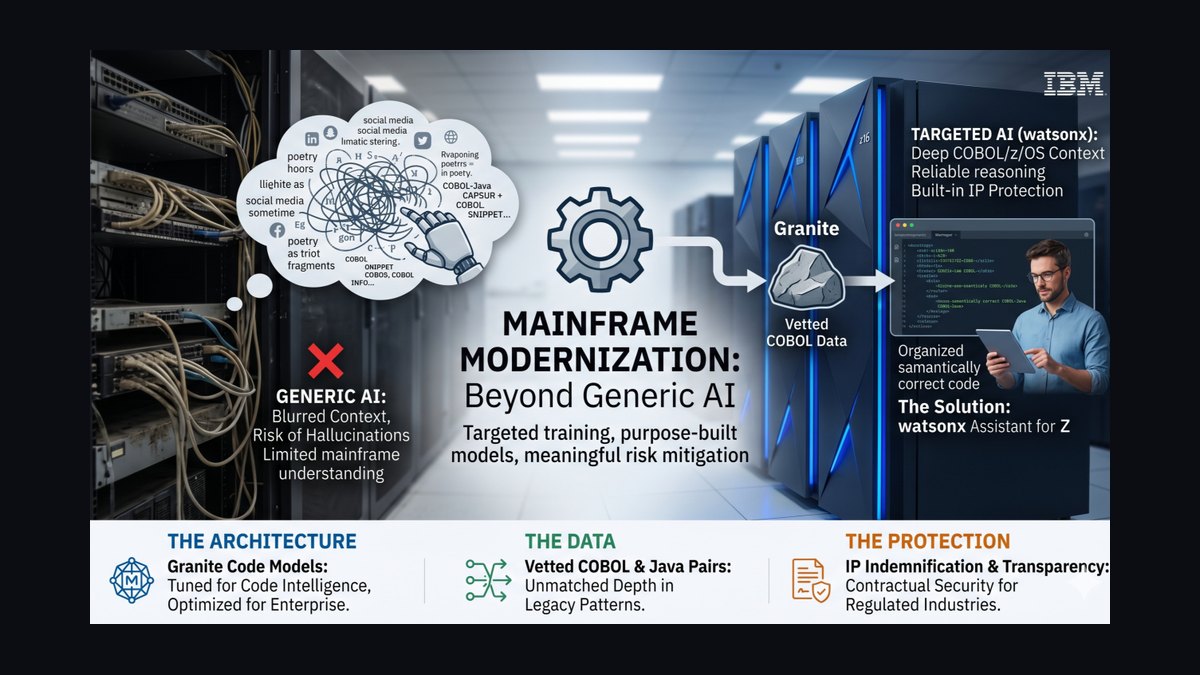
The honest outcome of a rehost-first mainframe migration is narrower than most vendor decks suggest, and that narrowness is what makes it achievable. You are not modernizing COBOL. You are moving the runtime underneath it. Micro Focus Enterprise Server (now sold under the OpenText brand following the 2023 acquisition) compiles and executes existing COBOL and PL/I source on x86 Linux or Windows, emulating the CICS, IMS, and JCL environments those programs expect. AWS DMS moves the data — from Db2 for z/OS, from VSAM files exposed through a supported source, or from an intermediate landing database — into Amazon RDS, Aurora, or another managed target. Together they let you decommission the physical mainframe while the application code stays recognizably the same to the people who maintain it.
What you should expect concretely: the same transaction screens, the same batch job names, the same COBOL copybooks, running on EC2 instances or containers that you can scale, snapshot, and version-control. What you should not expect: that the migration itself makes the application better. A 30-year-old order-entry system with 4,000 lines of nested IF statements in a single paragraph is still that system after the move. Rehosting buys you infrastructure economics and toolchain modernity; it does not buy you code quality, and teams that conflate the two end up disappointed by month nine.
The cost story is real but needs framing. Mainframe economics are dominated by MSU/MIPS-based software licensing — IBM's own middleware plus ISV products like CA/Broadcom tools, sorting utilities, and monitoring agents — which typically dwarfs the hardware lease. When you retire the LPAR, those license lines go to zero. What replaces them is EC2 or ECS compute, EBS or S3 storage, the Enterprise Server subscription, and the managed database. Public reference cases and vendor-published studies have claimed reductions in the range of 50–70% of total run cost, and AWS markets its Mainframe Modernization service around that band. Treat any specific percentage as a hypothesis to validate against your own bill, not a number you can commit to a CFO before assessment.
There is a second-order outcome that matters more to revenue operations than the infrastructure line. Once the data lands in a standard relational target with change data capture running, downstream systems can read it continuously instead of waiting for the nightly batch window to close. Order status, credit holds, contract terms, entitlement data — the things that sit in mainframe records and block quoting and billing — become queryable in near real time. That is the change that shortens quote-to-cash, not the compute swap.
Finally, expect the talent picture to improve modestly rather than transform. Your COBOL developers keep working in COBOL, but now inside Visual Studio Code or Eclipse with Micro Focus extensions, with Git for source control instead of an ISPF-based library manager, and with CI pipelines that can run a regression suite in minutes. That is a genuine productivity gain and a genuine retention argument, and it is available without asking anyone to learn Java under duress.
What drives that outcome
Four variables determine whether a mainframe migration lands near the optimistic end or the pessimistic end, and they are knowable during assessment if you actually do the assessment.
Application inventory accuracy. The single most common cause of schedule overrun is discovering, in month seven, that the estate is larger than the inventory said. Mainframe estates accumulate orphaned load modules with no matching source, copybooks that exist in three divergent versions, and JCL that calls utilities nobody documented. Micro Focus Enterprise Analyzer and AWS's own assessment tooling parse the source and build a dependency graph, but they can only analyze what you hand them. Budget four to eight weeks purely for inventory reconciliation: every load module in production traced to compilable source, every copybook resolved, every external call catalogued. If more than 5–10% of production modules lack matching source, that gap becomes your critical path, because those modules must be reverse-engineered or replaced before anything else can be certified.
Data type and file structure complexity. COBOL data is not relational data. Packed decimal (COMP-3), zoned decimal, binary COMP fields, REDEFINES clauses that let one storage area mean different things depending on a record-type byte, and OCCURS DEPENDING ON arrays all have to be mapped into columns. Simple numeric and character fields convert mechanically. REDEFINES and variable-length occurring groups do not — they require a human decision about whether to normalize into child tables, flatten into wide tables with nullable columns, or keep the raw record as a binary blob with an access layer. Every REDEFINES in a high-traffic copybook is roughly a day of design plus test work. Count them early.
Transaction and batch coupling. An online CICS transaction that reads a VSAM file and returns a screen is straightforward. A batch stream where job A writes a sequential file, job B sorts it with a vendor utility, job C reads the sorted output and updates a Db2 table, and job D triggers only if C's return code is 4, is a distributed system encoded in JCL. Enterprise Server executes JCL, which helps enormously, but vendor sort utilities and third-party schedulers may need substitution, and return-code semantics must be verified job by job.
Downstream consumer count. Every system that reads mainframe output — the data warehouse, the reporting layer, partner file transfers, regulatory extracts — is a contract you must honor byte for byte during cutover. Ten consumers is manageable. Eighty is a program of its own.
Benchmarks and realistic ranges
Use these as planning envelopes, not commitments. Every number below is a range because the variance across estates is genuinely enormous.
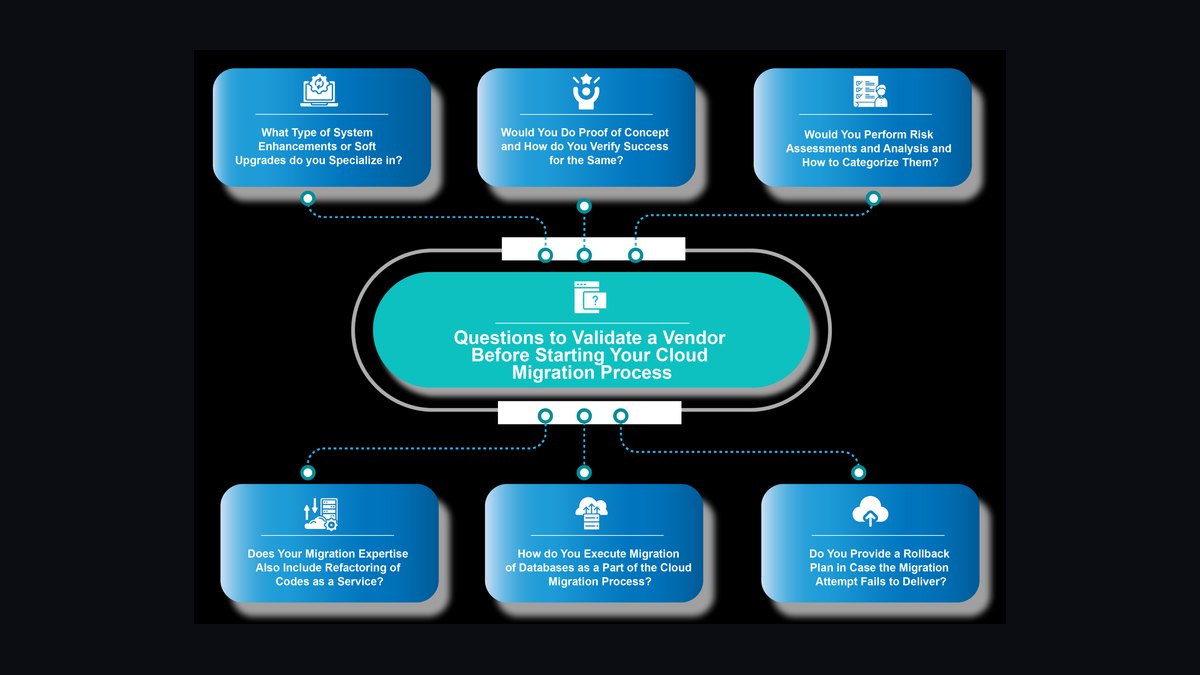
Timeline. A contained workload — one application, roughly 200–500 COBOL programs, a handful of downstream consumers, no exotic third-party middleware — commonly runs 9–15 months end to end: 2–3 months assessment and inventory, 3–5 months conversion and initial testing, 3–4 months parallel run, 1–2 months cutover and stabilization. A full estate migration of several thousand programs across multiple applications is a multi-year program, typically sequenced application by application rather than attempted as one cutover. Anyone quoting a full-estate migration in under 18 months is describing a pilot.
Effort distribution. Across published case studies and practitioner accounts, the effort split tends to land near 15–20% assessment, 25–30% code and data conversion, 40–50% testing and parallel run, and 10% cutover. Testing dominating is the correct shape. If your plan allocates less than a third of total effort to testing and comparison, the plan is wrong and you will find out late.
Data migration throughput. AWS DMS full-load performance depends on replication instance size, source read capacity, target write capacity, and network path. A well-provisioned setup moving into Aurora can commonly sustain tens of gigabytes per hour per task, and parallel tasks scale that further, but mainframe-side read throughput is usually the constraint, not DMS. For CDC, sub-minute lag is a realistic target for moderate transaction volumes on a properly sized replication instance; single-digit-second lag is achievable but requires tuning and headroom. Measure your own before promising an SLA — and note that DMS reads Db2 for z/OS as a source with specific version and configuration prerequisites, while VSAM and sequential files generally require an intermediate step or a partner tool rather than direct DMS ingestion.
Compute sizing. Rehosted COBOL is usually not CPU-hungry by modern x86 standards; a workload consuming several hundred MIPS often runs comfortably on a modest number of vCPUs. The trap is I/O and single-thread latency for batch jobs that were tuned against mainframe channel architecture. Expect to right-size after measurement, and expect at least one batch job that runs dramatically slower on first attempt and needs restructuring — usually one doing record-at-a-time reads that a relational target handles poorly without set-based rewriting or an index that never existed on the VSAM side.
Parallel-run duration. Three months is the common floor and exists for a reason: you need at least one full month-end close, ideally one quarter-end, plus whatever periodic cycles your business runs — annual renewals, regulatory filings, seasonal peaks. If your heaviest processing is annual, either extend the parallel run or accept the risk explicitly and document it. Do not discover in month thirteen that the year-end job was never exercised.
Cost reduction. Model three scenarios rather than one point estimate. Pessimistic: 25–35% run-cost reduction, which happens when a large Enterprise Server subscription, an over-provisioned database, and a long dual-running period eat the savings. Base: 40–60%. Optimistic: 60%+, generally requiring aggressive decommissioning of ISV tooling and a genuinely retired LPAR rather than a shrunken one. Note that during parallel run you pay for both environments simultaneously — that overlap is the single largest cost line of the project itself and is often omitted from business cases.
Risks, edge cases, and failure modes
Partial decommission. The most expensive failure mode is not a failed migration; it is a successful migration of 90% of the workload that leaves one application on the mainframe. The LPAR stays. The ISV licenses stay. The specialized operations staff stays. You have added an environment without removing one, and the entire cost case evaporates. Before starting, identify what must move for the mainframe to actually go dark, and treat those workloads as mandatory scope, not optional phases.
Arithmetic and rounding divergence. COBOL packed decimal arithmetic is exact base-10 fixed point. If any converted logic drifts into binary floating point — via a rewritten component, a reporting layer, or a mapping that lands a COMP-3 field into a float column — you will get penny-level differences on financial calculations that are correct-looking and wrong. These surface as reconciliation breaks weeks into parallel running. Enforce DECIMAL/NUMERIC targets with explicit precision and scale for every monetary field, and make penny-exact comparison part of the automated test suite, not a manual spot check.
EBCDIC to ASCII and collation order. Character encoding conversion is mechanical, but sort order is not. EBCDIC collates lowercase before uppercase before digits; ASCII does the opposite in key respects. Any report, extract, or logic that depends on sorted output order will produce different sequencing after conversion. This breaks control-break reporting, partner file formats, and any downstream process that assumes an order. Also watch for packed-decimal sign nibbles and for fields that store binary data in character-typed columns, which conversion will corrupt silently.
Date and special-value handling. Legacy systems encode meaning in sentinel values: 999999 for "no date," low-values and high-values for boundary records, spaces in numeric fields meaning zero. Relational targets with NOT NULL constraints and typed date columns reject or mangle these. Decide the policy per field before conversion, document it, and make sure both the application and every downstream consumer agree on it.
Undocumented behavior that is load-bearing. Somewhere in the estate is a program whose observable behavior depends on a quirk — a file left open across a job step, a specific record ordering that happens to hold, a return code the scheduler interprets in a non-obvious way. These are invisible in code review and only surface under parallel run with real volumes. This is precisely why parallel running with automated output comparison is non-negotiable rather than a nice-to-have.
Vendor and skills concentration. Rehosting on Enterprise Server means your COBOL runtime is now a commercial product with a subscription. You have traded IBM dependency for OpenText dependency. That may well be a better trade — the licensing model is different and the platform is commodity x86 — but it is not independence. Understand the subscription terms, the support model, and what an exit would look like before signing.
Compliance and audit continuity. If the mainframe application is in scope for financial reporting controls or regulatory examination, the migration itself is an auditable event. Retention of historical data, immutability of records, access control equivalence, and evidence that outputs did not change all need to be demonstrable. Involve audit and compliance during assessment, not during cutover week.
Scope creep disguised as improvement. The strongest discipline in a rehost project is refusing to fix things. Every "while we're in here" change breaks the one property that makes parallel-run comparison meaningful: that outputs should be identical. Freeze functional change for the migration window, land the platform move, then improve on the new stack where changes are cheap and testable.
A practical rollout plan
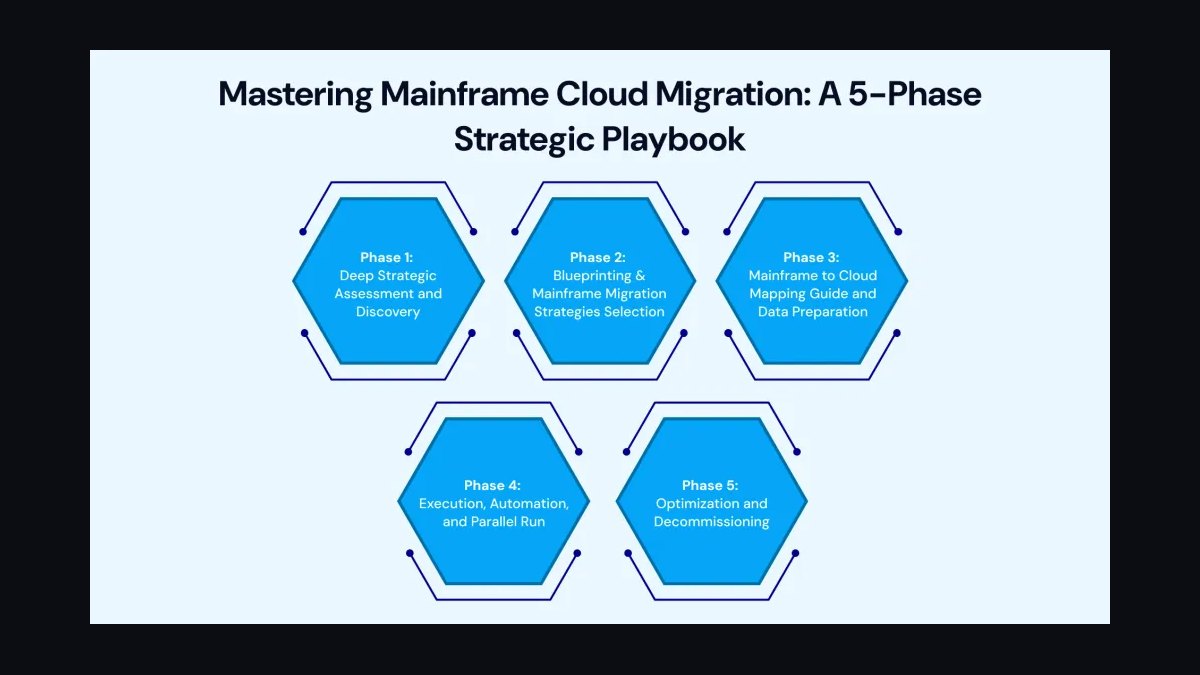
Phase one — assessment, 6–10 weeks. Build the inventory: every production load module traced to source, every copybook resolved and versioned, every JCL stream catalogued, every downstream consumer named with an owner. Run static analysis to produce the dependency graph. Classify each application into rehost, replace with SaaS, or retire outright — the retire bucket is usually larger than anyone expects, because estates carry programs that have not executed in years. Baseline current cost by line item: IBM software, ISV software, hardware, facilities, staff. Baseline current performance: batch window duration, peak transaction rates, SLA commitments. These baselines are what you will be judged against.
Phase two — pilot, 8–12 weeks. Pick a workload that is real but not critical: it exercises CICS or batch, touches representative data structures, has genuine users, and could fail without a headline. Migrate it fully — DMS replication configured, Enterprise Server compiled and running, CI pipeline building it, monitoring wired up. The pilot's purpose is not to prove COBOL runs on x86; it does. The purpose is to measure your team's actual conversion rate, surface tooling gaps, and calibrate every estimate in the plan against observed effort.
Phase three — build out the factory, ongoing. Migration at scale is repetitive work, and repetitive work wants automation. Build a conversion pipeline: source pulled from the mainframe library manager into Git, compiled by Enterprise Server in CI, deployed to a test environment, exercised against a captured input set, outputs diffed against mainframe-produced baselines automatically. Every application that follows the pilot uses this pipeline. The investment pays back around the third application.
Phase four — parallel run, 3+ months per application. Both environments process the same inputs. Outputs are compared automatically, field by field, with differences triaged daily. Set an explicit exit criterion before starting — for example, thirty consecutive business days with zero unexplained differences, including at least one month-end close. Track the difference count as a burndown; if it plateaus above zero, you have a real defect, not noise.
Phase five — cutover and decommission. Cut over during a low-volume window with a documented, rehearsed rollback that has actually been executed in a test. Keep the mainframe capable of resuming for a defined window — 30 to 90 days is typical — then decommission decisively. Cancel the ISV contracts. Release the LPAR. The savings only exist once this step completes, and every week of delay is dual-run cost.
Related questions
Does rehosting mean we never have to rewrite the COBOL?
Rehosting defers the rewrite indefinitely, which is often the right economic answer. The code runs unchanged on commodity infrastructure. You can then refactor selectively — extracting the two or three modules that actually block business change — rather than betting the program on a full rewrite.
Can AWS DMS read VSAM files directly?
Not generally. DMS supports relational sources including Db2 for z/OS under specific configurations. VSAM and sequential datasets typically require an intermediate step — unloading to a supported format or using partner tooling — before DMS handles ongoing replication into the cloud target.
What happens to our JCL and scheduler?
Enterprise Server executes JCL directly, which preserves most batch definitions. The enterprise scheduler is separate: if you use a mainframe-native scheduler, you either license its distributed equivalent or migrate the schedule to a cloud-native orchestrator, re-verifying every return-code dependency.
Should we refactor to Java instead of rehosting?
Automated COBOL-to-Java refactoring exists and can suit estates where the goal is eliminating COBOL skills dependency entirely. It carries higher risk and longer timelines, and generated Java is frequently unidiomatic. Rehost when the driver is cost and infrastructure; refactor when the driver is genuinely the language.
How do we prove outputs are identical during parallel run?
Automated field-level comparison of every report, extract, file, and database delta produced by both environments, run daily, with a triaged difference log. Manual spot-checking finds the obvious breaks and misses the rounding and ordering divergences that matter most.
FAQ
How long does a COBOL-to-cloud migration actually take?
For a single contained application of a few hundred programs, plan 9–15 months including a three-month parallel run. Full estates spanning thousands of programs are multi-year programs executed application by application. The assessment phase is what makes these numbers reliable — before it completes, any timeline is a guess, and the largest driver of overrun is estate size discovered late rather than technical difficulty.
Do we keep our existing COBOL developers?
Yes, and that is a primary argument for the rehost approach. Micro Focus Enterprise Server runs the same COBOL source, so your developers' domain knowledge and language skills stay directly relevant. What changes is the surrounding toolchain: modern IDEs, Git-based source control, and CI pipelines replace the mainframe development environment. Budget time for that transition, but it is generally received as a benefit rather than a burden.
What is the biggest hidden cost?
Dual running. During the parallel-run phase you pay full mainframe costs and full cloud costs simultaneously, and that phase lasts months per application. Business cases that model only the post-cutover steady state understate total project cost significantly. Model the overlap explicitly, and treat every week of parallel-run extension as a real, quantified expense when deciding whether to extend.
How do we handle COMP-3 and REDEFINES during schema conversion?
Packed decimal fields map to DECIMAL or NUMERIC columns with explicit precision and scale — never to floating-point types, which introduces rounding error in financial calculations. REDEFINES has no automatic equivalent: each one requires a design decision about normalizing into separate tables, flattening into a wide table, or preserving the raw record with an access layer. Count REDEFINES occurrences during assessment; they are a reliable complexity proxy.
Can we skip the parallel run to save time and money?
You can, and it is the single riskiest decision available in this class of project. Parallel running is how undocumented, load-bearing behavior surfaces — the file left open across a step, the sort order that logic silently depends on, the sentinel date value. Those defects are not findable by code review. Skipping the parallel run trades a known, budgeted cost for an unbounded production-incident risk on systems that typically run core financial processing.
Is a rehosted application easier to change afterward?
Modestly, and mostly for infrastructure reasons rather than code reasons. Deployments become faster, environments become reproducible, and testing becomes automatable. The COBOL itself is exactly as complex as it was. Real change velocity comes from the refactoring you do after the platform move, on a stack where experiments are cheap — which is why rehosting is best understood as the enabling step, not the finish line.
Sources
- AWS Mainframe Modernization — User Guide
- AWS Database Migration Service — User Guide
- Using IBM Db2 for z/OS as a source for AWS DMS
- OpenText (Micro Focus) Enterprise Server
- OpenText Enterprise Analyzer
- IBM Db2 for z/OS documentation
- AWS Prescriptive Guidance — Migration strategies
- AWS Blog — Mainframe Modernization category
- IBM z/OS documentation
Related on PULSE
- [The CRM Migration Playbook: Moving from Salesforce to HubSpot in 2027](/knowledge/tk0473)
- [A Bioinformatics Pipeline: Genome Assembly and Variant Calling with Nextflow, Conda, and AWS Batch](/knowledge/tk0441)
- [A Legal Tech Toolkit: Document Automation and Contract Analysis Using Python, Docassemble, and TextBlob](/knowledge/tk0399)
- [The Ideal Stack for a Real-Time Multiplayer Game Server](/knowledge/tk0462)
- [A Real Estate Appraisal Firm's Ideal Tech Toolkit for Field and Office](/knowledge/tk0348)
This page will be disappearing soon. Save it to your device for $1 — or read it free while it is here.
@Kory-White- · if Venmo asks, the last 4 of my number are 2012
 pulse-tech-stacksThe Supply Chain Visibility Stack: Track-and-Trace with Hyperledger Fabric, IoT, and SAP Integration
 pulse-tech-stacksIs Tech Stacks worth it in 2027?
 pulse-tech-stacksThe Healthcare RevOps Tech Stack for Multi-Location Clinics in 2027
 pulse-tech-stacksHow much does Tech Stacks cost in 2027?
 pulse-tech-stacksThe Music Production Tech Stack: DAW Automation, Sample Management, and Collaboration with JUCE and Google Drive API
 pulse-tech-stacksTop 10 Machine Learning Stacks for Fraud Detection Systems in 2027
 pulse-tech-stacksThe Billing and Revenue Recognition Stack for Usage-Based SaaS in 2027
 pulse-tech-stacksTech Stack Consolidation: Cutting SaaS Spend by 40% in 2027
 pulse-tech-stacksRecommended Hardware and Software Stack for VFX Artists
 pulse-tech-stacksTop 10 Stack for Legal Document Automation Platforms in 2027