


Should I open or buy a Nathan's Famous franchise in 2027?
Quality
Certified
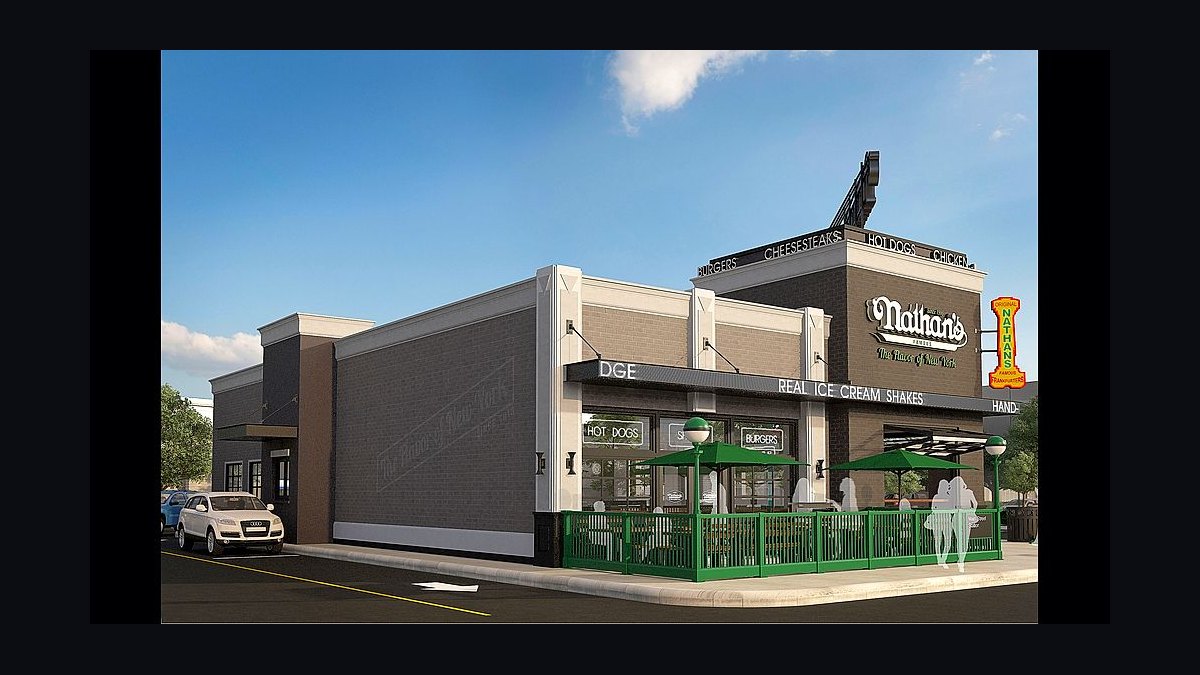
Opening a standalone Nathan's Famous is risky for a first-time single-unit operator — the specialty hot-dog menu, $441,000–$1,100,000 freestanding build cost, and thin Item 19 disclosure don't pencil for most suburban sites. The franchise works well in a captive high-traffic venue (stadium, airport, travel plaza, casino), as an existing-operator conversion, or as a branded menu license layered onto a business you already run.
What it is and why it matters
Nathan's Famous is not a general quick-service restaurant brand in the way Chick-fil-A or Culver's is — it's a specialty hot-dog concept built around roughly 225 franchised units worldwide as of fiscal 2026, anchored by 80-plus years of Coney Island heritage and the annual July 4 Hot Dog Eating Contest that still drives national media attention every summer. That heritage buys instant brand recognition the moment a sign goes up, but it does not buy a full menu. A family deciding where to stop for dinner will often drive past a hot-dog-only storefront in favor of a restaurant that can feed everyone in the car, which is precisely why the brand's own expansion strategy increasingly leans on two paths instead of one.
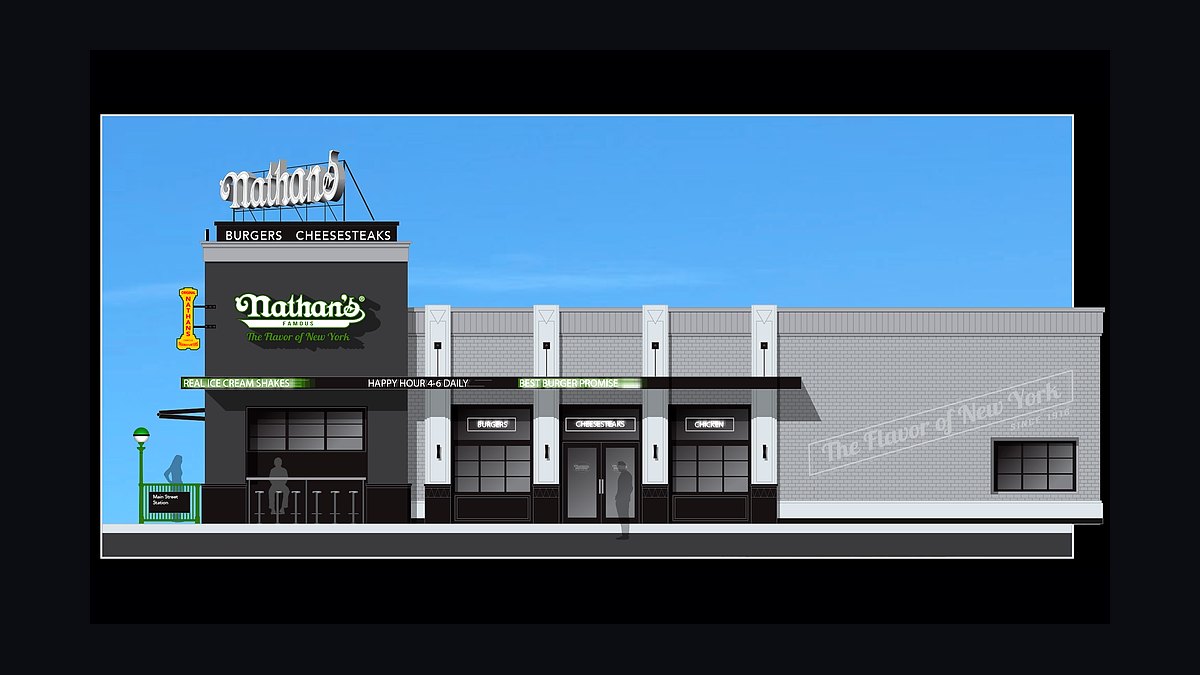
The first path is the traditional franchise: a freestanding building with a drive-thru, or an in-line/food-court unit, built from the ground up and operated as its own P&L. The second path — and the one Nathan's itself is pushing hardest in 2026 and into 2027 — is the non-traditional license: a branded menu program bolted onto a convenience store, travel plaza, bowling center, casino floor, or movie theater that already has foot traffic, staffing, and a point-of-sale system in place. This distinction matters enormously for anyone asking whether to open or buy in because the unit economics, the capital required, and the realistic payback window are almost entirely different animals depending on which path you choose.
It also matters because of what changed upstream in January 2026: Smithfield Foods closed a $450 million acquisition that gives it control of both the retail hot-dog supply chain (Nathan's all-beef franks are sourced through Smithfield/John Morrell) and significant influence over brand-standard enforcement going forward. For a franchisee, that acquisition is a supply-chain stabilizer more than a profit lever — it does not change your royalty rate, your build cost, or your average unit volume, but it does raise the odds of tighter brand-standard enforcement and possible consolidation inside the franchise system. Anyone weighing a 2027 purchase should treat the April 2027 FDD amendment, the first filed fully under Smithfield ownership, as a document worth reading closely rather than skimming.
Finally, this matters because Nathan's Famous does not publish a full Item 19 with bottom-line franchisee profitability. The FDD discloses system-wide gross sales and average gross sales by venue type, but nothing below the top line. That gap is the single biggest reason a generic franchise-fee-and-build-cost comparison is misleading on its own — you have to build your own net-margin model from validation calls, not from the disclosure document, before you can honestly answer whether this franchise opens into a profit or a slow bleed.
The step-by-step process (mermaid)
Due diligence on a Nathan's Famous franchise follows a reasonably standard 90-day arc, but skipping steps — especially the validation calls — is where most bad decisions get locked in.
The first ten days are a blunt capital-and-credit honest-check: Nathan's published minimums call for roughly $200,000 in liquid capital and $500,000 in net worth, and most franchisees finance the build through an SBA 7(a) loan, which as of mid-2026 was pricing around prime plus 2.75%. If clearing that minimum requires raiding a retirement account, that's the signal to stop before spending another dollar on due diligence.
Days 11 through 25 are for requesting the Franchise Disclosure Document directly through franchise.nathansfamous.com and reading Items 7, 19, 20, and 21 line by line — Item 7 for the real cost ranges, Item 19 for what little financial performance data exists, Item 20 for the franchisee contact list, and Item 21 for audited financials on the franchisor itself. This is also when a serious buyer builds a personal pro forma in a spreadsheet, not a slide deck, because the FDD's gaps mean you're responsible for modeling your own net margin.

Days 26 through 40 are the validation calls, and they are the step most prospective franchisees shortcut. Talking to at least three current franchisees and two former franchisees from the Item 20 list — and asking pointed questions about actual average unit volume, cost-of-goods percentage, labor percentage, rent percentage, and biggest regret — surfaces the information the disclosure document deliberately omits. Former franchisees in particular tend to be far more candid about what went wrong than anyone still operating under the brand.
Days 41 through 55 shift to trade-area analysis using tools like Placer.ai or SafeGraph, with rough thresholds of 5,000 daily vehicle counts for a freestanding site and 12,000 daily foot traffic for an in-line unit; a retail real-estate broker consult runs $1,500–$3,000 if you can't pull the data yourself. Days 56 through 70 culminate in Discovery Day at Nathan's headquarters in West Hempstead, New York, where you re-model your numbers against the company's own input and compare them explicitly to the economics of the conversion program, which is frequently better. The final stretch, days 71 through 90, is lender term sheets, a lease letter of intent with a diligence-out clause, and the actual decision to sign the franchise agreement or walk away — walking is a legitimate, often correct outcome when the site or capital structure doesn't support the model.
Costs, timelines, and typical ranges
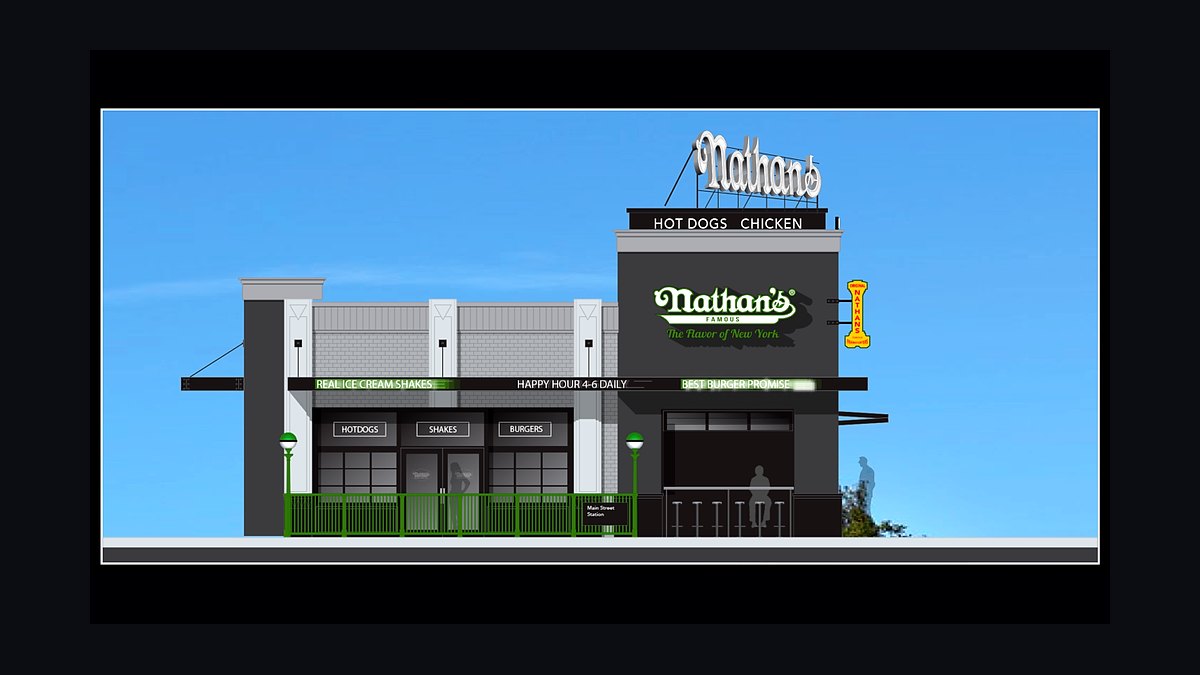
The cost structure splits cleanly by format. A food-court or in-line unit runs $277,000 to $660,000 all-in, covering an $80,000–$250,000 build-out, $90,000–$180,000 in equipment and signage, $8,000–$15,000 of opening inventory, three months of working capital at $40,000–$90,000, and $9,000–$25,000 in training and professional fees, on top of the flat $30,000 initial franchise fee. A traditional freestanding location with a drive-thru is meaningfully more expensive, running $441,000 to $1,100,000, driven mainly by a $200,000–$600,000 construction budget instead of the lighter in-line build-out.
Ongoing fees are straightforward: a 5.5% royalty on gross sales plus a 2.0% contribution to the brand/marketing fund, for a combined 7.5% off the top line regardless of format. Average unit volume across the franchise system runs roughly $520,000 to $1,050,000, implied from the company's fiscal 2026 quarterly sales divided across its unit count, and well-run locations tend to post EBITDA margins in the 6% to 12% range — though that figure comes from operator triangulation rather than the FDD, since Nathan's does not disclose franchisee-level net income in Item 19.
Translating that into owner cash flow, a strong traditional unit should generate roughly $40,000 to $110,000 in year-one cash flow, with payback typically landing between 28 and 42 months. Non-traditional licenses and branded menu programs move much faster — 12 to 24 months to break even — because they skip the full restaurant build and tap into foot traffic and labor that already exists on-site. That spread, more than any other single number, is the clearest argument for leaning toward the branded-license path over a ground-up freestanding build in 2027.
One more caveat belongs in the cost conversation: freestanding pro formas really only clear a comfortable margin when occupancy cost sits below roughly 8% of gross sales, which in practice usually means owning the real estate rather than leasing it. A franchisee paying market-rate rent on a newly built freestanding Nathan's is stacking two of the model's hardest-to-control costs — construction and occupancy — on top of each other at the same time.
Where teams get it wrong
The most common failure pattern is a first-time, single-unit operator building a freestanding suburban Nathan's from scratch and underestimating how hard a specialty menu is to sell against full-menu competitors. A household with kids will often choose Chick-fil-A, Raising Cane's, or Culver's over a hot-dog-only concept simply because the menu doesn't cover everyone's preference, and a $9.50–$12.00 average ticket doesn't generate enough volume to justify a $700,000-plus build in most suburban trade areas. Nathan's has tried to widen the menu with cheesesteaks, crinkle-cut fries, and a co-branded Arthur Treacher's fish-and-chips line, but those additions haven't fully solved the core traffic problem in lower-density locations.
A second recurring mistake is signing a 10-year mall food-court lease at peak-era rent assumptions that no longer hold. US mall foot traffic sits roughly 18% below 2019 levels, and in-line Nathan's units inside struggling B-malls have been closing faster than new ones open — the company's own fiscal 2026 filings show 23 franchised units closing against 18 openings in the 39 weeks ending late December 2025. Locking into a long lease on a declining property is one of the few mistakes that's genuinely difficult to undo once signed.
A third mistake is underestimating cost exposure to two macro inputs that move independently of anything a franchisee controls. Beef cost of goods sits at roughly 30–34% of sales, and USDA forecasts for 2027 put boxed beef cutout prices at $315–$340 per hundredweight, about 15% above the 2020–2024 trailing average — every 5% move in beef pricing pulls roughly 150 basis points out of unit margin. On the labor side, wage floors have climbed from about 26% of sales in 2019 to around 33% in 2026, driven by state-level minimum-wage legislation such as California's AB 1228, with New York, Illinois, and Washington tracking similar increases. A model built on 2019-era labor and commodity assumptions will overstate profitability by a wide margin.
Finally, franchisees who need $150,000 or more in owner draw during year one consistently get disappointed, because the single-unit math doesn't support that level of income. A realistic range is $40,000–$80,000 in year one, growing to $80,000–$130,000 by year three, and this franchise generally only becomes a meaningful income source once an operator controls three or more units.
Decision framework: when to choose what (mermaid)

If you already operate a stadium concession, airport hospitality contract, travel plaza, casino food court, convenience-store chain, or theme-park midway, the branded menu program is almost always the highest-return path — licensing fees run $30,000–$80,000 with no restaurant build required, and incremental revenue of $300,000–$700,000 per location has been reported with minimal added labor, since the Nathan's name alone commands a $1.50–$2.50 price premium over a generic hot dog.
If you're an existing restaurant operator with an underperforming concept, the conversion program deserves serious attention before anything else — Nathan's is actively recruiting conversions with a discounted franchise fee and accelerated training, and it has been the fastest-growing channel in the system through 2026 and into 2027.
If neither applies and you're considering a ground-up freestanding build, the deciding factor is occupancy cost: owning the land or securing rent below roughly 8% of gross sales is close to a precondition for the freestanding math to work, which is why Latin American and Caribbean master franchisees — notably in Panama, the Dominican Republic, and Puerto Rico — have outperformed US suburban stores on return on invested capital.

If none of those conditions hold, it's worth comparing alternatives before committing capital. Wienerschnitzel runs a larger system (around 330 units), a lower 5.0% royalty, and a more detailed Item 19, and tends to be stronger in the Western US. Dog Haus is a premium hot-dog concept with reported AUVs above $1.4 million in top markets, trading a higher build for a higher ceiling. Portillo's offers stadium and event licensing rather than traditional franchising. And building an independent regional concept for the same roughly $700,000 in capital keeps the full 7.5% that would otherwise go to royalty and brand-fund fees, at the cost of forgoing brand recognition entirely. If your real interest is simply exposure to Nathan's brand cash flow rather than running a storefront, the retail and foodservice distribution side — now intertwined with Smithfield's roughly $170 million wholesale hot-dog business — is a genuinely different and, for some investors, more attractive way in.
Related questions
Is the Nathan's Famous conversion program better than opening new?
Often yes for existing restaurant operators — it carries a discounted franchise fee and faster training, and has been the system's fastest-growing channel through 2026–2027, letting you reuse an existing lease and crew instead of absorbing full freestanding build costs.
How does the Smithfield Foods acquisition affect franchisee costs?
It stabilizes hot-dog supply since Nathan's franks run through Smithfield/John Morrell, but it hasn't changed royalty rates, build costs, or disclosed unit economics — treat it as a supply-chain shift, not a profitability lever, pending the April 2027 FDD amendment.
What's the difference between a branded menu program and a full franchise?

A branded menu program licenses the Nathan's menu into an existing business (C-store, travel plaza, bowling center) for $30,000–$80,000 with no dedicated building, while a full franchise requires its own freestanding or in-line construction costing $277,000–$1,100,000.
Why doesn't Nathan's disclose franchisee profitability in its FDD?
Item 19 discloses only system-wide and average gross sales by venue type, not net income — a disclosure gap common among smaller franchise systems, which is why direct validation calls with current and former franchisees are essential before buying.
Are non-traditional hot dog licenses growing faster than standalone restaurants industry-wide?
Yes — captive-venue and convenience-retail food licensing has outpaced standalone specialty-QSR openings across the sector since 2022, as operators favor lower capital, faster payback, and existing foot traffic over new construction.
FAQ
What is the total investment to open a Nathan's Famous franchise? For a traditional freestanding location, the all-in investment ranges from $441,000 to $1,100,000. A food court or in-line unit costs between $277,000 and $660,000. These figures include the franchise fee, equipment, construction, and initial inventory.
How much can I expect to earn in the first year?

First-year cash flow for a strong traditional location is typically $40,000 to $110,000, based on average unit volumes of $650,000 to $950,000. Branded menu programs in captive venues often see faster returns due to lower overhead.
How long does it take to break even? Traditional freestanding units generally break even in 28 to 42 months. For branded menu programs or non-traditional licenses, breakeven can occur in 12 to 24 months, depending on foot traffic and existing customer base.
What are the ongoing royalty and marketing fees? You'll pay a 5.5% royalty on gross sales and a 2.0% marketing fee. These are standard across Nathan's franchise agreements and fund national brand support and advertising.
Is Nathan's Famous a good fit for a standalone restaurant? Generally no, unless you have a high-traffic captive venue like a stadium, airport, or travel plaza. Standalone units carry higher build costs and longer breakeven periods than non-traditional licenses or branded menu programs.
How did the Smithfield Foods acquisition affect franchisees? The $450 million acquisition that closed in early 2026 improved supply-chain stability for hot dogs and related products. It did not materially change per-unit economics or franchisee fees, which remain governed by the existing FDD terms.
Sources
- Nathan's Famous, Inc. 2025 Franchise Disclosure Document (FDD), Items 5, 6, 7, 19, 20, 21
- Nathan's Famous, Inc. Form 10-Q, Third Quarter Fiscal 2026, SEC EDGAR (sec.gov)
- Nathan's Famous, Inc. Form 10-K, Fiscal Year 2025, SEC EDGAR (sec.gov)
- IBISWorld, "Hot Dog & Sausage Stands in the US," industry report, ibisworld.com
- International Franchise Association, Franchise Economic Outlook, franchise.org
- ICSC, US Mall Foot Traffic Index, icsc.com
- USDA Economic Research Service, Livestock, Dairy, and Poultry Outlook, ers.usda.gov
- US Bureau of Labor Statistics, QSR wage and employment data, bls.gov
- Nathan's Famous franchise portal, franchise.nathansfamous.com
- Franchise Direct, Nathan's Famous franchise profile, franchisedirect.com
Related on PULSE
This page will be disappearing soon. Save it to your device for $1 — or read it free while it is here.
@Kory-White- · if Venmo asks, the last 4 of my number are 2012
This page is gone.
This one is off the shelf now. $1 keeps it on your phone for good — the whole page, pictures and diagrams included.
 franchiseShould I open or buy a Panera Bread franchise in 2027?
 franchiseShould I open or buy a Primrose Schools franchise in 2027?
 franchiseShould I open or buy a Great Clips franchise in 2027?
 franchiseShould I open or buy a Cinnabon franchise in 2027?
 franchiseShould I open or buy a Meineke franchise in 2027?
 franchiseShould I open or buy a Mathnasium franchise in 2027?
 franchiseShould I open or buy a Little Caesars franchise in 2027?
 franchiseShould I open or buy a Take 5 Oil Change franchise in 2027?
 franchiseShould I open or buy a Merry Maids franchise in 2027?
 franchiseShould I open or buy a Subway franchise in 2027?