


“Help us build the revenue engine.” — LinkedIn Banner
Quality
Certified
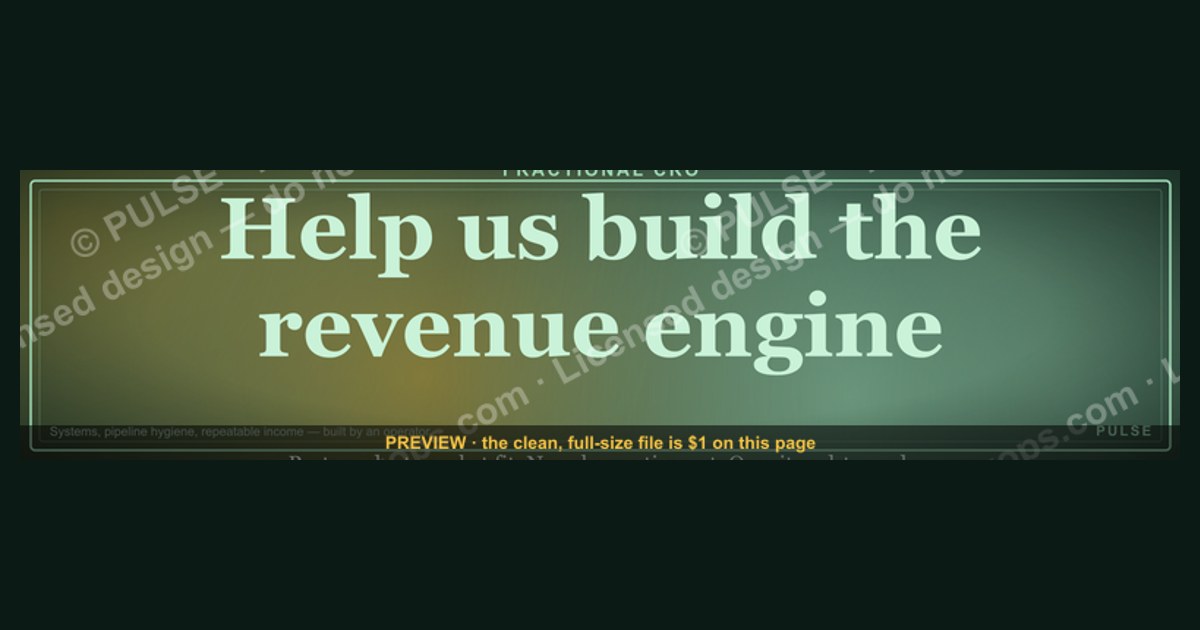

This LinkedIn Banner invites experienced revenue professionals to join a company in growth mode, signaling a hands-on role designing and scaling the systems that turn leads into predictable income. It targets CROs, RevOps leaders, and sales executives who thrive on building repeatable processes rather than maintaining existing ones, and it works as both a recruiting tool and a personal brand statement.
A Concrete Scenario: The Founder Who Posted the Banner
Imagine a B2B SaaS founder who just closed a $4 million Series A round. The product has 40 paying customers and strong retention, but revenue growth has plateaued at roughly 8% month-over-month because there is no formal sales process, no pipeline hygiene, and no clear owner for the go-to-market function. The founder is spending 60% of their time on demos and discovery calls, leaving little room for fundraising, product strategy, or team building.
This founder posts the "Help us build the revenue engine" LinkedIn Banner on their profile to signal to a specific type of professional: someone who has built revenue systems before and can do it again without needing hand-holding. The banner is not a job description; it is a filter. It tells experienced operators that the company is past product-market fit but has not yet institutionalized its sales motion. The implicit promise is autonomy, strategic influence, and the chance to own the revenue function end-to-end.
The scenario plays out in a specific way. A fractional CRO with 12 years of experience sees the banner, clicks through to the profile, and reads the headline: "Founder & CEO | Scaling B2B SaaS | Building the Revenue Engine." The profile summary mentions a prior exit and a history of building sales teams from zero to $10 million ARR. The fractional CRO sends a message: "I've built three revenue engines from scratch. Here is how I'd approach your current stage." Within two weeks, the founder and the fractional CRO agree on a 90-day sprint to build the foundational infrastructure.

This scenario illustrates the core function of the banner: it compresses the first round of qualification into a single visual statement. The founder does not need to explain their stage or their needs; the banner does that work. The candidate self-selects based on whether the phrase "build the revenue engine" resonates with their experience and career trajectory.
How the Revenue Engine Mechanism Actually Works
The phrase "revenue engine" is not just marketing language; it describes a specific operational architecture that combines people, processes, and technology into a repeatable system. Understanding how this mechanism works is essential for anyone responding to the banner, whether as a candidate or as a founder posting it.
The revenue engine operates on a simple input-output model, but the internal mechanics are complex. At the top of the funnel, marketing generates leads through content, paid acquisition, and outbound campaigns. These leads enter a qualification process that scores them based on fit and intent. Qualified leads move to sales development representatives (SDRs) who book meetings for account executives (AEs). AEs run discovery, demo, and negotiation, then close deals. Post-sale, customer success managers (CSMs) drive adoption and expansion, feeding renewals and upsells back into the top of the funnel as referrals and case studies.

The engine only works when each stage has clear metrics, defined handoffs, and accountability. A common failure point is the transition from marketing to sales. If marketing generates 1,000 leads per month but sales only follows up on 200, the engine leaks revenue. Similarly, if AEs close deals but CSMs do not have a structured onboarding process, churn erodes the gains.
Here is a visual representation of how the revenue engine functions as an end-to-end system:
The engine is not static; it requires continuous tuning. Weekly pipeline reviews, monthly forecast calls, and quarterly territory adjustments keep the system aligned with market conditions. The person who "builds" the engine is responsible for designing this architecture, selecting the tools (CRM, marketing automation, sales engagement platforms), hiring the team, and establishing the cadence of measurement and improvement.
For a candidate responding to the banner, the key insight is that the role is not about selling; it is about building the system that enables selling. This distinction matters because it changes the skill set required. A top-performing AE might not be the right person to build the engine; they excel at executing within a system, not designing it. The banner targets architects, not just operators.
Real Numbers, Ranges, and Benchmarks

While specific figures depend on company size, industry, and stage, there are established benchmarks that frame what "building the revenue engine" actually involves. These numbers help both founders and candidates calibrate expectations before engaging.
Timeline to first results. A foundational revenue engine typically takes 6 to 18 months to build, depending on the starting point. A company with zero sales infrastructure and no CRM will take longer than one with existing processes that need optimization. Fractional CRO engagements often begin with a 90-day assessment period, followed by a 6-month implementation phase. The first measurable improvements—usually pipeline velocity or conversion rates—appear within 60 to 90 days of changes being made.
Cost of a fractional CRO. Fractional CROs charge between $2,000 and $8,000 per month for 10 to 20 hours per week, depending on experience and market. A senior operator with a track record of scaling companies from $1 million to $10 million ARR commands the higher end of that range. Full-time CRO compensation at a Series A startup typically ranges from $180,000 to $250,000 base salary, plus 30% to 50% in variable compensation and equity packages of 1% to 3%.
Team composition. A revenue engine requires specific roles, and the sequencing matters. The typical build order is: (1) a sales leader who owns the number, (2) two to three AEs who can carry quota, (3) one SDR to generate outbound pipeline, and (4) a RevOps manager to own the data and tools. This four-person core team can support up to $5 million in ARR. Scaling beyond that requires adding CSMs, more SDRs, and dedicated marketing support.
Conversion benchmarks. Healthy B2B SaaS conversion rates provide a baseline for diagnosing engine performance. Lead-to-opportunity conversion typically runs 10% to 20% for inbound leads and 5% to 10% for outbound. Opportunity-to-close rates range from 20% to 30% for qualified pipeline. Average sales cycle length for mid-market deals is 60 to 90 days; enterprise deals run 120 to 180 days. If a company's numbers fall significantly below these ranges, the engine has a structural problem, not a talent problem.

Revenue per salesperson. A well-functioning engine should produce $500,000 to $1 million in ARR per salesperson for mid-market deals, and $2 million to $5 million for enterprise deals. These figures vary by industry and pricing model, but they provide a sanity check. If a company has five AEs and only $1 million in ARR, the engine is either under-resourced, poorly designed, or the product has a pricing problem.
Churn and retention. The engine does not stop at the close; retention is part of the system. Annual net revenue retention (NRR) for best-in-class B2B SaaS companies is 120% or higher, meaning expansion revenue offsets churn and adds growth. Gross revenue retention (GRR) should be 90% or above. If a company's NRR is below 100%, the engine is leaking value on the back end, and the builder must address onboarding, customer success, and product-led expansion before scaling the front end.
These benchmarks are directional, not absolute. A company selling $50,000 annual contracts to enterprise clients will have different metrics than one selling $500 monthly subscriptions to SMBs. The point is that "building the revenue engine" is a measurable engineering problem, not a vague aspiration. The banner signals that the founder understands this distinction and is looking for someone who can operate with data, not just intuition.
Trade-offs and Alternatives

Deciding how to build the revenue engine involves real trade-offs. The banner phrase "Help us build" implies a specific approach, but there are multiple paths, each with distinct costs and benefits. Understanding these trade-offs helps candidates position themselves and helps founders choose the right engagement model.
Fractional versus full-time leadership. The most fundamental trade-off is whether to hire a fractional CRO or a full-time executive. Fractional leadership offers flexibility, lower cost, and immediate access to expertise. A fractional CRO can start within days and bring patterns from multiple companies. The downside is limited availability; a fractional leader working 15 hours per week cannot be present for every team meeting or customer call. Full-time leadership offers total commitment and accountability, but it is more expensive and carries hiring risk. If the full-time hire does not work out, the cost of replacement is significant.
Build versus buy. Another trade-off is whether to build the engine with internal hires or buy it through consultants and agencies. Building creates institutional knowledge and long-term capability, but it is slow and requires management bandwidth. Buying delivers speed but creates dependency and often lacks the cultural fit of internal hires. A hybrid approach—using a fractional leader to build the system and hiring internal operators to run it—combines the benefits of both.
Inbound versus outbound focus. The engine can be designed around inbound marketing, outbound sales, or a combination. Inbound engines are more cost-efficient over time but take 6 to 12 months to generate meaningful pipeline. Outbound engines produce faster results but require more SDR headcount and higher cost per acquisition. The right mix depends on product complexity, average deal size, and market maturity. A $5,000 ACV product with a short sales cycle might thrive on inbound; a $100,000 ACV enterprise product likely needs a heavy outbound motion.

Process standardization versus flexibility. A revenue engine requires standardized processes to be repeatable, but over-standardization can crush creativity and adaptability. The trade-off is between consistency and agility. Early-stage companies need flexible processes that can evolve; later-stage companies need rigid systems that scale. The builder must design for the current stage while anticipating the next one.
Here is a visual comparison of the primary engagement models:
The choice of model shapes everything downstream: team composition, tooling decisions, and the pace of implementation. A founder posting the banner should be clear about which model they are offering. A fractional CRO will read the banner differently than a full-time VP of Sales candidate. The banner's ambiguity is a feature—it attracts multiple types of operators—but the founder must be prepared to clarify the engagement model in the first conversation.
Common Pitfalls and How to Avoid Them
Building a revenue engine is fraught with failure modes, and the banner itself can contribute to these pitfalls if not handled carefully. Here are the most common mistakes, drawn from patterns observed across startups and scale-ups.
Pitfall 1: Confusing activity with output. Many founders believe that more sales calls, more demos, and more outreach will automatically produce more revenue. This is false. The engine must be designed around output metrics—pipeline value, conversion rates, average deal size, and win rates—not activity metrics. A team making 500 calls per week that closes 2% of opportunities is worse than a team making 200 calls per week that closes 8%. The builder must install a measurement system that tracks output, not just effort.

Pitfall 2: Skipping the data foundation. A revenue engine cannot be built without clean data. If the CRM is a mess—duplicate accounts, missing fields, inconsistent stage definitions—every downstream process suffers. The builder must spend the first 30 days cleaning the data, defining the funnel stages, and establishing reporting. This is unglamorous work, but it is the foundation upon which everything else rests. Skipping it leads to inaccurate forecasts, misallocated resources, and a team that cannot trust its own numbers.
Pitfall 3: Hiring for pedigree instead of pattern recognition. The banner attracts candidates with impressive titles and logos on their resumes, but past success at a large company does not guarantee success at a startup. Building a revenue engine from scratch requires pattern recognition—the ability to see what is missing and build it without a playbook. The right candidate has done this before, ideally at a similar stage and market. Founders should probe for specific examples of building, not just managing.
Pitfall 4: Underfunding the engine. A revenue engine requires investment in tools, headcount, and time. Companies that expect to build a system on a shoestring budget will fail. The typical cost to build a foundational revenue stack—CRM, marketing automation, sales engagement, analytics—ranges from $2,000 to $5,000 per month in software costs alone. Add headcount and the total investment for the first year is $300,000 to $500,000. Founders who are not prepared to make this investment should not post the banner.

Pitfall 5: Ignoring the post-sale experience. The revenue engine does not end at the close. Churn is a leak in the engine, and expansion is a multiplier. Companies that focus exclusively on acquisition while ignoring onboarding, customer success, and renewal processes are building a leaky engine. The builder must design the full lifecycle, from first touch to renewal and referral. This means investing in CSM roles and onboarding processes before scaling the front end.
Pitfall 6: Failing to iterate. A revenue engine is never finished. Markets change, competitors emerge, and customer expectations shift. The builder must establish a cadence of review—weekly pipeline meetings, monthly forecast calls, quarterly strategy sessions—and be willing to change what is not working. The engine is a living system, not a static artifact.
Avoiding these pitfalls requires discipline, experience, and a willingness to make hard trade-offs. The banner attracts people who have navigated these challenges before; the interview process should verify that experience with specific, behavioral questions.
Related questions
What does "build the revenue engine" mean in practice?
It means designing the end-to-end system that generates, qualifies, and closes revenue opportunities, then retains and expands customers. This includes defining funnel stages, selecting tools, hiring roles, setting metrics, and establishing review cadences. The builder owns the architecture, not just the execution.
Who should post this banner on their LinkedIn profile?
Founders and CEOs of companies past product-market fit, typically with $1 million to $10 million ARR, who need structured revenue operations. Fractional CROs and revenue consultants also use it to market their services. It signals that the company values revenue as a core function worth building deliberately.
How is this banner different from a standard job posting?

A job posting lists requirements and responsibilities; the banner signals identity and stage. It attracts candidates who self-identify as builders rather than managers. It also works passively—every profile view becomes a recruiting touchpoint, and it positions the founder as someone who understands revenue strategy.
What should a candidate do after seeing this banner?
Review the founder's profile for signals: company stage, funding, prior exits, and content quality. Send a personalized message referencing the banner and offering a specific observation about their revenue challenges. Avoid generic outreach; the banner filters for operators who can speak to the building process specifically.
Can this banner work for a full-time job, or is it only for fractional roles?
It works for both. The phrase "help us build" is stage-agnostic. A company hiring a full-time VP of Sales can use it to attract builders rather than maintainers. A fractional CRO can use it to market their services. The key is clarity in the follow-up conversation about the engagement model.
FAQ
What does "Help us build the revenue engine" mean in a LinkedIn Banner? It signals that a company is actively seeking a senior revenue leader—often a fractional or full-time CRO—to design and scale their sales, marketing, and customer success processes. The phrase emphasizes building a repeatable system rather than just hitting short-term targets.

Who typically uses a banner like this? Startups and mid-market companies that have product-market fit but lack a structured revenue operation. Founders or CEOs often post it to attract experienced operators who can move from strategy to execution without needing extensive ramp-up time.
Is this banner a job posting or a service offer? It can be both. Some companies use it to recruit a full-time CRO, while fractional CROs use it to market their own services. The key is the emphasis on "building" the engine, which implies a hands-on, interim, or project-based role.
How long does it take to build a revenue engine? Honest ranges vary widely—typically 6 to 18 months for a foundational system, depending on company size, market complexity, and existing infrastructure. Fractional CROs often commit to 3 to 6 months initially to assess and implement changes.
What skills should a candidate have for this role? Proven experience carrying a revenue number, designing sales processes, hiring and coaching teams, and using data to forecast. Familiarity with CRM tools, pipeline management, and go-to-market strategy is essential, but the most critical skill is the ability to execute, not just advise.
How do I know if I need a fractional vs. full-time CRO? Consider budget, urgency, and long-term need. Fractional CROs are ideal for companies that need immediate expertise without a full-time salary commitment—often $2,000 to $8,000 per month for 10 to 20 hours per week. Full-time CROs make sense when you need a permanent leader to build and own the function for years.
Sources
- LinkedIn Engineering Blog — technical architecture and product development insights
- LinkedIn Official Press Room — company announcements and strategic initiatives
- Harvard Business Review — revenue growth and business model analysis
- Gartner — sales and marketing technology trends
- Forrester Research — B2B revenue operations and platform strategies
- U.S. Securities and Exchange Commission (SEC) filings — LinkedIn's financial performance and business disclosures
- SaaStr — SaaS metrics and revenue benchmarks
- Pavilion — RevOps community resources and best practices
Related on PULSE
This page will be disappearing soon. Save it to your device for $1 — or read it free while it is here.
@Kory-White- · if Venmo asks, the last 4 of my number are 2012
This page is gone.
This one is off the shelf now. $1 keeps it on your phone for good — the whole page, pictures and diagrams included.
 graphicProduct Marketing Lead — LinkedIn Banner
 graphicHow to build a champion champion plan in 2027?
 graphicSpeech-to-Text Operator — LinkedIn Banner
 graphicHow to design a LinkedIn banner that converts viewers into leads in 2027?
 graphicVP of Sales — LinkedIn Banner
 graphic“The next call is the most important one.” — LinkedIn Banner
 graphicVector Database CTO — LinkedIn Banner
 graphic"Build, don't chase." — LinkedIn Banner
 graphic“Process over pressure.” — LinkedIn Banner
 graphicTrust compounds. — LinkedIn Wallpaper