


Process scales. — LinkedIn Wallpaper
Quality
Certified
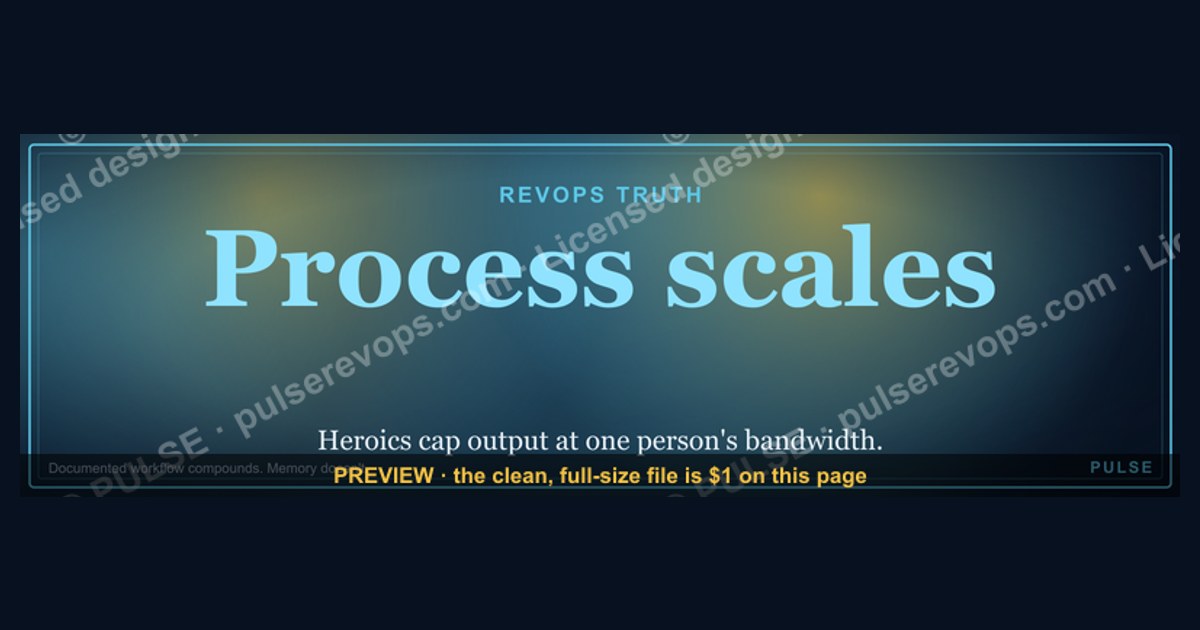
"Process scales." is the line printed on this free 1584×396 LinkedIn Wallpaper, and it states a RevOps truth: documented, repeatable workflow grows a business, while individual heroics cap it. Process can be taught, measured, and run in parallel; a hero cannot. Download it, recolor it, and let your profile back the claim.
What the wallpaper says and why the claim holds up
A LinkedIn cover image is roughly 1584 pixels wide by 396 tall — a wide, shallow strip that sits behind your profile photo and headline. Most people fill it with a mountain range, a city skyline at dusk, or an abstract gradient, which communicates exactly nothing. This one carries two words and a layered pulse-line backdrop. The words do the work.
The claim underneath the slogan is not a motivational platitude; it is an operational statement about where output comes from. When work depends on one person staying late, holding the context in their head, or "just knowing how it's done," total output is capped at that person's bandwidth. Every result they produce is also fragile: it disappears when they take a week off, get pulled onto another priority, or leave for a competitor. You cannot hire your way past that ceiling either, because a new person has nothing to be handed — there is no artifact, only a colleague's memory.
A process behaves differently in a way that compounds. Once a workflow is written down with defined stages, entry criteria for each stage, a single named owner, and one metric that says whether it is healthy, three things become possible that were impossible before. It can be taught, so a new hire produces acceptable output in days instead of quarters. It can be run in parallel, so five people execute the same sequence at the same quality instead of five improvisations. And it can be improved deliberately, because when output drops you can point at a specific stage and ask what changed, rather than shrugging and asking everyone to try harder.

That is the difference between effort and leverage. Effort is linear and expires nightly. Leverage persists — the machine you build keeps producing after you stop pushing on it. Putting "Process scales." on your banner is therefore a positioning statement, not decoration. It tells a recruiter scanning fifty profiles that you think like an architect rather than a firefighter, that you build the thing that produces the result instead of being the result yourself.
The visual reinforces it. Repeating pulse lines suggest rhythm, repetition, and measurement — three properties every scalable system needs and no heroic effort has. The dark field keeps text legible behind the circular profile photo that LinkedIn overlays on the lower-left corner, which is a practical concern most banner designs ignore. The file ships as SVG, so it stays crisp at full cover resolution and can be recolored to your palette without re-rendering from a source you do not have.
It is worth naming the counterargument honestly, because a banner that overclaims is worse than a generic one. Process is not free and it is not always right. Early-stage teams that formalize too soon encode guesses as gospel and then defend them. Some work — genuinely novel product discovery, a first enterprise deal in a new segment, an incident nobody has seen before — is irreducibly improvisational, and forcing it through a checklist produces theater. The honest version of "Process scales" is that repeatable work should be made repeatable, so your scarce judgment gets spent on the work that is not.
What actually separates a process from a pile of documentation

Most teams confuse "we have a process" with "someone wrote down what we already do." That produces a wiki page nobody opens after week two. A workflow that survives contact with a growing team has a small number of non-negotiable components, and skipping any one of them is the usual reason the documentation goes stale.
Entry and exit criteria per stage. Each stage must define what has to be true to enter it and what has to be true to leave it. "Prospect confirmed a budget owner exists and named a decision date" is an entry criterion. "Proposal sent with pricing approval attached" is an exit criterion. Without these, stages become vibes — deals sit in "negotiation" for six weeks because nobody agreed what negotiation means, and your forecast becomes fiction assembled from optimism.
One owner per stage. Not one team, one person or one clearly named role. Shared accountability is the reliable way to produce no accountability. Others contribute; one name is responsible for the stage's throughput and for raising a hand when it clogs.
A measurable output. Every stage should emit something you can count weekly: conversion from demo to proposal, median hours from inbound lead to first human contact, percentage of accounts with a completed onboarding checklist at day 30. If a stage produces nothing measurable, you cannot tell improvement from noise, and you will end up arguing about it from anecdote.

A named exception path. This is the component that most documentation omits and the one that determines whether the process survives real conditions. There must be a defined way to deviate — who approves it, what gets recorded, how the deviation gets reviewed. A process with no exception path gets bypassed silently the first time reality does not fit, and once bypassing is normal the document is dead. A process with a legible exception path collects data about its own gaps, and those exceptions become the backlog for the next revision.
A revision owner and cadence. Someone owns the document, and it gets reviewed on a schedule — monthly for a young process, quarterly once it stabilizes. Documentation without an owner rots at the speed your product changes.
Notice how little of this is tooling. You can run all five components in a shared document and a weekly meeting. Software helps you enforce and instrument what you have already decided, and it will happily automate a bad process into a faster bad process if you skip the deciding.
Building one: the sequence that works
Start with the workflow causing the most friction this quarter, not the one that would be most satisfying to diagram. In most revenue organizations that is a handoff — marketing to sales, sales to customer success, or sales to implementation. Handoffs are where context evaporates, where fields go unfilled, and where two teams each believe the other owns follow-up.
Map what actually happens first, not what the org chart says should happen. Sit with three people who do the work and walk one real record end to end. You will find undocumented steps, a spreadsheet somebody maintains privately, and at least one place where work waits on a person who does not know they are the bottleneck. Then design the target state with the five components above, write it in one page, and run it on a narrow slice — one segment, one pod, one region — for two to four weeks before you widen it.

Two habits make the loop actually turn. First, review the exception log as carefully as the metric — exceptions tell you where the design does not match the work, and they arrive earlier than a metric decline. Second, resist widening scope until the pilot slice is boring. A process that half-works at ten records per week will fail loudly at two hundred, and you will have burned the team's willingness to try the next one.
Costs, timelines, and what to expect
Nobody can give you a universal number here, and any page that quotes a precise ROI percentage for process documentation is making it up. What is reasonable to say is where the effort typically goes and roughly how it is shaped.
Time, not license fees, is the dominant cost. Mapping a single mid-complexity workflow honestly takes a few working sessions: interviews with the people who do it, one end-to-end trace, and a draft. Writing it down is fast; agreeing on the exit criteria is where the days go, because that conversation surfaces genuine disagreements about who owns what that the team has been routing around for months. Budget for the argument, not the typing.
Pilots want weeks, not days. You need enough records through the new flow to distinguish signal from a bad week. For a high-volume workflow — inbound lead routing, support triage — two weeks may be plenty. For enterprise deal stages with long cycles, you will not see a stage-conversion change inside a quarter, so instrument leading indicators instead: completeness of required fields, time-in-stage, percentage of stage transitions with the exit criterion satisfied.

Instrumentation lands after the design, and costs more than you plan. Encoding stages, required fields, validation rules, and reports in the CRM is real work, and it is where scope creep lives. The discipline is to instrument only what you piloted. Every field you add is a tax on every user forever, and unused required fields are the fastest way to teach a team that the system is an obstacle rather than a tool.
The recurring cost is maintenance. A process is a living artifact. A modest standing commitment — a scheduled review, an owner, and a habit of reading the exception log — is what separates a workflow still in use next year from a wiki page with a last-edited date from three quarters ago.
Where the return shows up. Realistically: faster ramp for new hires, because there is something to hand them. Less rework, because the same task is done the same way and the outputs are comparable. Cleaner data, because fields get filled as a condition of moving forward rather than as an afterthought. More trustworthy forecasting, because stages mean something. And lower key-person risk, which is invisible right up until the person leaves. These are real, and they are also hard to attribute cleanly to the process, which is why process work is chronically underfunded relative to its value.
Where teams get it wrong
Documenting instead of designing. Writing down the current mess produces a documented mess. If the map shows a stage where work waits three days for one approver, the fix is to change the approval, not to describe the wait in nicer prose.
Formalizing too early. A team of four that has not yet found a repeatable motion should not be writing a twelve-stage playbook. You cannot standardize what you have not yet learned. Early on, the correct artifact is a shared notes habit and a weekly review of what worked — the raw material a real process gets built from later.

Building for the exception. Someone always says "but what about the deal where legal is involved and the customer uses a partner reseller." Design for the eighty percent case, then give the exceptions a named path. A process built to handle every edge case up front will be too heavy for the common case, and the common case is the volume.
Tooling as a substitute for deciding. Buying software before agreeing on stages produces an expensive encoding of confusion. Decide the flow on one page first; configure second.
No owner, no cadence. The single most common cause of death. It is written, it works, everyone is pleased, and eleven months later half the steps reference a tool the team no longer uses.
Measuring activity instead of outcomes. Counting the steps completed tells you people are compliant, not that the process works. Measure what the stage is supposed to produce.
Rolling out by announcement. A company-wide email and a training deck is not a rollout. Pilot narrowly, fix what the pilot surfaces, then expand with the people from the pilot as the local experts.
Treating the process as the point. The process exists to produce an outcome. When following it starts costing more than the outcome is worth — when reps spend more time updating stages than talking to buyers — that is a design failure, and the answer is to cut steps, not to add a compliance report.
Choosing where process pays and where it does not

Not every workflow deserves the same treatment. The useful question is whether the work is repeatable and whether it matters when it goes wrong. High-frequency, high-consequence work — lead routing, renewals, security review, onboarding — earns full formalization. Low-frequency, low-consequence work earns a checklist at most. Low-frequency but high-consequence work, like an incident response or a first deal in a new segment, earns a lightweight decision guide and a designated escalation path rather than a rigid sequence, because the value there is fast judgment, not conformity.
The adjacent domains follow the same logic even when the vocabulary changes. Engineering calls it a runbook and an on-call rotation. Manufacturing calls it standard work. Aviation and surgery call it a checklist, and the evidence there is the strongest available for the general claim — a written sequence executed by competent professionals outperforms the same professionals working from memory, not because they are careless but because memory is the weak link under load. Support organizations call it tiered triage with templated responses. Finance calls it a close calendar. Every one of these is the same idea: convert judgment you have already exercised into a sequence, so scarce attention is spent only on what is genuinely new.
Making your profile back up the banner
A banner makes a promise; the rest of the profile has to pay it. Three moves close the gap.
Rewrite the headline as an outcome, not a title. "Sales Director at a software company" describes a seat. "I build repeatable revenue engines that scale without scaling chaos" describes a capability. Verbs like design, standardize, systematize, and instrument signal that you produce systems.

Pin proof in Featured. LinkedIn lets you pin posts and documents at the top of your profile. Pin an artifact — a one-page qualification framework, a handoff contract, an onboarding flow you built. Anyone who reads "Process scales." will look for evidence within about ten seconds; give them something concrete.
Tell a before-and-after in About. Not responsibilities — a transformation. "Support was handling every ticket as a one-off with inconsistent response times; we built tiered triage and templated the twenty most common cases, and absorbed substantially higher volume with faster first response without adding headcount." Specific, structural, and it makes the banner's claim believable.
On the file itself: recolor the background and lines to your palette with the picker, then export SVG or PNG. Drop the PNG straight into the cover slot — click the camera or edit icon on the cover area of your profile and upload. Since it already matches 1584×396, it lands without cropping. If you want your name or a proof point on it, open the SVG in Canva, Figma, or PowerPoint; because it is a vector it stays sharp at full resolution after you edit. Keep the lower-left region clear — that is where LinkedIn overlays your profile photo, and on mobile the visible crop is tighter than the desktop preview suggests, so check both before you commit.
Related questions
Does process work in a small team, or only at scale?
It works earlier than most people think, but lighter. A team of five needs shared definitions and one handoff contract, not a twelve-stage playbook. The rule is to formalize the motion once it repeats and is proven, not before.
What is the first process a revenue team should document?

Usually the handoff that loses the most context — marketing to sales, or sales to customer success. Handoffs concentrate the failure modes: dropped follow-up, missing fields, and two teams each assuming the other owns the next step.
How do you keep a documented process from going stale?
Give it a named owner and a review cadence, and read its exception log. Exceptions are early warnings that the design no longer matches the work, and they surface well before the headline metric declines.
Is "Process scales" an argument against working hard?
No. It is an argument against effort being the mechanism. Hard work inside a repeatable system compounds; the same effort spent improvising expires nightly and vanishes when the person does.
Can I use this Wallpaper commercially or edit the text?
Yes — it is free to use with no attribution required, and it is an SVG, so you can recolor it, change the background including transparent, and edit the wording in any vector editor before exporting.
FAQ
What does "process scales" actually mean?
It means repeatable, documented workflow — not individual talent or effort — is what lets an organization grow without breaking. When key activities are systematized, you onboard people faster, hold quality steady, and absorb more volume without a proportional jump in cost or chaos. Heroics close one quarter; process closes every quarter, because it can be taught, run in parallel, and improved on purpose.
Why does the slogan pair process against heroics?

Because heroics do not compound. One person's late nights are capped by that person's capacity and disappear when they leave, get sick, or get pulled elsewhere. A written process outlives any single contributor. The slogan signals that you build the machine producing the result rather than being the result yourself.
What size is this wallpaper, and is it free?
It is a 1584×396 pixel LinkedIn cover supplied as a scalable SVG, free to use with no attribution required. Recolor it to your brand with the color picker, switch or remove the background, and export SVG or PNG. No sign-up, no watermark.
How do I set it as my LinkedIn background image?
Download the PNG, open your profile, click the camera or edit icon on the cover area, and upload the file. LinkedIn's recommended cover size is 1584×396, which this banner already matches, so it drops in without cropping. Check the mobile view too — the visible crop is tighter there.
Does a process-focused banner actually help my profile?
It sets a tone of operational maturity, which is useful for operations, RevOps, and scaling roles where recruiters are screening for leverage rather than activity. It will not substitute for a strong profile or network, and it works only when your headline, Featured section, and About story back the claim with real examples.
Is there any situation where formalizing a process is the wrong call?
Yes. Early-stage teams that have not found a repeatable motion will encode guesses and then defend them. Genuinely novel work — first-of-its-kind deals, unprecedented incidents, product discovery — needs a decision guide and an escalation path, not a rigid sequence. Formalize the repeatable so judgment is reserved for what is not.
Sources
- LinkedIn Help Center — Add or edit a background photo on your profile
- Harvard Business Review — Operations management
- McKinsey & Company — Operations insights
- First Round Review
- Google SRE Book — Being On-Call and runbook practice
- Lean Enterprise Institute — Standardized Work
- Atul Gawande — The Checklist Manifesto
- WHO — Surgical Safety Checklist
Related on PULSE
- "Process scales. Heroics don't." — Quote Card
- "Process scales. Heroics don't." — LinkedIn Banner
- "Selling security that scales." — LinkedIn Banner
- Process over pressure. — LinkedIn Wallpaper
- Pipeline. Process. Predictability. — LinkedIn Wallpaper
- Renewal Process Flow
This page will be disappearing soon. Save it to your device for $1 — or read it free while it is here.
@Kory-White- · if Venmo asks, the last 4 of my number are 2012
This page is gone.
This one is off the shelf now. $1 keeps it on your phone for good — the whole page, pictures and diagrams included.
 graphic“Clarity closes.” — LinkedIn Banner
 graphic“Process over pressure.” — LinkedIn Banner
 graphicBring the energy. — LinkedIn Wallpaper
 graphicProduct Marketing Lead — LinkedIn Banner
 graphic“Great reps are coached, not born.” — LinkedIn Banner
 graphicPredictable revenue, by design. — LinkedIn Wallpaper
 graphicFractional CRO — LinkedIn Banner
 graphic“More pipeline, less panic.” — LinkedIn Banner
 graphic“Open to sales leadership roles.” — LinkedIn Banner
 graphicTrust compounds. — LinkedIn Wallpaper