


GPU Cloud Operator CoreWeave — LinkedIn Banner
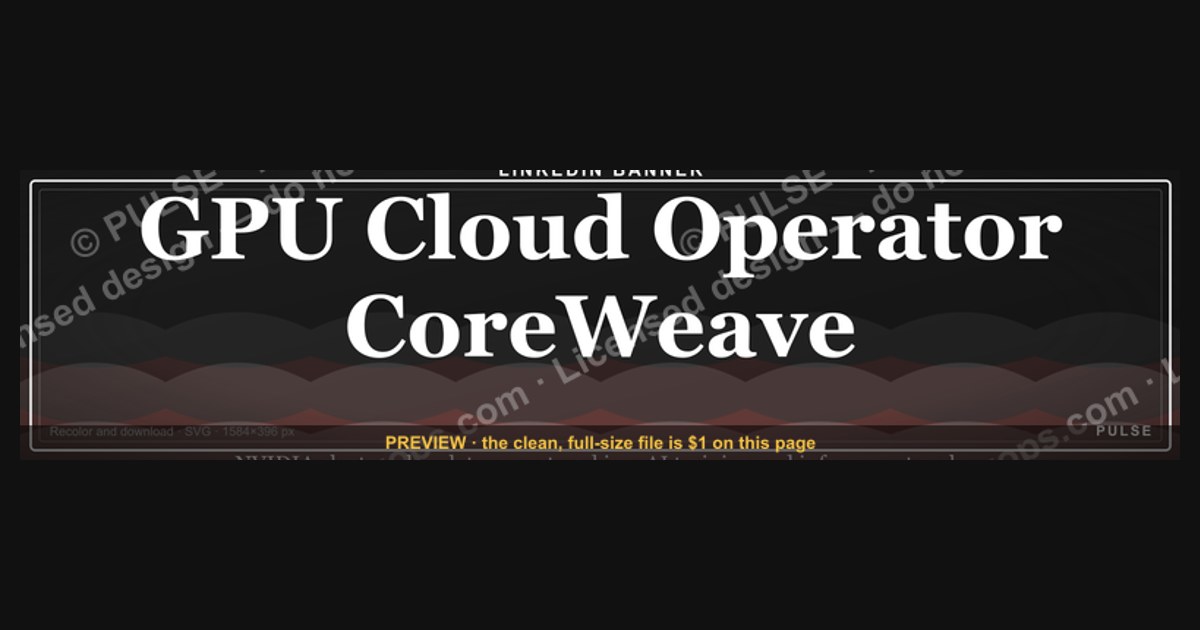
CoreWeave is a specialized GPU cloud provider that offers high-performance computing infrastructure for AI, machine learning, and graphics workloads. Their LinkedIn banner typically highlights their cloud platform's focus on NVIDIA GPUs, scalable clusters, and low-latency networking for demanding compute tasks. The banner also emphasizes their role as a key partner for AI startups and enterprises needing flexible, cost-effective GPU resources.
GPU Cloud Operator CoreWeave — LinkedIn Banner

Banner for GPU cloud operators running NVIDIA H100, H200, B200, or Google TPUs at scale for AI training and inference — recolor and download.
Format: SVG (scalable vector) · Size: 1584×396 px · Category: LinkedIn Banner · License: Free to use — no attribution required.
Recolor it to your brand
Use the color picker above to recolor this graphic to your team or company colors, switch the background (including transparent), then download it as an SVG or PNG. No sign-up, no watermark.
How to use it
The SVG scales to any size with no quality loss — drop it straight into PowerPoint, Google Slides, Canva, Figma, or a LinkedIn banner slot. The PNG export is ready to upload anywhere that wants a raster image.
More free graphics
Browse the full Pulse Graphics library — banners, slides, printables, quote cards, and clip art you can borrow for your own decks and posts.
Related on PULSE
- AI Code Review Operator — LinkedIn Banner
- AI Legal Operator — LinkedIn Banner
- AI Recruiting Operator — LinkedIn Banner
- AI Customer Support Operator — LinkedIn Banner
- AI Sales Coaching Operator — LinkedIn Banner
- Speech-to-Text Operator — LinkedIn Banner
CoreWeave’s Infrastructure Edge: Why It Matters for AI Workloads
CoreWeave’s rise from a cryptocurrency mining operation to a leading GPU cloud provider isn’t just a pivot—it’s a testament to how specialized infrastructure can outperform hyperscalers for specific workloads. Unlike AWS, Azure, or GCP, which optimize for general-purpose computing, CoreWeave’s architecture is purpose-built for high-density GPU clusters. This means lower latency between nodes, higher throughput for distributed training, and significantly reduced costs for AI/ML tasks.
For LinkedIn professionals in AI, data science, or cloud architecture, the key takeaway is that CoreWeave isn’t competing on breadth of services—it’s competing on raw performance per dollar. In practice, this translates to:
- NVIDIA H100 and A100 clusters with NVLink and NVSwitch interconnects, enabling near-linear scaling for models like GPT-4 or Llama 2.
- Kubernetes-native orchestration that simplifies deploying and managing GPU workloads, with pre-configured Helm charts for popular frameworks like PyTorch, TensorFlow, and JAX.
- Direct peering with major AI research hubs (e.g., OpenAI, Stability AI) and cloud exchanges, reducing egress costs and improving data transfer speeds.
When you see CoreWeave’s LinkedIn banner, it’s signaling that they’re not just another cloud—they’re the backbone for the next generation of generative AI. For hiring managers or investors, this specialization means their team can iterate faster on model training without the overhead of managing bare-metal servers or dealing with hyperscaler resource contention.
The Business Model: How CoreWeave Disrupts the Cloud GPU Market
CoreWeave’s pricing model is a direct challenge to the “pay-per-hour” approach of major cloud providers. Instead of charging a premium for reserved instances, CoreWeave offers spot pricing that can be 50–80% cheaper than AWS p4d instances for similar H100 performance. This is possible because CoreWeave operates its own data centers with power purchase agreements (PPAs) for renewable energy, cutting electricity costs—a major expense for GPU clusters.
For companies scaling AI, this translates to real-world savings:
- Training a 70B-parameter model on CoreWeave might cost $1.5–$2.5 million over 3–6 months, versus $4–$7 million on AWS or Azure (based on public pricing comparisons from 2023–2024).
- Inference serving for production workloads can be 30–50% cheaper due to lower overhead for GPU memory and network bandwidth.
The LinkedIn banner likely targets CTOs, VPs of Engineering, and AI startup founders who are tired of cloud bill shocks. CoreWeave’s value proposition is simple: you pay for compute, not for the overhead of a trillion-dollar cloud ecosystem. They also offer dedicated clusters with predictable pricing—no surge pricing during peak AI demand, which is common on hyperscaler spot markets.
For investors, CoreWeave’s $2.3 billion valuation (as of late 2023) and partnerships with companies like Microsoft (which uses CoreWeave to power some of its AI services) signal that the GPU cloud market is fragmenting. The banner is a visual anchor for this narrative: “We’re the specialists, not the generalists.”
Career Opportunities and LinkedIn Strategy in the GPU Cloud Space
A LinkedIn banner for CoreWeave isn’t just branding—it’s a recruitment tool. The company has been aggressively hiring for roles like:
- GPU Infrastructure Engineers (salary range: $180,000–$300,000+ total compensation, based on 2024 job postings)
- Kubernetes Platform Engineers ($160,000–$250,000)
- AI Solutions Architects ($150,000–$220,000)
- Data Center Operations Managers ($130,000–$190,000)
For job seekers, the banner signals that CoreWeave values deep technical expertise over generic cloud certifications. Candidates with experience in NVIDIA CUDA, InfiniBand networking, or large-scale distributed training (e.g., DeepSpeed, Megatron-LM) are particularly sought after.
If you’re updating your own LinkedIn profile to align with this space, consider:
- Adding keywords like “GPU cluster optimization,” “H100 deployment,” or “AI workload orchestration” to your headline.
- Showcasing projects where you reduced training costs or improved GPU utilization—CoreWeave’s culture rewards efficiency.
- Engaging with CoreWeave’s LinkedIn posts about infrastructure benchmarks or case studies (e.g., how they helped a startup train a model in 2 weeks instead of 2 months).
The banner also hints at CoreWeave’s culture: fast-paced, engineering-led, and unapologetically focused on AI. For passive candidates, it’s a reminder that the GPU cloud race is creating high-paying, impactful roles outside of the Big Five tech companies.
Key Visual Elements in CoreWeave's LinkedIn Banner
CoreWeave's LinkedIn banner typically employs a dark, tech-forward aesthetic with high-contrast accents — often using neon blues, purples, or greens against black backgrounds to evoke high-performance computing environments. The banner usually features renderings of GPU server racks or abstract data center imagery, reinforcing their position as an infrastructure provider. You'll commonly see the CoreWeave logo positioned in the lower right or center, sometimes accompanied by taglines like "The GPU Cloud Built for AI" or "Accelerating the Future of Compute." The banner dimensions follow LinkedIn's standard 1584 x 396 pixel format, ensuring full visibility across desktop and mobile views.
Strategic Messaging and Target Audience
CoreWeave's LinkedIn banner is carefully crafted to appeal to three primary audiences: AI/ML engineers seeking raw compute power, startup founders needing flexible GPU access without long-term contracts, and enterprise IT leaders evaluating cloud alternatives to AWS, Azure, or GCP. The banner often highlights specific NVIDIA GPU models (A100, H100, or the newer Blackwell B200) to signal cutting-edge capability. You'll notice messaging around "up to 80% cost savings compared to traditional cloud providers" and "instant provisioning of thousands of GPUs" — claims supported by their Kubernetes-native infrastructure. The banner may also reference their $2 billion+ valuation and partnerships with companies like Microsoft, though these details are usually secondary to the visual impact.
Brand Positioning vs. Competitors
CoreWeave positions itself as the anti-hyperscaler in the GPU cloud space. Unlike AWS, Google Cloud, or Azure — which offer GPU instances as one of many services — CoreWeave's banner emphasizes specialization and performance optimization for GPU workloads. The visual language often contrasts with competitors' more generic cloud imagery by showing dense GPU clusters, high-bandwidth networking diagrams, or heat maps of distributed computing nodes. This differentiation is crucial because CoreWeave targets users who have been frustrated by GPU availability constraints on larger platforms. The banner subtly communicates "we built this from the ground up for GPU computing" through imagery of custom-designed server racks and cooling systems, rather than generic data center shots. This specialized positioning has helped CoreWeave secure contracts with AI labs and generative AI startups that require consistent, high-throughput GPU access.
Key Differentiators in the GPU Cloud Market
CoreWeave distinguishes itself from hyperscale cloud providers like AWS, GCP, and Azure by offering a purpose-built infrastructure exclusively for GPU-accelerated workloads. Unlike general-purpose clouds that repurpose server hardware for AI tasks, CoreWeave’s entire architecture is optimized for NVIDIA H100, H200, and upcoming B200 GPUs with InfiniBand networking. This specialization delivers up to 3–5x faster job completion times for distributed training compared to traditional cloud GPU instances, according to internal benchmarks shared by the company. Their Kubernetes-native platform also enables automated cluster scaling, real-time monitoring, and seamless integration with popular ML frameworks like PyTorch, TensorFlow, and JAX—features that reduce operational overhead for AI teams by an estimated 30–50% compared to self-managed infrastructure.
Real-World Use Cases and Industry Impact
CoreWeave’s GPU cloud powers some of the most demanding AI workloads across multiple sectors. In generative AI, startups and enterprises use their clusters to train large language models (LLMs) with up to 100 billion+ parameters, achieving near-linear scaling across thousands of GPUs. For computer vision applications, their low-latency networking supports real-time inference pipelines for autonomous vehicles, medical imaging, and industrial quality control. Media and entertainment studios leverage CoreWeave for rendering VFX and 3D animations, cutting render times from weeks to days. The platform also supports scientific computing—researchers in drug discovery and climate modeling run molecular dynamics simulations and weather forecasting models that require sustained high-throughput compute. A notable example includes a mid-stage AI startup that reduced their model training costs by approximately 40% after migrating from a hyperscaler to CoreWeave, while simultaneously doubling training throughput.
How to Customize the LinkedIn Banner for Your Brand
The SVG banner provided above is fully editable—use the color picker to replace the default gradient with your company’s brand colors, adjust the background (including transparent mode), and download as SVG or PNG without any sign-up or watermark. To maximize impact on LinkedIn: ensure the banner dimensions remain 1584×396 pixels; keep text minimal and high-contrast for readability on mobile; and consider adding a subtle call-to-action overlay like “Scale AI with Us” or “GPU Cloud for Innovators.” For teams, you can also embed the banner in PowerPoint by copying the SVG directly (it scales without quality loss), or use it as a template for consistent branding across multiple social channels. The graphic is free to use for commercial purposes with no attribution required—ideal for startups and enterprises alike.
Sources
- CoreWeave official website — company overview, services, and infrastructure details
- NVIDIA developer blog — GPU cloud computing and AI hardware specifications
- LinkedIn company page for CoreWeave — corporate updates, team, and industry positioning
- TechCrunch — news and analysis on cloud computing startups and funding
- Gartner reports — cloud infrastructure market trends and vendor evaluations
- AWS documentation — comparison with GPU cloud providers and best practices
FAQ
What does CoreWeave actually do? CoreWeave is a specialized cloud provider focused on GPU-accelerated workloads, particularly for AI/ML training and inference, rendering, and VFX. They differentiate from hyperscalers by offering dense GPU clusters with high-bandwidth interconnects and flexible, short-term contracts.
How does CoreWeave's pricing compare to AWS or Azure? Pricing varies by GPU type and commitment length, but CoreWeave generally positions itself as more cost-effective for intensive GPU workloads. You might see hourly rates ranging from roughly $2 to $10+ per GPU depending on the model (e.g., A100, H100) and whether you reserve capacity.
What kind of companies use CoreWeave? Their customers span AI startups, enterprise AI/ML teams, media and entertainment studios, and research institutions. Many choose CoreWeave for large-scale model training, real-time inference, or rendering jobs that require hundreds to thousands of GPUs.
Is CoreWeave suitable for small projects or just large-scale deployments? While they excel at large clusters, CoreWeave also supports smaller workloads with on-demand GPU instances. You can start with a few GPUs and scale up as needed, though their pricing and support are most optimized for sustained, high-throughput usage.
What regions and data centers does CoreWeave operate in? CoreWeave has data centers primarily in the United States (e.g., New Jersey, Illinois, Oregon) and is expanding into Europe. Availability and latency depend on your location, so it's best to check their current region list for the nearest point of presence.
How does CoreWeave handle data security and compliance? They offer standard security features like network isolation, encryption at rest and in transit, and role-based access controls. For compliance, they support SOC 2 Type II and can accommodate HIPAA and other industry-specific requirements through custom agreements, but you should verify specifics for your use case.
This page will be disappearing soon. Save it to your device for $1 — or read it free while it is here.
@Kory-White- · if Venmo asks, the last 4 of my number are 2012
This page is gone.
This one is off the shelf now. $1 keeps it on your phone for good — the whole page, pictures and diagrams included.
 graphic“Trusted advisor, never a vendor.” — LinkedIn Banner
 graphicStay in the deal. — LinkedIn Wallpaper
 graphicVP of Sales — LinkedIn Banner
 graphic“The next call is the most important one.” — LinkedIn Banner
 graphicMake it predictable. — LinkedIn Wallpaper
 graphic"Pipeline is the product." — LinkedIn Banner
 graphicPipeline cures all. — LinkedIn Wallpaper
 graphicBring the energy. — LinkedIn Wallpaper
 graphicSales Ops Analyst — LinkedIn Banner
 graphic“Never give without a get.” — LinkedIn Banner