


Radical Candor by Kim Scott — Cliff Notes Summary
Quality
Certified

Radical Candor by Kim Scott argues managers fail by defaulting to Ruinous Empathy (nice but withholding truth) or Obnoxious Aggression (honest but cruel); the fix is caring personally while challenging directly, at the same time. This Cliff Notes Summary covers the 2x2 framework, the Get Stuff Done Wheel, Rock Star/Superstar career tracks, and the employee-owned 1:1 — a complete feedback strategy, not just a slogan about being nice.
A Manager Stuck Between Two Bad Options
Picture a sales manager with a top rep who is missing deadlines on CRM hygiene — deal stages are stale, next steps are blank, forecast accuracy is slipping. The rep is the number-one closer on the team, six weeks from President's Club. The manager has two instincts, and Scott's book exists because both are wrong.
The first instinct is to say nothing. The rep is producing, the manager doesn't want to "demotivate" someone carrying the number, and correcting a top performer feels like punishing success. Scott calls this Ruinous Empathy — feedback withheld out of what looks like kindness. The cost shows up three months later: forecast calls become guesswork, the deal desk stops trusting the pipeline, and when the rep finally gets passed over for a promotion because their operational discipline is a known gap, they have no idea why, because nobody ever told them.

The second instinct is to overcorrect — a blunt Slack message or a public dressing-down in the pipeline review, because the manager is frustrated and the deadline already slipped twice. Scott calls this Obnoxious Aggression. It's honest, but there's no visible care attached to it, so the rep hears "you don't trust me" instead of "fix the CRM." The feedback is accurate and still lands as an attack, because accuracy alone doesn't make feedback usable.
Radical Candor is the third option: the manager sits down with the rep, names the specific gap ("three of your last five deals have no next step logged, and I need that clean before forecast call"), and pairs it with a specific, credible statement of care ("I flagged you as our next enablement lead last week — I need the CRM discipline to hold up when I make that case"). The criticism is not softened into vagueness, and the care is not left implicit. Scott's own origin story for this idea comes from Sheryl Sandberg telling her directly that saying "um" every third word made her sound stupid — a blunt correction delivered inside an unmistakable envelope of investment in Scott's career. That single exchange is the seed the entire book grows from, and it is the model for the CRM conversation above: specific, immediate, and clearly in service of the person's success, not the manager's irritation.
How the Radical Candor 2x2 Actually Works

The mechanism is a two-axis grid. The vertical axis is Care Personally — does the other person believe you have their long-term interest in mind, demonstrated through specific investment, not stated intention. The horizontal axis is Challenge Directly — are you willing to say the true, specific, sometimes uncomfortable thing out loud, to the person's face, in time for them to act on it.
Both axes have to register as high, simultaneously, from the *listener's* point of view — not the speaker's. A manager can believe they care personally and still land in Ruinous Empathy if the employee never experiences that care as anything other than silence. The four quadrants:

- High Care + High Challenge = Radical Candor. The target state. Specific praise and specific criticism, delivered because you're invested in the person's growth.
- High Care + Low Challenge = Ruinous Empathy. The most common failure mode among first-time managers and among managers of top performers specifically, because the perceived cost of destabilizing a strong producer feels higher than the cost of staying silent.
- Low Care + High Challenge = Obnoxious Aggression. The brilliant-jerk pattern. Feedback is accurate but stripped of visible investment, so it reads as attack.
- Low Care + Low Challenge = Manipulative Insincerity. The worst quadrant — faint praise, hallway politicking, feedback given to third parties instead of the person who needs it.
The diagram matters because it shows the two failure quadrants are not opposites of each other — they're both failures of one axis while the other stays intact. Ruinous Empathy has real care and no challenge; Obnoxious Aggression has real challenge and no care. Fixing either one requires adding the *missing* axis, not replacing the one you already have.
The Numbers Behind the Framework
Scott's book is light on hard statistics compared to a research monograph, but it is specific about cadence, timing, and structure — and those specifics are what make the framework operational rather than aspirational.
Career Conversations run as three separate sessions, roughly one hour each, spaced two to four weeks apart: Life Story (the full arc from childhood to present, mapped for inflection points), Dreams (five different possible peak-life scenarios, deliberately unfiltered for realism), and an 18-Month Plan (what skills, relationships, and experiences move the person closer to those dreams inside a year and a half). That two-to-four-week spacing is deliberate — close enough that the thread doesn't go cold, far enough apart that each conversation gets real reflection time rather than being rushed through in one sitting.

The Get Stuff Done Wheel is a seven-step sequence — Listen, Clarify, Debate, Decide, Persuade, Execute, Learn — and Scott's guidance is that skipping any single step is where team decisions break down. Skipping Debate produces decisions nobody is bought into; skipping Persuade produces decisions people quietly sandbag; skipping Learn means the same mistake repeats every cycle.
On feedback timing, the book's operating rule is that criticism has a shelf life measured in hours, not weeks — an impromptu, five-minute hallway correction beats a scheduled sit-down, which beats saving it for a quarterly or annual review. The annual-review-only pattern is explicitly named as the most expensive version of Ruinous Empathy a company can institutionalize, because by the time the feedback arrives, the employee has had six to twelve months to build a self-image that the review then contradicts all at once.
On the 1:1, Scott's benchmark is that the meeting belongs to the employee's agenda, not the manager's status-update template, and that it should be near-impossible to cancel — canceling a 1:1 for a customer call is a legible signal to the employee about where they rank. The Rock Star/Superstar split isn't given as a fixed ratio, but Scott's practical guidance is that most healthy teams are majority Rock Stars — people on a stable trajectory who want depth, not promotion — with a smaller number of Superstars on a steep trajectory who need frequent new scope or they stall and leave. Treating a Rock Star like a Superstar (constant pressure to seek promotion) and treating a Superstar like a Rock Star (leaving them in the same seat for years) are both named as retention failures.
Trade-offs and Alternative Management Models

Radical Candor doesn't operate in a vacuum — Scott positions it explicitly against nearby management philosophies, and understanding the trade-offs is more useful than treating the 2x2 as a universal answer.
Against command-and-control management, Radical Candor trades speed of decision-making for buy-in and retention. A directive manager can issue a decision faster than a manager running the full Get Stuff Done Wheel, but the wheel's Debate and Persuade steps are what prevent the decision from being quietly undermined during Execute. The cost is time up front; the payoff is durability.
Against consensus-driven management, the trade-off runs the other way. Consensus-seeking avoids the risk of a decider getting it wrong, but Scott is blunt that "voting is for democracies, not teams" — a manager who won't make the call after Debate has happened is deferring responsibility, not building trust. The Decide step requires someone to own the outcome, which means Radical Candor accepts more individual accountability risk in exchange for faster, clearer execution.

Against pure results-only management (the Andy Grove *High Output Management* tradition Scott's book sits alongside), Radical Candor adds the relational layer — Care Personally — as a precondition, not a nice-to-have. The trade-off is time investment: Career Conversations and protected 1:1s cost real calendar hours that a pure output-metrics manager wouldn't spend. Scott's bet is that the relationship is what makes the hard feedback landable at all, so skipping it doesn't save time, it just defers the cost to a later, messier conversation.
There's also a well-known critique worth weighing: the line between Radical Candor and Obnoxious Aggression depends almost entirely on relationship strength built *before* the feedback moment, and the book's own 2x2 graphic gets reproduced constantly without that caveat. A manager with no banked trust who tries to "challenge directly" on day one is not practicing Radical Candor — they're practicing Obnoxious Aggression with better branding. The trade-off is sequencing: Care Personally has to be established first, through small, specific, repeated actions, before Challenge Directly is safe to deploy at full strength.
Common Pitfalls When Applying Radical Candor
The most common pitfall is treating the 2x2 as a personality label instead of a per-conversation choice. Managers read the framework, decide they are "naturally more Ruinous Empathy," and use that as an excuse rather than a diagnosis — the quadrant describes a specific interaction, not a fixed identity, and the same manager can land in different quadrants with different people on the same day.

A second pitfall is skipping straight to Challenge Directly without ever depositing Care Personally in the relationship first. This is the fastest way to convert a well-intentioned attempt at Radical Candor into Obnoxious Aggression from the listener's side, because care that exists only in the manager's head doesn't count — it has to be visible and specific to the other person.
A third pitfall is confusing public praise with private criticism and reversing the pattern — criticizing in front of the team while saving praise for a private message. Scott's rule is the opposite in both directions: praise publicly, criticize privately, always, because public criticism recruits an audience the feedback doesn't need and private praise wastes an opportunity to reinforce behavior the whole team should see.
A fourth pitfall is delaying feedback until a scheduled review cycle. Scott's framing is that delayed feedback is functionally dishonest feedback — by the time it arrives, it's disconnected from the moment that caused it, and the recipient has already built months of self-narrative the feedback now has to fight against. The five-minute impromptu correction is cheaper for everyone than the twenty-minute formal one that happens two months later.

A fifth pitfall, specific to sales organizations, is applying Ruinous Empathy asymmetrically — giving direct, timely feedback to average performers while going silent with top producers out of fear of demotivating the number. This is precisely the pattern Scott's Google/AdSense and Apple University experience was built to correct, and it's the single most expensive version of the mistake in a revenue org, because the rep with the most leverage to change team behavior is the one least likely to hear the truth.
A sixth pitfall is mistaking the Get Stuff Done Wheel for a one-time exercise instead of a recurring loop — teams that run Listen through Learn once on a big decision and then abandon the discipline for smaller day-to-day calls lose the compounding benefit; the wheel's value comes from repetition, not from a single well-run cycle.
Related questions
What is the difference between Radical Candor and Radical Respect?
*Radical Respect* (2024) is Scott's follow-up, extending the original model to address cultural context and DEI dynamics the 2017 book underweighted — Radical Candor as originally written assumes a fairly Western, low-context communication norm.
Does Radical Candor work for remote teams?
Yes, with adaptation. Scott's revised edition recommends more frequent 1:1s, video for hard conversations, and explicit async-feedback norms, since the original "in-person" emphasis predates widespread remote work.
What is the HHIPP test?

A feedback-delivery checklist from Chapter 6: Humble, Helpful, Immediate, In-Person (praise publicly, criticize privately when the feedback is critical). It's a practical filter to run before delivering criticism.
Are Rock Stars less valuable than Superstars?
No — Scott is explicit that both are stars and both deserve strong management. Rock Stars want depth and stability; Superstars want steep growth. Misapplying either track is a retention failure, not a performance judgment.
How does Radical Candor relate to Andy Grove's management writing?
Scott worked in the tradition Grove's *High Output Management* established and adds the relational layer — Care Personally — as an explicit precondition for the results-driven tactics Grove focused on.
FAQ
Is Radical Candor just about giving feedback? No. Feedback is the most famous piece, but the book also covers the Get Stuff Done Wheel for team execution, Rock Star/Superstar career management, and hiring and firing tactics — a full management system, not a single technique.
Does Radical Candor mean saying everything you think, all the time? No. Challenge Directly only counts as Radical Candor when it's paired with visible Care Personally. Challenge without care is Obnoxious Aggression, which Scott treats as a distinct failure mode, not a milder version of success.

How is this different from Extreme Ownership or Dare to Lead? Most management books emphasize either accountability or empathy as the primary lever. Scott's 2x2 insists both are required simultaneously and names the specific failure mode — Ruinous Empathy or Obnoxious Aggression — that results from having only one.
Does the framework only apply to tech and startups? No. Scott's examples draw from Google, Apple, and Twitter, but also from her time in government and from coaching across manufacturing and retail contexts. The core mechanism — care personally, challenge directly — is industry-agnostic.
Can Radical Candor backfire on a team with low trust? Yes. The model assumes a baseline of psychological safety. Without it, direct challenge reads as attack regardless of intent. Scott's guidance is to rebuild Care Personally first, through listening and small consistent support, before increasing how directly you challenge.
What's the single highest-leverage habit from the book to start with? The employee-owned 1:1 — handing the agenda to the direct report and protecting the meeting from cancellation. It's the lowest-cost entry point and creates the relational foundation the rest of the framework depends on.
Sources
- Scott, Kim — *Radical Candor: Be a Kick-Ass Boss Without Losing Your Humanity* (St. Martin's Press, 2017; revised 2019) — https://www.radicalcandor.com/
- Scott, Kim — *Radical Respect: How to Work Together Better* (St. Martin's Press, 2024)
- Grove, Andy — *High Output Management* (Random House, 1983)
- Sandberg, Sheryl — *Lean In: Women, Work, and the Will to Lead* (Knopf, 2013) — https://leanin.org/
- Schmidt, Eric; Rosenberg, Jonathan; Eagle, Alan — *Trillion Dollar Coach: The Leadership Playbook of Silicon Valley's Bill Campbell* (HarperBusiness, 2019)
- Google re:Work — Project Oxygen manager research — https://rework.withgoogle.com/
- First Round Review — interviews with Kim Scott on management practice — https://review.firstround.com/
- Harvard Business Review — "The Feedback Fallacy," Buckingham & Goodall (2019) — https://hbr.org/
- Lattice — feedback and performance management product documentation — https://lattice.com/
Related on PULSE
This page will be disappearing soon. Save it to your device for $1 — or read it free while it is here.
@Kory-White- · if Venmo asks, the last 4 of my number are 2012
This page is gone.
This one is off the shelf now. $1 keeps it on your phone for good — the whole page, pictures and diagrams included.
 pulse-recentBlue Ocean Strategy by W. Chan Kim and Renee Mauborgne — Top 10 Key Takeaways for Sales Leaders in 2027
 pulse-recentWhat are the concrete steps in Strategic Selling for building a sales plan in 2027?
 pulse-recentWhat are the first three concrete steps in Sandler Rule #1 for a new sales rep in 2027?
 pulse-recentGetting to Yes by Roger Fisher and William Ury — Top 10 Key Takeaways for Sales Leaders in 2027
 pulse-recentWhat is the first concrete step in The Sandler Rules by David Mattson for building a sales plan in 2027?
 pulse-recentWhat is the second concrete step in Strategic Selling by Miller Heiman for identifying a sales coach in 2027?
 pulse-recentStrategic Selling by Robert Miller and Stephen Heiman — Top 10 Key Takeaways for Sales Leaders in 2027
 pulse-recentThe Sales Manager’s Guide to Greatness by Kevin Davis — Top 10 Key Takeaways for Sales Leaders in 2027
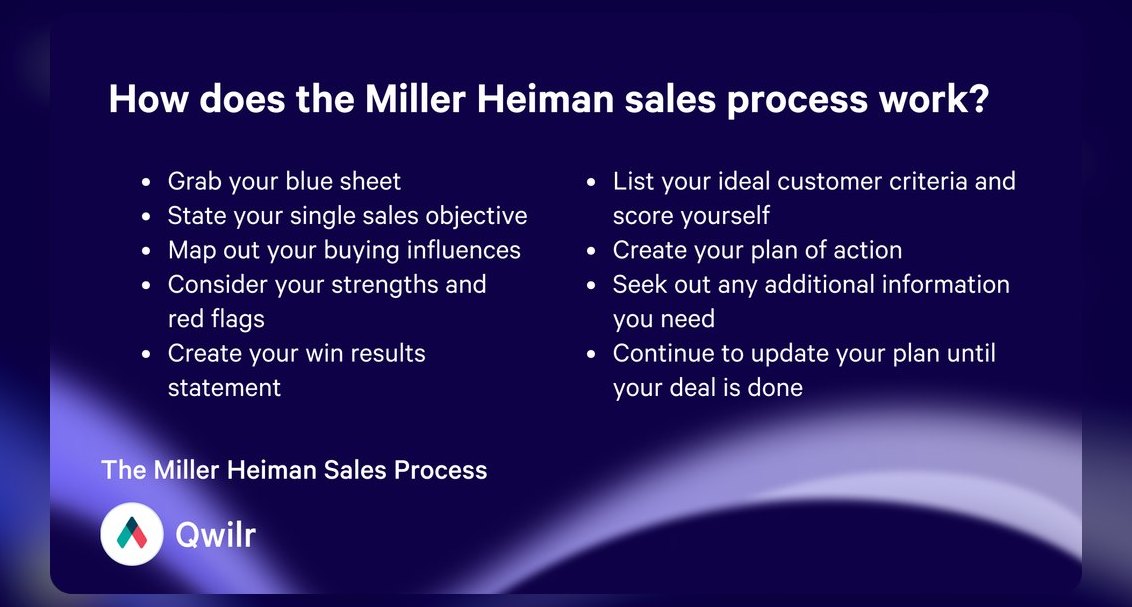 pulse-recentWhat is the step-by-step process for Strategic Selling by Miller Heiman in 2027?
 book-summaryMajor Account Sales Strategy by Neil Rackham: Summary, Key Lessons, and RevOps Takeaways