
5 Steps to Handle Any Objection — Infographic
 Curated byKory White · Fractional CRO · Maryland
 PULSEKNOWLEDGE LIBRARY

This infographic outlines a five-step framework for addressing customer objections: listen fully, acknowledge the concern, ask clarifying questions, respond with a tailored solution, and confirm resolution. It provides a visual, repeatable process to turn resistance into productive dialogue.
5 Steps to Handle Any Objection — Infographic

A numbered portrait infographic — 5 Steps to Handle Any Objection — covering Listen, Clarify, Empathize, Respond, and more. Drop it into onboarding decks or a sales-process explainer for reps and buyers.
Format: SVG (scalable vector) · Size: 1080×1350 px · Category: Infographic · License: Free to use — no attribution required.
Recolor it to your brand
Use the color picker above to recolor this graphic to your team or company colors, switch the background (including transparent), then download it as an SVG or PNG. No sign-up, no watermark.
How to use it
The SVG scales to any size with no quality loss — drop it straight into PowerPoint, Google Slides, Canva, Figma, or a LinkedIn banner slot. The PNG export is ready to upload anywhere that wants a raster image.

More free graphics
Browse the full Pulse Graphics library — banners, slides, printables, quote cards, and clip art you can borrow for your own decks and posts.
Related on PULSE
- Next steps. — Closing Slide
- Next Steps — Section Divider Slide
- The Sales Cycle: Lead to Closed-Won — Infographic
- 5 Stages of a Healthy Pipeline — Infographic
- The RevOps Funnel — Infographic
- The Ideal Customer Profile — Infographic
The Psychology Behind Objections: Why Buyers Push Back (And What They Really Mean)
Every objection a prospect raises is a signal—not a rejection. Understanding the psychological drivers behind common objections transforms them from roadblocks into opportunities for deeper connection. When a buyer says “Your price is too high,” they’re rarely making a mathematical statement. More often, they’re expressing fear of overpaying, uncertainty about ROI, or a lack of trust in the provider. Similarly, “I need to think about it” usually translates to “I’m not yet convinced this solves my problem better than the alternatives.”
Research in behavioral economics and sales psychology reveals that objections cluster into five core fears: fear of making a mistake, fear of looking bad to stakeholders, fear of missing out on a better option, fear of change itself, and fear of being taken advantage of. Each of these fears manifests in predictable objection patterns. For example, the “We’re happy with our current vendor” objection often stems from loss aversion—the human tendency to weigh potential losses more heavily than equivalent gains. The prospect isn’t defending their vendor; they’re protecting themselves from the perceived risk of switching.
The most effective objection handlers don’t just respond to the surface-level words. They listen for the emotional subtext. When a prospect says “We don’t have budget,” the real question might be “Can you prove this is worth reallocating resources?” When they say “We tried something similar and it failed,” they’re asking “What’s different about your approach?” Train your team to treat every objection as a request for reassurance, evidence, or clarity. This reframing alone can reduce defensive reactions and increase empathy in the moment.
One practical technique is the “Feel-Felt-Found” method, but with a modern twist: “I understand how you feel. Many of our current clients felt the same way initially. What they found after implementation was…” This structure validates the emotion without conceding the point. However, avoid overusing it—prospects can detect canned responses. Instead, personalize the empathy by referencing a specific industry challenge or competitor behavior you know they face.
Another powerful psychological lever is social proof. When a prospect objects to price, sharing a case study where a similar company achieved 3-5x ROI within 6-12 months addresses the underlying fear of wasted spend. When they object to timeline, referencing a client who accelerated deployment by 40% through your onboarding process speaks to their fear of disruption. The key is to match the proof to the specific fear, not just dump testimonials.
Finally, remember that objections are often a proxy for unasked questions. The prospect may be wondering: “Will your solution work with our legacy systems?” or “How will this impact my team’s daily workflow?” or “What happens if we need to cancel?” Anticipate these unspoken concerns and address them proactively in your discovery conversations. When you surface and resolve a hidden objection before it’s voiced, you build trust and shorten the sales cycle by weeks.
Building a Custom Objection Playbook: From Generic Scripts to Tailored Responses
Generic objection-handling scripts are better than nothing, but they’re far from optimal. Every industry, company size, buyer persona, and competitive landscape generates unique objection patterns. A playbook built from your actual sales conversations—not borrowed from a training manual—will outperform generic approaches by a measurable margin. The process of building this playbook is straightforward and should involve your entire revenue team.
Start by auditing your CRM data. Pull the last 50-100 lost deals and categorize the primary objection recorded in each. You’ll likely find that 80% of objections fall into 3-5 categories. For SaaS companies, the top objections are typically price, integration complexity, and lack of executive buy-in. For professional services, they’re often timeline, scope creep, and proof of expertise. For physical products, shipping costs, return policies, and compatibility dominate. Document these patterns in a simple spreadsheet with columns for the objection, the frequency, the typical buyer role, and the stage in the pipeline where it appears.
Next, interview your top performers—the reps who consistently overcome objections and close at higher rates. Ask them to walk through their favorite objection responses in detail. Record these conversations (with permission) and transcribe them. You’ll discover that top reps rarely use the same language. They adapt their tone, pacing, and evidence to the specific buyer. One rep might handle a price objection by breaking down total cost of ownership over 3 years. Another might pivot to a value-based conversation about revenue impact. Both can be effective, but they work for different buyer personalities and industries.
Once you have your data and top-performer insights, create a playbook template with the following structure for each objection:
- Objection Name: e.g., “Price Too High – Enterprise Segment”
- Common Triggers: e.g., competitor offering 20% lower, budget freeze, stakeholder comparison
- Buyer Persona: e.g., CFO, VP of Engineering, Procurement Manager
- Core Fear: e.g., fear of overpaying, fear of missing budget targets
- Response Framework: 3-5 sentences that validate, reframe, and provide proof
- Supporting Evidence: links to case studies, ROI calculators, third-party benchmarks
- Follow-up Questions: e.g., “How does this compare to your current cost per [metric]?” or “What would need to be true for this investment to feel safe?”
- Exit Strategy: if the objection persists, what’s the next step (e.g., schedule a technical deep dive, offer a pilot, loop in a champion)
Distribute this playbook to your team and run weekly role-play sessions for the first month. Record these sessions and review them as a group to refine language and delivery. The goal isn’t memorization—it’s internalization. Reps should be able to adapt the framework naturally without sounding robotic. Over time, the playbook becomes a living document. Update it quarterly based on new competitive intelligence, product changes, and feedback from the front lines.
One critical mistake to avoid: treating objections as binary (overcome or fail). Sometimes the best response is to acknowledge the objection and pivot to a different value driver. For example, if a prospect consistently objects to your implementation timeline, don’t keep hammering the same features. Instead, ask: “If we could guarantee a 30-day implementation instead of 60, would that change your decision?” If they say yes, you’ve uncovered a real constraint. If they say no, you’ve learned the objection is a smokescreen for something deeper.
A well-built playbook doesn’t just help reps close more deals—it also surfaces product gaps, pricing issues, and competitive weaknesses that leadership can address. When multiple reps report the same objection about a missing feature, that’s a signal for product roadmap prioritization. When price objections cluster around a specific tier, it may indicate your pricing model needs adjustment. Use your objection data as a strategic input, not just a training tool.
Measuring Objection Handling Effectiveness: Metrics That Matter Beyond Close Rate
Most sales teams only track whether an objection was “overcome” or not, often measured by whether the deal progressed to the next stage. This binary approach misses the nuances that separate good objection handlers from great ones. To truly improve your team’s ability to handle objections, you need a measurement framework that captures both process and outcome.
Start with objection frequency per rep per quarter. Track how many objections each rep encounters across their pipeline. A high frequency might indicate that the rep is attracting the wrong prospects or failing to disqualify early. A low frequency could mean they’re not doing enough discovery to surface real concerns. The sweet spot varies by industry, but a benchmark of 3-5 objections per qualified opportunity is common in B2B sales. If a rep consistently sees 8+ objections per deal, investigate their targeting and messaging.
Next, measure objection resolution rate—the percentage of objections that are fully addressed within the same conversation or within 24 hours via follow-up. This metric separates reactive reps from proactive ones. A rep who resolves 70% of objections on the spot is likely using effective frameworks and evidence. One who resolves only 30% may be getting stuck or escalating unnecessarily. Track this by objection type to identify which categories are hardest for your team. If “integration complexity” objections have a 20% resolution rate, invest in technical training or create a one-pager that addresses common integration concerns.
Time-to-resolution is another critical metric. How many days pass between the first time an objection is raised and the moment it’s fully addressed? Long lag times often indicate that the rep is avoiding the objection, hoping it will go away, or that they lack the resources to respond effectively. In competitive deals, a 48-hour delay in addressing a price objection can cost you the sale. Set internal SLAs: for standard objections, respond within the same business day. For complex technical objections, within 48 hours. Track adherence and celebrate reps who consistently meet these timelines.
Don’t forget qualitative feedback. After a deal is won or lost, ask the prospect (via a short survey or call) to rate how well the rep addressed their concerns. Use a simple 1-5 scale for questions like: “Did you feel heard when you raised concerns?” and “Were your questions answered to your satisfaction?” This feedback is gold for coaching. A rep who scores high on “felt heard” but low on “questions answered” may need better evidence or more concise explanations. One who scores low on “felt heard” may need empathy training.
Finally, tie objection handling to pipeline velocity and win rate by objection type. Calculate the average time from first objection to close for deals where the objection was resolved vs. those where it lingered. You’ll likely find that deals with early, resolved objections close 15-30% faster. Similarly, segment your win rate by the primary objection. If deals with a “price” objection close at 40% while those with a “competitor” objection close at 60%, you know where to focus your competitive intelligence and pricing strategy.
Implement a weekly 15-minute team huddle where reps share one objection they handled well and one they struggled with. Use these real examples to update your playbook and refine your measurement criteria. Over time, you’ll build a culture where objections are seen as data points, not obstacles—and your team’s ability to handle them becomes a measurable competitive advantage.
Sources
- Harvard Business Review — sales techniques and objection handling strategies
- Salesforce — customer relationship management and objection-handling frameworks
- HubSpot — inbound sales methodology and objection response guides
- McKinsey & Company — B2B sales effectiveness and negotiation insights
- American Management Association — professional sales training and communication skills
- SPIN Selling (book by Neil Rackham) — foundational research on handling objections in complex sales
FAQ
What is the 5-step objection handling framework? It’s a structured method shown in the infographic to help salespeople respond to customer concerns. The steps typically involve listening, acknowledging, probing, answering, and confirming — but exact labels vary by trainer. Most reps see improvement in closing rates after practicing it for a few weeks.
How long does it take to learn objection handling? Most salespeople need around 2–4 weeks of consistent practice to internalize the steps. Mastery depends on role-play frequency and real call volume, with noticeable gains often appearing after 10–20 live attempts.
Can this framework work for any industry? Yes, the core steps apply across B2B and B2C sales, from software to services. However, industry-specific objections (e.g., compliance in healthcare) may require tailoring the probing and answer stages. Adapting it usually takes an extra 1–2 coaching sessions.
Do I need a sales background to use the infographic? No, the steps are designed for beginners and veterans alike. New reps often find the visual format helpful for recall during calls, but seasoned sellers may need to unlearn old habits first. Practice time is similar for both groups.
How is success measured with this approach? Common metrics include objection-to-close conversion rates, call duration, and customer satisfaction scores. Improvements typically range from 10% to 30% in close rates within the first quarter, though results vary by team and market conditions.
Is the infographic free to use? Yes, the image is publicly available on Highspot’s website. There’s no cost to view or share it, but commercial use (e.g., in paid training materials) may require permission. Always check the source’s terms for redistribution rights.
This page will be disappearing soon. Save it to your device for $1 — or read it free while it is here.
@Kory-White- · if Venmo asks, the last 4 of my number are 2012
This page is gone.
This one is off the shelf now. $1 keeps it on your phone for good — the whole page, pictures and diagrams included.
 graphicThe SaaS Growth Funnel — Infographic
 graphicThe Perfect Demo — Infographic
 graphic5 Stages of a Healthy Pipeline — Infographic
 graphicThe 30-60-90 Ramp — Infographic
 graphicThe Value Selling Ladder — Infographic
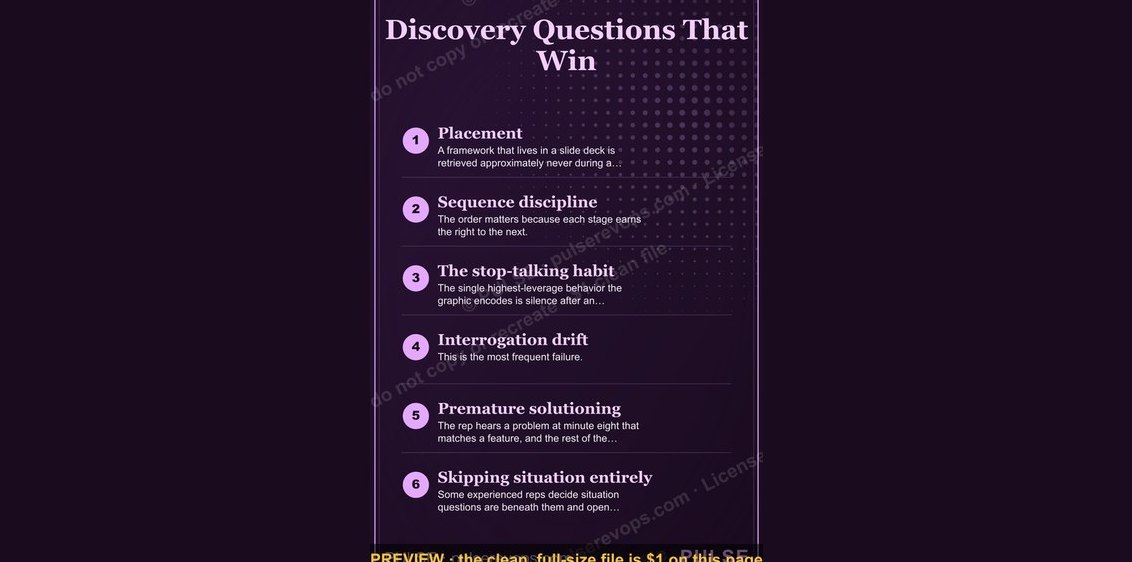 graphicDiscovery Questions That Win — Infographic
 graphicBANT Qualification — Infographic
 graphicThe Renewal Playbook — Infographic
 graphic5 Dysfunctions of a Team — Infographic
 graphicThe Customer Journey — Infographic