
“People buy outcomes, not features.” — Quote Card
 Curated byKory White · Fractional CRO · Maryland
 PULSEKNOWLEDGE LIBRARY
Quality
Certified
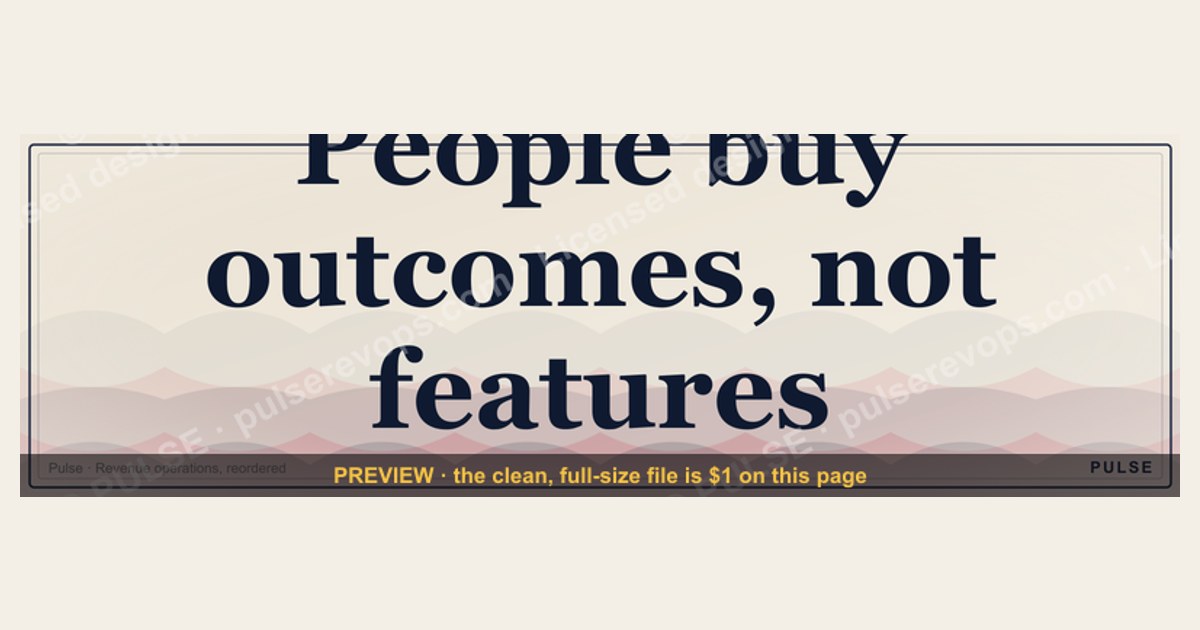
People buy outcomes, not features, because a buyer's budget is attached to a result they need — revenue recovered, hours returned, risk removed — not to a capability list. Features earn belief only after an outcome earns attention. This Quote Card exists to force that reordering in decks, landing pages, and discovery calls.
What it is and why it matters
The line "People buy outcomes, not features" compresses a decades-old sales axiom into eight words, which is exactly why it works as a Quote Card: it fits on a slide, a social square, or a whiteboard, and everyone in the room instantly knows whether the deck they just built violates it. The card itself is a 1080×1080 SVG in the Pulse accent style — scalable, recolorable to your brand palette, and free to reuse without attribution. But the artifact is trivial compared to the operating discipline it encodes.
Here is the distinction in plain terms. A feature is something the product has. An outcome is something the buyer gets. "Automated email sequences" is a feature. "Nobody on your team forgets a follow-up again" is an outcome. "Real-time analytics dashboard" is a feature. "You walk into the Monday pipeline review with numbers you trust instead of numbers you apologize for" is an outcome. The feature is a noun that lives in your product. The outcome is a verb that happens in the buyer's week.
Why does the distinction carry so much commercial weight? Because features require the buyer to do translation work, and translation work is friction. When a prospect reads "50+ native integrations," they have to run a private mental query — *do I use any of those? would that actually remove the CSV export I do every Thursday?* — and that query costs them attention they were only lending you in the first place. Multiply that across a twelve-slide feature deck and you have asked a distracted person to solve twelve small puzzles before they are allowed to feel anything. Most of them stop at slide three.

There is also a structural reason rooted in how purchases get approved, and it matters more in B2B than in consumer. The person you demo to is rarely the person who signs. Your champion has to re-tell your story internally, from memory, in a hallway or a Slack thread, to a CFO who has never seen your product. Features do not survive that retelling — nobody repeats a spec sheet accurately. Outcomes do, because an outcome is already shaped like the sentence a champion needs: "They say we'd cut month-end close from nine days to four." That sentence travels. "They have a rules engine with conditional branching" does not.
The adjacent effect is on your own roadmap. Teams that market features tend to build features, because the feedback loop rewards countable additions. Teams that market outcomes tend to build toward a measured delta, because the marketing claim creates an obligation to prove it. In practice this shows up in what a product team argues about in planning: shipping-count versus effect-size. The Quote Card, hung in a product room rather than a sales room, quietly changes which argument happens.
Two honest caveats, because the axiom is often over-applied. First, outcomes without features read as vapor. A buyer in the late stage absolutely wants to see the mechanism — the "how" is what makes the "what" credible, and a page of pure benefit language with no substantiation triggers skepticism rather than desire. Second, some markets genuinely are spec-driven: infrastructure buyers comparing latency, engineers comparing API surface, regulated buyers comparing certifications. The rule is not "never mention features." The rule is that features are evidence, and evidence is presented *after* a claim, never instead of one.

The step-by-step process
Turning "People buy outcomes, not features" from a Quote on a wall into a repeatable habit takes a documented pass over your existing assets. Here is the sequence that actually holds up in practice.
Step one: inventory the features. Pull every feature claim you currently make — website nav labels, pricing-page bullets, the demo script, the one-pager, the battlecard, the boilerplate at the bottom of your press releases. Most mid-size companies land somewhere between 40 and 120 distinct claims. Put them in a single sheet, one per row. Do not edit yet. The inventory alone usually shocks people, because the same feature appears under six different names across six different assets.
Step two: write three outcomes per feature. For each row, force yourself to three, not one. The first outcome you write is almost always the generic one ("saves time"). The second is usually better. The third is where the specific, ownable version lives ("your ops lead stops spending Friday afternoon rebuilding the forecast by hand"). If you cannot get to three, that is diagnostic — the feature may not actually be doing anything for anyone, which is a product finding disguised as a copy finding.

Step three: attach a measurable unit to each outcome. Hours per week, dollars per quarter, days off a cycle time, percentage points off a churn rate, headcount avoided, errors caught. If you have customer data supporting the number, cite the range you actually observe, not the ceiling. If you have no data, use the *unit* without the number — "cuts the number of manual re-keys per week" is honest; "cuts manual re-keys by 90%" without evidence is a liability that a procurement team will eventually make you defend.
Step four: rewrite the top of every asset. The first screen, the first slide, the first sentence of the cold email — those carry the outcome. The feature moves down the page as proof. A useful discipline: the reader should be able to stop after your first two sentences and correctly describe what changes in their life. If they cannot, the top is still feature-led.
Step five: rewrite the discovery script before the demo script. This is the step teams skip. Outcome-led *selling* is not a rewriting exercise, it is a questioning exercise. If a rep does not know which outcome this specific prospect is chasing, outcome language just becomes a different flavor of guessing. The opening question is some version of: "What's the result you've been trying to get and haven't been able to?" Everything shown afterward gets tied explicitly back to that answer.

Step six: install a review gate. Nothing publishes without someone asking the one question — "what human outcome does this deliver?" — of every claim on the page. Gates die without an owner, so name one.
Costs, timelines, and typical ranges
The conversion is cheaper than most repositioning work and slower than most people expect, because the bottleneck is not writing — it is evidence gathering and internal agreement.
Effort, by asset class. A single landing page rewrite is a half-day of writing plus a day of review cycles. A pricing page is harder, typically two to three days, because every bullet is scrutinized by product, legal, and finance. A twelve-to-twenty-slide sales deck is usually a full week of elapsed time even though the writing is maybe six hours — the delay is the approval chain. A full asset inventory across a company with a real content library (100+ pages) is a multi-week project, and the honest scope is usually four to eight weeks of part-time work by one owner, not a sprint.

The customer-interview cost. This is the line item people underfund. To get specific, defensible outcomes you need to talk to existing customers and ask what changed after they bought. Eight to twelve interviews is the range where patterns stabilize; below five you are generalizing from anecdotes, above about fifteen you hit diminishing returns for a single segment. Each interview is 30–45 minutes plus roughly the same again in synthesis. Budget 20–30 hours total for a solid round. If you use an outside researcher, this is where external cost concentrates.
What incentives and comp look like. If you want reps to sell outcomes, the CRM has to capture them. Adding a required "desired outcome" field to opportunities is a small config change but a real behavioral one, and adoption is typically poor for the first 30–60 days without a manager inspecting it in pipeline reviews. Plan on a quarter before the field contains anything trustworthy.

Timeline to signal. Website messaging changes show up in analytics within two to four weeks if you have meaningful traffic, but attribution is noisy — seasonality, campaign changes, and pricing tests all confound it. Sales-motion changes take a full sales cycle plus one to read honestly. If your average cycle is 60 days, do not draw conclusions before month four. Teams that judge outcome messaging at week three almost always misread noise.
Where the numbers get abused. Be careful with lift claims. You will see conversion-improvement figures quoted for outcome-led copy across the industry, and they range wildly because they depend entirely on the starting baseline, the traffic quality, and the offer. A page that was pure spec sheet has enormous headroom; a page already written in benefit language has almost none. Run your own test, report your own delta, and resist quoting someone else's percentage as if it will transfer to your funnel. That discipline is itself an application of the Quote — you are selling your buyer an outcome, so you owe them a real one.
Ongoing maintenance. The library rots. New features ship, new outcomes emerge from customer success calls, and old numbers go stale. A quarterly half-day refresh keeps it current; annual-only refreshes produce decks that describe the product you had eighteen months ago.

Where teams get it wrong
Mistake one: swapping specs for adjectives. The most common failed conversion replaces "256-bit encryption" with "powerful, enterprise-grade security." That is not an outcome, it is a feature wearing a costume. An outcome names something that happens to a person: "you pass your customer's security review without pulling an engineer off the roadmap for two days." If the sentence could appear verbatim on a competitor's site, it is not an outcome — it is filler.
Mistake two: outcome inflation. Under pressure to sound impactful, teams reach for the top of the observed range and present it as typical. This survives exactly until one buyer's procurement team asks for substantiation, or until a customer who got the median result feels misled. The reputational cost lands on renewal, not on the first sale, which is why it is easy to miss. State ranges. Say "typical" and "best case" as separate things.
Mistake three: dropping features entirely. Late-stage buyers, technical evaluators, and anyone who has been burned before need the mechanism. A page that never explains *how* the outcome happens reads like a promise with nothing behind it. The structure that works is claim → mechanism → proof: outcome headline, short explanation of the feature that produces it, then evidence. Removing the middle term does not make the page more persuasive, it makes it less credible.

Mistake four: outcome language without discovery. A rep who has memorized twelve outcome statements but never asked what this buyer wants is just running a more sophisticated pitch. The outcome has to be *their* outcome. Two prospects buying the same product often want opposite things — one wants speed, one wants control — and the same feature has to be framed differently for each. Scripted outcome language applied uniformly is nearly as bad as a feature dump, and sometimes worse, because it sounds like you listened when you did not.
Mistake five: no owner for the review gate. Everyone agrees with the Quote in the meeting and nobody enforces it in the pull request. Six months later the site has drifted back to feature bullets because feature bullets are easier to write — they require no customer knowledge. Whoever owns messaging has to own the veto.
Mistake six: ignoring the multi-stakeholder split. In a committee purchase the outcomes genuinely differ by seat. The end user wants their day to get less annoying. The manager wants a metric to move. The economic buyer wants a number in a budget line, and the security or legal reviewer wants risk removed. Writing one outcome for all four flattens the deal. Better practice is a short outcome statement per persona, all pointing at the same product, and letting the champion pick which one to carry upstairs.

Mistake seven: treating it as a copy project. If discovery, CRM fields, demo structure, and case-study selection do not change, the messaging change is cosmetic and will not survive contact with a live pipeline.
Decision framework: when to choose what
Not every surface should be outcome-heavy. The useful question is not "outcome or feature" but "what does this reader already believe, and what do they need next?" Use the buyer's stage and role to set the mix.
When outcome language should dominate (roughly 80/20). Cold outreach, homepage hero, ad copy, the first two minutes of a discovery call, conference booth signage, and social content — all situations where you have not yet earned attention and the reader has no reason to translate specs on your behalf. Here the Quote Card is literal instruction: lead with what changes.

When the mix should be even (50/50). Mid-funnel comparison pages, the body of a sales deck, solution briefs, and webinar content. The buyer is now shortlisting and needs to know both what they get and how you produce it. This is where "claim → mechanism" pairs work best: every outcome headline is immediately followed by the feature that makes it real.
When features should lead (20/80). Technical documentation, API references, security questionnaires, RFP responses, integration pages, and any conversation with an evaluator whose job is verification rather than desire. Outcome language in a security questionnaire reads as evasion. Answer the spec, cleanly, and let the outcome live in the executive summary.
When the whole frame needs adjusting. Two edge cases deserve their own handling. In genuinely commoditized categories where every vendor produces the same outcome, differentiation moves to *how* — implementation speed, support model, contract flexibility — so the "feature" that matters is often not in the product at all. And in brand-new categories where the buyer does not yet know the outcome is achievable, you often have to teach the mechanism first, because the outcome sounds implausible without it. In both cases the axiom still holds directionally; the sequencing just shifts.
Related questions
How do I find the real outcome my customers care about?
Interview eight to twelve existing customers and ask what changed after they bought — what they stopped doing, what got faster, what stopped worrying them. Listen for emotional phrasing and for units of time or money. Those phrases, quoted nearly verbatim, become your outcome library.
Does this apply to B2C as well as B2B?
Yes, and it is often more visceal in B2C because the buyer is spending their own money. The difference is that B2B outcomes usually need a business metric attached for the approval chain, while B2C outcomes can rest on relief, status, or convenience alone.
Should I ever remove features from my website entirely?
No. Move them, do not delete them. Late-stage and technical buyers actively look for the spec detail, and its absence reads as concealment. Demote features to a supporting section beneath the outcome claim, or to a dedicated technical page.
How do I stop reps from reverting to feature dumps?
Change what gets inspected. Require a "desired outcome" field on every opportunity, review it in pipeline meetings, and coach on the discovery question rather than the demo. Behavior follows inspection, not training decks.
Can one Quote Card actually change anything?
The card itself changes nothing; it functions as a shared shorthand. Its value is that it makes the standard sayable in a review — someone can point at it instead of arguing — which lowers the social cost of rejecting a feature-led draft.
FAQ
What does "People buy outcomes, not features" actually mean?
It means a buyer's motivation attaches to the result they experience, not to the capabilities that produce it. A longer battery life only matters because someone stops carrying a charger. A faster processor only matters because a render finishes before a meeting. The feature is the cause; the outcome is the thing the buyer actually wanted, and it is what their attention and budget respond to.
How do I rewrite feature copy into outcome copy without losing accuracy?
Keep the feature, change its position. Lead with the outcome, follow immediately with the feature as the mechanism, and close with evidence. "Cut month-end close from nine days to four — automated reconciliation matches transactions as they land, so nothing queues up for the last week" is accurate and outcome-led at once. Accuracy is lost by exaggerating the number, not by leading with it.
Is it risky to downplay features?
Only if you eliminate them. Outcome-only copy fails with evaluators, technical reviewers, and anyone conducting a formal comparison, because they are specifically hunting for mechanism and proof. The safe structure keeps every feature on the page and simply subordinates it to a claim, so both the skimmer and the scrutinizer get what they came for.
Does this principle apply differently in B2B?
The principle is identical but the outcome has to be expressible as a business metric, because your champion must defend the purchase to someone who never saw the demo. Personal outcomes still matter — nobody buys a tool that makes their own week worse — but the sentence that travels upstairs needs a number attached to revenue, cost, cycle time, or risk.
How long before outcome-led messaging shows results?
Website changes produce readable signal in two to four weeks with meaningful traffic, though attribution stays noisy. Sales-motion changes require a full sales cycle plus one before you can judge them honestly — with a 60-day cycle, that is roughly four months. Judging either at week three usually means reading normal variance as a result.
Where should I actually use the Quote Card?
Anywhere the standard needs to be visible at the moment work happens: the messaging review meeting, the first slide of sales onboarding, a LinkedIn post, a wall in the product room. It is a 1080×1080 SVG, so it scales cleanly into slides, banners, and print without quality loss, and can be recolored to a brand palette before export.
Sources
- https://hbr.org/2005/12/marketing-malpractice-the-cause-and-the-cure
- https://www.nngroup.com/articles/value-proposition/
- https://www.nngroup.com/articles/f-shaped-pattern-reading-web-content-discovered/
- https://www.gartner.com/en/sales/insights/b2b-buying-journey
- https://www.mckinsey.com/capabilities/growth-marketing-and-sales/our-insights
- https://www.forrester.com/blogs/category/b2b-marketing/
- https://www.ama.org/marketing-news/
- https://www.svpg.com/product-vs-feature-teams/
Related on PULSE
- "People buy outcomes, not features." — LinkedIn Banner
- Sell outcomes, not features. — LinkedIn Wallpaper
- "Selling outcomes, not hours." — LinkedIn Banner
- Deals Do Not Stall, People Do — Banner
- "Sell something people love." — LinkedIn Banner
- "Selling to people leaders." — LinkedIn Banner
This page will be disappearing soon. Save it to your device for $1 — or read it free while it is here.
@Kory-White- · if Venmo asks, the last 4 of my number are 2012
This page is gone.
This one is off the shelf now. $1 keeps it on your phone for good — the whole page, pictures and diagrams included.
 graphic“The next call is the most important one.” — Quote Card
 graphic“Champions sell when you're not in the room.” — Quote Card
 graphic“Discovery is the deal.” — Quote Card
 graphic“The best discovery feels like free therapy.” — Quote Card
 graphic“Don't pitch. Diagnose.” — Quote Card
 graphic“Sell the meeting, not the demo.” — Quote Card
 graphic“Win the week. The quarter wins itself.” — Quote Card
 graphic“Every no is closer to a yes.” — Quote Card
 graphic“Ask better questions.” — Quote Card
 graphic“You can't shrink your way to growth.” — Quote Card