
“Trust compounds. So does pipeline.” — Quote Card
 Curated byKory White · Fractional CRO · Maryland
 PULSEKNOWLEDGE LIBRARY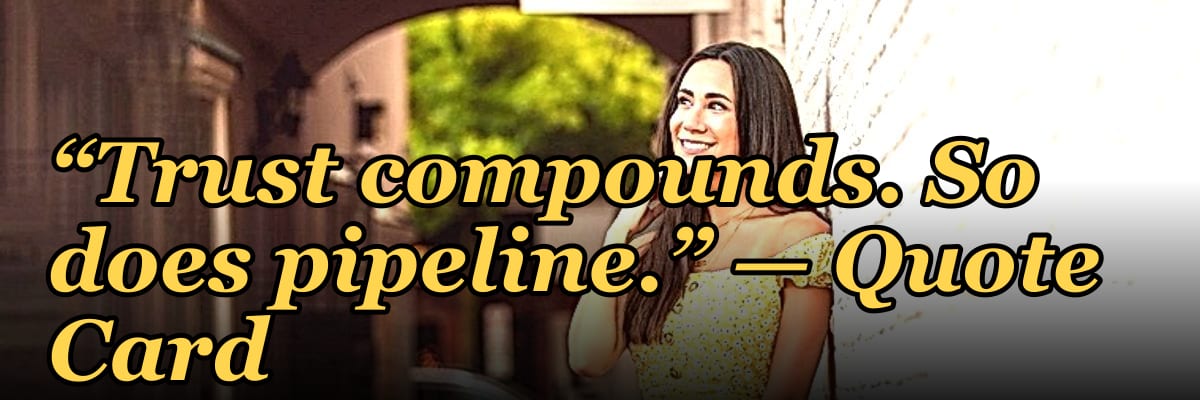
"Trust compounds. So does pipeline." means that trust and sales pipeline grow the same way — through small, reliable actions repeated over time, where each new deposit builds on the last. Trust isn't won in a single meeting, and pipeline isn't built in a single quarter; both reward consistency and punish shortcuts. The card is a shareable visual reminder for sellers and revenue leaders that the durable way to grow pipeline is to keep earning trust, deal by deal and interaction by interaction.
“Trust compounds. So does pipeline.” — Quote Card
A square social quote card — "Trust compounds. So does pipeline." in the Pulse accent style. A shareable LinkedIn or Instagram graphic and a ready slide pull-quote.
Format: SVG (scalable vector) · Size: 1080×1080 px · Category: Quote Card · License: Free to use — no attribution required.

Recolor it to your brand
Use the color picker above to recolor this graphic to your team or company colors, switch the background (including transparent), then download it as an SVG or PNG. No sign-up, no watermark.
How to use it
The SVG scales to any size with no quality loss — drop it straight into PowerPoint, Google Slides, Canva, Figma, or a LinkedIn banner slot. The PNG export is ready to upload anywhere that wants a raster image.
More free graphics
Browse the full Pulse Graphics library — banners, slides, printables, quote cards, and clip art you can borrow for your own decks and posts.
Related on PULSE
- “Trust compounds. So does pipeline.” — LinkedIn Banner
- “TRUST COMPOUNDS” — Sales Floor Print
- Trust compounds. — LinkedIn Wallpaper
- “Revenue Is a Lagging Indicator of Trust” — Quote Card
- “Pipeline Cures All” — Quote Card
- “Your pipeline is your paycheck.” — Quote Card
Why Trust Compounds in a Sales Pipeline
Trust rarely appears in a single meeting. When a prospect first meets your brand, they are evaluating not just your product but your reliability, expertise, and motives. Each dependable interaction — a follow-up that lands on time, an honest answer about a gap, a problem solved without an immediate ask — adds a small deposit to the relationship. Repeated over weeks and months, those deposits accumulate into something a competitor can't easily copy: a buyer who feels safe telling you what's actually going on.
That accumulation is what makes the effect *compound* rather than merely *add up*. Early trust might earn a short discovery call. Sustained trust earns access to other stakeholders, internal-champion support, and candid feedback during a competitive evaluation. The reverse compounds too: one broken promise — a missed commitment, an overpromised feature, pressure to close before the buyer is ready — can undo months of patient relationship-building in a single conversation. Trust is slow to build and fast to lose, which is exactly why consistency is the whole game.
Leaders who internalize this organize pipeline stages around trust milestones, not just activity counts. Instead of tracking only demos delivered or proposals sent, they watch for signals like *"Has the prospect introduced us to procurement?"* or *"Did they share their evaluation criteria without being asked?"* These behaviors tend to be more honest predictors of a deal's health than raw volume, because they reflect whether the buyer has chosen to let you in.
Practical Ways to Compound Pipeline Trust
Building a pipeline that compounds trust comes down to three repeatable habits: consistency, transparency, and value between touches.
Consistency means showing up predictably — replying when you said you would, delivering promised materials on schedule, and bringing the same care to a small deal as a large one. Predictability is itself a form of proof; a buyer who can set their watch by you starts to assume you'll be just as reliable after the contract is signed.
Transparency is the counterintuitive accelerator. When you say what you don't know, flag where your solution isn't the best fit, or name an implementation risk before the buyer hits it, you signal that their outcome matters more than your quota. That honesty tends to deepen trust precisely because most sellers avoid it — and buyers who feel respected are far more willing to advocate for you internally and refer you onward.
Value between touches is where trust compounds fastest. Replace the generic "just checking in" email with something useful: a relevant report, a comparable customer's story, or a short answer to a question they raised. A simple discipline — make every interaction leave the buyer better informed than before — turns routine follow-up into a steady stream of small trust deposits. Connecting a prospect to an existing customer for a peer reference works the same way, because the endorsement carries more weight coming from someone with nothing to sell.
Measuring Pipeline Trust
Trust feels qualitative, but it leaves fingerprints in your CRM. A few signals are worth watching:
- Time-to-disclosure — how long before a prospect volunteers their budget range, decision criteria, or competitive alternatives. Earlier disclosure usually reflects higher trust.
- Internal-advocate spread — how many stakeholders the prospect introduces you to without being prompted. A champion who proactively pulls in the technical evaluator, procurement, and an executive sponsor is a champion who trusts you.
- Meeting reliability — whether prospects reschedule rather than cancel, and arrive prepared with the right people. Quiet ghosting is often the first sign trust has stalled.
- Initiation balance — the share of interactions the *prospect* starts. When you're doing all the chasing, the pipeline is being held up by your effort, not mutual interest.
None of these require a new tool — they require deciding which behaviors you treat as evidence, and coaching reps toward the actions that produce them. Track them directionally over time and you'll see trust move before revenue does.
The Psychology Behind the Compounding Effect
The quote draws on two well-known ideas. The first is the compound effect, popularized by Darren Hardy in his book of the same name: small, consistent actions produce outsized results over time, while inconsistency quietly erodes them. In sales, the rep who adds one genuine, non-selling touch a day builds, over months, a network that generates referrals and repeat business almost on its own.
The second is the trust equation from *The Trusted Advisor* (Maister, Green, and Galford), which frames trust as (Credibility + Reliability + Intimacy) ÷ Self-Orientation. Pipeline follows the same logic: credibility from expertise, reliability from consistent follow-through, intimacy from genuinely understanding the buyer, and low self-orientation from putting their outcome first. Strengthen the numerator and shrink the denominator, and trust — and the pipeline that rides on it — starts to compound.
Common Misinterpretations to Avoid
The most common misread is treating the quote as permission to focus on relationships and ignore pipeline mechanics. The balance is the point: trust without structure produces warm relationships that never convert, while structure without trust produces high activity and low close rates. A second mistake is expecting instant results — trust compounds slowly, and the first stretch of a more patient approach can look flat before referrals, larger deals, and shorter cycles begin to show up. A third is treating every relationship as equally worth the investment; the compounding is most valuable when concentrated on the accounts and decision-makers who influence many deals, not spread thin across a contact list.
Why This Quote Resonates with Revenue Leaders
The power of this quote lies in its reframing of pipeline as a relationship asset, not just a number in a CRM. Revenue leaders who have lived through multiple sales cycles know that the deals that close predictably are almost always those where trust was built early and consistently. Pipeline that is forced—through aggressive discounting, cold outreach without context, or pressure to add unqualified opportunities—rarely compounds. Instead, it creates a fragile funnel that collapses under scrutiny. The quote serves as a counterweight to the "more is better" pipeline mentality, reminding teams that the quality of trust embedded in each deal determines whether that pipeline will actually convert or just inflate forecasts.
Practical Application: How to Make Trust and Pipeline Compound
To operationalize this idea, start with the smallest repeatable trust-building action: a follow-up that adds value, a reference introduction, or a candid conversation about timeline. Track not just pipeline volume but pipeline "health" through metrics like referral rate, repeat business from existing clients, or the percentage of deals where the buyer proactively re-engaged. Set a team norm that every interaction should either deepen trust or advance a deal—ideally both. Over a quarter, these small deposits accumulate into a pipeline that is more resilient to competitive pressure and less dependent on discounting to close. The compounding effect becomes visible when a single trusted relationship opens doors to three new opportunities, or when a client's referral cuts a sales cycle in half.
Why This Quote Resonates in Sales
The phrase works because it reframes pipeline-building from a mechanical process into a relationship-driven one. Many sellers chase volume—more calls, more emails, more demos—but that approach often yields shallow, low-conviction deals. "Trust compounds" reminds you that each honest conversation, each follow-through on a promise, and each piece of genuine advice you give a prospect is a deposit. Over time, those deposits create a pipeline that's not just full but *strong*—deals move faster because buyers already believe you. The best sales leaders I've observed spend less time on activity metrics and more on trust signals: referrals, repeat buyers, and shortened sales cycles.
How to Use This in Your Work
Print this card or save it as a desktop wallpaper. When you're tempted to rush a discovery call or skip a follow-up because it feels small, look at it. The "compound" part means today's tiny action matters more than you think. In team stand-ups, use the card as a discussion prompt: "What trust deposit did we make this week?" or "Where did we try to shortcut pipeline?" It works as a shared language—everyone knows you're not just filling a funnel; you're earning the right to fill it.
A Quick Self-Check
Before your next big outreach push, ask: *If I had to earn this deal purely through trust over the next 90 days—no discounts, no urgency plays, no stunts—would my pipeline still exist?* If the answer is no, you're probably relying on tactics that don't compound. The card is a nudge to shift from transaction to relationship, one small deposit at a time.
Sources
- Maister, D., Green, C., & Galford, R. — *The Trusted Advisor* (the trust equation: Credibility + Reliability + Intimacy ÷ Self-Orientation)
- Darren Hardy — *The Compound Effect* (how small, consistent actions compound over time)
- Paul J. Zak — "The Neuroscience of Trust," *Harvard Business Review* (the biology and business impact of trust)
- Stephen M.R. Covey — *The Speed of Trust* (trust as a measurable driver of speed and cost)
- Gartner — research on B2B buyer behavior and the high-trust "buying jobs" buyers must complete
- Edelman — *Edelman Trust Barometer* (annual research on trust across business and institutions)
FAQ
What does “Trust compounds. So does pipeline.” mean? It means trust and pipeline grow the same way — through small, reliable actions repeated over time. Each positive interaction builds on the last, so the returns multiply rather than just add up. Both reward patience and consistency, and both can be set back quickly by a single broken promise.
Is this quote from a specific person or book? No single, verifiable source is attributed to it. It's a widely shared principle in B2B sales and relationship-building rather than a documented quotation, so it's best treated as a common-sense maxim, not a citation.
How can I apply this quote to my sales process? Build trust deliberately through reliability and transparency: do what you said you'd do, name risks before the buyer hits them, and make every touch useful. As trust grows, buyers share real context earlier and refer you onward, which feeds the pipeline and shortens future cycles.
Does this apply to both inbound and outbound sales? Yes. In inbound, existing trust speeds conversion once a buyer raises their hand. In outbound, consistent, low-pressure follow-through is how you earn trust from a cold start. Both motions benefit from the compounding effect — only the starting point differs.
How long does it take to see pipeline compound from trust? It varies by deal size, sales cycle, and how consistent you actually are. There's no fixed timeline, and the early stretch can look flat. The reliable lever isn't a calendar date — it's repeating trust-building actions long enough for buyers to start initiating, referring, and returning.
Can this principle work for small teams or solo operators? Yes, and often faster. Small teams and solo sellers can offer a level of personal attention and follow-through that's hard to scale, which lets trust deepen quickly. Even one person can compound pipeline by treating every interaction as a deposit worth making.
This page will be disappearing soon. Save it to your device for $1 — or read it free while it is here.
@Kory-White- · if Venmo asks, the last 4 of my number are 2012
This page is gone.
This one is off the shelf now. $1 keeps it on your phone for good — the whole page, pictures and diagrams included.
 graphic“Coachable beats talented.” — Quote Card
 graphic“Every no is closer to a yes.” — Quote Card
 graphic“Qualify hard. Close easy.” — Quote Card
 graphic“Revenue Is a Lagging Indicator of Trust” — Quote Card
 graphic“Sell like you'd want to be sold to.” — Quote Card
 graphic“A forecast is a promise, not a guess.” — Quote Card
 graphic“The next call is the most important one.” — Quote Card
 graphic“Data beats opinions.” — Quote Card
 graphic“Sell the meeting, not the demo.” — Quote Card
 graphic“Don't pitch. Diagnose.” — Quote Card