
“EARN EVERY YES” — Sales Floor Print
 Curated byKory White · Fractional CRO · Maryland
 PULSEKNOWLEDGE LIBRARY
Quality
Certified


This is a downloadable sales-floor print/poster, 1200x1600 px, titled “EARN EVERY YES” in bold display type. It states one rule for the room: treat every deal as something you earn, not something you are owed. Print it, hang it where the team sees it daily, and use it to anchor pipeline reviews.
The outcome you should expect
A poster does not change a forecast. What it changes is the language in the room, and language is the leading indicator. When “EARN EVERY YES” is on the wall, the phrase becomes a shared shortcut that any manager or rep can invoke without a speech. The expected outcome is a slow shift in three places: how reps describe a deal’s status, what questions get asked in pipeline review, and how quickly a stalled opportunity gets named as stalled rather than carried as hopeful.
Be realistic about the timeline. In the first two weeks, expect nothing measurable — people read it, some roll their eyes, a few screenshot it. Weeks three through six are when the phrase starts showing up in Slack threads and one-on-ones, usually because a manager used it first. By the second month, the useful signal is qualitative: are reps volunteering the evidence behind a deal before they are asked? That is the behavior the print is designed to prompt.
What you should not expect is a lift in win rate attributable to the poster. If win rate moves, it moved because of the review cadence the poster supports, the coaching that followed, or a change in qualification standards. The print is a trigger and a reminder, not a mechanism. Treat any claim that a wall print alone moved a number as noise.

The clearest early indicator that it is working is negative in tone and positive in effect: reps start killing deals earlier. A pipeline that shrinks in count while holding steady in weighted value is usually a healthier pipeline, because the unearned yeses have been removed before they consumed another month of forecast attention. That shrinkage is the outcome to watch for, and it is the one teams most often misread as bad news.
What drives that outcome
Three inputs drive whether the print does anything at all. The first is placement — it has to be in the room where pipeline conversations actually happen, not the lobby. The second is manager usage — if no one with authority ever says the phrase out loud in a review, it stays wallpaper. The third is a definition, agreed in advance, of what evidence counts as earning a yes.

The failure branch on that diagram is the common one. A poster hung without a manager who will say the words out loud for six straight weeks has essentially zero effect. Budget your effort accordingly: the print takes ten minutes to download and print, and the usage habit takes a quarter to build.
The definition matters more than it sounds. If “earned” means something different to each manager, the phrase creates arguments instead of clarity. Write down two or three concrete examples of evidence — a signed technical validation, a named economic buyer who has confirmed budget, a documented mutual action plan with dates the buyer agreed to — and treat those as the working standard. Keep the list short enough that a rep can recite it from memory.
There is also a reinforcement effect worth engineering deliberately. The print works best when it is paired with a recurring ritual: a standing pipeline review where the first question for any deal in the commit category is what earned it. Rituals outlast posters. The poster’s job is to make the ritual feel inevitable rather than arbitrary.

Finally, expect the phrase to get tested. Some reps will use it defensively — “I earned this one” as a shield against scrutiny. That is a signal the definition was too loose. Tighten it in the next review rather than letting the phrase degrade into a debate tactic, because a slogan that can be used to shut down questions has inverted its purpose.
Benchmarks and realistic ranges
There are no published benchmarks for wall prints, and anyone quoting a percentage lift from a poster is guessing. What you can benchmark is the behavior around it, using numbers your own CRM already produces.

Start with evidence-attachment rate: the share of commit-stage deals that have at least one artifact attached in the last fourteen days — a call recording, an email thread, a mutual action plan, a security review document. A reasonable starting range for a mid-market team is somewhere between a third and half of commit deals. Track it before you hang the print and again ninety days later. Movement of ten to fifteen points is a meaningful result; movement of two points is noise.
Second, track the age of the oldest commit-stage deal. If your commit category routinely contains deals that have not advanced a stage in sixty days or more, the “earned” standard is not being applied. A healthy pattern is that commit deals are the youngest cohort in the pipeline, not the oldest, because they moved recently and on evidence.
Third, measure slip rate: the share of deals forecast to close in a given month that push to a later month. This is the number the print is ultimately aimed at. Teams commonly run a slip rate in the twenty to forty percent range on commit deals. If yours is at the high end, the poster is not the fix — the qualification standard is — but the poster is a reasonable place to start the conversation.

Fourth, watch pipeline coverage ratio. If the print is working, coverage should rise slightly rather than fall, because reps stop counting unearned deals toward their number and go build more. A coverage ratio that jumps from three times to four times in a quarter is usually a sign of honest re-categorization rather than new pipeline creation, so read it alongside new pipeline created per rep.
One caution on all four: pick two, not four. Teams that try to instrument every behavior at once end up watching dashboards instead of deals. Pick evidence-attachment rate and slip rate, run them for a full quarter, and add a third only if the first two are stable.

Risks, edge cases, and failure modes
The most common failure is tone. “EARN EVERY YES” can read as an accusation if the room is already under pressure about performance. In a team that has just missed a quarter, a poster implying that reps have not been earning their wins will land badly and may be resented. If your team is in that state, either soften the framing or hold the print until the next quarter opens with a cleaner emotional baseline.
The second failure is ambiguity. Without a written definition of evidence, the phrase becomes a cudgel. You will see it used in performance conversations as a vague criticism — “I don’t think you earned that one” — with no standard behind it. That is worse than no poster at all, because it makes review subjective in a way reps cannot prepare for.
The third is misapplication to early-stage deals. A discovery call is not supposed to be earned; it is supposed to be exploratory. If the “earned” standard gets applied to the top of the funnel, reps will over-qualify prematurely and stop taking first meetings with imperfect-fit prospects. Scope the phrase explicitly to the commit and best-case categories, and say so out loud when you introduce the print.

The fourth is the poster as substitute for process. Hanging a print is cheap and visible; rebuilding a stage-exit criteria document is neither. Teams sometimes adopt the slogan precisely because it feels like progress without the harder work. If your stages have no exit criteria, the print will not supply them, and the phrase will have nothing concrete to point at.
A fifth edge case is remote and hybrid teams. A physical print in an office does nothing for reps who are never in that office. If more than a third of your team is remote, the print has to be paired with a digital version — a slide in the review deck, a pinned message in the team channel, a recurring calendar banner. The message travels; the paper does not.

Finally, watch for slogan fatigue. Any phrase repeated weekly for a year loses force. Plan a refresh at the two-quarter mark: either reprint with a new line that carries the same idea, or rotate the print out and let the ritual carry the standard on its own. A poster that has been on the wall for three years is furniture.
A practical rollout plan
Roll it out over six weeks rather than overnight, so the phrase arrives with a definition attached instead of as a surprise on a Monday.
Week one is the only step that requires real work. Get the frontline managers in a room for forty-five minutes and agree on two or three concrete evidence types. Write them down, one page, no more. Circulate it before the print goes up, so no one is surprised by the standard.

Week two is logistics: download the PNG, print at the size your wall supports, and hang it where pipeline reviews actually happen. If reviews happen on video, put the digital version in the recurring invite. Do not announce it with a company-wide email; let the managers introduce it in their own reviews, in their own words.
Weeks three and four are the whole experiment. Every manager, every review, uses the phrase at least once and asks the evidence question for at least one commit deal. This is the step that gets skipped, and skipping it is why most posters fail. Track informally whether reps start volunteering evidence before being asked.

Week five is measurement. Pull your baseline numbers for evidence-attachment rate and slip rate. If you did not capture a baseline before the print went up, use the prior quarter as a rough comparison and note the limitation.
Week six is a short retrospective with the managers: what worked, what felt forced, what the phrase got misused for. Adjust the definition if needed. Then decide at the two-quarter mark whether to refresh, keep, or retire it. A print that has done its job — the ritual is running without it — can come down without loss.
One practical note on printing: matte finish reads better than gloss under office lighting, and a size around 18x24 inches is legible from across a sales floor without dominating the wall. If you are printing in-house on letter paper, print two and place them at eye level near the desks rather than one large sheet in a hallway no one lingers in. The point is proximity to conversation, not square footage.
Related questions
What exactly does the print say?
It carries the line “EARN EVERY YES” as its central message, set in bold display type on a 1200x1600 px canvas. The design is intentionally minimal so the phrase reads from across a room. You can download it as a PNG and print it at whatever size your wall supports.
Is it a poster or a digital asset?
Both. The primary form is a print for the sales floor, but the same PNG works as a slide in a review deck, a pinned image in a team channel, or a recurring banner on a pipeline review invite. Hybrid teams should use both forms together.
Does hanging it actually change anything?
Only if managers use the phrase out loud in pipeline reviews for several consecutive weeks. The print supplies the shorthand; the review supplies the behavior. Without the second, the first is decoration and will be treated as such within a month.
Can I change the wording?
Yes, and you probably should if your team already has its own language for this idea. Keep the structure — short, imperative, one idea — and swap in whatever phrase your managers will actually say without embarrassment. A line nobody repeats is a line that failed.
How long should it stay up?
Plan for two quarters. That is long enough to build the habit and short enough to avoid slogan fatigue. At the two-quarter mark, either refresh the wording or retire the print if the ritual is running on its own.
FAQ
What is the “EARN EVERY YES” sales-floor print? It is a downloadable poster, 1200x1600 px, carrying the line “EARN EVERY YES” as its main message. It is designed to hang in the room where pipeline reviews happen, as a shared shorthand for the standard that a deal in commit should be backed by evidence rather than optimism.
What size should I print it? Around 18x24 inches works well for a sales floor — legible from across the room without dominating the wall. Matte finish reads better than gloss under typical office lighting. If you are printing on letter paper, print two and place them at eye level near the desks instead of one sheet in a hallway.
Who is this for? Frontline sales managers and RevOps leads who run pipeline reviews and want a physical anchor for a qualification standard. It is least useful for teams that have no recurring review cadence, because the print has nothing to attach to and will be read once and ignored.
What counts as “earning” a yes? Agree on this before you hang the print. Two or three concrete evidence types is enough — for example a completed technical validation, a named economic buyer who has confirmed budget, or a mutual action plan with dates the buyer agreed to. Write it on one page and circulate it first.
Will this work for a remote team? Only in its digital form. A physical print in an office does nothing for reps who are never there. Use the PNG as a slide in the review deck, a pinned message in the team channel, and a banner on the recurring review invite, and have managers use the phrase verbally the same way.
Can I customize the colors or add my logo? Yes. The layout is deliberately simple so the phrase stays the focal point. If you add branding, keep it small and out of the reading path — a logo large enough to compete with the headline defeats the purpose of a print meant to be read in two seconds from across a room.
Sources
- Salesforce — State of Sales report
- HubSpot — Sales enablement guide
- Gartner — Sales research and insights
- Harvard Business Review — The End of Solution Sales
- MEDDIC Academy — Qualification framework overview
- Miller Heiman Group — Sales performance research
- Sales Management Association — Research and benchmarks
- Forrester — B2B sales research
Related on PULSE
- Pipeline review cadence: what to ask in every deal inspection
- Stage exit criteria: writing definitions reps can actually apply
- Forecast categories explained: commit, best case, pipeline
- Slipped deals: diagnosing why commit deals push a month
- Sales floor rituals that survive past the first quarter
- Qualification frameworks compared: MEDDIC, SPICED, and plain evidence
This page will be disappearing soon. Save it to your device for $1 — or read it free while it is here.
@Kory-White- · if Venmo asks, the last 4 of my number are 2012
This page is gone.
This one is off the shelf now. $1 keeps it on your phone for good — the whole page, pictures and diagrams included.
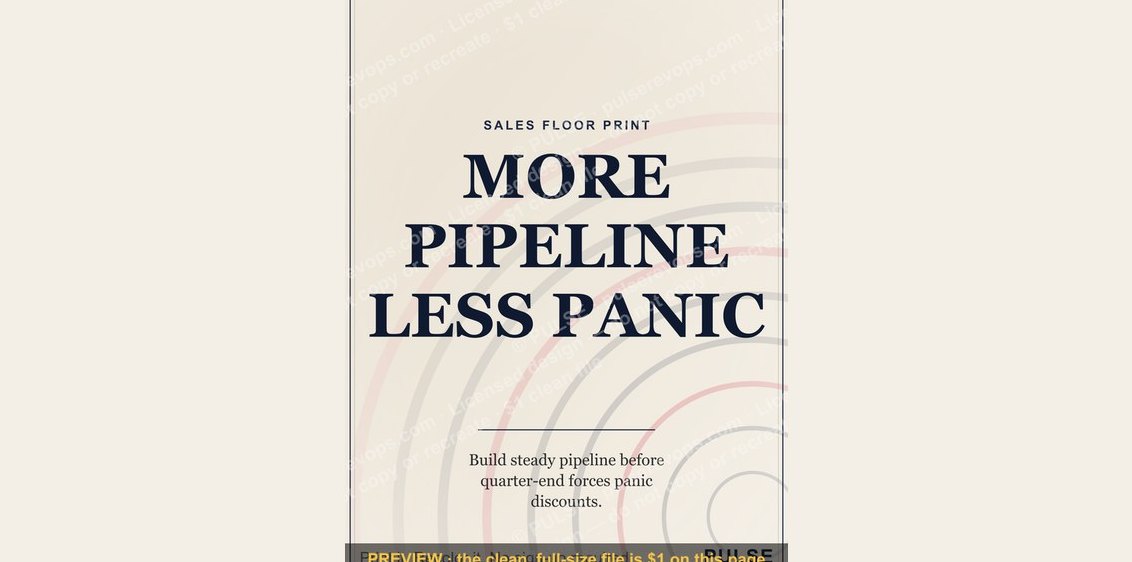 graphic“MORE PIPELINE LESS PANIC” — Sales Floor Print
 graphic“COMMIT MEANS COMMIT” — Sales Floor Print
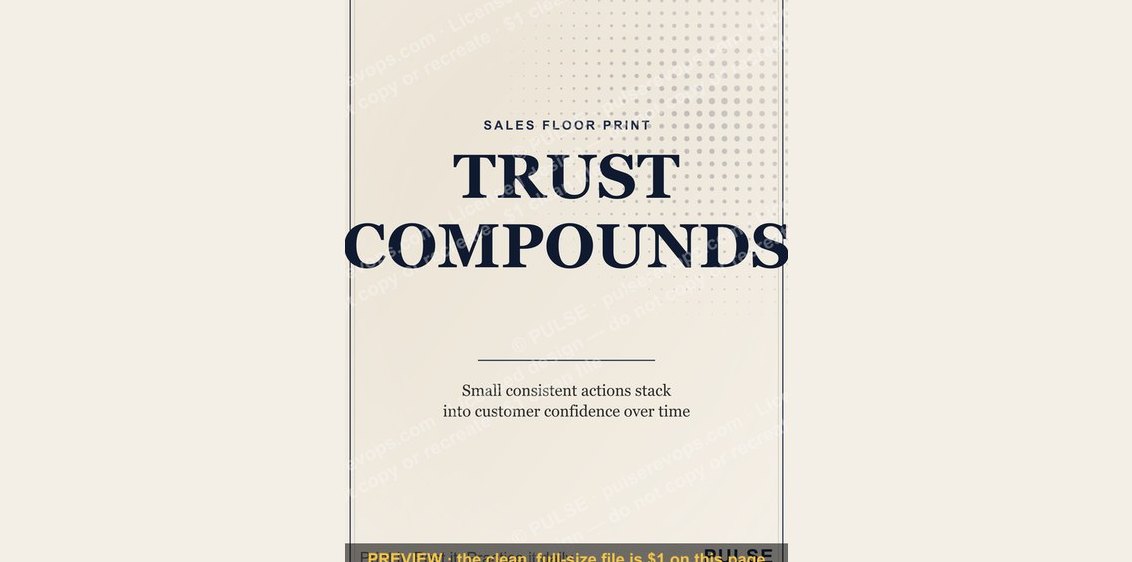 graphic“TRUST COMPOUNDS” — Sales Floor Print
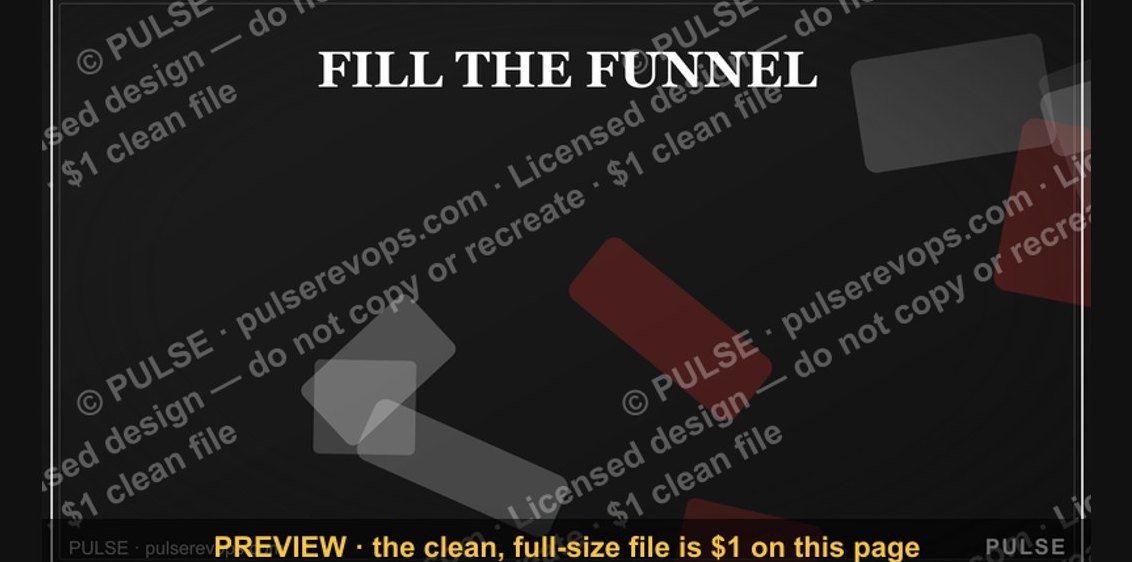 graphic“FILL THE FUNNEL” — Sales Floor Print
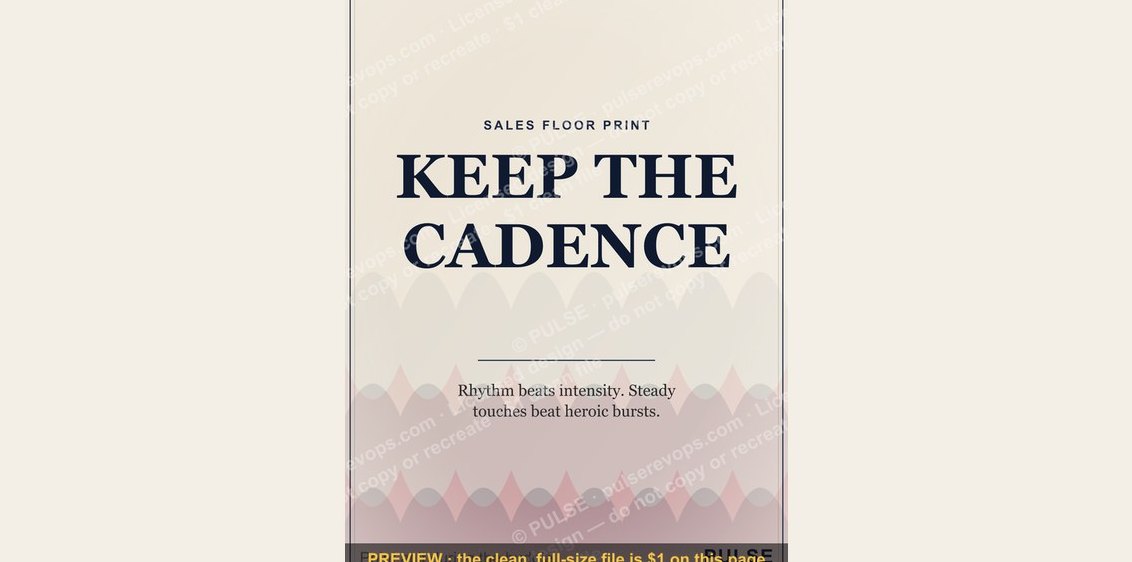 graphic“KEEP THE CADENCE” — Sales Floor Print
 graphic“PROGRESS EVERY DEAL” — Sales Floor Print
 graphic“Always Be Closing” — Sales Floor Poster
 graphic“NEXT CALL WINS” — Sales Floor Print
 graphic“DO THE REPS” — Sales Floor Print
 graphic“EARN THE RIGHT” — Sales Floor Print