
“STAY IN THE DEAL” — Sales Floor Print
 Curated byKory White · Fractional CRO · Maryland
 PULSEKNOWLEDGE LIBRARY
Quality
Certified
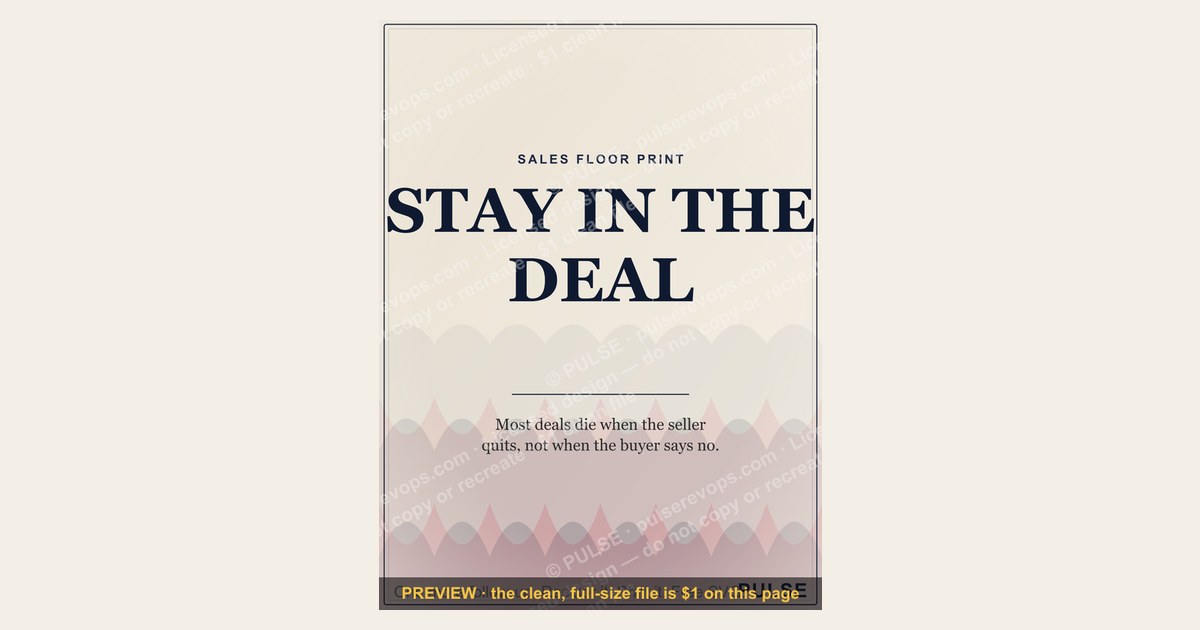
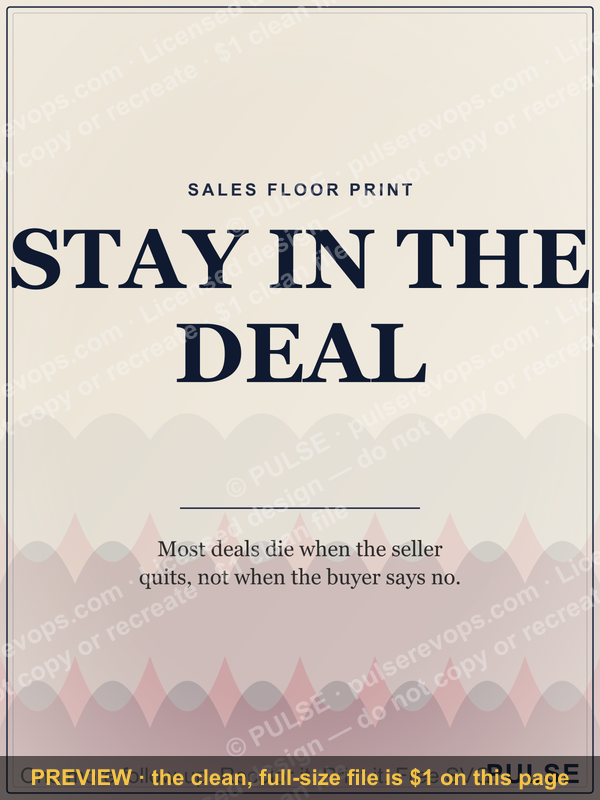
This is a sales-floor print — a 1200x1600 px poster titled "STAY IN THE DEAL" — designed to be hung where reps see it during the final push of a quarter. It reads as a short, blunt reminder: keep working every open opportunity until it is signed or dead, and never let a live deal drift into silence. Print it, hang it, and use it as a shared reference for pipeline discipline.
A concrete scenario that frames the problem
Imagine a mid-market software team on the second-to-last Wednesday of a quarter. A rep — call her Priya — is carrying six open opportunities into the final ten selling days. One is a $64,000 expansion with an existing customer whose security review closed two weeks ago; the only remaining step is a countersignature from procurement. Another is a $140,000 new-logo deal that went quiet nine days ago after a strong technical demo. A third is a $31,000 renewal that the customer says is "basically done" but has not returned the order form. The remaining three are earlier-stage and unlikely to close this period.
Priya's instinct, like most reps, is to spend her best hours on the new-logo deal because it is the biggest number. That instinct is exactly what a poster like this is built to interrupt. The $64,000 expansion is the closest to cash and the most likely to slip simply because nobody chased the signature. The $31,000 renewal is the same story in miniature. The $140,000 deal may genuinely be stalled — or it may just need one more conversation with the right person before the budget window closes.

The Sales floor is where this pattern repeats every quarter. Reps gravitate to the exciting, uncertain, high-ceiling deal and quietly neglect the boring, near-certain, low-drama one. Then the quarter ends, the near-certain deal rolls into next period, and the number misses by exactly the amount that was sitting there waiting to be closed. A Print on the wall does not fix the behavior by itself, but it puts a name on it. "STAY in the deal" is the instruction: stay engaged, stay present, stay on the customer until the paperwork is done.
The scenario also exposes a second failure mode. Priya's manager reviews the pipeline on Thursday and asks about the $140,000 opportunity. Priya says it is "still alive." That phrase is doing a lot of work. Alive can mean the champion is still replying, or it can mean the deal has been dead for a week and nobody has admitted it. A poster that says STAY in the deal forces a harder question: is this actually moving, or am I just refusing to let it go? Both readings matter, and the best teams hold both at once.
How the mechanism actually works
The poster works as a behavioral trigger, not as information. It carries no data, no forecast, no process diagram. Its only job is to interrupt a default and replace it with a check. The mechanism has three parts: a visible cue, a short instruction, and a repeated moment of contact with that instruction. In practice the loop looks like this.

The loop above is the entire design. It is deliberately shallow, because a poster that requires study gets ignored. The cue has to land in under two seconds, and the instruction has to be short enough to hold in working memory while the rep walks to their desk. "STAY in the deal" does that. It is three words and one idea.
The second half of the mechanism is the manager's side. A poster on the Sales floor is also a shared vocabulary. When a manager says "are you staying in that deal?" the rep knows exactly what is being asked, because the phrase is already on the wall. That shared language shortens the conversation. Instead of a five-minute pipeline review, the manager can ask one question and get a useful answer.

There is a third, quieter mechanism: the poster makes neglect visible to the rep themselves. Most pipeline slippage is not a decision to abandon a deal. It is a drift — a few days of not calling, then a week, then the deal is cold and the rep feels awkward reaching out. A wall poster does not prevent drift, but it creates a daily checkpoint where drift can be caught early, while the deal is still warm.
The mechanism only works if the poster is placed where reps actually pause. A poster behind a monitor, above a printer, or beside the coffee station gets seen dozens of times a day. A poster in a hallway nobody uses gets seen twice. Placement is the difference between a behavior change and decoration.

Real numbers, ranges, and benchmarks
Because this is a print rather than a program, the numbers that matter are the ones around it: how often it is seen, how big it needs to be, and what it costs to produce. Useful ranges for a sales-floor poster:
- Viewing distance and size. A poster read from 6-8 feet needs a headline of roughly 1.5-2 inches tall. At 10-12 feet, the headline should be 3-4 inches tall. The 1200x1600 px file is a 3:4 portrait ratio, which prints cleanly at 18x24 inches (150 ppi) or 24x32 inches (50 ppi at the larger size, acceptable for a wall poster viewed from several feet).
- Paper and finish. Matte or satin paper reduces glare under office lighting. A 100-120 lb text or a lightweight cover stock is typical for in-office posters. Lamination adds durability if the poster will be handled or moved.
- Print cost. A single 18x24 inch poster at a retail print shop typically runs in the low tens of dollars; volume printing of 10 or more drops the per-unit cost substantially. Cost is not the constraint — placement and consistency are.
- Refresh cadence. A poster that never changes becomes wallpaper. Teams that rotate the message quarterly — new slogan, new quarter, same slot — report that reps keep noticing it. A cadence of one refresh per quarter or per half is a reasonable default.
- Coverage. One poster per selling pod, or roughly one per 8-12 reps, is enough to keep it in everyone's field of view without turning the floor into a billboard.
For the pipeline behavior the poster is meant to influence, useful benchmarks to track alongside it:

- Deals touched per rep per week. A rep carrying 15-25 open opportunities should be touching each live deal at least once every 5-7 business days during the final month of a quarter.
- Days since last activity. Any open deal with no logged activity in 10 or more days is a drift risk. Deals silent for 14+ days close at a materially lower rate than deals touched in the last week.
- Next-step coverage. The share of open deals with a scheduled next step and a date should be above 80% in the final month. Below that, the pipeline is mostly hope.
- Slippage rate. Track the share of commit deals that push to the next period. A single-digit percentage is normal; a double-digit percentage usually means deals were being counted before they were actually done.
None of these numbers come from the poster. They come from the CRM. The poster's job is to make reps check them. A team that hangs the poster and never looks at the underlying metrics has a decoration, not a system.

Trade-offs and alternatives
A wall poster is cheap, visible, and shared. It is also static, easy to ignore, and impossible to personalize. Weighing it against alternatives:
The honest trade-off is that the poster is the cheapest intervention with the lowest ceiling. It changes the ambient environment, not the incentive structure. Teams that pair it with a daily digest and a weekly 1:1 review get more from it than teams that rely on it alone.
A second trade-off is tone. A poster that reads as scolding gets resented. A poster that reads as a shared standard gets adopted. "STAY in the deal" works because it is an instruction to the team, not an accusation at any individual. A version that named underperformers or implied blame would backfire within a week.

A third trade-off is specificity. The poster is deliberately vague about what "staying in the deal" means. That vagueness is a feature — it lets each team fill in the behavior — but it is also a risk. If the team never defines the behavior, the poster becomes a slogan with no teeth. The fix is a short companion document or a team meeting where the behavior is defined: what counts as staying in, how often to touch a deal, what to do when a deal goes quiet.
Alternatives worth considering alongside the poster:

- A daily or weekly "stalled deals" report pulled from the CRM and shared with the team. Concrete, per-rep, and directly actionable.
- A deal-review ritual in the last month of the quarter where every commit deal gets a five-minute check: who is the buyer, what is the next step, what is the date.
- A "no silent deals" rule in the team's operating norms, written down and referenced in onboarding.
- A manager-led pipeline inspection on a fixed cadence, with the poster as the reminder that the inspection is coming.
Common pitfalls and how to avoid them
The most common failure is hanging the poster and doing nothing else. A poster is a cue, not a system. Without a defined behavior and a cadence for checking it, the cue fades within two weeks. Avoid this by pairing the poster with one concrete ritual — a weekly stalled-deal review, a daily digest, or a manager question in every 1:1.

The second failure is over-messaging. If the Sales floor is covered in posters, none of them land. One poster per pod, rotated quarterly, beats six posters competing for attention. The Floor should feel focused, not noisy.
The third failure is using the poster to paper over a real problem. If deals are slipping because the product is mispriced, the qualification is weak, or the handoff from marketing is broken, a poster will not fix it. It will just make the team feel blamed for a structural issue. Diagnose the root cause before reaching for a morale poster.
The fourth failure is stale wording. A poster that says the same thing for two years becomes invisible. Rotate the message, or at least refresh the design, on a regular cadence. The instruction can stay the same; the visual should not.

The fifth failure is a poster that contradicts the comp plan. If reps are paid on new-logo bookings but the poster urges them to chase renewals, the poster loses. Incentives beat posters every time. Align the message with what the comp plan actually rewards, or the wall becomes a joke.
The sixth failure is no measurement. If the team cannot say whether slippage went down after the poster went up, they cannot tell whether it worked. Pick two or three metrics before hanging it — days since last activity, next-step coverage, slippage rate — and check them a quarter later. If nothing moved, change the approach.
Related questions
What does "STAY in the deal" actually mean?
It means keep working every open opportunity until it is signed or formally disqualified. Do not let a live deal drift into silence. Touch each active deal on a regular cadence, confirm the next step, and log the activity so the pipeline reflects reality.
Who is this poster for?
It is for Sales teams — reps, managers, and anyone who owns a pipeline number. It works best on a Floor where reps walk past the same spot several times a day, so the message lands repeatedly without anyone having to deliver it verbally.
Can I customize the wording?
Yes. The file is a Print, so the headline, subtext, colors, and layout can be edited for your team. Keep the headline short — three to five words — and keep the instruction behavioral rather than motivational. Longer text gets ignored at a distance.
When does this poster backfire?
It backfires when the team is already stretched, when the root cause of slippage is structural, or when the message contradicts the comp plan. In those cases the poster reads as blame rather than guidance, and it damages trust instead of improving pipeline discipline.
How often should I refresh it?
Quarterly is a reasonable default. A refresh can be as small as a new accent color or a new subline. The goal is to keep the poster from becoming invisible wallpaper while keeping the core instruction stable.
FAQ
What is the "STAY IN THE DEAL" sales-floor print? It is a downloadable 1200x1600 px poster titled "STAY IN THE DEAL," intended for the Sales Floor. It uses a short headline to remind reps to keep working open opportunities until they close or are disqualified. It is a cue, not a system, and works best alongside a defined pipeline ritual.
What size should I print it? The 3:4 portrait ratio prints cleanly at 18x24 inches for a standard office wall, or 24x32 inches for a larger space. For a headline read from 10-12 feet, aim for a 3-4 inch tall headline. Matte or satin paper reduces glare under office lighting.
Does it work without a manager enforcing it? It works better with a manager, but it can still shift behavior on its own. The poster creates a daily cue that reps notice. The strongest results come when a manager uses the same phrase in pipeline reviews, so the wall and the conversation reinforce each other.
How is this different from a pipeline review? A pipeline review is a scheduled, specific, per-deal conversation. The poster is ambient and continuous. They solve different problems: the review catches issues on a cadence, the poster keeps the standard visible between reviews. Use both.
Can I use this for a remote team? Yes, with adaptation. A physical poster does not reach remote reps, so use the same graphic as a desktop wallpaper, a Slack channel header, or a recurring calendar image. The message stays the same; the delivery changes.
Is this a motivational poster? No. It is an operational reminder. It does not celebrate effort or pump up the team. It states a standard — stay in the deal — and leaves the behavior to the team's process. That is why it holds up over time.
Sources
- Salesforce — Sales Pipeline Management
- HubSpot — Sales Pipeline Stages
- Gartner — Sales Execution Research
- Harvard Business Review — The Pipeline Problem
- CSO Insights / Korn Ferry — Sales Performance Research
- Miller Heiman — Sales Process and Pipeline Best Practices
- Sales Management Association — Research and Benchmarks
- Adobe — Poster Print Size and Resolution Guide
Related on PULSE
- "Stay in the Deal" — Deal Review Checklist
- Pipeline Hygiene: The Weekly Stalled-Deal Sweep
- End-of-Quarter Commit Discipline
- Sales Floor Rituals That Actually Change Behavior
- When to Disqualify: Letting Dead Deals Go
- Comp Plan Alignment for Renewals and Expansions
This page will be disappearing soon. Save it to your device for $1 — or read it free while it is here.
@Kory-White- · if Venmo asks, the last 4 of my number are 2012
This page is gone.
This one is off the shelf now. $1 keeps it on your phone for good — the whole page, pictures and diagrams included.
 graphic“TRUST THE PROCESS” — Sales Floor Print
 graphic“WIN THE DAY” — Sales Floor Print
 graphic“ONE TEAM ONE NUMBER” — Sales Floor Print
 graphic“EARN THE RIGHT” — Sales Floor Print
 graphic“HELP FIRST” — Sales Floor Print
 graphic“BRING THE ENERGY” — Sales Floor Print
 graphic“MAKE THE CALLS” — Sales Floor Print
 graphic“SELL THE VALUE” — Sales Floor Print
 graphic“ACTIVITY PIPELINE REVENUE” — Sales Floor Print
 graphic“QUOTA IS A FLOOR” — Sales Floor Print