
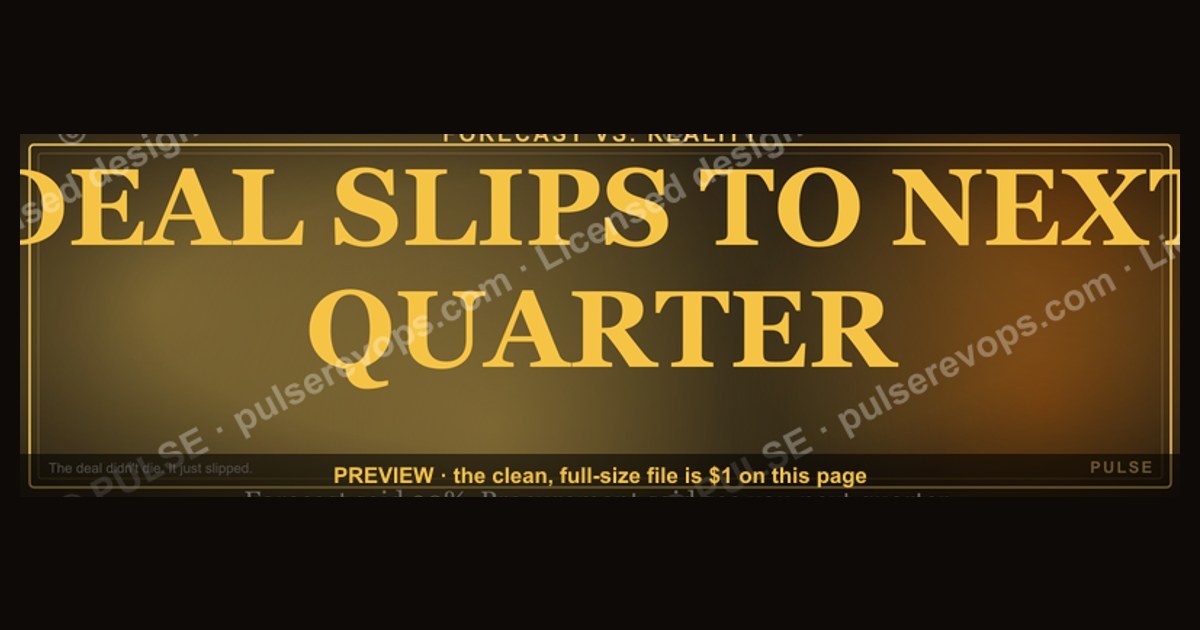
“DEAL SLIPS TO NEXT QUARTER” — Sales Meme
 Curated byKory White · Fractional CRO · Maryland
 PULSEKNOWLEDGE LIBRARY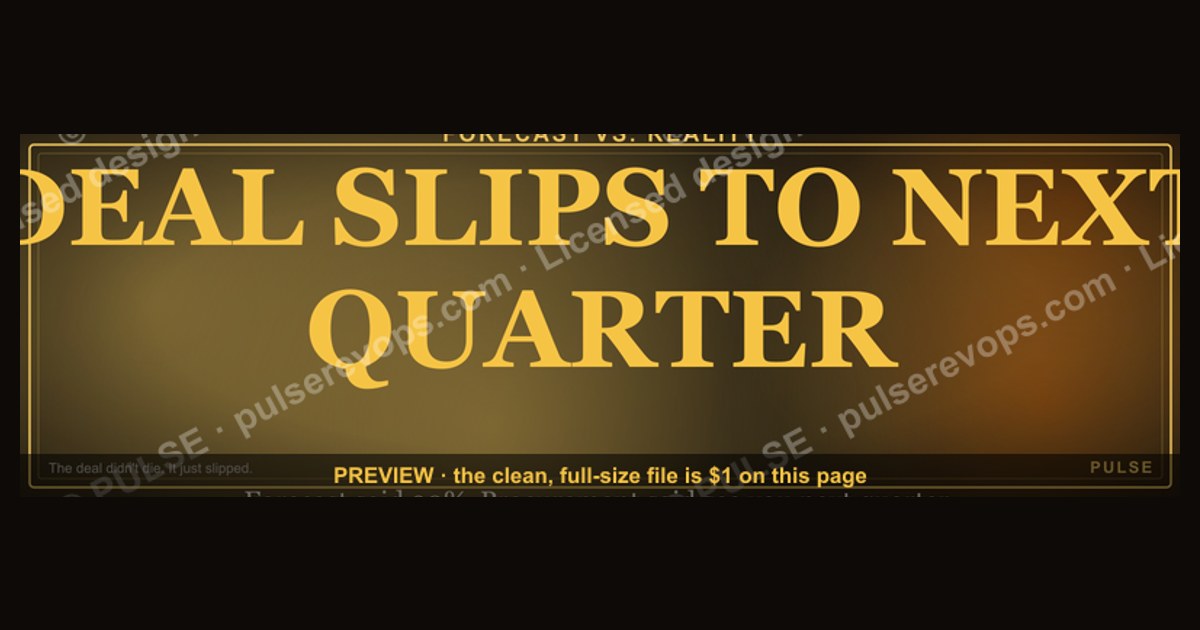

This sales meme pokes fun at one of the most familiar moments in B2B selling: a deal everyone was confident about quietly moves its expected close date from the current quarter into the next one. It captures the gap between an optimistic forecast ("90% to close!") and the messier reality of procurement reviews, legal redlines, budget freezes, and stakeholders who go quiet at exactly the wrong time. Salespeople share it because it names a shared frustration in one image — the deal didn't die, it just slipped — and because dark humor is how sales floors process the pressure of quota-by-date. Practically, "deal slips to next quarter" is shorthand for *the forecast was too confident, too early, and the real next step hadn't actually been secured.*
“DEAL SLIPS TO NEXT QUARTER” — Sales Meme

A clean vector sales meme — "FORECAST SAYS 90%" over "DEAL SLIPS TO NEXT QUARTER" with a pulse-monitor motif. Light, shareable humor for your sales Slack or kickoff.
Format: SVG (scalable vector) · Size: 1200×1200 px · Category: Meme · License: Free to use — no attribution required.
Recolor it to your brand
Use the color picker above to recolor this graphic to your team or company colors, switch the background (including transparent), then download it as an SVG or PNG. No sign-up, no watermark.
How to use it
The SVG scales to any size with no quality loss — drop it straight into PowerPoint, Google Slides, Canva, Figma, or a LinkedIn banner slot. The PNG export is ready to upload anywhere that wants a raster image.
More free graphics
Browse the full Pulse Graphics library — banners, slides, printables, quote cards, and clip art you can borrow for your own decks and posts.
Related on PULSE
- “Win the week. The quarter wins itself.” — Quote Card
- "Win the quarter." — LinkedIn Banner
- “Win the week. The quarter follows.” — LinkedIn Banner
- “...AFTER THE DEAL CLOSES” — Sales Meme
- “NEXT CALL WINS” — Sales Floor Print
- “The next call is the most important one.” — Quote Card
Why This Meme Lands in Sales Operations
"Deal Slips to Next Quarter" works because it names a friction point every revenue team recognizes: slippage — a deal pushing its close date — is usually a bigger drag on the quarter than outright losses. A lost deal is closed and accounted for; a slipped deal keeps living in the pipeline, distorts the forecast, and resurfaces the same pressure one quarter later. That's why the joke resonates more than "we lost the deal" ever could.
The visual language does the heavy lifting. The pulse-monitor motif — borrowed from medical drama — maps neatly onto the emotional arc of a quarter: the steady beat of a "committed" deal, then the flatline when it slips to the next period. It compresses a whole shared experience into one image, which is exactly why it spreads on a sales floor without explanation.
There's also an operational truth underneath the humor: forecast confidence and deal size tend to pull in opposite directions. Smaller, transactional deals move quickly and predictably; larger enterprise deals carry more approval gates — procurement, legal, security review, executive sign-off — and any one of them can stall a deal that looked locked. The "90% confidence" in the meme is a textbook case of optimism bias: the rep is forecasting their own intent to win rather than the buyer's confirmed ability to buy on time.
How to Use This Meme Strategically in Your Sales Organization
The meme is funny, but it's also a useful cultural lever. A few ways sales leaders put it to work:
1. Pipeline review icebreaker. Open a weekly pipeline review with it. It signals up front that you understand slippage is normal, which makes it safer for reps to flag at-risk deals honestly instead of defending an artificially rosy commit. Honest pipeline conversations are the foundation of a forecast you can actually trust.
2. Onboarding and training opener. When you teach a qualification framework — MEDDIC, BANT, Challenger — lead with the meme to establish that slippage is an expected part of complex selling, not a personal failure. Then run a short exercise: have reps name the top reasons their last deal slipped (budget, authority, timeline, competition, internal politics) and tie each one back to a qualification gap they could have closed earlier.
3. CRM slippage trigger. A common RevOps automation: when a deal stage moves *backward* — say from "Verbal Commit" to "Proposal" — post a prompt (the meme optional) in the deal's Slack channel asking, "What's the new close date, and what specifically has to happen to prevent another slip?" It keeps the deal top-of-mind and forces a concrete next step without adding admin overhead.
4. QBR learning slide. In a quarterly business review, pair the meme with anonymized patterns from the quarter's slipped deals. If a cluster of them stalled in legal review, that's a process fix — pre-approved contract templates, earlier legal involvement — not a coaching problem. The meme turns a sore subject into a non-threatening entry point for process improvement.
The Psychology Behind Why Deals Slip — and Why the Meme Helps
Several well-documented behavioral patterns explain both the slippage and the humor:
The endowment effect. Once a rep has poured time and emotional energy into a deal, they tend to overvalue its likelihood of closing — we overrate things we feel we own. When it slips, the dissonance stings, and laughing at the situation helps the rep step back and re-assess with clearer eyes.
Loss aversion. Prospect theory (Kahneman and Tversky) shows losses loom larger than equivalent gains. A deal sliding from this quarter to next *feels* like a loss, which can drive frantic, margin-eroding behavior — late discounts, scope creep, weak concessions. Reframing a slip as a delay rather than a loss is what keeps reps from giving away the deal to save the date.
Social proof and normalization. Reps who feel alone in their slippage tend to internalize it as a personal failing. A meme circulating through the team is quiet proof that slippage is universal — which lowers the shame, encourages people to surface bad news earlier, and makes the whole forecast more honest.
The forecasting paradox. Teams that can joke openly about slippage often forecast *better*, because the humor creates room to flag risk early. Teams where slippage is taboo tend toward "hockey-stick" forecasts — everything predicted to close in the final two weeks — and the predictable end-of-quarter disappointment that follows.
Practical countermeasures. Beyond the laugh, a few habits genuinely reduce slippage:
- Run a "commit-to-close" checklist before any larger deal can be forecast for the quarter — confirmed budget, named approver, legal status, and executive sponsor. If a box is empty, it's not a commit.
- Forecast on next steps, not percentages. Instead of "90% confidence," have reps state the exact next action and its date. A confirmed next step is harder to fool yourself with than a number.
- Build a slippage playbook with pre-agreed countermeasures for the top reasons deals stall in your market — e.g., a ready procurement-extension path when buying cycles run long.
The "Deal Slips to Next Quarter" meme is more than a laugh — it's a mirror held up to the structural realities of modern B2B selling. Shared openly, it turns a recurring frustration into a prompt for better pipeline hygiene, earlier honesty, and steadier forecasts. Next time it shows up in your Slack, don't just drop a laughing emoji — use it to ask which deal is about to slip, and what would actually keep it on track.
Why This Meme Hits Harder in Enterprise Sales
In enterprise SaaS, a deal slip is rarely a single event — it's a cascade. One stakeholder goes on PTO, legal adds three new clauses, or the procurement team decides to run a "competitive review" that was never mentioned in the discovery calls. The meme resonates because it visualizes the gap between a CRM forecast (green pipeline) and the actual buying committee's calendar. Experienced reps know that when a deal slips once, the probability of closing in the next quarter drops by roughly 30–50% — not because the buyer lost interest, but because the internal champion's influence often erodes with each delay.
How to Prevent the Slip Before It Happens
The best defense against the "slip to next quarter" meme is to build a mutual action plan with clear, dated milestones before the verbal commitment. Ask the champion: "If we don't close by [date], what specifically will cause the delay?" Common answers — budget approval cycles, legal review bandwidth, or a mandatory vendor consolidation — can be addressed proactively. Also, never mark a deal above 70% in your CRM until the contract is in legal review with a signed term sheet. That single discipline eliminates the surprise slip that the meme mocks.
The Dark Humor as a Sales Culture Signal
Sales teams that share this meme excessively may be signaling a deeper issue: a culture of over-optimistic forecasting driven by management pressure rather than buyer reality. The humor is a coping mechanism for reps who are asked to "paint the pipe green" every Friday. If your team's Slack channels are flooded with slip memes, it's worth auditing whether your forecast methodology rewards honesty or penalizes it. The best sales orgs use the meme as a teaching moment — not just a laugh.
Sources
- Harvard Business Review — research and commentary on B2B sales forecasting and pipeline management
- Gartner for Sales — guidance on forecast accuracy, deal slippage, and pipeline reviews
- Forrester — research on B2B buying complexity and deal velocity
- McKinsey & Company — perspectives on B2B sales strategy and revenue operations
- Daniel Kahneman & Amos Tversky — *Prospect Theory: An Analysis of Decision under Risk* (foundational work on loss aversion)
- Salesforce — *State of Sales* report and CRM forecasting guidance
FAQ
Why do deals always seem to slip at the end of the quarter? Because end-of-quarter pressure is the seller's deadline, not the buyer's. The buyer's approval chain gets delayed, a key stakeholder is out, or a budget review gets pushed — events that don't care about your fiscal calendar. There's usually a natural lag of a couple of weeks between a verbal "yes" and a signed contract, so pushing hard against a quarter line often backfires.
Is it better to push for a close this quarter or let it slide to next? Pushing too hard can erode trust and produce a rushed, poorly structured deal. A cleaner approach is a firm-but-fair deadline: if the buyer genuinely needs more time, a deliberate handoff to next quarter usually preserves both the relationship and the deal size better than a forced, discounted close.
How do strong reps handle a deal that slips? They get in front of it. They schedule a "re-commit" call to reconfirm next steps, update the CRM with an honest new close date, and surface any new risk. Often they'll also ask for a small forward commitment — a meeting with the economic buyer, for example — to keep real momentum rather than wishful momentum.
What's the biggest mistake salespeople make when a deal slips? Going quiet — either ghosting the buyer or hiding the slip from their manager. The fix is to diagnose *why* it slipped (budget, authority, or timing) and adjust. A slip you talk about openly can be recovered; a slip you bury usually becomes a lost deal.
Can a slipped deal ever be a good thing? Sometimes, yes. A slip can buy time to resolve a hidden objection, recruit an internal champion, or let the buyer's internal politics settle. A number of large enterprise deals actually close stronger after a delay because alignment and trust improve in the extra time.
How should managers react when a rep's deal slips? Skip the blame and focus on forecast accuracy and pipeline hygiene. Use the slip as a coaching moment on qualification and realistic close dates. Overreacting just teaches reps to hide bad news — which damages the forecast far more than any single slipped deal.
This page will be disappearing soon. Save it to your device for $1 — or read it free while it is here.
@Kory-White- · if Venmo asks, the last 4 of my number are 2012
This page is gone.
This one is off the shelf now. $1 keeps it on your phone for good — the whole page, pictures and diagrams included.
 graphic“FREE CONSULTING SESSION” — Sales Meme
 graphic“BOUGHT THE COMPETITOR” — Sales Meme
 graphic“FOR THE 6TH TIME” — Sales Meme
 graphic“EVERY. SINGLE. MONTH.” — Sales Meme
 graphic“THE KISS OF DEATH” — Sales Meme
 graphic“SUDDENLY EVERYONE REPLIES” — Sales Meme
 graphic“GHOSTED BY MONDAY” — Sales Meme
 graphic“It’s in the CRM, I Swear” — Sales Meme
 graphic“PANIC SUNDAY NIGHT” — Sales Meme
 graphic“12 TIMES. NO REPLY.” — Sales Meme