
“SUDDENLY EVERYONE REPLIES” — Sales Meme
 Curated byKory White · Fractional CRO · Maryland
 PULSEKNOWLEDGE LIBRARY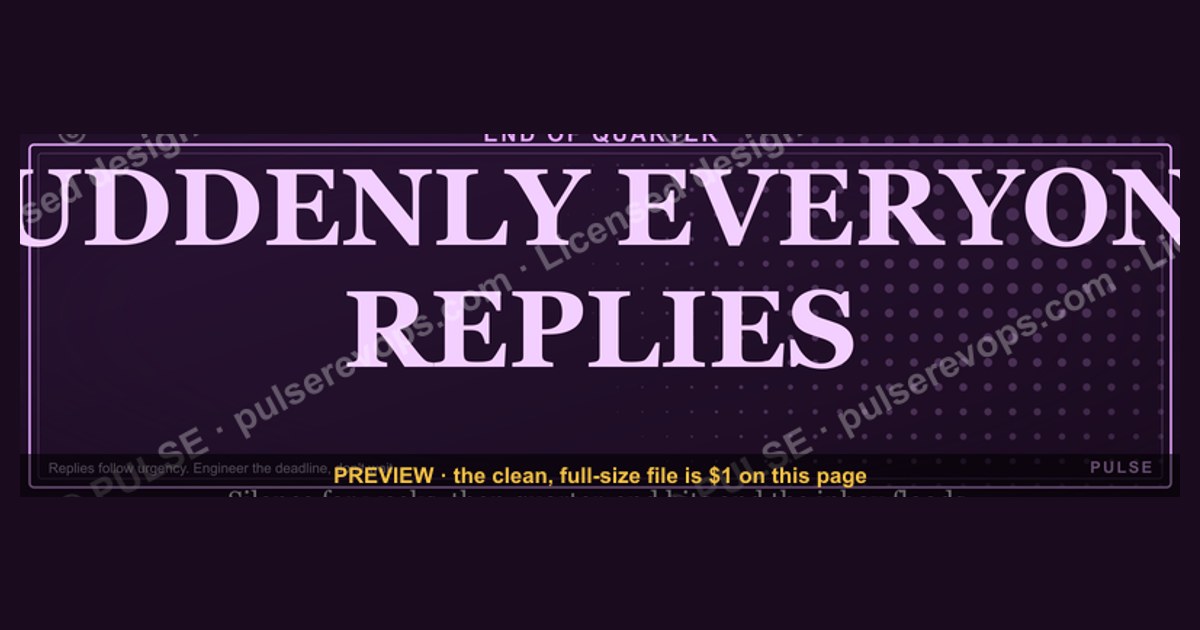
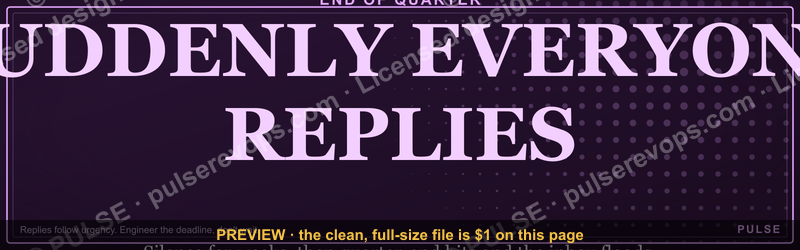
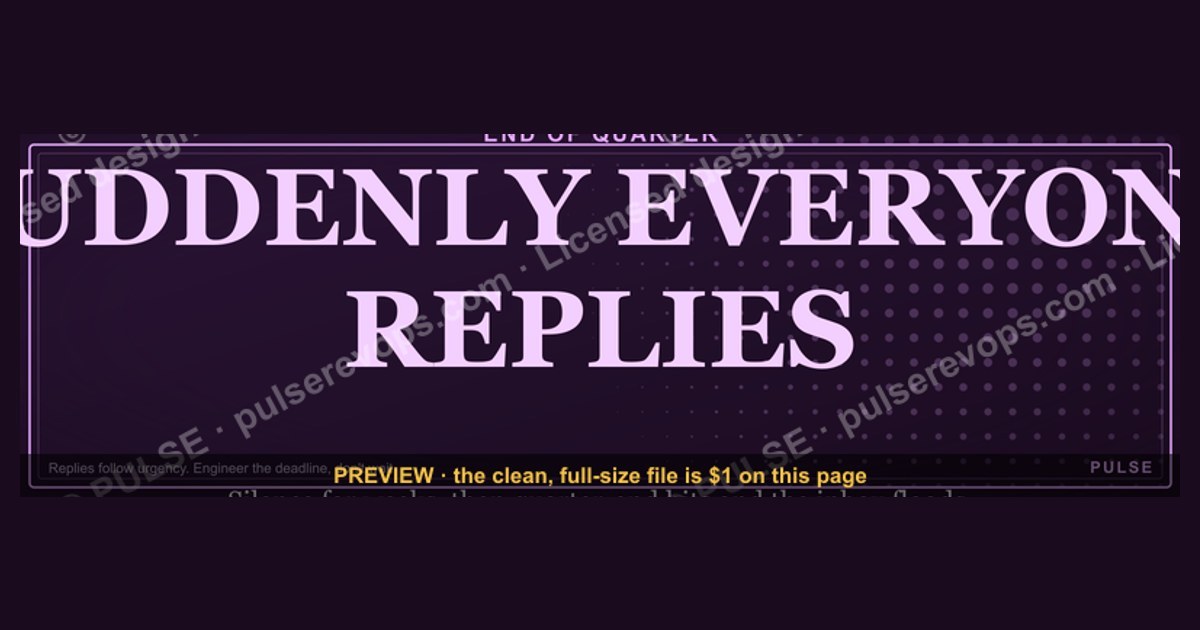
The "Suddenly Everyone Replies" meme captures one specific, painfully familiar moment in B2B sales: a prospect (or a whole buying committee) ignores your outreach for weeks, then floods your inbox the instant a real deadline appears — quarter-end, an expiring budget, a competitor in the mix, or a board meeting on the calendar. The joke lands because the cause isn't your charm or your follow-up cadence; it's that the buyer's own clock finally started ticking. The meme is sales shorthand for a deeper truth worth acting on: replies follow urgency, and urgency is something you can often engineer instead of wait for. The pulse-monitor visual underlines it — a long flatline, then a sudden spike, exactly how a stalled pipeline behaves when a deadline hits.
“SUDDENLY EVERYONE REPLIES” — Sales Meme

A clean vector sales meme — "END OF QUARTER" over "SUDDENLY EVERYONE REPLIES" with a pulse-monitor motif. Light, shareable humor for your sales Slack or kickoff.
Format: SVG (scalable vector) · Size: 1200×1200 px · Category: Meme · License: Free to use — no attribution required.
Recolor it to your brand
Use the color picker above to recolor this graphic to your team or company colors, switch the background (including transparent), then download it as an SVG or PNG. No sign-up, no watermark.
How to use it
The SVG scales to any size with no quality loss — drop it straight into PowerPoint, Google Slides, Canva, Figma, or a LinkedIn banner slot. The PNG export is ready to upload anywhere that wants a raster image.
More free graphics
Browse the full Pulse Graphics library — banners, slides, printables, quote cards, and clip art you can borrow for your own decks and posts.
Related on PULSE
- “It’s in the CRM, I Swear” — Sales Meme
- “TIME TO DO IT AGAIN” — Sales Meme
- “FINANCE: NOT YET” — Sales Meme
- “THE KISS OF DEATH” — Sales Meme
- “EVERY. SINGLE. MONTH.” — Sales Meme
- “IT'S A NOT YET” — Sales Meme
Why This Meme Hits So Hard: The Psychology of End-of-Quarter Urgency
The "SUDDENLY EVERYONE REPLIES" meme isn't just a joke — it's a near-universal sales experience rooted in well-documented behavioral psychology: deadlines change how people decide. When the end of a quarter looms, both buyers and sellers shift their cognitive processing, which is why an inbox that was silent for weeks suddenly buzzes.
From the buyer's side, the end of a fiscal period often coincides with budget expiration. Prospect theory (Kahneman & Tversky, 1979) found that people weigh a loss more heavily than an equivalent gain — losing an unspent budget *feels* worse than the satisfaction of a new purchase feels good. When a buyer realizes unallocated funds vanish on the last day of the quarter, their framing flips from "evaluate carefully" to "act now or lose it." That's why procurement teams who ghosted you for six weeks suddenly want a demo at 4:30 PM on a Friday.
For sellers, the meme captures the scarcity-driven adrenaline of a ticking clock. Compressed timelines collapse the multi-stakeholder analysis paralysis that stalls deals mid-quarter; when buyers have days instead of months, a solution that clearly fits a real need gets a faster "yes." This isn't a guaranteed lift you can put a number on — it varies by deal, segment, and how real the deadline actually is — but the directional pattern is familiar to almost anyone who has carried a quota.
The pulse-monitor motif is clever because it mirrors the physiological side: heart rate climbs and attention narrows when a deadline is real and close. Teams that understand this can deliberately create *mini-deadlines* throughout the quarter rather than waiting for the cliff at the end. A "budget approval window closing" note two weeks out, or a genuine "limited implementation slots this month," can trigger the same reply pattern — without the panic.
A practical takeaway: don't wait for the meme to become your reality. Map your buyers' fiscal calendars. Calendar-year companies peak in Q4 (October–December); many government and education buyers peak around June or September. Align your cadence to land inside their "use it or lose it" window, and "suddenly everyone replies" becomes a predictable outcome instead of a surprise.
How to Generate Your Own “Suddenly Everyone Replies” Moments (Without the Panic)
The meme is funny because it's true, but *relying* on end-of-quarter chaos is a fragile strategy. The better move is to engineer these moments on purpose, with three repeatable plays that create urgency without the last-minute scramble.
1. The "Budget Pulse" Campaign Instead of waiting for buyers to remember their own deadlines, remind them. Build a sequence that starts ~45 days before quarter-end:
- Week 1: Share a case study of a comparable company that closed late in a quarter and saw fast ROI.
- Week 2: Send a genuine "we have capacity for a few more implementations this quarter" note — real scarcity, not invented.
- Week 3: Offer a "quarter-end pricing lock" if they sign by the last Friday.
- Week 4: The final push — a direct call or voicemail: "I know you're slammed, but your budget won't roll over. Let's get this done."
This spreads activity across a month and lowers everyone's stress. The mechanism is simple: a clear, real deadline tends to pull more responses than an open-ended "just checking in," because it gives the buyer a reason to act *now* rather than later.
2. The "Internal Champion" Activation Buyers often go silent mid-quarter because they lack internal consensus — your champion is fighting finance, legal, and their boss alone. At quarter-end those stakeholders suddenly care because the budget is at stake. Replicate that earlier by helping your champion build a one-page budget justification that ties your solution to a specific quarterly goal (e.g., "cut onboarding time before the next planning cycle"). When that document circulates to decision-makers, it manufactures a mini-deadline — and people who ignored you start replying.
3. The "Reverse Deadline" Technique Most sellers chase buyers. Flip it: make the buyer chase you. Offer a quarter-end concession that genuinely expires (a price hold, a bundled onboarding) tied to a signed letter of intent. You control the timing, so the scarcity is real rather than manufactured pressure. This leans on the endowment effect — once a buyer feels they've "almost" secured something, they act to avoid losing it.
An illustrative example (composite, not a specific client): a SaaS team facing a stack of stalled leads sent a single "your current pricing holds through Friday" email to that segment. Replies clustered in the next 48 hours from contacts who'd been quiet for weeks, and a handful converted before quarter-end. The meme became their reality — but because they *planned* the deadline, not because they got lucky. Treat the specifics as the shape of the play, not a benchmark to expect.
The principle: create multiple small "quarter-ends" across the year — product launches, feature releases, seasonal pricing — so "suddenly everyone replies" becomes a tool in your kit instead of a panic button.
The Dark Side of the Meme: When “Suddenly Everyone Replies” Backfires
The meme is funny, but it also exposes a dangerous habit in sales culture: the last-minute hero complex. Leaning on end-of-quarter urgency as your *only* engine erodes trust, strains relationships, and produces deals that feel forced rather than earned.
The Trust Erosion Problem When a buyer only hears from you in the final weeks of a quarter, they read you as transactional — chasing a quota, not solving their problem. Buyers consistently say (in survey after survey from sales-research groups) that they prefer reps who understand their business context over reps who only show up when there's a deadline. If your only "reply" moments are deadline-driven, you're training prospects to ignore you until it's urgent.
The Quality vs. Quantity Trap Deals jammed through in the final days of a quarter carry real risk: a buyer who signed to avoid losing budget — rather than because they were convinced — is a buyer more likely to disengage during onboarding or churn at renewal. There's no single industry number that proves this for every business, but the logic is sound and most renewal teams have lived it: pressure gets the signature; it doesn't get the commitment. The meme might earn the close, but it won't keep the customer.
The Burnout Cycle For the team, "suddenly everyone replies" creates a boom-and-bust rhythm — 60-hour weeks at quarter-end, then a coast through the early weeks of the next one. That cadence is hard to sustain and tends to drive stress, attrition, and a culture where the only wins feel like last-minute saves. Quarter-end crunch is one of the most commonly cited stressors in sales-rep wellbeing discussions, and it's worth managing deliberately rather than treating as a badge of honor.
How to Fix It Shift toward a steady-state closing model:
- Pipeline hygiene: Review deals weekly, not just at quarter-end. Catch stalls early and apply controlled pressure.
- Multi-quarter planning: Don't let every deal become a Q4 emergency — if something is likely to land next quarter, start the process this one so the close is natural.
- Value-based urgency: Replace "budget deadline" with "value deadline." For example: "If we implement by November 1st, you'll see results before your January board meeting." Urgency, without the panic.
The meme is a mirror. The best sellers don't just laugh at it — they change what it reflects. They build systems where "everyone replies" happens because of alignment and real, honest deadlines, not a ticking clock. When you do that, the pulse monitor stops being a flatline-then-spike and starts looking like a steady heartbeat.
Sources
- Kahneman, D. & Tversky, A. (1979). "Prospect Theory: An Analysis of Decision under Risk," *Econometrica* — foundational research on loss aversion and how people weigh losses vs. gains.
- Cialdini, R. *Influence: The Psychology of Persuasion* — the scarcity and commitment principles behind deadline-driven behavior.
- Harvard Business Review — coverage of urgency, deadlines, and decision-making in B2B buying.
- Gartner — research on B2B buyer behavior, buying groups, and sales effectiveness.
- HubSpot Blog — practitioner guidance on sales follow-up cadence and email outreach.
- LinkedIn Sales Solutions — published trends on buyer engagement and seller-buyer relationships.
FAQ
What does “Suddenly Everyone Replies” actually mean? It's a meme about the moment a salesperson finally gets responses from prospects who went silent for weeks — usually right when a deadline appears, like quarter-end or an expiring budget. The humor is in the contrast: total silence, then a sudden flood of attention. The underlying point is that the replies are driven by the buyer's clock, not the seller's latest follow-up.
Is this meme based on a real sales situation? Yes. In B2B sales, leads routinely go cold and then become responsive when an external trigger hits — a budget cycle closing, a competitor surfacing, a new internal mandate. The meme exaggerates the timing for laughs, but the pattern is genuine, and it's why experienced reps map their buyers' fiscal calendars instead of just sending more emails.
Does the meme imply the salesperson did something wrong? Usually not. The silence-then-flood pattern is mostly about the buyer's shifting priorities, not a failure by the rep earlier in the cycle. That said, it's a useful nudge: if *every* one of your closes is a deadline scramble, that's a signal your pipeline is too dependent on urgency and not enough on earlier, value-based engagement.
How can I use this meme with my sales team? It's a lighthearted way to normalize the ups and downs of outreach — drop it in a team channel to acknowledge the grind and celebrate when persistence pays off. The one caution: don't weaponize it to shame reps for slow weeks. It works best as shared camaraderie, paired with a real conversation about engineering deadlines earlier so closes aren't always last-minute.
Does the meme apply to every sales channel? It resonates most with email and LinkedIn outreach, where ghosting is common and silence can stretch for weeks. It lands less on phone or in-person motions, where responses are more immediate and the "sudden flood" dynamic is rarer. It's fundamentally about asynchronous, digital cold outreach — the channels where a buyer can ignore you indefinitely until something forces their hand.
Is there a risk the meme makes selling look too easy? Only if it's read out of context. The "sudden replies" moment is the satisfying exception, not the daily reality — behind it sits weeks of follow-up, relationship-building, and timing. Used correctly, the meme builds team camaraderie and quietly makes a strategic point: those replies tend to cluster around deadlines, which is exactly why the smartest move is to create honest deadlines on purpose rather than wait for one.
This page will be disappearing soon. Save it to your device for $1 — or read it free while it is here.
@Kory-White- · if Venmo asks, the last 4 of my number are 2012
This page is gone.
This one is off the shelf now. $1 keeps it on your phone for good — the whole page, pictures and diagrams included.
 graphic“FOR THE 6TH TIME” — Sales Meme
 graphic“TIME TO DO IT AGAIN” — Sales Meme
 graphic“EVERY. SINGLE. MONTH.” — Sales Meme
 graphic“BOUGHT THE COMPETITOR” — Sales Meme
 graphic“PANIC SUNDAY NIGHT” — Sales Meme
 graphic“12 TIMES. NO REPLY.” — Sales Meme
 graphic“DEAL SLIPS TO NEXT QUARTER” — Sales Meme
 graphic“THE KISS OF DEATH” — Sales Meme
 graphic“...AFTER THE DEAL CLOSES” — Sales Meme
 graphic“It’s in the CRM, I Swear” — Sales Meme