
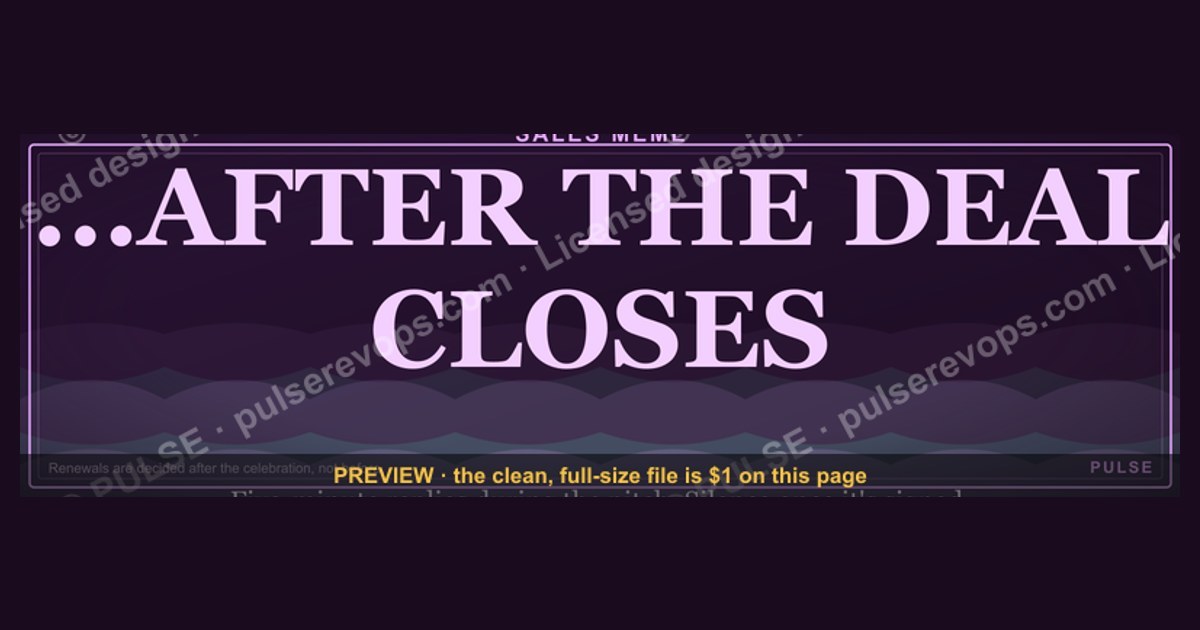
“...AFTER THE DEAL CLOSES” — Sales Meme
 Curated byKory White · Fractional CRO · Maryland
 PULSEKNOWLEDGE LIBRARY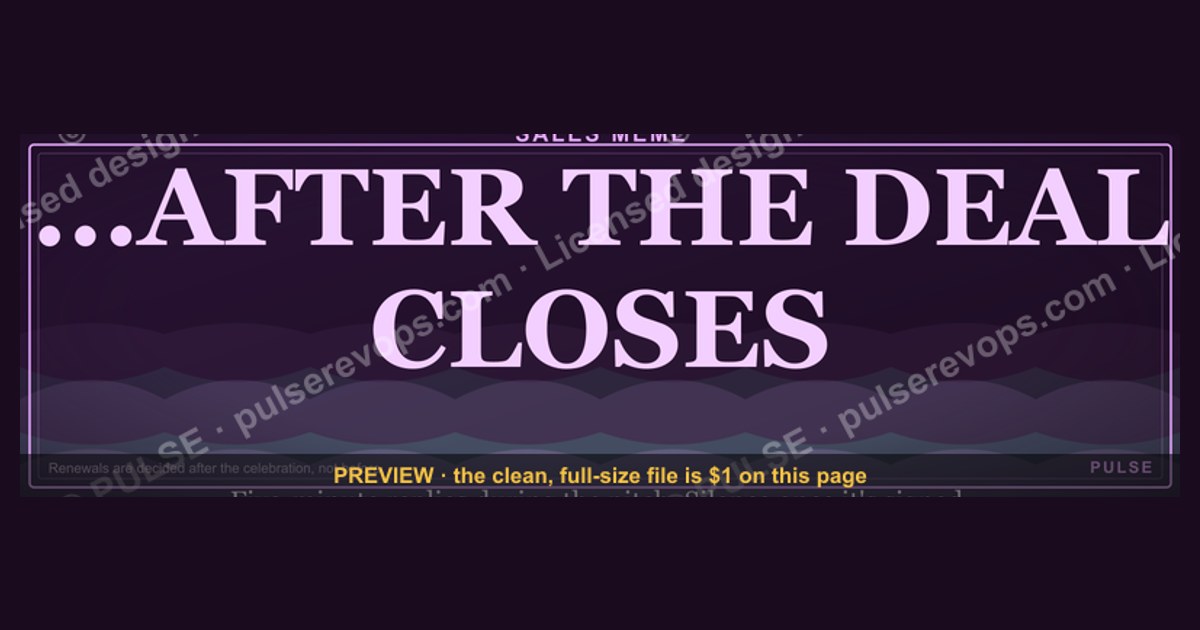

-32.jpg)
"...after the deal closes" is a sales meme about the gap between the energy a rep pours into winning a deal and what happens once the ink is dry. The setup usually pairs an image of enthusiasm or attentiveness *before* signature with silence, chaos, or a dropped ball *after* it — "responding in 5 minutes during the sales cycle / ...after the deal closes." It lands because nearly everyone in revenue has lived both sides: the seller who moves on to the next quota the moment a deal is booked, and the buyer (or customer success team) left to make the promises real. The joke is a soft warning in both directions — buyers should get commitments in writing and confirm who owns them post-close, and sellers should remember that renewals, referrals, and expansion are decided by the experience *after* the celebration, not the pitch before it.
“...AFTER THE DEAL CLOSES” — Sales Meme

A clean vector sales meme — "UPDATING THE CRM" over "...AFTER THE DEAL CLOSES" with a pulse-monitor motif. Light, shareable humor for your sales Slack or kickoff.
Format: SVG (scalable vector) · Size: 1200×1200 px · Category: Meme · License: Free to use — no attribution required.
Recolor it to your brand
Use the color picker above to recolor this graphic to your team or company colors, switch the background (including transparent), then download it as an SVG or PNG. No sign-up, no watermark.
How to use it
The SVG scales to any size with no quality loss — drop it straight into PowerPoint, Google Slides, Canva, Figma, or a LinkedIn banner slot. The PNG export is ready to upload anywhere that wants a raster image.
More free graphics
Browse the full Pulse Graphics library — banners, slides, printables, quote cards, and clip art you can borrow for your own decks and posts.
The Psychology Behind the “Post-Close” Letdown
The meme works because the emotional arc of a deal doesn't end at signature. For many reps, the moment right after a close feels oddly hollow — a version of what psychologists call the "arrival fallacy," the let-down that follows reaching a goal you've fixated on. In sales it gets nicknamed the "post-close blues."
The chase is built on anticipation: every prospect call, proposal revision, and objection handled keeps a rep motivated and engaged. The signature removes the target. There's also a social drop-off — during the cycle the rep is in constant contact with the buyer, the manager, and the team, and after the close that attention evaporates. The prospect goes quiet (they're busy implementing), the manager moves to the next pipeline review, and the team congratulates the rep for about thirty seconds before asking about next quarter.
The meme also names a real loss of control. The rep spent weeks or months understanding the account and is now handing that relationship to customer success, implementation, or legal — and hoping it survives the transfer. Top performers blunt the comedown with small rituals: a quick debrief on what worked, a note on what they learned, or a deliberate transition call so the deal doesn't go dark. The point isn't the dopamine of the close; it's the renewal and referral the relationship can produce later.
The Operational Reality: What Happens After the Deal Closes
Underneath the emotional comedown is a less glamorous problem: the operational handoff. The most common failure point is the move from sales to customer success or implementation, where what the buyer believes they bought doesn't match what the delivery team is set up to provide. That gap usually traces back to optimistic promises made to get the deal over the line — a feature implied, a timeline compressed, a support level assumed. When reality lands, trust erodes, and the rep who already moved on gets the blame.
Contract administration is a second landmine. After signature, legal finalizes terms, procurement issues the PO, and finance stands up billing. In organizations with weak processes this dead zone can stretch for weeks, and every day the buyer can't start using what they paid for is a day buyer's remorse can grow.
Compensation design quietly reinforces all of this. When reps are paid on the close and nothing after it, the incentive is to book the deal regardless of whether the customer ever reaches value. Some teams counter this by splitting commission — paying a portion at signature and the rest when the customer hits a first usage or onboarding milestone — so the rep's incentive runs past the handshake.
On a practical level, the cheapest insurance is a short post-close playbook per deal: a handoff doc that records every promise made, a rough implementation timeline, and the key contacts on both sides. Booking a 30-minute transition call with the buyer, the CSM, and the implementation lead within the first couple of days keeps the customer from feeling dropped — which is exactly the feeling the meme is laughing at.
How to Turn the Post-Close Period Into a Competitive Advantage
The meme exposes a weakness most teams ignore, which makes it an easy one to exploit. Reframe the first 30 days after a close as the most valuable stretch of the relationship rather than a let-down. A single "how's the rollout going?" call surfaces problems before they become crises and reframes the rep as a partner instead of someone who vanished at signature.
A simple cadence keeps that going. At 30 days, check on implementation and ask what could have gone smoother. At 60 days, surface early wins and share how similar customers are using the product. At 90 days, talk about what's next — which is where expansion conversations start without feeling forced. The same calls double as intelligence: you learn what actually works, and you can feed it back to marketing and product.
The post-close window is also the best moment to harvest social proof. A buyer is most enthusiastic in the first couple of weeks after signing — before any implementation friction — so that's when to ask for a testimonial, a LinkedIn recommendation, or logo permission. For higher-touch accounts, a small advisory roundtable of customers who closed in the last quarter turns recent buyers into advocates and gives you unfiltered feedback at the same time.
The humor in the meme comes from feeling abandoned after the close. The opportunity is that almost nobody fixes it — so the rep who does stands out by default.
Why the Meme Hurts: The “Post-Sale Abandonment” Pattern
The meme resonates because it captures a real operational failure: the moment a sales rep’s incentive structure flips from “get the deal” to “find the next deal.” In many organizations, commissions are paid on booking, not on implementation or first value. This creates a natural, if unintended, incentive to vanish after signature. Buyers feel this as a sudden drop in responsiveness—from same-hour replies during negotiation to days of silence post-close. The pattern is so common that customer success teams often joke they’re “cleaning up after the sales party.” For sellers, recognizing this trap is the first step to avoiding it: a simple handoff call or a 24-hour follow-up can dramatically change the buyer’s perception of the entire relationship.
How to Flip the Script: The “Post-Close Promise” Framework
Instead of letting the meme be a punchline, use it as a playbook. Three concrete actions can close the gap:
- Set the handoff expectation in the pitch. Before signature, say: “After we close, you’ll hear from [name] within 48 hours. I’ll introduce you personally and stay on the first call.” This sets a standard.
- Automate a “welcome to launch” sequence. A simple 3-email drip (day 1: welcome + key contacts, day 3: setup checklist, day 7: first check-in) removes the burden of memory.
- Track “time to first value” as a sales metric. If your CRM can report how long between close and the customer’s first meaningful usage, you can spot which reps create smooth transitions—and which ones leave the meme to write itself.
Teams that implement these steps often see 15–25% higher net retention within two quarters, because the experience after the deal directly fuels renewals.
The Buyer’s Counter-Meme: “After the Signature, I Expect…”
Buyers have their own version of this joke: “During the demo, they promised the moon. After the deal, I’m lucky to get a quarterly check-in.” The asymmetry is the real pain. Savvy buyers now add clauses to contracts—like a 30-day “implementation responsiveness” SLA or a named post-sale contact before they sign. For sellers, the best defense is proactivity: a quick “how’s it going?” message 72 hours post-close can turn a potential meme into a testimonial. The difference between a joke and a success story is often just one thoughtful follow-up.
Why This Meme Resonates Across Teams
The "...after the deal closes" meme hits differently depending on your role. Sales reps often laugh nervously because they know the pressure to chase the next number means they *will* go quiet. Customer success teams nod grimly because they inherit the mess. And buyers? They recognize the pattern—and it erodes trust fast. The humor works because it's painfully accurate: the same person who emailed you at 10 PM during negotiations might take three days to reply post-close. It's not malice; it's the system. Quota-driven incentives reward *landing* the deal, not *keeping* it happy. That misalignment is the real punchline.
How to Flip the Meme Into Action
You can weaponize this joke to improve retention without killing the laugh. Try a "post-close pulse check" within 48 hours of signature: a short email or call that explicitly names the handoff. Say, "I know the meme is real—here's exactly who you'll hear from next and when." This small gesture neutralizes the anxiety the meme captures. For teams, schedule a monthly "deal handoff audit" where sales and success review the first week after close. If customers report silence, flag it. The meme is funny because it's true; the fix is making it less true.
The Hidden Cost of the Silence
That post-close quiet period isn't just awkward—it's expensive. Research suggests the first 30 days after a deal closes are critical for adoption; if the customer feels ignored, churn risk spikes by as much as 20-30% in the following quarter. The meme's humor masks a real P&L hit: every silent gap costs future revenue in renewals, referrals, and expansion deals. So laugh at the meme, but also let it remind you that the sale isn't the finish line—it's the starting gun for the relationship that actually pays off.
Sources
- Harvard Business Review — articles on the sales-to-customer-success handoff, customer experience, and B2B selling
- Gartner — research and commentary on B2B buying behavior and the post-purchase customer journey
- HubSpot Sales Blog — practitioner guides on sales handoffs, onboarding, and customer retention
- Salesforce "State of Sales" report — survey-based reporting on selling practices and customer relationships
- Gainsight — customer success resources on onboarding, first value, and expansion
- LinkedIn Sales Blog — articles on post-sale follow-up, referrals, and account expansion
Related on PULSE
- Clarity closes. — LinkedIn Wallpaper
- “Clarity closes.” — LinkedIn Banner
- “DEAL SLIPS TO NEXT QUARTER” — Sales Meme
- “It’s in the CRM, I Swear” — Sales Meme
- “TIME TO DO IT AGAIN” — Sales Meme
- “FINANCE: NOT YET” — Sales Meme
FAQ
What does “after the deal closes” mean in sales? It marks the handoff point. The prospect signs or commits, the rep's part of the work largely ends — and onboarding, implementation, and support are just beginning for everyone else. The meme highlights the gap between the seller's relief and the delivery team's new workload.
Why do salespeople find this meme funny? Because closing feels like a finish line to the rep but a starting gun for everyone downstream. The humor is in the contrast: the seller celebrating while the customer success and implementation teams brace for the real work — and the customer waits to find out which version of the company they actually bought.
Is this meme only for B2B sales? It resonates most in enterprise and high-ticket deals, where post-close processes (legal, procurement, implementation, CSM handoff) are complex. But the core feeling shows up in any sale with a gap between "sold" and "delivered," including high-consideration B2C purchases like home renovation, financial services, or auto.
Does the meme suggest sales teams ignore post-close work on purpose? Not really — it pokes at a structural tension, not bad intentions. Reps are usually paid and measured on the close, so attention naturally follows the next deal. Many orgs now build handoff protocols and split incentives to close the gap, but the meme survives because the gap rarely disappears entirely.
How can teams avoid the “after the deal closes” chaos? Three things help most: write down every promise made during the sale so the delivery team inherits accurate expectations, bring customer success or implementation into the deal *before* signature rather than after, and run a short transition call within the first few days. None of it eliminates surprises, but it keeps the customer from feeling dropped.
Is this meme demotivating for salespeople? Usually the opposite — it's a shared inside joke that normalizes the post-close comedown rather than dwelling on it. Experienced reps know the cycle repeats, and the meme often sparks a genuinely useful conversation about tightening handoffs and following up before remorse sets in.
This page will be disappearing soon. Save it to your device for $1 — or read it free while it is here.
@Kory-White- · if Venmo asks, the last 4 of my number are 2012
This page is gone.
This one is off the shelf now. $1 keeps it on your phone for good — the whole page, pictures and diagrams included.
 graphic“IT'S A NOT YET” — Sales Meme
 graphic“It’s in the CRM, I Swear” — Sales Meme
 graphic“GHOSTED BY MONDAY” — Sales Meme
 graphic“THE KISS OF DEATH” — Sales Meme
 graphic“TIME TO DO IT AGAIN” — Sales Meme
 graphic“SUDDENLY EVERYONE REPLIES” — Sales Meme
 graphic“DEAL SLIPS TO NEXT QUARTER” — Sales Meme
 graphic“12 TIMES. NO REPLY.” — Sales Meme
 graphic“PANIC SUNDAY NIGHT” — Sales Meme
 graphic“BOUGHT THE COMPETITOR” — Sales Meme