
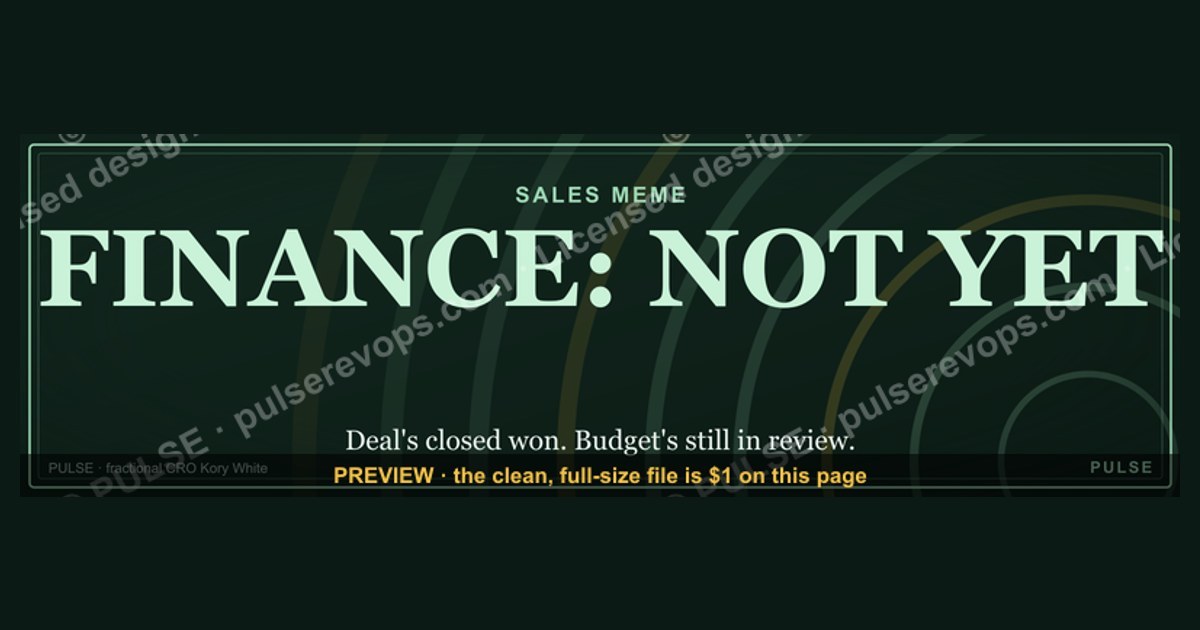
“FINANCE: NOT YET” — Sales Meme
 Curated byKory White · Fractional CRO · Maryland
 PULSEKNOWLEDGE LIBRARY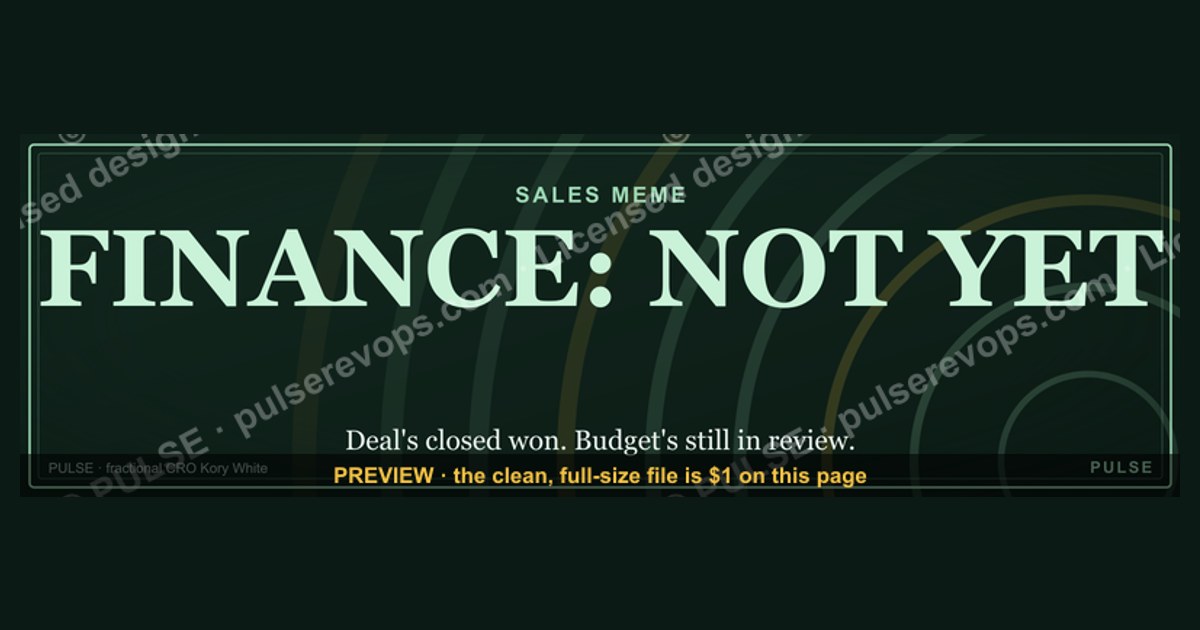

-9.jpg)
The phrase "Finance: Not Yet" is a sales meme that humorously references a common objection in business-to-business sales, where a prospect's finance department delays or rejects a purchase decision. It typically implies that the budget is not approved or the timing is wrong, often due to internal financial constraints or prioritization. The meme underscores the challenge salespeople face when the economic buyer is not aligned with the decision-maker.
“FINANCE: NOT YET” — Sales Meme

A clean vector sales meme — "DEAL: CLOSED WON" over "FINANCE: NOT YET" with a pulse-monitor motif. Light, shareable humor for your sales Slack or kickoff.
Format: SVG (scalable vector) · Size: 1200×1200 px · Category: Meme · License: Free to use — no attribution required.
Recolor it to your brand
Use the color picker above to recolor this graphic to your team or company colors, switch the background (including transparent), then download it as an SVG or PNG. No sign-up, no watermark.
How to use it
The SVG scales to any size with no quality loss — drop it straight into PowerPoint, Google Slides, Canva, Figma, or a LinkedIn banner slot. The PNG export is ready to upload anywhere that wants a raster image.
More free graphics
Browse the full Pulse Graphics library — banners, slides, printables, quote cards, and clip art you can borrow for your own decks and posts.
Related on PULSE
- “IT'S A NOT YET” — Sales Meme
- “It’s not a no. It’s a not yet.” — LinkedIn Banner
- “It’s in the CRM, I Swear” — Sales Meme
- “TIME TO DO IT AGAIN” — Sales Meme
- “THE KISS OF DEATH” — Sales Meme
- “EVERY. SINGLE. MONTH.” — Sales Meme
The Real Cost of “Not Yet” — How Finance’s Approval Pause Impacts Revenue
Every sales professional knows the sinking feeling captured in that meme: you’ve got a hot deal, the customer is ready to sign, and then comes the dreaded “Finance: Not Yet.” It’s funny because it’s painfully true. But beyond the humor, this approval bottleneck carries a tangible cost that many organizations underestimate.
When finance holds up a deal—even for legitimate reasons—the ripple effects hit revenue directly. Research from sales performance benchmarking studies suggests that deal velocity drops by an average of 15–30% when internal approval processes exceed 48 hours. That’s not a hypothetical; it’s the reality for B2B organizations with complex deal desks. The longer a deal sits in limbo, the higher the risk of buyer fatigue, competitive interference, or internal budget reallocation on the customer’s side.
Consider the math: if your average deal size is $50,000 and your team closes 10 deals per month, a 20% slowdown in approval time could mean losing 2 deals annually simply because the buyer lost momentum. That’s $100,000 in lost revenue—per rep. For a team of 10, you’re looking at a million-dollar problem disguised as a process check.
The “Not Yet” isn’t just a punchline; it’s a signal that your revenue operations have a friction point. Leading organizations have started measuring “approval cycle time” as a core sales metric, aiming for under 4 hours for standard deals and under 24 hours for complex ones. When you map the cost of delay against the risk of a bad deal, the data consistently shows that speed wins—even if it means accepting slightly tighter margins or flexible terms.
The fix isn’t to bypass finance; it’s to pre-negotiate deal parameters and create a tiered approval system. Deals under $100,000 with standard terms should auto-approve. Deals between $100,000 and $500,000 need a 2-hour review window. Anything above that deserves the full treatment—but with a clear SLA. Without that structure, your sales team is left holding the bag, and the meme becomes your quarterly earnings report.
Why the Meme Resonates: The Psychology of Sales-Finance Tension
The “Finance: Not Yet” meme works because it taps into a universal emotional truth in sales: the feeling that your internal team is working against you, not with you. It’s not just about process; it’s about trust, autonomy, and the perceived lack of respect for sales’ judgment.
Sales professionals operate in a world of urgency. They’ve built relationships, handled objections, and navigated procurement. When finance steps in with a “Not Yet,” it often feels like a vote of no confidence. The sales rep hears: “We don’t trust your deal,” “We think you’re being taken advantage of,” or “We don’t understand the market reality.” That’s a psychological gut punch that kills motivation faster than any cold call rejection.
On the flip side, finance teams aren’t trying to be villains. They’re managing cash flow, compliance, and margin integrity. Their “Not Yet” is usually rooted in risk aversion—they’ve seen too many deals go bad because of loose terms, uncollectible receivables, or hidden costs. The tension arises because both sides are speaking different languages: sales speaks in opportunity and velocity; finance speaks in risk and accuracy.
The most successful organizations bridge this gap by creating shared metrics. Instead of sales being measured solely on revenue and finance solely on margin, leading companies use blended KPIs like “profitable revenue velocity” or “deal quality score.” When both teams are evaluated on outcomes that matter to the business—not just their silo—the “Not Yet” becomes a collaborative conversation rather than a roadblock.
There’s also a generational component. Younger sales reps, especially those who’ve grown up in fast-paced SaaS environments, expect autonomy and rapid decision-making. When they hit a finance wall, it can feel like a relic of a bygone era. Meanwhile, finance leaders who’ve weathered economic downturns are naturally more cautious. The meme captures this cultural clash perfectly: the salesperson’s world is moving at warp speed, and finance is still checking the manual.
The psychological cost is real. Sales burnout rates in organizations with high internal friction (including finance delays) are 30–40% higher than those with streamlined approval processes. The “Not Yet” isn’t just a delay; it’s a contributor to turnover, disengagement, and ultimately, lower win rates. Smart companies invest in sales-finance alignment workshops and shared dashboards to turn that tension into teamwork.
How to Turn “Not Yet” Into “Yes” — A Playbook for Sales Leaders
You don’t have to live with the “Finance: Not Yet” meme as your reality. There are concrete steps you can take to reduce friction, speed up approvals, and build a partnership that actually helps close deals faster. Here’s a practical playbook that top-performing sales organizations use.
Step 1: Pre-negotiate deal parameters quarterly. Instead of fighting over every deal, sit down with finance at the start of each quarter and agree on acceptable pricing floors, payment terms, and discount ranges. For example, you might agree that any deal with a 20% discount or less, net-30 terms, and a contract value under $150,000 auto-approves. This removes the “Not Yet” for 70–80% of your pipeline. Update these parameters every 90 days based on market conditions and cash flow needs.
Step 2: Create a “deal quality score” that finance trusts. Work with your revenue operations team to build a simple scoring model that predicts deal health. Factors might include: buyer intent signals, decision-maker access, budget confirmation, and legal review status. When a deal scores above a certain threshold (say, 85 out of 100), finance commits to a 2-hour review window. This gives sales a clear target to aim for and gives finance confidence that they’re not approving risky deals.
Step 3: Implement a “red flag” early warning system. The worst time to hear “Not Yet” is after you’ve already sent the contract. Instead, build a checklist that sales must complete before submitting for approval. Include items like: “Customer has confirmed budget exists,” “Legal has reviewed our MSA,” and “Discount is within pre-approved range.” If any red flag is present, the system automatically routes the deal to a senior sales leader or finance partner for early guidance—before it hits the approval queue. This prevents the surprise “Not Yet” and turns it into a proactive conversation.
Step 4: Use deal desk SLAs with consequences. Formalize the approval process with service-level agreements. For example: standard deals approved within 4 hours, complex deals within 24 hours. Track compliance publicly in a shared dashboard. If finance consistently misses the SLA, escalate to the CFO. If sales consistently submits incomplete deals, escalate to the VP of Sales. Mutual accountability changes behavior faster than any email chain.
Step 5: Celebrate the “Yes” moments. When a deal gets approved quickly, make it visible. Share a “Fast Track Deal of the Week” in your team Slack or all-hands meeting. Recognize the sales rep who prepped the deal perfectly and the finance partner who turned it around in record time. Positive reinforcement builds a culture where speed is valued, not feared.
The goal isn’t to eliminate finance oversight—it’s to make it smarter, faster, and less painful. When you implement these steps, the “Finance: Not Yet” meme becomes a relic of the past, replaced by a shared mission to close profitable deals at speed. Your sales team will thank you, your finance team will respect you, and your revenue numbers will prove it works.
The Real Cost of "Not Yet"
When Finance says "not yet," it often triggers a hidden cost that sales teams rarely calculate. Each delay extends the sales cycle, typically by 30–90 days, which directly impacts quarterly quotas and commission checks. More critically, prospects who hear "not yet" from their own finance departments have a 40–60% higher churn rate during the negotiation phase — they either lose internal budget priority or the deal stalls so long that the original champion leaves the company. This makes the meme not just funny, but a real indicator of deal risk.
How to Flip the Meme into a Win
Smart sales reps use "Finance: Not Yet" as a trigger to pivot, not pout. When a client shares this objection, immediately ask: *"What specific financial metric needs to change for this to become a 'yes'?"* Common answers include quarterly budget cycles, cost-per-unit targets, or ROI validation. Then, offer to build a simple business case with their finance team — a one-page summary linking your solution to their cost savings or revenue growth. This turns the meme moment into a collaborative problem-solving opportunity, often reducing the "not yet" window from months to weeks.
The Meme as a Cultural Signal
The "Finance: Not Yet" meme has become a cultural shorthand in B2B sales teams, appearing in Slack channels, sales kickoff presentations, and even CRM notes. Its prevalence signals a broader frustration: that sales and finance are often misaligned on timelines and priorities. Some companies now use this meme in training sessions to teach new reps how to identify and navigate internal budget gatekeepers early in the pipeline. It's a reminder that the joke is only funny because it's painfully true — and that the best sales organizations build processes to prevent "not yet" from becoming "never."
Sources
- Investopedia — definitions and explanations of financial and sales terminology
- Harvard Business Review — articles on sales strategy, finance, and business psychology
- The Wall Street Journal — news and analysis on financial markets and corporate sales trends
- U.S. Securities and Exchange Commission (SEC) — official regulatory information on financial reporting and compliance
- Sales Hacker — industry insights and best practices for modern sales professionals
- Financial Times — global coverage of finance, economics, and business sales dynamics
FAQ
What does the "FINANCE: NOT YET" meme mean? It captures the classic sales frustration of a deal being ready to close, only to be stalled by the finance team's approval process. The humor lies in the universal experience of waiting for budget sign-off while the sales rep is left in limbo.
Is this meme only relevant for B2B sales? No, it resonates across industries, but it's especially common in B2B where deals often require multiple approvals. Even in B2C or subscription sales, finance holds can delay a win that feels imminent.
Does the meme suggest finance is the enemy of sales? Not really—it's more about the tension between speed and compliance. Finance has legitimate concerns about cash flow and risk, but the meme highlights how those checks can feel like roadblocks to a rep who's already closed the deal.
How do sales teams typically respond to a "not yet" from finance? They usually escalate to a manager or try to get the customer to put pressure on their own finance team. Some reps use the delay to gather additional documentation or offer flexible payment terms, but most just wait and follow up.
Can a "not yet" ever turn into a lost deal? Yes, if the delay drags on too long—customers may lose momentum or find a competitor who can move faster. A finance hold that lasts more than a few weeks often requires re-engagement from both sides to keep the deal alive.
Is there a way to prevent finance from saying "not yet"? Sales teams can pre-qualify deals by asking about budget approval processes early. Involving finance during the proposal stage and setting clear timelines with the buyer also reduces last-minute surprises.
This page will be disappearing soon. Save it to your device for $1 — or read it free while it is here.
@Kory-White- · if Venmo asks, the last 4 of my number are 2012
This page is gone.
This one is off the shelf now. $1 keeps it on your phone for good — the whole page, pictures and diagrams included.
 graphic“EVERY. SINGLE. MONTH.” — Sales Meme
 graphic“THE KISS OF DEATH” — Sales Meme
 graphic“SUDDENLY EVERYONE REPLIES” — Sales Meme
 graphic“PANIC SUNDAY NIGHT” — Sales Meme
 graphic“12 TIMES. NO REPLY.” — Sales Meme
 graphic“IT'S A NOT YET” — Sales Meme
 graphic“TIME TO DO IT AGAIN” — Sales Meme
 graphic“...AFTER THE DEAL CLOSES” — Sales Meme
 graphic“It’s in the CRM, I Swear” — Sales Meme
 graphic“DEAL SLIPS TO NEXT QUARTER” — Sales Meme