
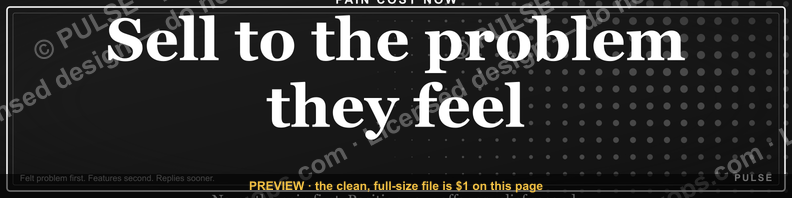
“Sell to the problem they feel.” — LinkedIn Banner
 Curated byKory White · Fractional CRO · Maryland
 PULSEKNOWLEDGE LIBRARY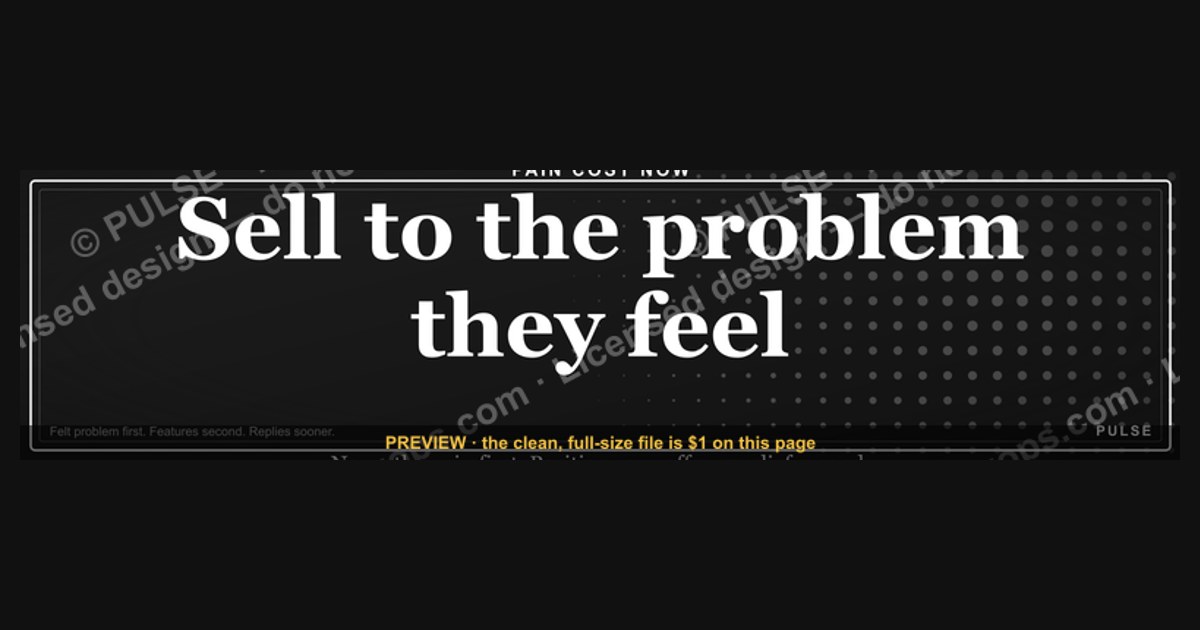
"Sell to the problem they feel" means anchoring your LinkedIn messaging to the specific frustration your buyer is living with right now — not the features you ship. A felt problem is emotional and present-tense ("our follow-up is so slow we're losing deals"), while a feature is abstract ("CRM automation"). Lead with the felt problem and your profile becomes instantly relevant to the exact people you want, because they recognize their own pain before they ever read your pitch. This banner puts that reminder on your cover image: name the pain first, position your offer as the relief second.
“Sell to the problem they feel.” — LinkedIn Banner

A dark, on-brand LinkedIn banner — "Sell to the problem they feel." over a "Pain Cost Now" line with a pulse motif. Put it on your profile to signal exactly what you do.
Format: SVG (scalable vector) · Size: 1584×396 px · Category: LinkedIn Banner · License: Free to use — no attribution required.
Recolor it to your brand
Use the color picker above to recolor this banner to your team or company colors, switch the background (including transparent), then download it as an SVG or PNG. No sign-up, no watermark.

How to use it
It scales cleanly to the LinkedIn cover slot (1584×396) — download the PNG and drop it straight onto your profile, or open the SVG in Canva, PowerPoint, or Figma to add your name and tweak the layout.
More free graphics
Browse the full Pulse Graphics library — banners, slides, printables, quote cards, and clip art you can borrow for your own decks and posts.

Related on PULSE
- “Sell the Problem, Not the Product” — Quote Card
- “Sell the problem, not the product.” — Quote Card
- "Sell the problem." — LinkedIn Banner
- Sell the problem. — LinkedIn Wallpaper
- “Sell the problem, not the product.” — LinkedIn Banner
- “SELL THE VALUE” — Sales Floor Print
Why “Sell to the Problem They Feel” Works Better Than “Sell the Solution”
Most sales advice tells you to lead with your product's features, your company's credentials, or the ROI your solution delivers. That's table-stakes noise. The banner's message cuts deeper because it targets the emotional core of every buying decision — the *felt* problem.
When a prospect feels a problem, they're not just rationally aware of a gap. They're experiencing frustration, anxiety, or urgency. A CTO who loses sleep over system downtime doesn't want a "99.9% uptime SLA" — they want the dread of explaining another outage to the board to disappear. A marketing director drowning in unqualified leads doesn't need a "lead scoring tool" — they need the relief of finally walking into a pipeline review without cringing.
This distinction matters because people act to resolve discomfort, and discomfort they feel right now is more motivating than a benefit they'd notice later. Selling to the *felt* problem meets the buyer where their attention already is. You're not asking them to imagine a future improvement; you're naming a present irritation they'd pay to make stop.
Practical application: When you craft your LinkedIn profile, your outreach messages, or your sales deck, don't start with "We help companies reduce costs by 20%." Start with "You're tired of explaining to your CFO why costs keep creeping up despite headcount freezes." The first statement is a feature. The second is a feeling. The banner's phrasing forces you to articulate that feeling before you ever mention your product.
For sales teams, this principle translates into a simple diagnostic question: "What keeps your prospect up at night?" Not "What's your budget?" or "What's your timeline?" — those are logistics. The felt problem is the emotional weight they carry. If you can name that weight in your first interaction, you've earned more trust than a dozen case studies would.
How to Find the “Felt Problem” in Your Own Market
The banner's wisdom is useless if you can't identify the specific emotional pain your audience experiences. Many sellers default to surface-level complaints ("Our software is too slow") without digging into the visceral impact. Here's a repeatable process to uncover the felt problems in your niche:
Step 1: Collect emotional language from your best customers. Go back through your CRM notes, call recordings, or email threads with your happiest, most profitable clients. Highlight every phrase that expresses emotion — not just "we needed X feature," but "we were embarrassed by our reporting" or "we were terrified of losing the account." These phrases are gold. They reveal the exact feeling your banner should target.
Step 2: Map the "before and after" emotional states. For each felt problem you uncover, write down the emotional state your customer was in *before* they found you (e.g., anxious, overwhelmed, frustrated) and the emotional state *after* they implemented your solution (e.g., relieved, confident, proud). The gap between those two states is your value proposition. The banner's "Pain Cost Now" line hints at this — it's the price they pay for staying in the before state.
Step 3: Test your banner copy with a simple split. Create two versions of your LinkedIn banner — one that states the felt problem (e.g., "Stop losing deals to indecision") and one that states the solution benefit (e.g., "Close more deals faster"). Run each for two weeks. Track profile views, connection requests, and inbound messages, and keep whichever pulls more of the *right* conversations. Treat this as your own experiment rather than trusting a generic benchmark — what resonates is specific to your audience and category.
Step 4: Refine based on audience feedback. Once your banner is live, monitor the comments and DMs you receive. If someone says "That's exactly what I'm dealing with," you've nailed it. If they say "What do you actually do?" you're too vague. The banner should be a magnet for the right people, not a puzzle for everyone. Adjust the phrasing until prospects self-identify with the problem before they ask about your solution.
The Psychology Behind “Pain Cost Now” — Why Urgency Drives Action
The banner's second line — "Pain Cost Now" — isn't a random tagline. It leans on three well-documented ideas from behavioral economics: loss aversion, temporal discounting, and status quo bias.
Loss aversion, central to Kahneman and Tversky's prospect theory, describes how people tend to feel losses more sharply than equivalent gains. When a prospect reads "Pain Cost Now," they're reminded that every day they don't solve the problem, they're *losing* something — time, money, credibility, or sanity. For many buyers that framing lands harder than a promise of future upside, which is why "what this is costing you" is often a stronger opener than "what you could gain."
Temporal discounting explains why people tend to undervalue future rewards relative to present costs. If you tell a prospect "Our solution saves you $50,000 per year," that benefit sits in the future and gets discounted. "Pain Cost Now" makes the cost of inaction feel immediate and tangible. It's the difference between "you'll save money next quarter" and "you're bleeding money this month." The banner pushes the prospect to confront the present-tense cost of their problem.
Status quo bias is the default human preference for keeping things as they are. Many buyers stay with their existing vendor or process even when a better option exists, simply because change is uncomfortable. "Pain Cost Now" works against that bias by making the status quo feel costly. When the price of staying the same is high enough, the discomfort of change becomes the lesser evil. That's why the banner functions as a profile signal — it pre-frames every conversation so the prospect arrives already questioning their current situation.
For practical use, pair this banner with a LinkedIn headline that reinforces the urgency. For example: "Helping SaaS founders stop the cash burn — before the board asks hard questions." The banner sets the emotional stage; the headline delivers the context. Together they make your profile hard to scroll past for anyone living that specific pain.
Finally, remember that "Pain Cost Now" is a diagnostic tool, not a sales pitch. When a prospect connects with you after seeing this banner, your first message should acknowledge the cost they're feeling: "I see you're dealing with [specific pain]. How long has that been costing you?" That validates their experience and opens a conversation about the real problem — not your solution. The banner's job is to attract the right people; your job is to help them articulate the cost they're already paying.
Sources
- Kahneman, D., & Tversky, A. (1979). "Prospect Theory: An Analysis of Decision under Risk." *Econometrica* — foundational work on loss aversion and decision framing.
- Daniel Kahneman, *Thinking, Fast and Slow* (Farrar, Straus and Giroux, 2011) — accessible overview of loss aversion, framing, and status quo bias.
- Harvard Business Review — articles on buyer psychology and the emotional drivers of B2B purchase decisions.
- LinkedIn Marketing Solutions Blog — guidance on B2B audience targeting and profile/messaging best practices.
- HubSpot Blog — guides on buyer personas, pain-point discovery, and inbound messaging.
- American Marketing Association (ama.org) — resources on positioning and customer pain points.
FAQ
What does “sell to the problem they feel” actually mean? It means focusing your pitch on the emotional pain or frustration your prospect is experiencing right now, rather than listing features. People act to escape discomfort or gain relief, so you lead with empathy for their specific struggle and present your offer as the path out of it.
How do I identify the problem a prospect feels? Ask open-ended questions about their daily frustrations, bottlenecks, or what keeps them up at night. Listen for emotional words like "annoyed," "stressed," or "waste of time" — those signal the felt problem you can speak to directly. Mining call notes and emails from your best existing customers is the fastest source.
Is this different from selling to a logical need? Yes. Logical needs ("we need a CRM") are rational and easy to defer; felt problems ("I'm embarrassed by our slow follow-up") carry emotional urgency. The strongest sales conversations connect the logical solution back to the emotional pain so the buyer has both a reason and a reason to act now.
Can this approach work for B2B or enterprise sales? Absolutely. Even in committee-driven enterprise deals, decisions are made by humans who feel pressure, fear, and frustration. Naming a VP's anxiety about missing quarterly targets often moves a deal further than a dry ROI table — then you back it with the numbers once you have their attention.
What if the prospect doesn’t seem to have a strong emotional pain? Dig deeper or reframe. The pain is often buried — they may not realize how much a small inefficiency costs them in time, money, or credibility. Ask about consequences: "What happens if this isn't fixed by next quarter?" If there's genuinely no real pain, that's a signal they may not be a fit yet, which saves you both time.
How do I avoid sounding manipulative when using this tactic? Stay genuine — your goal is to help, not to pressure. Only name a pain you can actually relieve, and frame your solution honestly rather than as a magic fix. When you truly believe your product solves their felt problem, naming that problem reads as empathy and understanding, not manipulation.
This page will be disappearing soon. Save it to your device for $1 — or read it free while it is here.
@Kory-White- · if Venmo asks, the last 4 of my number are 2012
This page is gone.
This one is off the shelf now. $1 keeps it on your phone for good — the whole page, pictures and diagrams included.
 graphicHow do you build a Champions sell motion from scratch in 2027?
 graphic“Bring the energy every call.” — LinkedIn Banner
 graphic“Data beats opinions.” — LinkedIn Banner
 graphic“Revenue for marketing tech.” — LinkedIn Banner
 graphicCommercial Director — LinkedIn Banner
 graphicFaster deals, fewer leaks. — LinkedIn Wallpaper
 graphic“Champions are made before the call.” — LinkedIn Banner
 graphicOne team. One number. — LinkedIn Wallpaper
 graphicHow to build a champion seller playbook in 2027
 graphicSIEM and Data Lake CRO — LinkedIn Banner