
One team. One number. — LinkedIn Wallpaper
 Curated byKory White · Fractional CRO · Maryland
 PULSEKNOWLEDGE LIBRARY
Quality
Certified
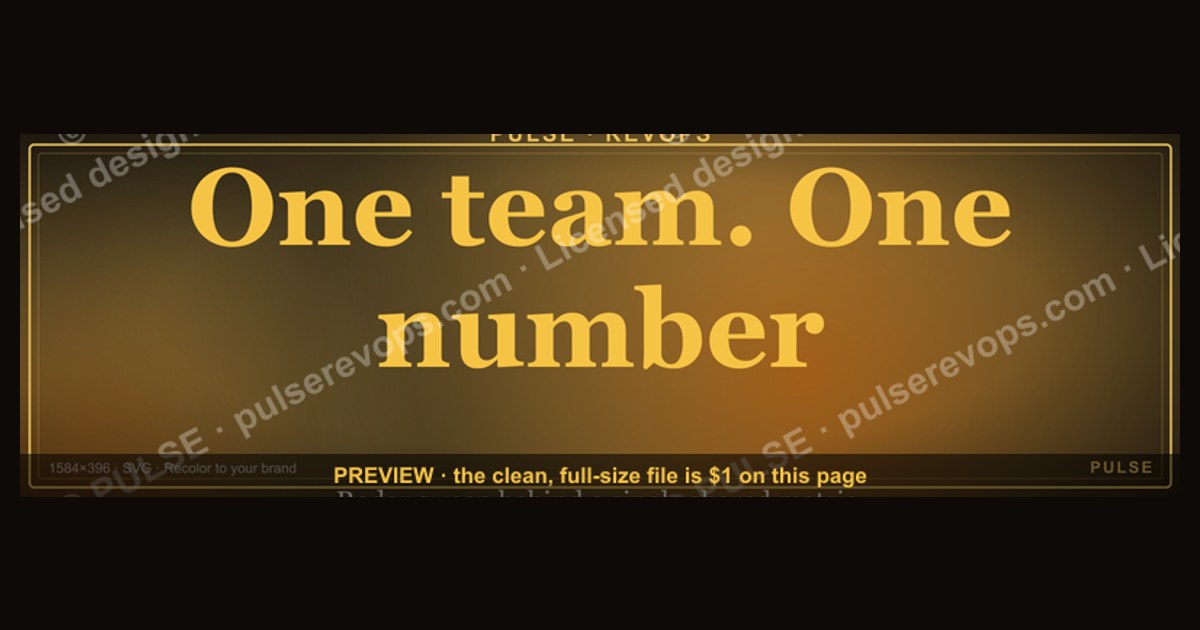
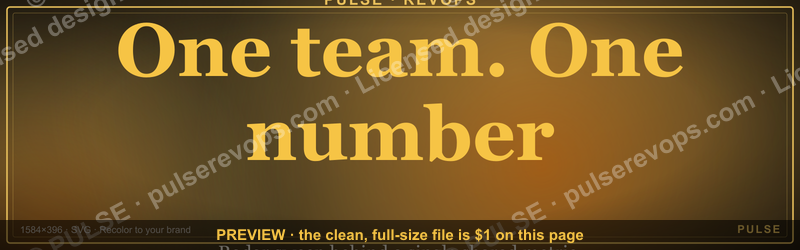
This is a downloadable LinkedIn banner — a 1600x500 px PNG titled "One team. One number." It is a leadership statement graphic: one team, one shared number, one direction. Use it as a LinkedIn profile banner or post header when you want your whole team to visibly commit to a single metric, and download it free from this page.
The scenario that makes this banner necessary
Picture a revenue organization of roughly forty people: eight account executives, four SDRs, three customer success managers, two marketing leads, a RevOps analyst, and a sales engineer. Every Monday the leadership team reviews a dashboard. Marketing reports marketing-qualified leads and pipeline contribution. Sales reports closed-won ARR and stage conversion. Customer Success reports net revenue retention and churn. RevOps reports forecast accuracy. Each function is technically healthy. Each function also has its own definition of "the number" — and none of them match.
The result is a predictable monthly ritual. Marketing claims it delivered 320 MQLs; Sales says only 90 were real; CS says the accounts Sales closed are churning at twice the expected rate; Finance says the board number is different from all three. Nobody is lying. They are simply optimizing against different scoreboards, and the scoreboards were built by different people at different times for different audiences.
This is the exact situation the "One team. One number." banner is designed to interrupt. It is not a dashboard, not a KPI framework, and not a compensation plan. It is a visible, public, unmissable commitment artifact — a LinkedIn Wallpaper that sits behind your profile photo and says, to your team, your peers, and your candidates, that this organization has agreed on a single shared metric and is not going to negotiate it every quarter.

The banner works because it is social, not analytical. A dashboard is private and revisable. A banner on a public profile is a statement. When the VP of Sales, the VP of Marketing, the CRO, and the RevOps lead all carry the same banner, the message to the org is unambiguous: we are one team, and we are accountable to one number. That is a cultural signal that no slide deck can replicate, and it costs nothing to deploy.
The scenario that fails is equally instructive. If leadership puts up the banner but continues to run four separate bonus plans against four separate metrics, the banner becomes a joke within one quarter. The graphic is a commitment device, not a substitute for alignment. It should be deployed after the single number has been chosen, defined, and wired into the operating cadence — never before.

How the mechanism actually works
The banner operates on three layers simultaneously, and understanding all three is what separates a decoration from a management tool.
The first layer is identity. A LinkedIn banner is the largest visual real estate on a professional profile — 1584x396 px on desktop, with the profile photo overlapping the lower left. It is seen by every recruiter, every prospect, every candidate, and every peer who visits the profile. Putting "One team. One number." there is a public identity claim. It says: I lead a team that has agreed on a shared metric. That claim travels further than any internal memo.
The second layer is repetition. The banner is not consumed once. It is consumed every time a team member visits a colleague's profile, every time a candidate researches the hiring manager, every time a prospect checks out the person they are about to buy from. Repeated low-fidelity exposure to a single phrase is how slogans become operating assumptions. The phrase "one team, one number" is short enough to be repeated verbatim in meetings without sounding like a script.

The third layer is constraint. Once the banner is public, leadership has voluntarily narrowed its own options. You cannot quietly revert to functional silos when the commitment is on forty public profiles. That is the point. The banner is a pre-commitment device — it makes the aligned behavior the path of least resistance and the misaligned behavior socially expensive.
The sequence matters. Deploying the banner before step one produces cynicism. Deploying it after step three produces reinforcement. The most common failure mode is skipping step three — putting up the graphic while leaving four separate incentive plans in place — which converts a leadership signal into evidence that leadership is not serious.

A practical detail: the banner should be deployed as a coordinated wave, not individually. If the CRO changes their banner on a Tuesday and the rest of the team follows over six weeks, the signal is diluted. A single-day rollout, announced in a team meeting, with everyone updating their profile in the same hour, produces a visible, shared moment. That moment is the actual intervention; the graphic is just the artifact.
Real numbers, ranges, and benchmarks
The banner itself is a fixed spec. At 1600x500 px, it is slightly wider than the standard LinkedIn banner recommendation of 1584x396 px, which means it will be cropped on some surfaces and scaled on others. The safe zone — the area not covered by the profile photo on desktop — is roughly the right two-thirds of the image. Any wording placed in the left third risks being obscured.
For the underlying number, the ranges that matter are the ones a revenue team actually commits to. A single shared number is typically one of five candidates: total ARR, net new ARR, pipeline coverage, net revenue retention, or qualified pipeline created. Each has a defensible range. Net new ARR targets for a mid-market B2B SaaS company commonly land between 20% and 40% year-over-year growth, depending on stage. Pipeline coverage — the ratio of qualified pipeline to quota — is conventionally held between 3x and 4x for a healthy quarter, with 3x being the floor most operators accept. Net revenue retention for a strong mid-market business typically sits between 100% and 120%, with best-in-class exceeding 120%.

The reason these ranges matter to the banner is that the banner implies a number exists. If leadership puts up "One team. One number." without a number, the graphic is aspirational noise. The strongest deployments pair the banner with a specific, named metric — either in the banner text itself (for example, "One team. One number. $50M ARR.") or in the accompanying post and team communication. The banner carries the slogan; the launch communication carries the number.
A realistic timeline for the full deployment runs four to six weeks. Week one: choose and define the number. Week two: align compensation and reporting. Week three: socialize with the leadership team and confirm the definition in writing. Week four: announce and deploy the banner across all revenue-facing profiles. Weeks five and six: run the first two review cycles against the single metric and publish the results internally. Teams that compress this into a single week usually skip the definition work and end up with four interpretations of the same word within a month.

One more number worth holding: the banner is free. There is no license fee, no seat cost, and no vendor. The only cost is the coordination time — roughly two to four hours of leadership attention across the rollout. Against the cost of a misaligned quarter, that is a rounding error.
Trade-offs and alternatives
The banner is not the only way to signal a single shared metric, and it is not always the right one. Understanding the trade-offs keeps you from over-deploying it.
The primary trade-off is visibility versus precision. A public banner is high-visibility and low-precision — it communicates commitment but cannot carry definitions, caveats, or segment breakdowns. A dashboard is the opposite: high-precision, low-visibility, and easily ignored. Mature organizations use both, with the banner as the cultural layer and the dashboard as the operational layer. Neither replaces the other.

The second trade-off is commitment versus flexibility. Once the banner is public, changing the number is expensive. If your business is pre-product-market-fit, or if you are mid-pivot, a public single-number commitment can lock you into a metric that stops being the right one within two quarters. In that situation, the banner is premature. The signal is strongest when the business model is stable enough that the number will hold for at least four quarters.
The third trade-off is inclusion versus relevance. "One team" implies the whole revenue org, but not every role influences the same number equally. A customer success manager influences net revenue retention far more than net new ARR. If the chosen number is net new ARR, the banner can feel exclusionary to CS. The mitigation is to choose a number that every function genuinely contributes to — total ARR, or net revenue retention including expansion — or to explicitly frame the banner as a leadership commitment rather than an individual one.

Alternatives worth considering: an internal Slack channel named after the number, a recurring all-hands segment titled "the number," a physical poster in the office, or a shared dashboard link pinned in the team channel. Each has different reach. The LinkedIn Wallpaper has the unique property of being externally visible, which is why it works as a commitment device and why it should be reserved for moments when the commitment is real.
The diagram is the argument: the banner is one of four reinforcing mechanisms. Remove the other three and the banner carries the entire load alone, which it cannot do. Keep all four and the banner becomes the visible tip of a system that is already working.
Common pitfalls and how to avoid them
The first pitfall is deploying the banner before the number exists. The fix is sequencing: name the metric, define it in one sentence, and confirm that every revenue leader can state it from memory before anyone touches their profile. A simple test — ask five leaders to write down the number and its definition without conferring. If the answers differ, you are not ready.

The second pitfall is choosing a number that only one function controls. If the shared number is closed-won ARR and only Sales influences it, Marketing and CS will treat the banner as someone else's slogan. The fix is to pick a number with cross-functional leverage — total ARR, net revenue retention, or pipeline coverage — and to show each function how their work moves it.
The third pitfall is leaving compensation untouched. This is the most damaging failure. A banner that says "one number" above a comp plan that pays four different numbers is worse than no banner at all, because it makes the misalignment visible and therefore corrosive. The fix is to reweight variable compensation so that a meaningful portion — commonly 20% to 40% — is tied to the shared metric for every revenue leader.

The fourth pitfall is treating the banner as a one-time launch. Commitment decays. The fix is cadence: reference the number in every weekly review, publish a one-line update in the team channel, and revisit the banner annually. If the number changes, the banner changes with it, and the change is announced.
The fifth pitfall is over-customizing the banner to the point that the message disappears. Adding a logo, a tagline, a URL, a photo, and a gradient produces a cluttered graphic that reads as decoration. The message works because it is sparse. Keep the wording to a single line, keep the contrast high, and let the empty space do the work.
The sixth pitfall is deploying it only at the top. If the CRO and VPs carry the banner but the front-line team does not, the signal reads as executive branding rather than a team commitment. The fix is to offer the banner to every revenue-facing employee and make participation voluntary but visible. Voluntary adoption that reaches 70% or more is a stronger signal than mandated adoption at 100%.
Related questions
What exactly does the banner say?
It reads "One team. One number." — a three-word leadership statement in high-contrast type on a 1600x500 px canvas. The wording is intentionally minimal so it stays legible when LinkedIn crops or scales the image on mobile and desktop feeds.
Can I change the wording?
Yes. The downloadable PNG is a starting point. Many teams swap in their specific metric — for example, a target ARR figure or a coverage ratio — or translate the phrase for a regional team. Keep it to one line and high contrast.
Where do I place it on LinkedIn?
Upload it as your profile banner, which LinkedIn displays behind your profile photo. Keep critical wording in the right two-thirds of the image, since the profile photo overlaps the lower-left area on desktop.
Does the banner replace a dashboard?
No. The banner is a cultural signal; the dashboard is the operational instrument. Use the banner to make the commitment visible and the dashboard to track, segment, and diagnose the number week to week.
Is it free to use?
Yes. The graphic is downloadable as a PNG from this page at no cost, with no license fee and no attribution requirement. Coordinate the rollout across your team so the signal lands as one moment.
FAQ
What is the "One team. One number." LinkedIn Wallpaper?
It is a downloadable banner graphic sized 1600x500 px, carrying the phrase "One team. One number." It is designed for use as a LinkedIn profile banner by revenue leaders and their teams who want to publicly signal commitment to a single shared metric. The file is a PNG and can be uploaded directly to LinkedIn without editing.
Why use a LinkedIn banner instead of an internal slide?
Because it is public and persistent. An internal slide is seen once and forgotten. A banner sits on every team member's profile and is seen repeatedly by peers, candidates, and prospects. That repetition converts a slogan into an operating assumption, and the public nature makes the commitment harder to quietly abandon.
What number should the team actually choose?
Choose one metric that every revenue function genuinely influences. Common choices are total ARR, net new ARR, pipeline coverage, or net revenue retention. The test is simple: can each function describe, in one sentence, how their daily work moves that number? If not, the metric is too narrow and the banner will feel like someone else's slogan.
How long does a rollout take?
Plan on four to six weeks for a full deployment: one week to choose and define the number, one to align compensation and reporting, one to socialize with leadership, one to announce and deploy the banner, and two to run the first review cycles. Compressing this into a single week usually means skipping the definition work.
What happens if we deploy the banner without aligning incentives?
The banner becomes evidence that leadership is not serious. If variable compensation still rewards four separate metrics, the public commitment reads as branding rather than management, and the team will treat it with cynicism within a quarter. Align the comp plan first, then deploy the graphic.
Can individual contributors use the banner, or is it for leaders only?
Both. Leadership adoption creates the initial signal, but broad adoption across the revenue team is what makes it a team statement rather than an executive one. Voluntary adoption reaching roughly 70% of the revenue org is a strong indicator that the commitment is real rather than mandated.
Sources
- LinkedIn Help — Profile background and banner photo specifications: https://www.linkedin.com/help/linkedin/answer/a563575
- LinkedIn — Official company newsroom and product updates: https://news.linkedin.com/
- Harvard Business Review — research and articles on goal setting and organizational alignment: https://hbr.org/
- Salesforce — sales performance and quota benchmark research: https://www.salesforce.com/resources/research-reports/
- HubSpot — sales and marketing alignment research and benchmarks: https://blog.hubspot.com/sales
- Gartner — sales and revenue operations research: https://www.gartner.com/en/sales
- Pavilion — revenue leadership community and benchmarking resources: https://www.joinpavilion.com/
- OpenView Partners — SaaS benchmarking and expansion revenue research: https://openviewpartners.com/blog/
Related on PULSE
- Building a single source of truth for pipeline
- Choosing the one metric your revenue team owns
- Aligning sales and marketing compensation to a shared target
- Running a weekly revenue review against one number
- Rolling out a team commitment without creating cynicism
- Profile and banner specs for revenue leaders on LinkedIn
This page will be disappearing soon. Save it to your device for $1 — or read it free while it is here.
@Kory-White- · if Venmo asks, the last 4 of my number are 2012
This page is gone.
This one is off the shelf now. $1 keeps it on your phone for good — the whole page, pictures and diagrams included.
 graphicRevOps Manager — LinkedIn Banner
 graphicSell outcomes, not features. — LinkedIn Wallpaper
 graphic“Great reps wanted.” — LinkedIn Banner
 graphicHow do you build a Champions sell motion from scratch in 2027?
 graphicRenewals Manager — LinkedIn Banner
 graphic“Data beats opinions.” — LinkedIn Banner
 graphicCalm closers win. — LinkedIn Wallpaper
 graphic“Join a team that runs on pipeline.” — LinkedIn Banner
 graphic“Revenue for marketing tech.” — LinkedIn Banner
 graphic“More pipeline, less panic.” — LinkedIn Banner