
Better reps, every week. — LinkedIn Wallpaper
 Curated byKory White · Fractional CRO · Maryland
 PULSEKNOWLEDGE LIBRARY
Quality
Certified
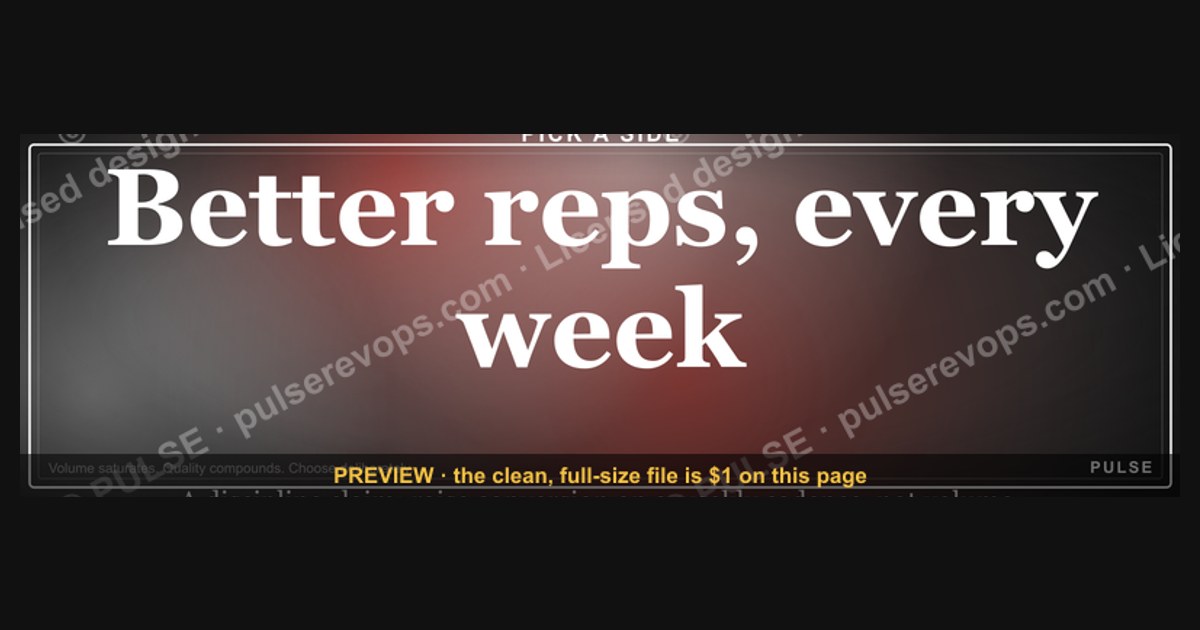
"Better reps, every week" is a discipline claim, not a slogan: it means improving the quality of each sales interaction on a weekly cadence instead of chasing more volume. As a LinkedIn wallpaper it works only when your posting rhythm, coaching calendar, and pipeline numbers visibly back the promise up.
The two models: more reps versus better reps
Every sales org eventually picks a side of this fork, whether or not anyone says it out loud. The volume model says the constraint is at-bats — if a rep makes 60 dials instead of 40, books more meetings, and sends more sequences, revenue follows arithmetic. The quality model says the constraint is conversion — the same 40 dials converted at a higher rate beat 60 mediocre ones, and the way you raise conversion is deliberate, repeated practice on a narrow set of skills.
Both models are defensible, and both fail in predictable ways. The volume model fails when a team hits activity saturation: reps are already working a full day, the calendar has no more slots, and the only remaining lever is compressing time per conversation — which drags discovery quality down and lengthens cycles on the back end. You see this in the numbers as flat or falling meeting-to-opportunity conversion while activity dashboards look green. Leadership reads the green dashboards and pushes harder, which accelerates the decline.
The quality model fails differently. It fails when there is not enough volume to generate a usable sample. A rep having six conversations a week cannot tell whether a new discovery question is working — the noise swamps the signal, and any "improvement" is just variance. It also fails when "coaching" degenerates into unstructured deal review: a manager walking through the forecast, asking status questions, and calling it development. That is inspection, not coaching, and it produces no measurable skill change.

The honest answer for most teams is a sequencing question rather than an either/or. Below a floor of activity — enough conversations per rep per week to produce a readable signal — you are in the volume regime and should fix top-of-funnel before anything else. Above that floor, incremental activity has sharply diminishing returns and the quality lever dominates. The wallpaper's message applies to the second regime. A team that is genuinely starved of at-bats does not need a banner about better reps; it needs a list and a working outbound motion.
There is a third position worth naming, because it is where most functioning teams actually live: fixed volume, rising quality. You hold the activity number constant as a floor — non-negotiable, tracked, not celebrated — and put all improvement pressure on conversion at each stage. This is the version that survives contact with a comp plan, because it does not ask reps to trade income today for skill tomorrow. It asks them to keep doing what they are doing while changing *how* they do one specific part of it.
How to decide which model your team is in
The decision is diagnostic before it is philosophical. You are trying to answer one question: is the bottleneck at the top of the funnel, or inside the conversation? Pull four weeks of data and look at three ratios per rep — conversations per week, conversation-to-next-step rate, and opportunity-to-close rate. The shape of the drop tells you where to spend.

If conversations per week are low and both conversion ratios look normal for your segment, you have a volume problem. More coaching will not create pipeline that does not exist. Fix list quality, channel mix, and time-blocking first. If conversations are plentiful but the next-step rate is weak, the problem is early-conversation skill: opening, framing, discovery, qualification. If next-step rates are healthy but late-stage conversion sags, the problem lives in multithreading, business-case construction, and negotiation — different drills entirely.
The trap is treating "coach the reps" as a single undifferentiated intervention. Coaching an early-stage discovery weakness with a closing-technique workshop is a common and expensive mistake. It burns the scarcest resource in a sales org — manager attention — on the wrong skill, and it teaches reps that practice sessions are theater.
One more decision input: sample size. A weekly improvement cadence needs enough events per rep to distinguish a real shift from noise. If a rep runs three discovery calls a week, a week is the wrong unit — move to a two- or four-week review window and keep the practice weekly. Practice cadence and measurement cadence are separate dials, and conflating them is why so many "weekly improvement" programs produce confident conclusions from unreadable data.

Also weigh manager capacity honestly. A frontline manager with eight reps and a full deal-support load cannot run eight substantive weekly sessions plus call reviews plus forecast. Either the span narrows, the session shortens and tightens, or peer review absorbs part of the load. Programs that ignore this arithmetic die in week three — not because anyone disagreed with them, but because the calendar quietly ate them.
The numbers behind each option
Nobody should promise a specific lift, and any source that does is selling something. What you can do is reason about the arithmetic honestly and set your own baseline before you start.
Compounding is real but frequently misquoted. A 1% weekly improvement compounded over 52 weeks is roughly 1.68× — a 68% gain, not 52%. That math is correct as math and misleading as a forecast, because conversion rates do not compound indefinitely; they asymptote. A team converting 20% of first meetings to opportunities will not reach 34% in a year by grinding. What compounds in practice is the *rate of learning* — how quickly the team absorbs a new play, a new objection, a new competitor's positioning — and that shows up as shorter time-to-competence rather than an unbounded conversion curve.

Set a baseline before the first session. Record, per rep: conversations per week, next-step rate, average cycle length, average deal size, and win rate. Without those five numbers you cannot attribute anything, and the program will be evaluated on vibes, which means it will be cancelled the first time a quarter goes sideways.
Expect a lag, and budget for it. Conversation quality changes are visible in call recordings within a few weeks — you can hear a better discovery question immediately. Revenue impact lags by at least one full sales cycle, usually two, because the deals in flight were created under the old behavior. If your average cycle is 90 days, do not evaluate revenue impact at day 45. That mismatch is the single most common reason enablement programs get killed just before they would have shown results.
Cost the time explicitly. A 30-minute weekly session across ten reps is five rep-hours plus five manager-hours per week — roughly 260 rep-hours and 260 manager-hours a year. Price that against the fully loaded cost of a rep and you have the real investment figure. It is usually smaller than one bad hire and larger than most leaders assume when they wave a program through.

Watch leading indicators, not just revenue. Useful ones: percentage of calls where a next step was set on the call, percentage of opportunities with more than one contact engaged, ramp time for new hires, and the spread between your top and bottom quartile reps. That last one is the most underrated metric in sales management. Weekly practice tends to compress the bottom quartile toward the median faster than it lifts the top, and median lift across a team is worth more revenue than a superstar getting marginally better.
Be honest about attribution. Territory changes, pricing moves, a competitor stumbling, and seasonality all move the same numbers you are attributing to coaching. Where possible, stagger the rollout — start with half the team, keep the other half as a comparison for one cycle — so you have something to compare against.

Implementing it: cadence, sequencing, and the LinkedIn layer
Start narrow. The failure mode is a program that tries to improve six skills at once and improves none. Pick one skill for the quarter — say, setting a specific next step before the call ends — and drill only that until it is automatic across the team.
The weekly loop. Monday, a 15-minute review: each rep pulls last week's numbers, names one thing that worked and one that did not, and writes a single measurable target for the week. Midweek, a 10-minute drill on the quarter's focus skill — write the three objections you hear most, draft a two-sentence response to each, say them out loud. Friday, a five-minute reflection on the best and worst conversation of the week and one change for next week. Under 30 minutes total; that constraint is what makes it survive a bad month.
Add peer review. Pair reps for a 20-minute weekly swap where each brings one recording or one lost deal. Peer review scales past manager capacity and catches things a manager will not hear, because reps are more candid with each other about what actually happened on the call.

Adjacent surfaces this touches. The same cadence pays off well outside the AE seat. Customer success teams run it against renewal conversations and churn signals. Solutions engineers use it on demo narrative and technical objection handling. Support teams use it on escalation language. In field-service and trades businesses — HVAC, home services — the same loop runs against the in-home consultation, where the "rep" is a technician quoting work. The unit of practice changes; the loop does not.
Downstream effects to expect. Better discovery produces better CRM data, because reps who ask sharper questions have real answers to record. Better CRM data produces a more accurate forecast, which reduces the end-of-quarter scramble that destroys deal quality. Recruiting improves too — candidates increasingly ask about coaching cadence in interviews, and "we run a weekly rep loop, here is what it looks like" is a concrete answer where most competitors offer platitudes.
The LinkedIn layer. This is where the wallpaper earns its place. A cover image is a visual handshake — a viewer scans the banner, then the headline, then the featured section, all before reading a word of your experience. A banner reading "Better reps, every week." telegraphs process discipline over heroics. Make the headline echo it rather than contradict it: "Helping sales teams build repeatable pipeline — every week" reads as one coherent claim.

Then close the credibility gap. A banner promising weekly improvement above a profile whose last post was eight months ago about a company offsite reads worse than no banner. Post something short and specific on a weekly rhythm — a discovery question that changed a call, an objection pattern you are seeing, what a lost deal taught you. Two hundred words is plenty. The banner is the promise; the feed is the proof.
For sales leaders the banner does recruiting work. Candidates who respond to "better reps, every week" tend to be fundamentals people rather than lone-wolf closers, which is exactly the self-selection you want if your motion depends on repeatable process. For teams, a consistent banner across profiles reads as a deliberate operating system rather than individual branding.
Practical specs. The LinkedIn personal cover slot is 1584×396 pixels. Design in SVG so it scales without softening, export a PNG for upload, and keep the important content away from the left region where the profile photo overlaps on desktop. Test it on mobile before committing — LinkedIn crops covers differently across surfaces, and text that sits comfortably on desktop routinely gets clipped in the app. If you are recoloring to brand, keep contrast high; a banner nobody can read at thumbnail size is decoration, not signal.

What to do when the program stalls
Most weekly cadences die in week five or six, and the causes are boringly consistent. Name them in advance and you can usually route around them.
Sessions get cancelled for pipeline emergencies. Every week has an emergency. If the session is the first thing cut, it was never protected. Fix: make it 15 minutes, put it before the selling day starts, and have the manager attend even when a rep cannot — the calendar block survives because it is cheap, not because it is sacred.
Practice feels disconnected from real deals. Reps disengage from abstract role-play. Anchor every drill to something that actually happened last week: a real objection from a real call, a real lost deal. Relevance is the whole game; a generic objection-handling exercise teaches reps that the session is filler.

The manager talks the whole time. If the manager is speaking more than a third of the session, it is a lecture. Structure it so the rep does the reps — literally saying the words out loud — while the manager observes and gives one specific correction. One correction, not five. Five corrections produce zero changes.
No one can tell whether it worked. Without the baseline metrics, the program is evaluated on feeling, and feelings track the quarter. Publish the leading indicators monthly, including the ones that did not move. Honesty here buys you the runway to get through the revenue lag.
Remote and hybrid teams. These teams need the structure more, not less, because they lack the ambient coaching that happens when someone overhears a call. Recorded reviews, virtual breakouts, and a shared scorecard substitute for proximity. Async works for review; the drill itself should stay live, because saying words out loud in front of another person is the part that changes behavior.
Related questions
Does a LinkedIn banner actually affect inbound interest?
Directly, marginally. Indirectly, more than people expect — the banner sets the frame a viewer reads your headline and posts through. It is a cheap consistency signal, not a lead source. Treat it as packaging for activity you are already doing.
Should activity metrics be dropped entirely under a quality model?
No. Keep them as a floor, not a target. Reps need a minimum number of conversations to generate a readable signal and to keep pipeline coverage healthy. Track activity, stop celebrating it, and put the improvement pressure on conversion instead.
How many skills should a team work on at once?
One per quarter, in most cases. Teams that drill six skills simultaneously improve at none of them, because none gets enough repetition to become automatic. Retire a skill only when it shows up unprompted in call recordings across the whole team.
Who runs the weekly session when managers are overloaded?
Split it. Managers own the 15-minute review and one correction; peer pairs own the 20-minute swap. Peer review scales past manager capacity and surfaces candid detail managers rarely hear, especially about deals that went sideways.
Does this apply outside software sales?
Yes. Any business with a repeatable customer conversation — home services, insurance, financial advisory, equipment dealers — runs the same loop against its own unit of practice. The in-home consultation replaces the discovery call; the weekly rhythm is identical.
FAQ
What does "better reps, every week" actually mean?
It means improving the quality of each sales conversation on a weekly cadence rather than simply adding volume. The unit of improvement is a specific, named skill — discovery questions, objection handling, next-step setting — practiced deliberately and reviewed against real calls from that week.
How do I know if the reps are actually getting better?
Watch leading indicators before revenue: percentage of calls ending with a concrete next step, next-step-to-opportunity conversion, multithreading rate on open deals, ramp time for new hires, and the spread between your top and bottom quartile. Baseline all of them before the first session or you will have nothing to attribute results to.
How long before it shows up in revenue?
Conversation quality changes are audible in recordings within a few weeks. Revenue lags by at least one full sales cycle and usually two, because deals currently in flight were created under the old behavior. If your cycle runs 90 days, judging revenue impact at day 45 is measuring the wrong deals.
What if reps push back on weekly practice?
Pushback almost always means the practice feels disconnected from real deals. Anchor every session to something that actually happened last week — a live objection, a specific lost deal — and cut the session to 15 minutes. Relevance and brevity resolve most resistance; enforcement resolves none of it.
Can this work for a fully remote team?
Yes, and remote teams often gain more because they lack the informal coaching that happens in an office. Use recorded call reviews, live virtual breakouts for the drills, and one shared scorecard everyone can see. Keep the drill synchronous — saying the words out loud in front of someone is what changes behavior.
Is the wallpaper itself worth bothering with?
Only as the visible layer over a real cadence. On its own it is decoration. Paired with a weekly posting rhythm and a headline that echoes the same claim, it makes your operating philosophy legible to buyers, candidates, and peers in about three seconds — which is all the attention a profile visit gets.
Sources
- https://hbr.org/2017/03/how-to-give-feedback-people-can-actually-use
- https://hbr.org/2015/01/the-power-of-consistency
- https://www.linkedin.com/help/linkedin/answer/a570443
- https://www.nngroup.com/articles/first-impressions-human-automaticity/
- https://www.pewresearch.org/internet/fact-sheet/social-media/
- https://hbr.org/2016/10/what-great-listeners-actually-do
- https://www.mckinsey.com/capabilities/growth-marketing-and-sales/our-insights
- https://sloanreview.mit.edu/topic/sales-marketing/
Related on PULSE
- Win the week. — LinkedIn Wallpaper
- "Win the week. The quarter wins itself." — Quote Card
- "Win the week. The quarter follows." — LinkedIn Banner
- Ask better questions. — LinkedIn Wallpaper
- "ASK BETTER QUESTIONS" — Sales Floor Print
- "Ask better questions." — Quote Card
This page will be disappearing soon. Save it to your device for $1 — or read it free while it is here.
@Kory-White- · if Venmo asks, the last 4 of my number are 2012
This page is gone.
This one is off the shelf now. $1 keeps it on your phone for good — the whole page, pictures and diagrams included.
 graphicHow do you build a Champions sell motion from scratch in 2027?
 graphic“Ready to lead a sales team.” — LinkedIn Banner
 graphicOffensive Security Pentest CRO — LinkedIn Banner
 graphic“Process over pressure.” — LinkedIn Banner
 graphicFaster deals, fewer leaks. — LinkedIn Wallpaper
 graphicMake it predictable. — LinkedIn Wallpaper
 graphic“Champions are made before the call.” — LinkedIn Banner
 graphic“Don’t pitch. Diagnose.” — LinkedIn Banner
 graphic“Bring the energy every call.” — LinkedIn Banner
 graphic“Great reps wanted.” — LinkedIn Banner