


Discovery Call Flow Diagram
Quality
Certified
This process flowchart is a 1600x900 px downloadable graphic titled "Discovery Call Flow Diagram." It maps a sales discovery call as a left-to-right sequence of stages — opening, situation questions, pain surfacing, impact quantification, next-step close — with decision branches for qualified versus unqualified paths. Use it as a shared visual reference for reps, managers, and enablement.
The outcome you should expect
The realistic payoff of putting a Discovery Call Flow Diagram in front of a team is not a sudden jump in win rate. It is a reduction in variance. When every rep works from the same visual sequence, the middle of the Call stops being improvised, and the middle is where most deals are actually won or lost. Expect three concrete shifts within one to two quarters of adoption.
First, consistency. Reps who previously ran discovery in whatever order felt natural will converge on the same stage order. In practice this shows up as fewer calls where the rep jumps to demo within the first eight minutes, and more calls where a documented pain statement precedes any product mention. Managers reviewing call recordings report that coaching becomes faster because they can point at a stage on the Diagram instead of describing an abstract principle.
Second, qualification quality. A flow with an explicit decision branch forces the rep to answer a yes/no question before advancing: has the buyer articulated a problem in their own words, with a consequence and a rough cost? If not, the flow sends them back a step rather than forward. That single loop typically removes the weakest opportunities from the pipeline earlier, which improves forecast accuracy even when total pipeline value drops.
Third, handoff cleanliness. When the flow ends in a defined next-step gate — a scheduled technical call, a mutual action plan, or a documented disqualification — the downstream team receives context instead of a mystery. Solutions engineers and implementation staff stop re-asking the same five questions on the first follow-up call.

What you should not expect: a flow diagram does not fix a weak value proposition, a mispriced product, or a territory with no demand. It is a process artifact, not a strategy. Teams that treat it as a substitute for messaging work end up with a tidy call structure that reliably surfaces a problem nobody wants to buy a solution for. The realistic range of improvement is modest and compounding — a few percentage points of stage conversion, better coaching throughput, and fewer wasted cycles — not a step change.
What drives that outcome
Four forces determine whether the Diagram actually changes anything.
Visibility during the Call. A flow that lives in a PDF on the shared drive changes nothing. It has to be visible while the rep is talking — a second monitor, a printed one-pager beside the laptop, or an annotation in the call notes template. Reps under cognitive load revert to habit; the artifact has to be in the field of view at the moment of decision.

Stage granularity. Too few stages and the flow is a platitude ("open, discover, close"). Too many and reps cannot hold it in working memory mid-conversation. Five to seven stages with one or two decision diamonds is the practical band. Each stage should map to a single behavior a manager could observe and score.
Question ownership. Every stage needs an owner and a question set. If the flow says "surface pain" but nobody has written the four questions that reliably surface pain for your buyer, the stage is decorative. The flow is the skeleton; the question bank is the muscle.
Reinforcement cadence. One training session produces a two-week spike and then decay. Flows that stick are reviewed in weekly one-on-ones against actual recordings, with the manager asking "which stage did that call stall on?" rather than "how did it go?"
The two loops in that Diagram carry most of the value. The first loop back to situation questions is the one reps skip most often — they hear a hint of a problem and immediately start quantifying, which produces a number the buyer does not believe. The second loop back to impact is where deals get saved: a buyer who cannot state the cost of inaction in their own terms is not yet a buyer, and pushing forward produces a stalled opportunity three weeks later.
The decision node on next steps deserves special attention. A Discovery Call that ends without a calendar commitment is a data-gathering session, not a sales call. Building that gate into the flow makes the standard explicit and removes the ambiguity reps hide behind.
Benchmarks and realistic ranges

Because no two teams measure discovery the same way, treat any single number with suspicion. What follows are directional ranges that hold across most B2B sales motions, useful for sanity-checking your own data rather than as targets to hit.
Call duration. A discovery Call in mid-market B2B typically runs 30 to 45 minutes for a first conversation, with 45 to 60 minutes for enterprise. Calls under 20 minutes rarely reach impact quantification; calls over 75 minutes usually indicate the rep is doing implementation scoping, which belongs in a later stage.
Talk ratio. Reps should be speaking roughly 40 to 45 percent of the time. Above 60 percent is a strong signal the rep is pitching rather than discovering. Below 25 percent often means the rep has lost control of the agenda and the buyer is monologuing without structure.
Question distribution. A healthy discovery call spends roughly 20 percent of its question time on situation, 40 percent on problem and impact, 25 percent on decision process and stakeholders, and 15 percent on next steps. Reps who spend more than half their questions on situation are running an interrogation, not a discovery.
Stage conversion. Moving from a completed discovery to a second substantive meeting typically converts at 50 to 70 percent for well-qualified inbound and 25 to 45 percent for outbound. If your flow shows conversion below 20 percent, the qualification gate is too loose. Above 80 percent usually means the gate is not filtering anything.

Time to next step. The gap between discovery and the next scheduled interaction should be under ten business days. Longer gaps correlate with deal decay; the flow should treat a two-week gap as a risk flag, not a neutral state.
Documentation rate. In teams with a written discovery template tied to the flow, 70 to 85 percent of calls produce a completed notes record within 24 hours. Without a template, that figure commonly falls under 40 percent, and handoff quality collapses accordingly.
Coaching throughput. A manager using a stage-based flow can typically review and score eight to twelve call recordings per week with useful specificity. Without a shared stage vocabulary, the same manager reviews fewer calls and gives vaguer feedback, because each review requires rebuilding the criteria from scratch.
None of these ranges are universal laws. Deal size, buyer seniority, and whether the product is a replacement or a net-new category all shift them. The point is to pick two or three, measure your baseline for a month, and use the flow to move them deliberately.
Risks, edge cases, and failure modes
The flow becomes a script. The most common failure. Reps read the stages as a linear checklist and march through them regardless of what the buyer says. The buyer notices within ten minutes and disengages. Mitigation: frame the Diagram as a map of destinations, not a route. Train reps to name the stage they are in out loud when they change direction — "let me back up and ask about how this started" — which makes the navigation feel responsive rather than mechanical.

Stage skipping under time pressure. When a buyer says "I only have 20 minutes," reps cut the impact and stakeholder stages, which are precisely the stages that determine whether the deal is real. Mitigation: define a minimum viable discovery — the three questions that must be asked even in a 15-minute call — and protect those above all else.
The qualification gate is too strict. A flow with a hard stop on unquantified pain will disqualify genuinely early-stage buyers who would have matured. Mitigation: add a nurture branch rather than a discard branch, and revisit on a defined cadence.
Multi-threading breaks the linear model. The flow assumes one buyer. Real deals have three to six stakeholders, each entering the conversation at a different stage. A rep running the flow with a champion may never speak to the economic buyer, and the Diagram offers no guidance for that. Mitigation: annotate the flow with a parallel track for stakeholder mapping, or run a second, shorter flow for each additional stakeholder conversation.
The artifact drifts from the CRM. The flow says five stages; the CRM has seven opportunity stages with different names. Reps stop trusting either. Mitigation: align naming at the outset, even if it means renaming CRM stages, and document the mapping in one place.
Over-customization. Each segment team edits the Diagram until there are six versions and no shared vocabulary. Mitigation: one canonical flow, with segment-specific question banks layered underneath rather than separate diagrams.

Measurement theater. Teams instrument the flow with twelve metrics, nobody reviews them, and the flow becomes a compliance checkbox. Mitigation: two metrics per quarter, reviewed in the same meeting where call recordings are discussed.
New-hire over-reliance. Junior reps follow the flow so literally that they never develop conversational judgment. Mitigation: pair the flow with recorded examples of experienced reps deviating from it successfully, and explicitly reward good deviation in coaching.
A practical rollout plan
Rolling this out well takes about six weeks from decision to steady state. The sequence below is deliberately front-loaded with definition work, because the most expensive mistake is training a team on a flow that changes two weeks later.
Week one: audit. Pull 20 recorded discovery calls, a mix of wins, losses, and stalls. Score each against a rough draft of the stages. You are looking for where calls actually break — not where the theory says they should. Most teams find that 60 to 70 percent of losses trace to a single stage, usually impact quantification or stakeholder mapping. That finding determines what the flow emphasizes.
Week two: draft. Write the flow with five to seven stages and no more than two decision diamonds. Name each stage with a verb phrase a rep would actually say. Circulate to two top performers and one struggling rep; the struggling rep's confusion is more informative than the top performer's approval.

Week three: question bank and CRM alignment. For each stage, write four to six questions, ordered from open to specific. Simultaneously, reconcile stage names with the CRM. If the CRM has an "Id. Decision Makers" stage, the flow should use the same words.
Week four: pilot. Run the flow with three or four reps for two weeks. Have them annotate the printed Diagram during calls with what worked and where they got stuck. Collect the annotations; they are the raw material for the final revision.
Week five: training. One 90-minute session, not a half-day. Structure it as: walk the flow (15 min), watch two recordings and score them against the flow together (45 min), role-play the two decision gates (20 min), and hand out the printed one-pager (10 min). Role-playing the gates specifically — the loop back to situation questions and the next-step close — is where behavior actually shifts.
Week six: manager scorecard. Give managers a one-page rubric with each stage scored 1 to 3. Require two scored recordings per rep per week for the first month, dropping to one thereafter. Review the scores in the existing one-on-one, not a new meeting.
Ongoing. Revisit the flow quarterly. If a stage is consistently scored low across the team, the stage or its questions are wrong, not the reps. If it is scored low for one rep only, that is a coaching issue. Distinguishing those two cases is the entire point of having a shared Diagram.

Customization guidance. Change the stage names to your buyer's language, not your internal jargon. Keep the color coding minimal — three colors maximum, one for stages, one for decisions, one for terminal states. If your motion is inbound-heavy, weight the flow toward problem surfacing; if outbound, add a pre-call research stage at the front. If you sell through partners, add a stage for confirming who holds budget authority. Print at A4 or Letter, laminate it, and put it where the rep's eyes actually go during a call.
Specs and download. The graphic is 1600x900 px, delivered as a PNG, and free to download from this page. It is sized for a second monitor, a slide, or a printed one-pager; at 1600 px wide it stays legible when scaled to a full 16:9 screen and holds up at A4 print. To swap it into your own deck, drop the PNG onto a slide and overlay your logo in a corner — leave the stage boxes untouched so the shared vocabulary survives. If you need to edit wording, rebuild from the structure rather than tracing over the raster; the flow's value depends on every team reading the same words.
Related questions
What should the first stage of a discovery call flow be?
Pre-call research, not the opening. Ten minutes of account and role research lets the rep open with a relevant hypothesis instead of "tell me about your business," which saves five to eight minutes of the call and signals preparation. The opening stage follows immediately and should set a two-item agenda with a time check.
How many stages should a discovery flow have?
Five to seven. Fewer than five and the flow cannot distinguish problem surfacing from impact quantification, which are different behaviors. More than seven and reps cannot hold it in working memory mid-conversation. Two decision diamonds maximum, placed at the qualification and next-step gates.
Should the flow be shared with buyers?

Rarely. Sharing the internal flow invites the buyer to game the stages. What you can share is a mutual action plan at the end of discovery — a short document listing what happens next and who owns each item. That is buyer-facing; the flow itself is a coaching artifact.
How do you measure whether the flow is working?
Track two things: the percentage of discovery calls that produce a scheduled next step within ten business days, and manager-scored stage coverage on a sample of recordings. Both should move within one quarter. Win rate is a lagging indicator and will confuse the picture early on.
FAQ
What exactly is a Discovery Call Flow Diagram? It is a visual map of a sales discovery conversation, showing the stages in order, the decision points where a rep either advances or loops back, and the terminal states of qualified, nurture, or disqualify. This particular one is a 1600x900 px PNG you can download from this page and use as a shared reference for reps, managers, and enablement.
Is this the same as a call script? No. A script prescribes wording in sequence; a flow diagram prescribes structure and decision logic while leaving the language to the rep. Scripts produce uniform, brittle calls. Flows produce consistent calls that can still adapt when the buyer goes somewhere unexpected, which is most of the time.

Can I use this flow for inbound and outbound calls? Yes, with one adjustment. Outbound calls need a stronger pre-call research stage and often a shorter situation section, because the rep should already know the basics. Inbound calls can spend more time on problem surfacing since the buyer has usually self-identified a need. Keep the same stage names so the vocabulary stays shared.
What if my CRM has different stage names? Rename one or the other so they match. Two vocabularies for the same concept is the fastest way to make reps ignore both. If renaming CRM stages is politically difficult, add a mapping table to the flow's footer listing CRM stage names beside flow stage names, and reference it in every review.
How often should the flow be revised? Quarterly at most, and only when the data justifies it. A stage that scores low across the whole team usually indicates a design problem worth fixing. A stage that scores low for one rep is a coaching issue and should never trigger a flow change. Frequent revisions destroy the shared vocabulary the flow exists to create.
Do I need to buy anything to use this? No. The PNG downloads free from this page. The only real cost is the time to build the question bank per stage and the manager hours for recording review — roughly six to ten hours of setup and two to three hours per week of reinforcement for a team of eight to twelve reps.
Sources
- Gong — sales call data and discovery research
- HubSpot — sales discovery questions and process guides
- Salesforce — State of Sales research
- Harvard Business Review — the new sales playbook
- RAIN Group — sales research and benchmarks
- CSO Insights / Korn Ferry — sales performance research
- Miller Heiman Group — sales process and methodology resources
Related on PULSE
- Discovery call question bank by stage
- Qualification framework comparison for B2B sales
- Call recording review rubric for sales managers
- Mutual action plan template for late-stage deals
- CRM stage naming conventions that reps actually use
- Onboarding new reps with a shared call vocabulary
This page will be disappearing soon. Save it to your device for $1 — or read it free while it is here.
@Kory-White- · if Venmo asks, the last 4 of my number are 2012
This page is gone.
This one is off the shelf now. $1 keeps it on your phone for good — the whole page, pictures and diagrams included.
 graphicCustomer Onboarding Flow
 graphicRenewal Process Flow
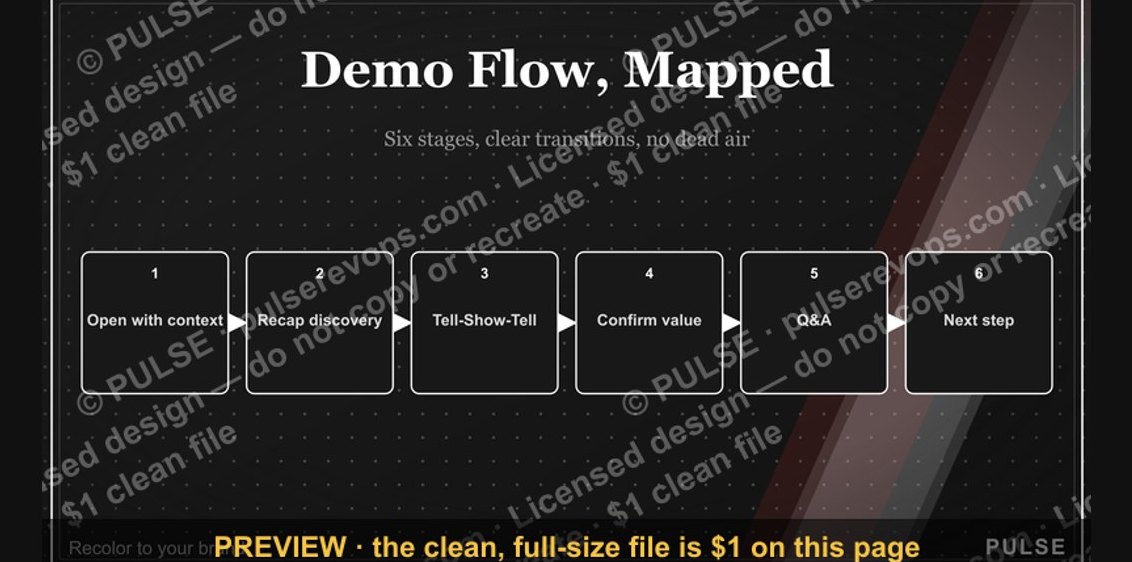 graphicDemo Flow Diagram
 graphicDeal Inspection Flow
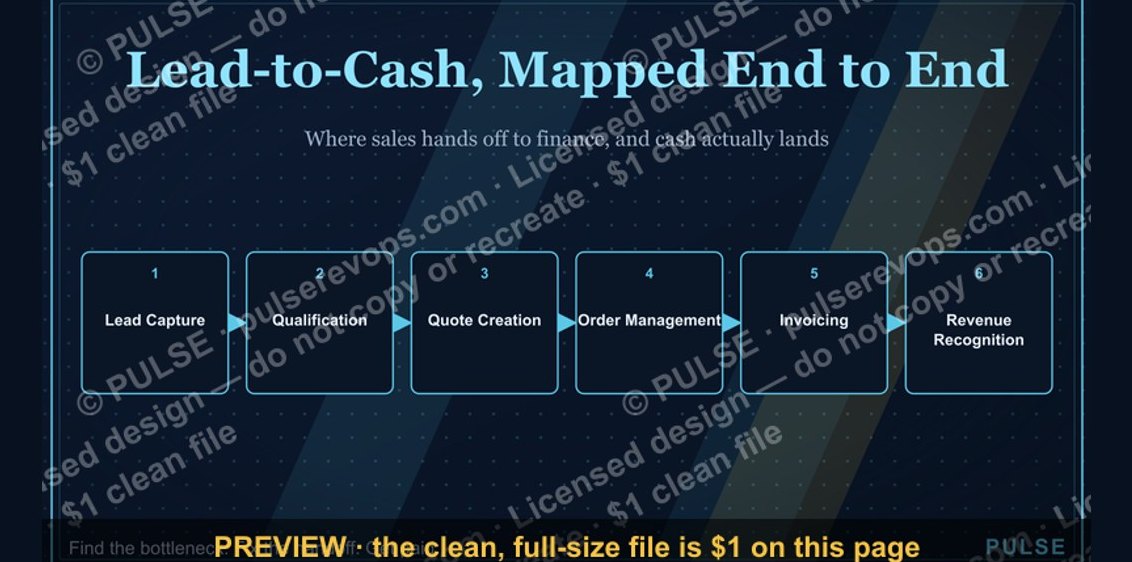 graphicLead-to-Cash Process Map
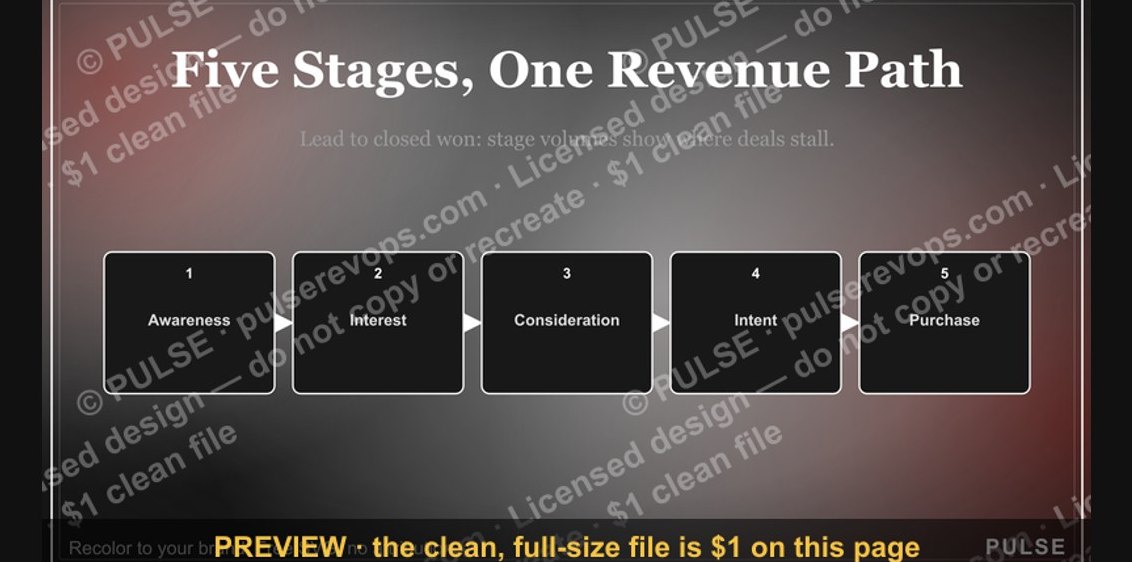 graphicSales Funnel — 5 Stages
 graphicSales Ops Analyst — LinkedIn Banner
 graphicPipeline Growth Arrow Icon — Icon / Clip Art
 graphicSpeech-to-Text Operator — LinkedIn Banner
 graphicThe Marketing Funnel — Infographic