 Pulse Reviews and Analysis
How do you handle model rollbacks safely in production?
 Curated by Kory White · Fractional CRO, CRO Syndicate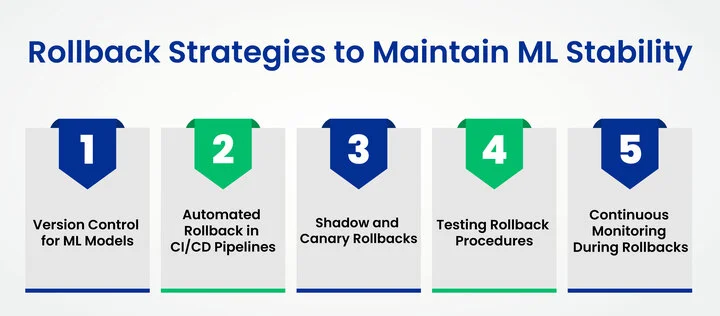
How do you handle model rollbacks safely in production?
Direct Answer
You handle model rollbacks safely by treating every model version as an immutable, versioned artifact you can re-deploy instantly, never as something you mutate in place. The core practices are: register each model in a model registry (MLflow, Weights & Biases, or a cloud registry) with a unique version and the exact data and code that produced it; deploy new versions behind a progressive rollout pattern — canary, blue-green, or shadow — so only a small slice of traffic hits the new model first; watch live quality and operational metrics against a baseline; and keep the previous version warm so a rollback is a routing change, not a redeploy.
When a guardrail trips, you flip traffic back to the known-good version in seconds, ideally automatically. The goal is to make rollback a boring, one-step operation you have rehearsed, not an emergency.
Why model rollbacks are different from code rollbacks
Rolling back code is well understood: redeploy the previous container image. Models add complications. A model's behavior depends not just on its weights but on the prompt template, retrieval context, tokenizer, and serving configuration, so "the previous version" must capture all of those together.
Model failures are also often silent — the service returns 200 OK with fluent but wrong, biased, or off-policy output — so you cannot rely on error rates alone to know something broke. And because LLM quality is probabilistic, a regression may only show up across a distribution of requests, not on any single call.
Safe rollback therefore depends on versioning the whole serving bundle and on monitoring quality, not just uptime.
Version everything as immutable artifacts
The foundation of safe rollback is immutability. Each deployable model version should be registered with a unique identifier and the metadata needed to reproduce and re-serve it: the weights or model reference, the prompt templates, the retrieval index version (for RAG), the tokenizer, and the serving config.
Model registries like MLflow Model Registry, Weights & Biases, or the registries built into Amazon SageMaker, Azure ML, and Vertex AI give each version a stage (such as staging, production, archived) and an audit trail of who promoted what and when.
Pair the registry with data and code versioning — DVC, LakeFS, or Git — so that for any production version you can answer "exactly which data and code produced these weights?" Without that, a rollback restores old behavior but leaves you unable to diagnose why the new version regressed.
Crucially, never overwrite a version in place; always publish a new one, so the previous artifact is always available to route back to.

Reach Kory White, Fractional CRO: 📅 Book a Quick Call · 💼 Kory on LinkedIn · 🏢 CRO Syndicate
Use progressive rollout so failures are contained
Never send 100% of traffic to a new model at once. Progressive rollout limits the blast radius and gives your monitoring time to catch problems:
- Shadow deployment: the new model receives a copy of real traffic but its responses are not served to users. You compare its outputs and metrics against production with zero user risk — ideal for validating a candidate before it ever serves a request.
- Canary release: route a small percentage (say 1–5%) of live traffic to the new version, watch quality and operational metrics, and ramp up gradually only if it stays healthy. If metrics degrade, shift the canary back to zero.
- Blue-green deployment: run the old (blue) and new (green) versions side by side. Cut traffic over to green when validated; if anything goes wrong, flip the router back to blue instantly. Because both are warm, rollback is near-instant.
The common thread is that the previous version stays deployed and warm, so rolling back is a routing decision, not a cold redeploy that takes minutes you do not have during an incident.
Define rollback triggers before you deploy
Decide what "bad" means before the deploy, not during the incident. Set explicit thresholds on both operational and quality metrics that, when breached, trigger a rollback:
- Operational: latency (p50/p95/p99), error rate, timeout rate, GPU memory or out-of-memory events, and cost per request.
- Quality: task-level evaluation scores from an automated eval harness, hallucination or groundedness checks (especially for RAG), refusal rate, toxicity or safety-filter hits, and user signals like thumbs-down rate or escalation rate.
Tools such as Arize, Fiddler, WhyLabs, and LangSmith or Langfuse let you track these for LLM and ML systems and alert on drift. Wire the most critical thresholds to automatic rollback so a severe regression flips traffic back without waiting for a human, and route softer signals to an on-call alert for a judgment call.
Document the runbook so anyone on call can execute the rollback the same way.
Keep the rollback path fast and rehearsed
A rollback plan you have never tested is a liability. Practices that keep rollbacks fast and reliable:
- Feature-flag or router-driven switching: control which model version serves traffic through a config flag or LLM gateway/router rather than a code deploy, so switching versions is instant and reversible.
- Keep the previous version warm: avoid cold-start delays by leaving the prior version loaded and ready to take traffic.
- Automate where the cost of being wrong is high: auto-rollback on hard guardrail breaches; require human confirmation only for ambiguous quality signals.
- Rehearse with game days: periodically practice rolling back in a staging or low-traffic window so the runbook and tooling actually work under pressure.
- Log the decision: record what triggered the rollback, which versions were involved, and the metrics at the time, both for the postmortem and for the audit trail.
An LLM gateway (such as LiteLLM, Portkey, or Kong AI Gateway) is especially useful here because it can route by version, do gradual rollouts, and fail over automatically, turning rollback into a controlled configuration change.
Pulling it together
Safe model rollback is the product of three habits working together: immutable, registered versions so the old model always exists to return to; progressive rollout so a bad version never reaches all users at once; and pre-defined, monitored triggers wired to fast — often automatic — switching with the previous version kept warm.
Get those right and a rollback stops being a fire drill and becomes a routine, low-drama routing change you can execute in seconds.
Frequently Asked Questions
What is the fastest rollback pattern for models? Blue-green deployment paired with router- or feature-flag-based traffic switching. Because both the old and new versions are deployed and warm, rolling back is just pointing the router at the previous version — typically seconds, with no cold start and no redeploy.
Should model rollbacks be automatic or manual? Both, depending on severity. Wire hard guardrail breaches — severe latency, error spikes, safety-filter failures, or out-of-memory — to automatic rollback. Route softer or ambiguous quality signals to an on-call alert for human judgment, since some quality dips are acceptable trade-offs and others are not.
How do I know a new model is worse if failures are silent? Use a quality monitoring layer, not just uptime metrics. Run an automated evaluation harness, track groundedness and hallucination for RAG, and watch user signals like thumbs-down and escalation rates. Tools like Arize, Fiddler, LangSmith, and Langfuse surface quality drift that error rates miss.
What exactly should I version for a rollback? The whole serving bundle: model weights or reference, prompt templates, retrieval index version, tokenizer, and serving configuration. A model's behavior depends on all of these, so rolling back only the weights while leaving a new prompt template in place can fail to restore the prior behavior.
Does a model registry replace the need for rollback planning? No. A registry (MLflow, SageMaker, Vertex AI, Weights & Biases) gives you versioned artifacts and stages, which is necessary but not sufficient. You still need the rollout pattern, monitored triggers, a warm previous version, and a rehearsed runbook to actually execute a rollback safely.
How does an LLM gateway help with rollbacks? An LLM gateway or router (LiteLLM, Portkey, Kong AI Gateway) sits in front of your models and controls routing by version. It can do canary and gradual rollouts, fail over automatically on errors, and switch back to a known-good version through configuration — turning rollback into a controlled routing change instead of a redeploy.
Sources
- MLflow — Model Registry documentation (mlflow.org)
- Amazon SageMaker — model deployment, shadow tests, and registry (docs.aws.amazon.com/sagemaker)
- Google Cloud — Vertex AI model versioning and traffic splitting (cloud.google.com/vertex-ai)
- Arize AI — ML and LLM observability and drift monitoring (arize.com)
- Fiddler AI — model monitoring and performance management (fiddler.ai)
- LangSmith / Langfuse — LLM tracing and evaluation (smith.langchain.com / langfuse.com)
- Martin Fowler — BlueGreenDeployment and CanaryRelease patterns (martinfowler.com)