


The Science of Selling by David Hoffeld — Cliff Notes Summary
Quality
Certified
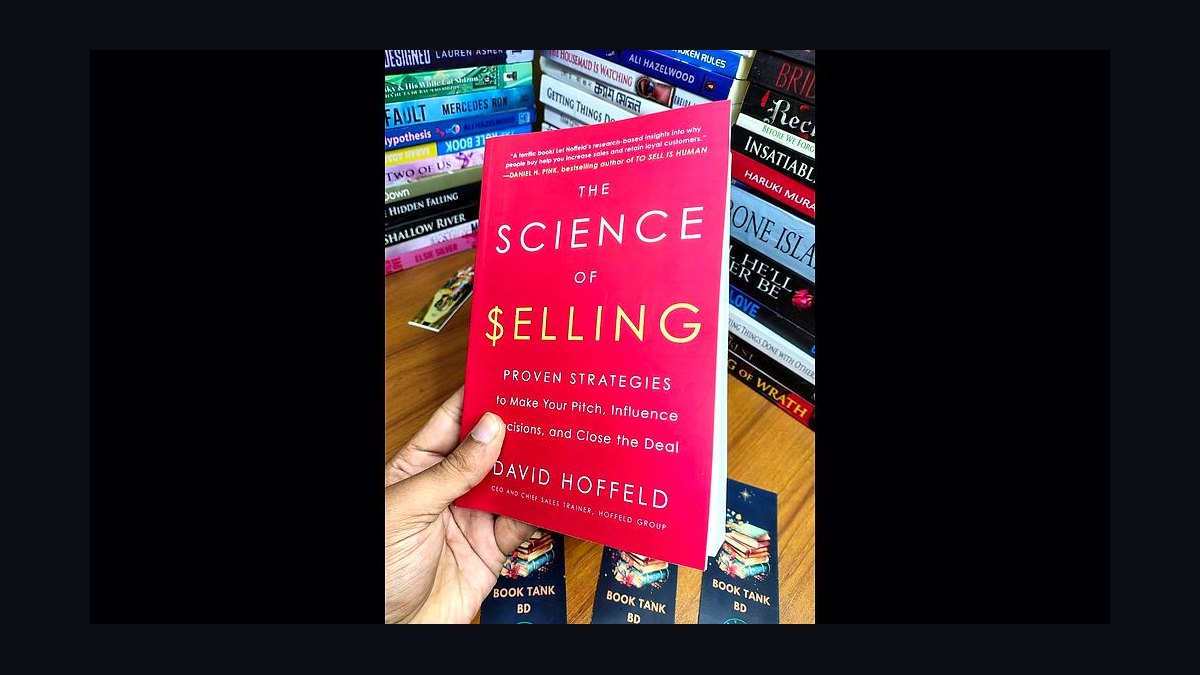
The Science of Selling (David Hoffeld, TarcherPerigee, 2016) argues selling is best understood as the science of buying behavior. Its core claim: every buyer must clear six subconscious gates — the 6 Whys — and make four sequential trust decisions before money moves. Hoffeld maps each gate to observable rep behaviors backed by published research.
What the book actually claims, and what competing sales books claim instead
David Hoffeld runs the Hoffeld Group, a corporate sales-training firm, and that origin explains the book's shape better than any summary of its chapters. This is not an academic monograph and it is not a memoir. It is a trainer's attempt to answer a specific complaint he heard from buyers of sales training: *why should I believe any of this works?* His answer was to attach a peer-reviewed citation to every recommended behavior — social psychology, cognitive psychology, and behavioral economics, drawn mostly from the 1970s through the 2010s.
The opening argument is a direct attack on the "selling is an art" framing that ran from Dale Carnegie in 1936 through the motivational-speaker era. Hoffeld's charge is that the art framing gave reps permission to improvise, and improvisation does not scale across a 40-person sales floor. He points at the durable, embarrassing statistic that industry benchmarks have shown quota attainment stuck near half of reps for years despite enormous training spend. If personality were the variable, he argues, the numbers would have moved.
Set that against the two books it is most often compared to, both published the same year or earlier. Cialdini's *Influence* (1984) is the ancestor: it catalogs six principles of persuasion — reciprocity, commitment and consistency, social proof, authority, liking, scarcity — but it is written for a general reader and stops short of telling a rep what to say on a Tuesday discovery call. Chris Voss's *Never Split the Difference* (2016) is the sibling: tactically superb, dialogue-level, built for the high-stakes single conversation, and almost entirely silent on how to structure a nine-month enterprise cycle.

Hoffeld sits between them. He is more operational than Cialdini and more structural than Voss. The trade-off is real: Voss gives you better lines, Cialdini gives you better theory, Hoffeld gives you a checklist you can run a pipeline review against. A third comparison worth making is Rackham's *SPIN Selling* (1988), which also grounded itself in observed data — thousands of coded sales calls. SPIN produced a question taxonomy (Situation, Problem, Implication, Need-payoff). Hoffeld produced a gate taxonomy. SPIN tells you what kind of question to ask; Hoffeld tells you which buyer objection you are trying to dissolve. They are complementary, not competing, and most modern enablement programs quietly run both.
The practical way to read this is as a choice between two strategies for improving a sales team. Option one: buy tactical dialogue training — objection handling, negotiation scripting, call openers. Option two: buy diagnostic structure — a shared vocabulary for *why* deals die that every manager can apply in a pipeline review. Hoffeld is squarely option two, and teams that already have decent talkers but terrible forecast accuracy get more from it than teams whose reps simply cannot hold a conversation.
The 6 Whys and the 4 Buying Decisions, side by side
The two headline frameworks are easy to confuse because both are ordered lists about buyer psychology. They do different jobs.

The 6 Whys are the questions a buyer must answer for themselves — usually without consciously articulating them:
- Why Change? What is actually wrong with the status quo? CEB (now Gartner) research has long shown a very large share of B2B pipeline dies in "no decision" rather than to a named competitor. Inertia is the incumbent. A rep who cannot make staying put feel expensive never earns a second meeting.
- Why Now? Agreement that change is needed does not produce a purchase order. This gate is answered with compelling events — a contract renewal, a regulatory deadline, an executive mandate, a competitor's move — and by quantifying the cost of delay in dollars per week. Research on temporal discounting shows humans systematically under-weight future losses, so a future problem has to be reframed as a present-tense bleed.
- Why You? Not the product — the vendor and the individual rep. Answered through named references, demonstrated domain fluency, and social proof. The Elaboration Likelihood Model (Petty & Cacioppo, 1986) is the underlying theory: when a buyer lacks the motivation or expertise to process arguments deeply, peripheral cues like perceived expertise carry the decision.
- Why Your Solution? Not "why your product over their product" but "why this *category* of approach at all." A revenue leader weighing tooling might genuinely be choosing between a platform purchase, a services engagement, and simply hiring two more reps. The rep has to articulate the mechanism of action in language the buyer can repeat to a CFO without the rep in the room.
- Why This Price? The question is not "is it cheap" but "is it fair." Prospect theory (Kahneman & Tversky, 1979) says losses loom larger than equivalent gains, so a price feels like a loss until it is anchored against a larger quantified gain. Anchor before the number is spoken, never after.
- Why Trust You? The gate the other five collapse into. Hoffeld spends more pages here than anywhere else.
The 4 Buying Decisions are the sequence in which trust gets granted, and Hoffeld insists the order is fixed: trust the salesperson, then the company, then the product or solution, then the price and risk. The practical consequence is a sequencing rule most reps violate weekly — demoing before decisions one and two are secured. A demo delivered into an untrusted relationship does not build trust; it burns the demo's persuasive ammunition on an audience that has not decided the presenter is credible.

The 6 Whys are diagnostic: run a lost deal through them and you find the gate that failed. The 4 Decisions are procedural: they tell you what to do *next* in a live cycle. Confusing them is the most common misreading of the book. Use the Whys in retro, the Decisions in sequencing.
Choosing between a Whys-first and a Decisions-first rollout
Most teams cannot adopt both frameworks at once without diluting each. The practical question is which one to install first, and the answer depends on where your revenue is actually leaking.
Read the diagram as a triage tool, not a maturity model. A team losing to no-decision has a *Why Change* and *Why Now* problem — the reps are talking to people who never had a reason to move. A team losing head-to-head to a named rival has a *Why You* and *Why Your Solution* problem — the buyer decided to buy, just not from you. A team whose deals evaporate between meetings has neither; it has a commitment-hygiene problem, and Behavioral Contracting fixes it faster than any framework.
The last branch matters and gets skipped. If your CRM's closed-lost reasons are a free-text field that reps fill in with "budget" 80% of the time, no framework will help, because you cannot see which gate failed. Clean the disposition taxonomy first — a picklist mapped to the six gates costs an afternoon of admin work and turns every subsequent pipeline review into a diagnostic session instead of a status recital.

One more decision criterion: team tenure. The 6 Whys are conceptual and reward reps who can already hold a consultative conversation. The 4 Buying Decisions are sequencing rules and work better with newer reps, because "do not demo until they trust you and the company" is a rule a six-week SDR can follow without judgment. Enterprise teams with long-tenured AEs usually get more from the Whys; high-velocity SMB floors get more from the Decisions plus contracting.
The research behind the claims, and where it has held up
Hoffeld's credibility rests on citation, so the citations deserve scrutiny. They fall into three tiers.
Tier one — solid and uncontroversial. Kahneman and Tversky's prospect theory (1979) and the System 1 / System 2 framing from *Thinking, Fast and Slow* (2011) are foundational behavioral economics. Cialdini's persuasion principles have survived four decades and a major revision. Damasio's *Descartes' Error* (1994) and the somatic-marker hypothesis established that emotion is not the enemy of rational decision-making but a precondition for it — patients with damage to emotional processing regions become notoriously unable to decide anything at all. When Hoffeld says buyers feel first and justify second, he is standing on stable ground.
Tier two — real research, contested interpretation. The Willis and Todorov work at Princeton on rapid trait inference from faces is genuine published research, and it is frequently over-extended in business writing into stronger claims than the studies support. The finding that people form consistent impressions extremely fast is robust; the leap from "impressions form fast" to "your first ninety seconds determine a nine-month enterprise cycle" is a rhetorical extension, not a research finding.

Tier three — walked back. The oxytocin-and-trust literature, drawn largely from Paul Zak's Claremont lab, is the weakest load-bearing element in the book. Subsequent replication efforts across behavioral economics and neuroendocrinology have substantially complicated the picture: effects appear context-dependent, dose-dependent, and considerably smaller than early papers suggested. Lisa Feldman Barrett's constructed-emotion work has separately pushed back on the whole genre of simple brain-region attribution that popular business neuroscience relies on. The honest 2026 reading is that the trust *behaviors* Hoffeld recommends — sustained eye contact, matched vocal pacing, calibrated self-disclosure, flawless follow-through on small commitments — are good advice supported by ordinary social psychology, and the neurochemical story wrapped around them is decorative rather than load-bearing.
That distinction matters operationally. If you train reps on the behaviors, you get the benefit. If you train reps on the *mechanism* and a skeptical buyer or a well-read sales manager challenges the science, the whole framework loses authority it did not need to claim. Teach the checklist; skip the oxytocin lecture.
There is a genuine external validation worth noting, though it arrived after publication and from an unexpected direction. Conversation-intelligence platforms — Gong, Chorus, Tethr and their successors — record and transcribe sales calls at scale and surface patterns across enormous transcript corpora. Their published findings on discovery-question density, talk-to-listen ratios, and the correlation between explicit next-step agreement and deal progression are broadly consistent with what Hoffeld argued from the psychology literature. Two independent methods converging on similar advice is meaningfully stronger evidence than either alone.
Behavioral Contracting, the 3 Levels of Why, and the parts that survive a Monday morning
Strip the neuroscience and two techniques remain that experienced operators consistently rate as the book's real contribution.
Behavioral Contracting is the simplest and highest-leverage. Every meeting closes with an explicit, specific, mutually-confirmed agreement about who does what by when. Not "I'll send over the proposal." Instead: "I'll send the proposal Wednesday by 5. You'll review it with your CFO before Friday noon. We'll meet Monday at 10 to walk her feedback. Does that work?" — and then you wait for an audible yes.

The mechanism is commitment and consistency, straight from Cialdini: people act in accordance with commitments they have voiced, particularly voluntary and specific ones. The operational effect is that a stalled deal becomes visible immediately rather than three weeks later. If the buyer will not commit to a next step with a date, that refusal is data — it usually means a gate failed earlier in the conversation and the buyer is being polite about it.
This idea did not stay contained. It shows up as the Paper Process element inside MEDDPICC, as the commitment sequence in Anthony Iannarino's work, and as the "mutual action plan" artifact that most enterprise sales methodologies now require in late-stage deals. A mutual action plan is Behavioral Contracting written down and shared with the buying committee.
The 3 Levels of Why restructures discovery as a descent rather than a checklist. The Surface Why is the stated business problem — "we need to hit the Q4 number." The Structural Why is the organizational mechanism producing it — "our SDR-to-AE handoff loses a third of booked meetings." The Personal Why is what the individual across the table gains or loses — "my promotion depends on this number." Reps who stop at Surface get vague RFPs and commodity comparisons. Reps who reach Personal get a champion who will fight internally when the rep is not in the room.
That structure maps almost exactly onto what modern discovery-coaching programs teach independently — Force Management's Command of the Message pushes toward required capabilities and metrics, Winning by Design's SPICED framework moves from Situation through Pain to Impact and Critical Event. Different vocabularies, convergent structure. When multiple methodologies built by different people for different market segments arrive at the same three-layer descent, that is a signal the structure reflects something real about how organizational buying works.

The sequencing rule tying it together is that questions have a right time. Early-cycle calls ask Why Change questions — "what is not working about how you handle this today?" Mid-cycle asks Why Your Solution — "how would this need to work for it to be obviously better than what you have?" Late-cycle asks Why This Price and Why Trust You — "what would need to be true for you to feel confident signing this?" Asking a late-cycle question early reads as presumptuous and kills momentum; asking an early-cycle question late reads as unprepared.
Installing it across a team without a six-month change program
A book summary is worthless without a sequencing plan, and this is where most enablement efforts fail: they teach the framework in a two-day offsite and then never reference it again.
The rollout logic is deliberate. Start with retrospective scoring because it costs nothing and produces buy-in — reps argue with frameworks in the abstract and stop arguing when they see their own lost deals cluster on one gate. Twenty deals is enough to see a pattern; you do not need statistical rigor, you need a visible clump.
Add the CRM field before the training, not after. If the gate that failed is not a structured field, the framework lives in a slide deck and dies there. One picklist on the opportunity object, six values, required on close-lost. That single change converts every future pipeline review into a diagnostic.
Coach to exactly one gate for the first month. This is the piece teams skip and the reason most enablement fails to stick — a manager who reviews calls against six criteria reviews them against none. Pick the gate the retrospective identified and coach only that until the behavior is automatic.

Behavioral Contracting goes in the call-close checklist immediately because it is the cheapest behavior to install and the easiest to measure. The metric is binary and inspectable: did the call end with a specific date-bearing next step confirmed by the buyer, yes or no. Pull it from calendar data or conversation-intelligence transcripts rather than asking reps to self-report, because self-reported compliance on any sales behavior runs optimistic.
Retire generic stage-exit criteria last. Most CRM stage definitions are activity-based — "demo completed," "proposal sent" — which measures rep effort rather than buyer progress. Replacing them with gate-based criteria ("buyer has articulated cost of inaction," "buyer has named the compelling event") is the endgame, and it is disruptive enough to forecasting that it should wait until the vocabulary is genuinely shared across the team.
Two adjacent effects to expect. Marketing gets a better brief, because "our losses cluster on Why Now" is an actionable content request in a way that "we need more leads" is not. And forecast accuracy usually improves before win rate does — reps stop calling deals commit when a gate is visibly unanswered, which makes the number smaller and truer before it makes it bigger.
Related questions
Is The Science of Selling still worth reading now that AI tools analyze calls automatically?
Yes. Conversation-intelligence tools detect *whether* a gate went unanswered. The book teaches *how* to answer it. The tool is the grader; the book is the study guide. Reading one without the other gives you either diagnosis without treatment or treatment without diagnosis.
How does it compare to The Challenger Sale?
Challenger (Dixon & Adamson, 2011) argues top performers teach, tailor, and take control — a claim about rep *profile*. Hoffeld makes a claim about buyer *process*. They are compatible: Challenger tells you what posture to adopt, Hoffeld tells you which gate that posture needs to clear.
What is the single highest-leverage takeaway for a new rep?

Behavioral Contracting. End every meeting with a specific, dated, verbally confirmed next step. It requires no expertise, takes fifteen seconds, and surfaces dead deals weeks earlier than hope-based follow-up does.
Does the neuroscience actually hold up?
Partially. The Kahneman, Cialdini, and Damasio foundations are solid. The oxytocin-trust link has been substantially complicated by replication work. Treat the recommended behaviors as good practice and the neurochemical explanations as illustrative rather than mechanistic.
Where should a sales leader start if the team already runs MEDDPICC?
Layer the 6 Whys onto the "Identify Pain" and "Champion" elements as diagnostic sub-questions. MEDDPICC is a qualification checklist; Hoffeld supplies the *why did it fail* vocabulary MEDDPICC lacks.
FAQ
Who is David Hoffeld and what is his background?
Hoffeld is the CEO of the Hoffeld Group, a sales-training and research firm that works primarily with mid-market and enterprise B2B organizations. He is a practicing trainer rather than an academic, which shapes the book's character: it is written to be executed by reps on Monday rather than defended at a conference. The Hoffeld Group continues to operate multi-day on-site programs built around the frameworks in the book.
What is the actual reading time and is there a shortcut?
The book runs to a standard business-trade length and reads in roughly six to eight hours cover to cover. The high-density chapters are the 6 Whys and Behavioral Contracting sections; the neuroscience chapters can be skimmed without losing the operational content. A team lead pressed for time can extract most of the practical value from those two areas and the discovery-sequencing material.

Does the framework work for transactional or SMB sales, or only enterprise?
Both, with different emphasis. In high-velocity SMB motions the gates compress — Why Change and Why This Price often get answered in a single call — so the sequencing discipline matters more than the diagnostic depth. In enterprise cycles the gates spread across months and multiple stakeholders, and different members of the buying committee stall on different gates, which makes the diagnostic use case stronger.
How does this apply to a self-serve or product-led motion where there is no rep?
The gates still exist; the answering mechanism changes. Why Change and Why Now get answered by marketing content and in-product prompts. Why Your Solution gets answered by the onboarding experience demonstrating mechanism rather than a rep explaining it. Why Trust You gets answered by security documentation, uptime history, and public customer proof. The book predates the product-led wave and does not address it, but the framework translates cleanly.
What are the book's clearest weaknesses?
Three. It over-claims on neuroscience, particularly around oxytocin. It predates AI-augmented selling entirely, so there is nothing on revenue intelligence, automated coaching, or how buyer research behavior changed once generative tools entered the evaluation process. And it is occasionally repetitive — the core frameworks could be delivered in half the pages, which is a common trait of books written by trainers adapting live curriculum to print.
Should I read this or Never Split the Difference first?
If you manage reps or build playbooks, read Hoffeld first — you need structure before dialogue. If you personally carry a number and struggle in live negotiation, read Voss first. Both were published in 2016 and they solve adjacent problems; most working sellers eventually read both and keep Voss on the desk while keeping Hoffeld in the enablement folder.
Sources
- https://www.penguinrandomhouse.com/books/533582/the-science-of-selling-by-david-hoffeld/
- https://www.hoffeldgroup.com/
- https://www.influenceatwork.com/
- https://www.gartner.com/en/sales/insights/b2b-buying-journey
- https://www.gong.io/resources/labs/
- https://www.apa.org/science/about/psa/2011/09/decision-making
- https://www.nobelprize.org/prizes/economic-sciences/2002/kahneman/facts/
- https://www.forrester.com/blogs/category/b2b-sales/
- https://hbr.org/2017/01/the-neuroscience-of-trust
- https://www.psychologicalscience.org/
Related on PULSE
- Sandler Selling System by David Sandler — Cliff Notes Summary & Key Takeaways
- The Sandler Rules for Sales Leaders by David Mattson — Cliff Notes Summary
- The Sandler Rules by David Mattson — Cliff Notes Summary
- The Go-Giver by Bob Burg and John David Mann — Cliff Notes Summary
- Range by David Epstein — Cliff Notes Summary for Sales Careers
- Rework by Jason Fried and David Heinemeier Hansson — Cliff Notes Summary
This page will be disappearing soon. Save it to your device for $1 — or read it free while it is here.
@Kory-White- · if Venmo asks, the last 4 of my number are 2012
This page is gone.
This one is off the shelf now. $1 keeps it on your phone for good — the whole page, pictures and diagrams included.
 pulse-recentThe Sales Acceleration Formula by Mark Roberge — Top 10 Key Takeaways for Sales Leaders in 2027
 book-summaryMajor Account Sales Strategy by Neil Rackham: Summary, Key Lessons, and RevOps Takeaways
 pulse-recentNever Lose a Customer Again by Joey Coleman — Top 10 Key Takeaways for Sales Leaders in 2027
 pulse-recentThe Transparency Sale by Todd Caponi — Top 10 Key Takeaways for Sales Leaders in 2027
 pulse-recentStart with No by Jim Camp — Top 10 Key Takeaways for Sales Leaders in 2027
 pulse-recentWhat is the first concrete step in Sandler Rule #4 for a sales leader to implement in 2027?
 pulse-recentHyper Sales Growth by Jack Daly — Top 10 Key Takeaways for Sales Leaders in 2027
 pulse-recentThe Closer’s Survival Guide by Grant Cardone — Top 10 Key Takeaways for Sales Leaders in 2027
 pulse-recentConceptual Selling by Robert Miller and Stephen Heiman — Top 10 Key Takeaways for Sales Leaders in 2027
 book-summaryLittle Red Book of Selling by Jeffrey Gitomer — Cliff Notes Summary