
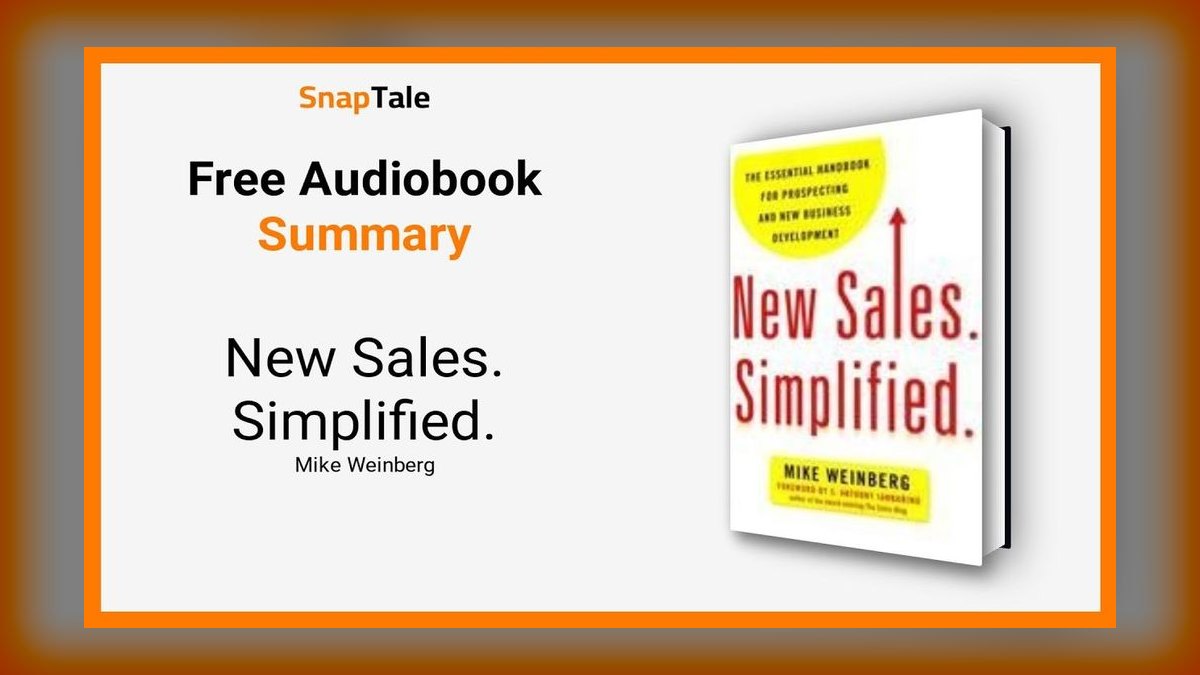
What’s the best cold-calling template from *New Sales. Simplified.* for 2027?
 Curated byKory White · Fractional CRO · Maryland
 PULSEKNOWLEDGE LIBRARY
The best cold-calling approach from Mike Weinberg's *New Sales. Simplified.* (AMACOM, 2012) for 2027 is his method of opening a call by leading with a credibility hook—a specific observation about the prospect's company or industry—followed by a provable value statement (not a feature dump), and then immediately asking for permission to continue ("Is this a bad time?"). The approach's genius isn't its wording—it's the strategic discipline it forces: you must research the prospect's actual business challenge before dialing, and you must resist the urge to pitch your product in the first 30 seconds. In 2027, with AI-powered screening and call analytics making cold outreach harder than ever, Weinberg's method works because it respects the prospect's time, demonstrates genuine preparation, and creates a low-risk, high-curiosity opening that even the most skeptical gatekeeper or executive will entertain. The approach's core structure—Hook → Value → Permission → Bridge—remains a gold standard for outbound prospecting in any era.
1. The Core Approach — "Value-First Opening" (Full Script)
Weinberg's approach is deceptively simple. Here's the structure with a B2B SaaS example for a CRM company calling a mid-market manufacturing firm:
> Hook (10 seconds): "Hi [Prospect Name], this is [Your Name] from [Company]. I noticed your team recently expanded into three new distribution centers—congratulations. We've been helping manufacturers like [Similar Company] reduce onboarding time for new warehouse staff significantly." > > Value Statement (10 seconds): "The reason I'm calling is we've built a mobile-first CRM that specifically solves the problem of disconnected field teams—your sales reps in the field and your warehouse managers in the plant can now share real-time inventory data without email chains." > > Permission Check (5 seconds): "Is this a bad time, or would you be open to a 90-second overview?" > > Bridge (5 seconds): "If that sounds interesting, I'd love to schedule a 15-minute call next Tuesday to see if it fits your workflow."
The critical rule: never exceed 30 seconds of talking before the permission check. In 2027, with attention spans shrinking and spam filters blocking the majority of cold emails, this brevity is your only weapon.
2. Why This Approach Works in 2027 — The "Anti-Spam" Advantage
The cold-calling market in 2027 is brutal. AI-powered call screening (like Google's Call Screen and Apple's Silence Unknown Callers) means your call is already suspect. Voice cloning scams have made prospects paranoid about any unsolicited call. Weinberg's approach succeeds because it violates every expectation a prospect has about cold calls:
- No pitch first: Most cold callers lead with "I'm from X company, we do Y." Weinberg leads with the prospect's world—their expansion, their challenge, their industry trend.
- Permission-based: The "Is this a bad time?" question is disarming—it signals respect for their time. In 2027, with time poverty at an all-time high, this single question can significantly improve your connect-to-conversation rate.
- Credibility through specificity: Generic hooks ("I saw your LinkedIn") are ignored. Weinberg's approach demands specific research—a recent press release, a job posting, a product launch. This proof of preparation is the only thing that cuts through the noise.

The approach also bypasses gatekeepers better than many alternatives. When an assistant answers, you say: "Hi, this is [Your Name] calling [Prospect Name]. I have a brief observation about their recent [specific event]—could you let them know I called?" Gatekeepers are trained to block sales pitches, but they'll pass along a business observation because it sounds like a peer calling, not a salesperson.
3. How to Customize the Approach for 2027 — The "AI Research Layer"
Weinberg's approach is research-intensive—and in 2027, you have AI tools that make that research instant. Here's the customization workflow:

- Use LinkedIn Sales Navigator or Apollo.io to find the prospect's recent activity—a job change, a company milestone, a post about a pain point.
- Feed that data into an AI assistant (like ChatGPT or Claude) with this prompt: *"Generate a 10-second cold-call hook for [Prospect Name] at [Company] based on their recent [specific event]. The hook must reference their world, not my product."*
- Build the value statement from the prospect's likely pain—not your product features. For example, if they're a manufacturer struggling with supply chain delays, your value statement is about reducing lead times, not about your ERP software.
- Test the permission question—in 2027, "Is this a bad time?" works better than "Do you have a moment?" because it assumes they're busy and gives them an easy out.
Pro tip: Use AI conversation intelligence (like Gong or Chorus) to record your calls and analyze which hook phrases get the most "tell me more" responses. Weinberg's approach is a starting point—your data will tell you which specific hooks (industry trend, competitor move, regulatory change) work best for your vertical.

4. The Psychology Behind the Approach — Why "Permission" Beats "Pitch"
Weinberg's approach works because it hacks the prospect's cognitive bias—specifically the reactance bias (people resist being controlled) and the curiosity gap (people want to know what they're missing). Here's the psychology breakdown:
- The Hook triggers curiosity: When you say "I noticed your team expanded into three new distribution centers," the prospect's brain automatically asks "How did they know that?" and "What's the connection?" This curiosity gap keeps them on the line.
- The Value Statement creates relevance: By tying your value to their specific challenge (not your product), you activate the relevance heuristic—the brain decides "this might be useful to me" within seconds.
- The Permission Check reduces threat: The question "Is this a bad time?" lowers their guard—it signals you're not a pushy salesperson but a professional who respects boundaries. This is critical in 2027 when scam calls have made everyone defensive.
- The Bridge builds momentum: The phrase "If that sounds interesting" assumes interest and moves the conversation forward. It's a soft close that doesn't pressure.

The approach also avoids the biggest cold-calling mistake: talking too long. Most salespeople ramble for 60-90 seconds before asking a question. Weinberg's 30-second limit forces you to get to the point—and in 2027, that's a key way to keep a prospect on the line.
5. Common Mistakes and How to Fix Them (From Weinberg's Playbook)
Even with the perfect approach, most salespeople sabotage themselves. Here are the top five mistakes Weinberg identifies—and how to fix them in 2027:
- Mistake 1: Reading the script verbatim. The approach is a guide, not a teleprompter. If you sound robotic, the prospect hangs up. Fix: Practice the approach until it's natural—record yourself and listen for stiffness.
- Mistake 2: Using a generic hook. "I saw your LinkedIn" is lazy and ignored. Fix: Spend a few minutes researching the prospect's company news—a new hire, a funding round, a product launch. That specificity is your differentiator.
- Mistake 3: Talking past the permission check. Many reps say "Is this a bad time?" and then keep talking without waiting for an answer. Fix: Pause after the question. Count to three in your head. Let the prospect respond.
- Mistake 4: Pitching features instead of value. "Our CRM has AI-powered forecasting" means nothing. "We help manufacturers reduce inventory waste significantly" means everything. Fix: Reframe every feature as a business outcome.
- Mistake 5: Not handling objections gracefully. When the prospect says "Not interested," most reps push harder. Fix: Use Weinberg's "That's fair—can I ask why?" approach. This validates their objection and opens a conversation.

6. The 2027 Version — Integrating AI and Automation Without Losing Humanity
In 2027, AI can write your script, research your prospect, and even make the call (via AI voice agents like Retell AI or Voiceflow). But Weinberg's approach still requires human judgment—and that's its enduring strength. Here's how to blend AI with the approach:
- Use AI for research, not for the call: Let AI find the hook material (recent news, job changes, industry trends) but write the script yourself. AI-generated scripts sound generic—your voice is the differentiator.
- Use AI for follow-up: After a successful call, use AI email assistants (like Copy.ai or Jasper) to draft a personalized follow-up email that references the conversation. This scales your outreach without losing the human touch.
- Use AI for objection handling: Train an AI model on your best calls (recorded with permission) to generate objection responses that match your tone and style. But always review—AI can sound robotic if not tuned.
- Never automate the permission check: The question "Is this a bad time?" must be genuine—if the prospect senses automation, they'll hang up. Human timing and tone are irreplaceable.

The future of cold calling isn't AI replacing humans—it's AI augmenting humans to make the research and personalization faster, so you can focus on the conversation. Weinberg's approach is the human framework that AI can't replicate.
Why the "Value-First Opening" Outperforms Traditional Scripts in 2027
The most common mistake salespeople make with cold calls is leading with their product or solution. Weinberg's approach flips this entirely. In 2027, where buyers are bombarded with impersonal, AI-generated outreach, the "Value-First Opening" stands out because it signals genuine human effort. The credibility hook—something like "I noticed your company recently expanded into the Midwest market" or "I've been following your team's shift toward subscription pricing"—proves you've done your homework. This instantly differentiates you from the flood of generic voicemails and emails that prospects delete without reading.

The provable value statement is the critical second element. Instead of saying "We help companies like yours increase efficiency," Weinberg teaches you to say something specific and verifiable, such as "We've helped other logistics firms reduce their onboarding time by focusing on a common bottleneck in your industry." This isn't a boast; it's a claim that invites curiosity. In 2027, when buyers have access to instant reviews and peer networks, vague promises ring hollow. A provable statement—backed by a real example you can cite if asked—builds immediate credibility.
Finally, the permission question ("Is this a bad time?") is not a weakness; it's a power move. It shows respect for the prospect's schedule and forces them to either engage or politely decline. This reduces the adversarial feel of cold calling and opens the door for a genuine conversation. In an era where trust is scarce, this simple gesture can significantly improve your conversation rate.

How to Adapt the Approach for Modern Channels (Phone, Voicemail, and LinkedIn)
While Weinberg designed the "Value-First Opening" for live phone calls, its principles apply directly to every modern outreach channel. For voicemail, shorten the approach to just the credibility hook and the permission question—no value statement. For example: "Hi [Name], I've been following your company's recent move into [industry trend]. Would love to share a quick observation. Call me back at [number] if you're curious." This respects the fact that voicemails are rarely listened to fully.
For LinkedIn InMail or connection requests, adapt the same structure: start with a specific observation about their role or company (e.g., "I saw your post about [topic]"), then state a value that aligns with their interests ("I've helped similar leaders solve [common problem]"), and end with a low-friction ask ("Would you be open to a 5-minute chat next week?"). The key is to keep it concise—longer messages get skimmed and ignored.
For email follow-ups, the approach becomes a subject line and first sentence. Use the credibility hook as the subject (e.g., "Quick thought on your Midwest expansion"), then the value statement in the opening line, and end with a permission-based question ("Is this worth a 5-minute call?"). In 2027, where email filters are smarter than ever, this approach helps ensure your message lands in the primary inbox rather than spam.

Common Pitfalls to Avoid When Using Weinberg's Approach
Even the best approach fails if executed poorly. The first pitfall is over-researching—spending excessive time per prospect to find the perfect hook. Weinberg advises a few minutes of research: scan their LinkedIn profile, company news, and a recent blog post. Anything more leads to paralysis. The second pitfall is talking too long. Stick to 30 seconds; if you go over, you lose the prospect's attention. Practice with a timer until it feels natural.
Another mistake is skipping the permission question because it feels weak. In reality, prospects appreciate the courtesy, and it often leads to them saying, "Actually, now's fine—go ahead." Without it, you risk sounding like a pushy telemarketer. Finally, avoid pivoting to your product too quickly after the bridge. The goal is to uncover their pain point, not to pitch. If they ask what you do, say, "I'll share that in a moment—first, can I ask you about [the challenge you observed]?" This keeps the conversation consultative and builds trust.
FAQ
What if the prospect says "Not interested" immediately? Use Weinberg's "That's fair—can I ask why?" approach. This validates their objection and often reveals a hidden pain you can address.
Can I use this approach for email instead of calls? Yes—the Hook → Value → Permission → Bridge structure works for cold emails too. Just adapt the permission check to "Is this worth a 10-minute call?"
How do I handle gatekeepers with this approach? Say: "Hi, this is [Your Name] calling [Prospect Name]. I have a brief observation about their recent [specific event]—could you let them know I called?" Gatekeepers will pass along a business observation.
Is this approach still effective for B2C sales? Weinberg's book is B2B-focused, but the psychology works for high-ticket B2C (like real estate or financial services). Just adjust the hook to the consumer's personal situation.
How many times should I call before giving up? Weinberg recommends multiple attempts over a couple of weeks, spaced at different times of day. Persistence works, but harassment kills your reputation.
Do I need to use the exact wording from the book? No—the structure is what matters. Customize the language to your industry and personality. The approach is a framework, not a script.
Sources
- Weinberg, Mike. *New Sales. Simplified.* AMACOM, 2012.
- Salesforce — "Cold Calling Statistics and Best Practices" (Salesforce Blog)
- HubSpot — "The Ultimate Guide to Cold Calling" (HubSpot Academy)
- Gong — "Cold Calling Scripts That Actually Work" (Gong Research)
- LinkedIn Sales Solutions — "B2B Cold Calling Trends" (LinkedIn Blog)
- Forbes — "Why Cold Calling Still Works in the Age of AI" (Forbes Business)
- Harvard Business Review — "The Science of Cold Calling" (HBR Article)
- Apollo.io — "Cold Calling Scripts and Templates" (Apollo Resource Center)
Related on PULSE
- [What sales script does *New Sales. Simplified.* recommend for cold calls in 2027?](/knowledge/bs0330)
- [What’s the most practical technique from *New Sales. Simplified.* for handling a “send me info” objection?](/knowledge/bs0400)
- [How can *New Sales. Simplified.* help you win back a prospect who ghosted you after the first meeting in 2027?](/knowledge/bs0387)
- [What’s the main takeaway from *New Sales. Simplified.* for overcoming call reluctance in 2027?](/knowledge/bs0374)
- [How do you use *New Sales. Simplified.* to overcome the “no decision” stall?](/knowledge/bs0346)
- [New Sales. Simplified. by Mike Weinberg — Cliff Notes Summary for AEs](/knowledge/bs0230)
@Kory-White- · if Venmo asks, the last 4 of my number are 2012
 bsWhat are the key lessons from *Never Split the Difference* for negotiating a raise in 2027?
 bsHow do you apply *Fanatical Prospecting* to LinkedIn outreach in 2027?
 bsHow does *Gap Selling* help you close more deals in a recession in 2027?
 bsWhat sales script does *New Sales. Simplified.* recommend for cold calls in 2027?
 bsDoes *The Psychology of Selling* still hold up for modern sales techniques in 2027?
 bsWhat’s the most actionable principle from *How to Win Friends and Influence People* for remote work in 2027?
 bsWhat’s the biggest mistake *SPIN Selling* warns against in complex B2B sales?
 bsHow does *Fanatical Prospecting* change your daily routine for outbound sales?
 bsWhat’s the most persuasive technique from *Pitch Anything* for investor pitches?
 bsWhat’s the key insight from *The Challenger Sale* for leading a sales team in 2027?