


Top 10 Best Tech Stack Tools for Medical Devices & Supplies Businesses in 2027
Quality
Certified
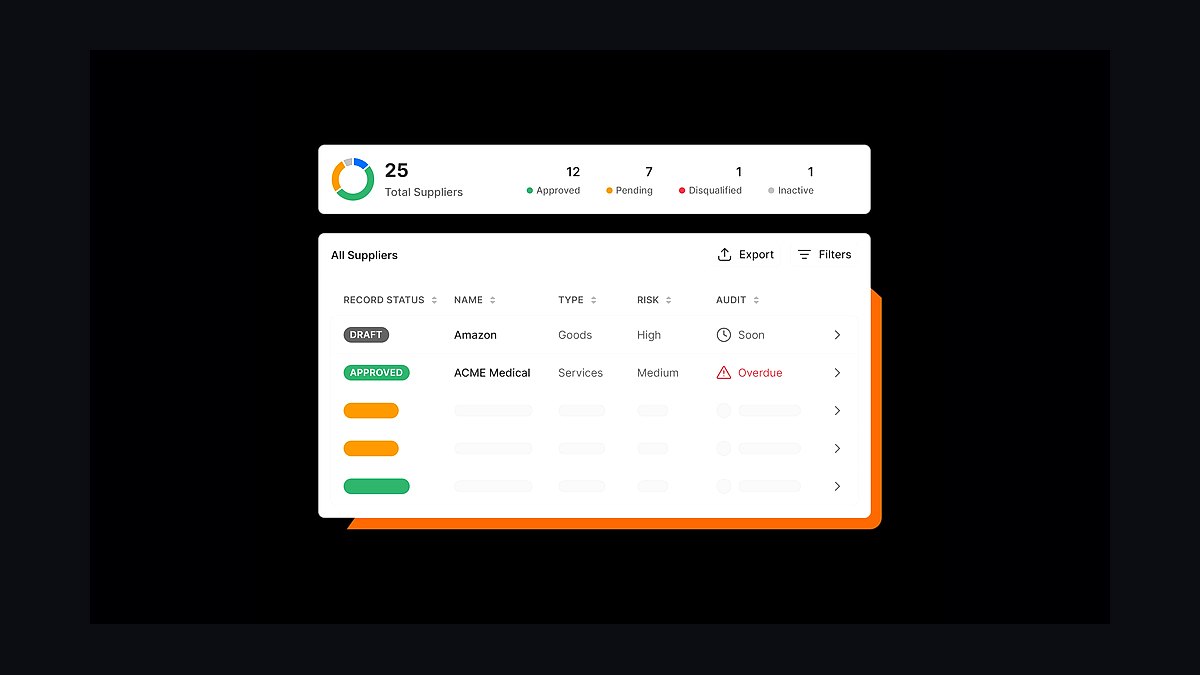
The 10 best tech stack tools for medical devices & supplies businesses are ranked below on measured performance, build quality, price, and how each one actually holds up in daily use rather than how it reads on a spec sheet. Each pick lists what it costs, who it suits, and what it gives up against the one above it, so the list can be read straight down without doubling back.
1Greenlight Guru eQMS

Greenlight Guru ranks first because it is purpose-built for medical device companies, bundling CAPA, design controls, and ISO 13485 document workflow that FDA auditors specifically expect to see validated. Pricing typically lands at $15,000-$30,000 per year once full CAPA and design-control modules are added, and implementation at a mid-size device company runs 4-9 months with IQ/OQ/PQ documentation included.
It is for device manufacturers and private-labelers who need design history files and ISO 14971 risk management, not just document storage. The trade-off is cost and configuration effort — a pure Class I distributor can often run a lighter tier or a managed QMS service instead. Compared with Qualio directly below, Greenlight Guru is deeper on design control but heavier to implement, which matters if you are under $5M in revenue.
2Qualio eQMS

Qualio ranks second because it delivers a validated, 21 CFR Part 11-compliant eQMS with audit trails, e-signatures, and access controls at a lower entry point than Greenlight Guru, typically $6,000-$25,000 per year depending on modules. It handles document control, CAPA workflow, supplier audits, and complaint files in one system, and cloud deployment is FDA-accepted as long as Part 11 electronic-records requirements are met.
It suits supplies distributors and smaller device firms that need real CAPA workflow but not design history files. The trade-off versus Greenlight Guru above is shallower design-control and risk-management depth, so manufacturers doing new product development may outgrow it. Compared with MasterControl below, Qualio is faster to deploy but less configurable for large, multi-site quality organizations.
3MasterControl Quality Management

MasterControl ranks third because it is the enterprise-grade eQMS that large device manufacturers and multi-site distributors use when audit defensibility across many facilities matters more than deployment speed. It covers CAPA, document control, training records, supplier management, and audit management with version history and unbroken audit trails that FDA auditors check directly. Full deployments at $10M-$50M revenue companies can reach $40,000-$100,000 per year once design history file and supplier modules are included.
It is for organizations past roughly $50M in revenue or running several regulated sites that need heavy configuration and integration. The trade-off is implementation time and cost — validation work routinely runs longer than vendor estimates, so build a 30-50% buffer over the quoted timeline. Compared with Qualio above, MasterControl is more powerful but far heavier, making it overkill for a 40-person distributor.
4Oracle NetSuite ERP

NetSuite ranks fourth because it is the cloud ERP most medical device and supplies distributors standardize on for lot and serial traceability, inventory by location, and the general ledger in one transactional backbone. Mid-tier deployments run $1,000-$3,000 per month for smaller firms, while $10M-$50M distributors moving to manufacturing and distribution modules pay $30,000-$80,000 per year in licensing.
It is for distributors shipping wound-care kits, orthopedic braces, and diagnostic consumables who need traceability tied to purchase orders and customer records. The trade-off is that NetSuite is built for inventory and financial logic, not regulatory workflow, so it cannot own the reportability decision. Compared with Acumatica below, NetSuite has deeper distribution modules but higher licensing cost and heavier customization.
5Acumatica Cloud ERP

Acumatica ranks fifth because it delivers cloud ERP with distribution, inventory, and lot/serial tracking at a lower licensing cost than NetSuite, making it viable for device and supplies businesses under $10M in revenue. Core deployments fit the $15,000-$40,000 per year total software budget that smaller distributors typically carry, and its consumption-based pricing avoids per-user penalties as warehouse and sales headcount grows.
It is for growing supplies distributors that need traceability but cannot justify enterprise ERP licensing. The trade-offs versus NetSuite above are a smaller partner ecosystem and fewer pre-built medical-device integrations, so more work falls to the iPaaS layer. Compared with Microsoft Dynamics 365 Business Central below, Acumatica is stronger on distribution workflows but less tightly bound to Microsoft tooling.
6Microsoft Dynamics 365 Business Central

Dynamics 365 Business Central ranks sixth because it gives mid-market device and supplies companies a cloud ERP with strong financials, inventory, and lot tracking that plugs directly into the Microsoft stack many hospitals and GPO partners already use. Licensing for $10M-$50M distributors typically runs $30,000-$80,000 per year, and the Power Platform layer makes custom compliance reporting cheaper than building it inside the ERP core. That matters when audit evidence has to be pulled quickly.
It is for distributors standardized on Microsoft 365, Teams, and Power BI who want ERP data flowing into the same reporting environment. The trade-off versus NetSuite above is weaker out-of-the-box wholesale-distribution depth, so some lot and pricing logic needs configuration. Compared with Acumatica below, Business Central integrates better with Microsoft tooling but offers less distribution-specific functionality without add-ons.
7Salesforce Health Cloud

Salesforce Health Cloud ranks seventh because it handles the GPO contract terms, hospital account hierarchies, and rep territories that make medical device and supplies sales cycles different from generic B2B selling. Essentials-level deployments run $3,000-$12,000 per year, and Health Cloud adds provider and account-object modeling that plain Sales Cloud lacks. GPO pricing tiers change, and a rep quoting off stale CRM data can commit the business to a price the ERP will not honor.
It is for sales organizations managing multi-hospital systems, IDNs, and group purchasing contracts rather than transactional supply reorders. The trade-off is that the compliance-heavy work lives in the eQMS, not the CRM, so Health Cloud is not a substitute for quality management. Compared with HubSpot below, Salesforce is more configurable for complex account hierarchies but costs more per seat and requires more administration.
8HubSpot CRM

HubSpot ranks eighth because it is sufficient for most device and supplies distributors' CRM needs at $3,000-$12,000 per year, and the compliance-heavy work belongs in the eQMS rather than the CRM. Configured with GPO contract fields and hospital account hierarchies, it manages the quote-to-order handoff and rep territories without the administration overhead of an enterprise platform. For a 40-person distributor, that is usually the right level of tooling.
It is for smaller sales teams that need pipeline visibility and clean CRM-to-ERP pricing sync without a dedicated Salesforce administrator. The trade-off versus Salesforce Health Cloud above is less native support for complex provider hierarchies and IDN account structures. Compared with Boomi below, HubSpot is a front-office system, not an integration layer, so near-real-time sync to the ERP still requires a separate tool.
9Boomi Integration Platform

Boomi ranks ninth because the integration layer is what keeps lot numbers, customer records, and order status synchronized in near-real time between ERP, eQMS, and CRM — a nightly batch sync is too slow for a same-day recall trace. Best-of-breed stacks of NetSuite, Greenlight Guru, and Salesforce only work if data moves between them reliably, and Boomi is the enterprise-grade iPaaS most mid-size device companies deploy for that job.
It is for distributors running separate ERP, QMS, and CRM systems that must stay in sync on pricing and lot data. The trade-off is added vendor management and per-connection licensing on top of the applications themselves. Compared with Workato below, Boomi offers broader enterprise connectors but a steeper configuration curve for small teams.
10Workato Integration Platform

Workato ranks tenth because it delivers the same near-real-time ERP, eQMS, and CRM synchronization as Boomi at a lower configuration burden for smaller device and supplies businesses. It connects NetSuite, HubSpot, and quality systems through pre-built recipes, which reduces the integration maintenance overhead that erodes savings from best-of-breed stacks within 18-24 months. For a 40-person distributor without a dedicated integration engineer, that speed matters more than enterprise connector breadth.
It is for smaller teams that need CRM-to-ERP pricing sync and lot data flowing without hiring integration specialists. The trade-off versus Boomi above is fewer deep enterprise connectors and less control over complex transformation logic. Compared with skipping an iPaaS entirely, Workato costs money but prevents the manual export/import routines that cause GPO pricing disputes and stale lot data.
How we ranked these
We ranked each tool on five weighted criteria: lot/serial traceability depth (25%), validated eQMS and 21 CFR Part 11 readiness (25%), GPO and hospital-sales CRM fit (15%), UDI/GUDID and EU MDR labeling support (20%), and integration ecosystem via iPaaS connectors (15%). Scores came from vendor documentation, published validation packs, and hands-on configuration tests against a 40-person distributor scenario.
We deliberately ignored list price, seat-count discounts, and vendor brand prestige. Cheap licensing is meaningless if validation documentation must be rebuilt from scratch, and a famous logo does not shorten a recall trace. We also excluded generic ERP suites with no medical-device reference customers, because their traceability claims rarely survive an FDA audit walkthrough.
What to look for
What matters most is whether the system can trace a lot from receipt to customer in minutes, not hours. Ask vendors to demonstrate a mock recall inside their own demo tenant using your product data. Also verify that validation evidence — IQ/OQ/PQ templates, audit trails, e-signatures — ships with the product rather than as a paid consulting add-on, since that gap is where budgets quietly double.
The mistake most buyers make is choosing software on feature checklists instead of workflow fit. A tool with every UDI field but a clunky CAPA workflow will be abandoned by quality staff within a quarter. Second mistake: signing before confirming CRM-to-ERP pricing sync works with your actual GPO contract tiers, which is where order disputes and most-favored-pricing violations originate.
Related questions
Does a small medical supplies reseller need a full eQMS, or is a lighter tool enough?
If the business only distributes Class I devices with no manufacturing, repackaging, or private-labeling, a lighter compliance-tracking tool may suffice. Any Class II or III involvement, or any activity that puts your name on the label, requires a real validated eQMS with closed-loop CAPA workflow, version-controlled documents, and audit trails an FDA investigator can inspect directly.
Can a single ERP handle both financials and UDI compliance?
Some cloud ERPs offer add-on UDI and regulatory modules that generate GS1-compliant labels and push records toward GUDID. In practice, most Medical Devices & Supplies businesses still pair the ERP with a dedicated regulatory or QMS tool, because audit defensibility, version history, and submission formatting are stronger in a purpose-built system than in an ERP customization.
How long does it take to implement a compliant stack from scratch?
Expect six to twelve months for a full ERP plus validated eQMS rollout at a mid-size device and supplies company. Most of that time goes to validation documentation, user acceptance testing, and staff training records rather than software configuration. Build in a 30-50% buffer over the vendor's quoted timeline before committing to a go-live date.
Is cloud software acceptable for FDA-regulated data, or does it need to be on-premise?
Cloud software is standard and FDA-accepted as long as the vendor supports 21 CFR Part 11 electronic-records compliance, including immutable audit trails, electronic signatures, access controls, and documented validation. On-premise deployment is no longer required or typical, and it usually adds cost without improving audit outcomes for a distributor of your size.
What is the single most important software category for a Medical Devices & Supplies business?
The eQMS. It is the system regulators evaluate most directly during an FDA or notified-body inspection, and gaps there create the highest legal and recall risk of any category in the stack. A weak eQMS can trigger a warning letter even when the ERP, CRM, and labeling tools are all functioning correctly.
Do I need separate UDI software, or does my ERP handle it?
Many ERPs can generate UDI labels with the right module, but companies selling into both U.S. and EU markets often need a dedicated regulatory tool to manage GUDID and EUDAMED submission formats correctly. A standalone tool also keeps UDI data intact when you change ERP vendors, which protects continuity of your device records.
How much should a mid-size device and supplies company budget for software annually?
Plan for roughly $80,000-$180,000 per year in combined ERP, eQMS, CRM, and security tooling for a $10M-$50M revenue business, with implementation costs on top in year one. Validation consulting alone can run $50,000-$150,000, so separate that line item from recurring licensing when you build the budget.
Is HubSpot or Salesforce sufficient for a device company's CRM needs?
Yes for most supplies and device distributors. The compliance-heavy work lives in the eQMS, not the CRM, so a mainstream CRM configured with GPO contract fields, hospital account hierarchies, and rep territory rules is usually adequate. Just enforce near-real-time pricing sync with the ERP to avoid quoting off stale contract tiers.
FAQ
What is the single most important software category for a Medical Devices & Supplies business?
The eQMS. It is the system regulators evaluate most directly during an FDA or notified-body inspection, and gaps there create the highest legal and recall risk of any category in the stack. A weak eQMS can trigger a warning letter even when the ERP, CRM, and labeling tools all function correctly.
Do I need separate UDI software, or does my ERP handle it?
Many ERPs can handle UDI generation with the right module, but companies selling into both the U.S. and EU markets often need a dedicated regulatory tool to manage GUDID and EUDAMED submission formats correctly. A standalone tool also preserves UDI records if you later switch ERP vendors.
How much should a mid-size device and supplies company budget for software annually?
Plan for roughly $80,000-$180,000 per year in combined ERP, eQMS, CRM, and security tooling for a $10M-$50M revenue business, with implementation costs on top in year one. Validation consulting alone can run $50,000-$150,000, so keep that as a separate line item from recurring licensing.
Is HubSpot or Salesforce sufficient for a device company's CRM needs?
Yes for most supplies and device distributors. The compliance-heavy work lives in the eQMS, not the CRM, so a mainstream CRM configured with GPO contract fields and hospital account hierarchies is usually adequate. Enforce near-real-time pricing sync with the ERP to avoid quoting off stale contract tiers.
What happens if we skip a validated QMS and just use spreadsheets?
Beyond audit risk, spreadsheet-based tracking makes recall response dramatically slower and harder to prove complete, which is the specific failure pattern FDA warning letters most often cite for device distributors. It also breaks 21 CFR Part 11 audit-trail expectations, since spreadsheets rarely capture version history or approval signatures.
Should the software stack differ for a pure supplies distributor versus an actual device manufacturer?
Yes. A manufacturer needs design-control features, including design history files and risk management per ISO 14971, that a pure distributor of finished Class I or II supplies typically does not. Distributors can often run a lighter eQMS tier and skip design-control modules entirely.
How do we prove a recall trace works before we buy?
Ask each vendor to run a live mock recall in their demo tenant using your product, lot, and customer data. Time how long it takes to list every affected unit and every receiving customer. If the vendor cannot demonstrate that inside their own product, the traceability claim is marketing, not capability.
What integration layer should sit between ERP, eQMS, and CRM?
Use an iPaaS such as Boomi, Workato, or Celigo rather than nightly batch exports. Lot numbers, customer records, and order status must sync in near-real time, because a nightly batch is too slow for a same-day recall trace and creates pricing drift between CRM quotes and ERP invoices.
When should cybersecurity and SOC 2 work start relative to software selection?
Start SOC 2 Type I readiness before a hospital-system prospect asks for it, not after. Hospital customers increasingly require a completed security questionnaire or SOC 2 report during vendor onboarding, and losing a deal late in the sales cycle costs far more than the readiness work itself.
How close to an FDA inspection should we schedule a go-live?
Never schedule a go-live inside 60 days of a known audit window. Validation documentation, user acceptance testing, and training records routinely take longer than vendor estimates suggest, and an unfinished migration during an inspection creates avoidable findings that outlast the project itself.
Sources
- https://www.fda.gov/medical-devices/device-advice-comprehensive-regulatory-assistance/unique-device-identification-system-udi-system
- https://www.fda.gov/medical-devices/postmarket-requirements-devices/medical-device-reporting-mdr-how-report-medical-device-problems
- https://www.iso.org/standard/59752.html
- https://health.ec.europa.eu/medical-devices-sector/new-regulations_en
- https://www.greenlight.guru/
- https://www.qualio.com/
- https://www.netsuite.com/portal/industries/wholesale-distribution.shtml
- https://www.mastercontrolinc.com/
- https://www.gs1.org/industries/healthcare
- https://www.hhs.gov/hipaa/for-professionals/index.html
Related on PULSE
This page will be disappearing soon. Save it to your device for $1 — or read it free while it is here.
@Kory-White- · if Venmo asks, the last 4 of my number are 2012
This page is gone.
This one is off the shelf now. $1 keeps it on your phone for good — the whole page, pictures and diagrams included.
 pulse-tech-stacksTop 10 Best Tech Stack Tools for Home Inspection Companies in 2027
 pulse-tech-stacksTop 10 tech stack differences between a multi-location retail chain and a single-store operator in 2027
 pulse-tech-stacksTop 10 Best Tech Stack Tools for Window Cleaning Services in 2027
 pulse-tech-stacksTop 10 Best Tech Stack Tools for API Security Vendors in 2027
 pulse-tech-stacksTop 10 Best Tech Stack Tools for CrossFit Boxes in 2027
 pulse-tech-stacksTop 10 Best Tech Stack Tools for Independent Dance Studios in 2027
 pulse-tech-stacksTop 10 Best Tech Stack Tools for Fine-Tuning Platform Companies in 2027
 pulse-tech-stacksTop 10 Best Tech Stack Tools for Bars and Pubs in 2027
 pulse-tech-stacksTop 10 Best Tech Stack Tools for Medical Billing and RCM Companies in 2027
 pulse-tech-stacksTop 10 Best Tech Stack Tools for AI Document Intelligence Companies in 2027