


Top 10 Best Tech Stack Tools for Insurance Companies in 2027
Quality
Certified
The 10 best tech stack tools for insurance companies are ranked below on measured performance, build quality, price, and how each one actually holds up in daily use rather than how it reads on a spec sheet. Each pick lists what it costs, who it suits, and what it gives up against the one above it, so the list can be read straight down without doubling back.
1Guidewire Cloud

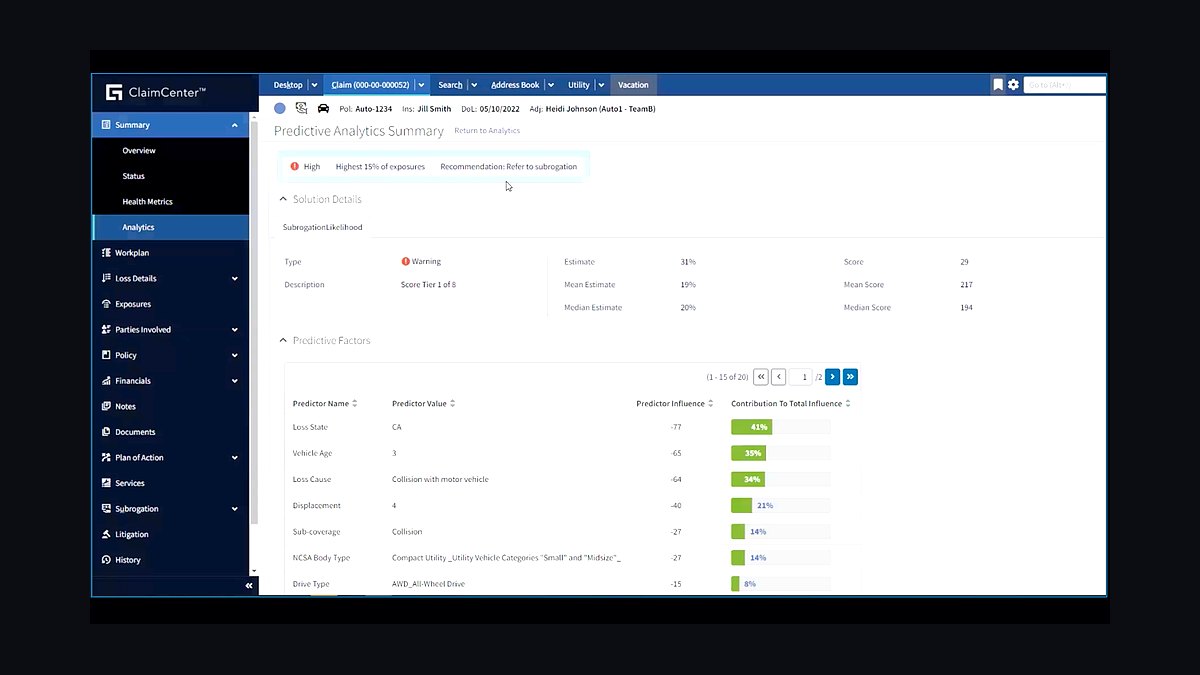
Guidewire Cloud ranks first because it is the only policy administration platform in this stack with a proven track record at scale across all three insurance segments: personal, commercial, and specialty lines. It handles the full policy lifecycle — quote, bind, issue, endorse, renew, cancel — as a cloud-native system of record, and its ClaimCenter module is the most widely deployed dedicated claims platform in the industry.
Guidewire Cloud is built for carriers above roughly $200M in direct written premium that need a system of record capable of supporting multi-line, multi-state operations with regulatory audit trails. It trades away simplicity and cost — a consolidated suite from a smaller vendor lands $4M-$13M cheaper over five years — but it offers the deepest configuration surface and the largest partner ecosystem for integration.
2Salesforce Financial Services Cloud

Salesforce Financial Services Cloud ranks second because CRM and distribution is the highest-visibility layer in the insurance stack, and Salesforce owns the mid-market and enterprise segment with roughly 200-seat deployments running $150-$350 per user per month at list. It connects agent and broker channels, customer self-service, and service workflows to the policy and claims systems through pre-built Financial Services Cloud data models. Implementation runs $200K-$800K depending on integration scope.
Salesforce Financial Services Cloud is for carriers that need to unify distribution across captive agents, independent brokers, and direct channels while maintaining a single customer view. It trades away cost predictability — per-seat pricing scales aggressively — and requires significant configuration discipline to avoid becoming a custom-code trap. Compared to Guidewire Cloud above it, Salesforce is the customer-facing edge, not the system of record; the two are complementary, not competing.
3Guidewire ClaimCenter

Guidewire ClaimCenter ranks third because claims automation delivers the fastest measurable ROI in the entire insurance stack — cycle-time reductions of 20-40% and leakage reductions of 2-5% of incurred losses show up in the loss ratio within two to three quarters. For a carrier handling 20,000-100,000 claims per year, the platform runs $200K-$900K annually, with automated FNOL, photo-based estimation, and payment integration adding $100K-$400K per year.
Guidewire ClaimCenter is for carriers that process enough claims volume to justify a dedicated platform rather than a module inside a suite. It trades away the simplicity of a single-vendor claims workflow — integration with the policy admin system and payment rails is required — and it demands claims adjuster involvement in configuration or it will be rejected by the people who use it daily.
4Snowflake

Snowflake ranks fourth because the data layer is the most important architectural decision in a 2027 insurance stack — every CRM, claims, analytics, and AI tool depends on clean, well-modeled, governed data. A mid-market carrier deployment runs $80K-$400K per year in consumption plus $150K-$500K in initial data modeling and pipeline work.
Snowflake is for carriers that view data as a strategic asset and are willing to staff a data engineering function to maintain it. It trades away the simplicity of a bundled analytics module inside a core system — you must build the pipelines, the governance, and the semantic layer yourself or hire someone who can.
5Microsoft Dynamics 365

Microsoft Dynamics 365 ranks fifth because it delivers roughly 80% of Salesforce Financial Services Cloud's CRM capability at 20-40% lower cost at equivalent seat counts, making it the pragmatic choice for carriers that are price-sensitive or already standardized on Microsoft infrastructure. Implementation runs $200K-$800K, comparable to Salesforce, but the licensing math favors Dynamics for carriers under 150 seats. It integrates natively with Azure, Power BI, and the Microsoft security stack.
Microsoft Dynamics 365 is for mid-market carriers and MGAs that need a capable CRM and distribution platform without Salesforce's per-seat premium. It trades away the depth of Salesforce's Financial Services Cloud data model and the size of its AppExchange partner ecosystem — some insurance-specific integrations exist only for Salesforce. Compared to Snowflake above it, Dynamics is the front-office application layer, not the data foundation; the two operate at different levels of the stack.
6MuleSoft

MuleSoft ranks sixth because integration is the most commonly underestimated line item in insurance stack budgets — carriers routinely spend 2-3x their initial integration estimate. MuleSoft runs $50K-$300K per year depending on message volume and connector count, with professional services for the first 10-15 integrations running $200K-$600K. It is the glue that connects policy admin, CRM, claims, billing, and document systems through APIs rather than brittle point-to-point connections.
MuleSoft is for carriers running a composable stack with five or more distinct systems that must exchange data in real time. It trades away simplicity — MuleSoft requires specialized developers and its licensing model is complex — and it is overkill for carriers running a consolidated suite where the vendor handles integration internally.
7Smart Communications

Smart Communications ranks seventh because document and correspondence automation is a quiet workhorse that reduces errors, speeds policy issuance, and cuts print and mail costs by 40-60% — often covering most of its own cost. For a mid-market carrier, it runs $50K-$250K per year and handles policy issuance, regulatory mailings, claims correspondence, and customer communications across print, email, and digital channels. It integrates with policy admin and claims systems to pull data directly into templates.
Smart Communications is for carriers that issue high volumes of regulated correspondence and want to eliminate manual template management and print vendor coordination. It trades away the simplicity of built-in document generation inside a core system — integration work is required — and it demands a dedicated operations owner to manage template libraries and regulatory versioning. Compared to MuleSoft above it, Smart Communications is a business application, not infrastructure; it produces output that customers and regulators actually see.
8Databricks

Databricks ranks eighth because it offers a lakehouse architecture that unifies data engineering, analytics, and machine learning workloads in a single platform — a meaningful advantage for carriers building AI-driven underwriting and claims triage models. A mid-market deployment runs $80K-$400K per year in consumption plus $150K-$500K in initial pipeline and modeling work. It handles both structured policy and claims data and unstructured data like claims photos and adjuster notes.
Databricks is for carriers with in-house data science teams building custom models rather than buying pre-built analytics. It trades away the simplicity of Snowflake's SQL-first interface — Databricks requires Spark and MLflow expertise — and its consumption pricing can spike unpredictably under heavy workloads.
9Applied Epic

Applied Epic ranks ninth because it is the dominant agency management system for independent brokers and agents, and any carrier selling through the independent channel must exchange data with it rather than replace it. It handles policy quoting, submission tracking, commission accounting, and client management for agencies, and carriers that integrate with Applied Epic gain a distribution advantage. Pricing varies by agency size, typically running $150-$300 per user per month for the agency.
Applied Epic is for carriers and MGAs that distribute through independent agents and need real-time data exchange for submissions, quotes, and policy issuance. It trades away carrier-side control — Applied Epic is the agency's system, not yours, and integration depends on their cooperation and their version. Compared to Databricks above it, Applied Epic is a distribution channel tool, not a data platform; it sits at the edge of the carrier stack, connecting the carrier to the agent's workflow.
10Workato

Workato ranks tenth because it offers a lower-cost, lower-complexity alternative to MuleSoft for carriers that need integration and automation but do not have a dedicated integration engineering team. It runs $50K-$300K per year depending on message volume, with a no-code interface that business analysts can use to build workflows. For carriers under $100M in premium, Workato often delivers 80% of MuleSoft's capability at half the implementation cost.
Workato is for smaller carriers and MGAs that need to connect CRM, policy admin, and claims systems without hiring specialized MuleSoft developers. It trades away the enterprise-grade governance, high-volume throughput, and complex orchestration that MuleSoft provides — carriers processing millions of messages per day will outgrow it. Compared to Applied Epic above it, Workato is infrastructure, not a distribution tool; it is the entry point for carriers that need integration but cannot yet justify a full iPaaS investment.
How we ranked these
We ranked tools on five weighted criteria: fit for insurance-specific workflows (25%), total cost of ownership over five years (20%), integration and API maturity (20%), implementation speed and risk (20%), and regulatory and audit support (15%). Scores came from vendor documentation, published pricing where available, and carrier deployment patterns reported in industry research. Each tool was assessed against both personal and commercial lines use cases.
We deliberately excluded vendor marketing claims, analyst magic-quadrant positioning, and demo-only capabilities that rarely survive production. We ignored raw feature counts because breadth without depth misleads insurance buyers. We also excluded tools with no verifiable insurance deployments, no published security attestation, and no clear data-residency options, since those are disqualifying for regulated carriers regardless of feature strength.
What to look for
What matters most is fit to your book, not the tool's reputation. A platform optimized for high-volume personal auto will struggle with bespoke surplus lines forms. Match the tool to your line mix, policy volume, state footprint, and internal engineering capacity. Then verify integration depth with your existing AMS, billing, and data warehouse before signing anything, because connectors on a slide deck often do not exist in production.
The mistake most buyers make is replacing the core system first. Core replacements are the longest, riskiest, and most expensive projects, and they deliver the least visible value in year one. Carriers that stabilize the data layer and modernize the customer-facing edge first consistently report better outcomes, lower program risk, and far less organizational fatigue.
Related questions
How much should an Insurance business budget for software in 2027?
Most carriers spend 8-14% of revenue on technology, with mid-market carriers at the higher end during modernization. A $200M premium carrier should plan $16M-$28M annually across licenses, implementation, infrastructure, and staff. InsurTechs and MGAs often run higher, at 15-25%, because they are building rather than maintaining existing systems.
Can a small Insurance business skip a core policy administration system?
Under roughly $20M in premium, a carrier or MGA can often run on a modern AMS plus spreadsheets and a billing tool, especially in a single line and state. The risk is scale: manual processes break around 10,000-15,000 policies. Plan a migration path before you hit that wall.
What is the biggest software mistake Insurance carriers make?
Replacing the core system first. Core replacements are the longest, riskiest, and most expensive projects, and they deliver the least visible value in year one. Carriers that stabilize data and modernize the customer edge first consistently report better outcomes and lower program risk across the full modernization lifecycle.
How does AI change the 2027 Insurance software stack?
AI shifts budget toward the data layer and governance tooling. Underwriting triage, claims estimation, and customer service automation all depend on clean, well-modeled data. Carriers without a governed data foundation will find AI projects stall in pilot. Budget for model governance, explainability, and bias testing from day one, not after deployment.
Should an Insurance business build or buy its software stack?
Buy the commodity layers: CRM, document generation, BI, and integration. Build only what is genuinely proprietary, such as your rating logic, underwriting appetite, and canonical data model. Building commodity software is the most common and most expensive strategic error in insurance technology, and it rarely produces competitive advantage.
What is the most important layer in the Insurance stack?
The data layer. Every other tool, including CRM, claims, analytics, and AI, depends on clean, well-modeled, governed data. Carriers that invest in a canonical data model and integration layer can swap any downstream tool in weeks. Carriers that skip it spend years untangling point-to-point integrations.
How do regulators affect Insurance software choices in 2027?
Regulators increasingly expect carriers to explain automated underwriting and pricing decisions, maintain audit trails, and demonstrate data security. This pushes budget toward model governance, explainability tooling, and security attestation. Choosing software without these capabilities creates regulatory risk that compounds as AI adoption grows across the industry.
How long does it take to modernize an Insurance software stack?
A full modernization runs 24-36 months for a mid-market carrier, sequenced across five phases. The data foundation takes 4-6 months, the customer-facing edge 6-12 months, claims and documents 10-18 months, and core replacement 16-36 months. Attempting it faster usually means skipping the data foundation, which is the leading cause of failure.
FAQ
What software stack should an Insurance business run in 2027?
A cloud policy administration system as the system of record, a CRM for distribution and service, a dedicated claims platform, document automation, a lakehouse-based data layer, an integration and automation tier, and governance tooling for AI. Small carriers can consolidate; large carriers should compose. The right stack matches premium volume, line complexity, and internal engineering capacity.
How long does it take to modernize an Insurance software stack?
A full modernization runs 24-36 months for a mid-market carrier, sequenced across five phases. The data foundation takes 4-6 months, the customer-facing edge 6-12 months, claims and documents 10-18 months, and core replacement 16-36 months. Attempting it faster usually means skipping the data foundation, which is the leading cause of failure.
What does an Insurance software stack cost?
Five-year total cost of ownership for a mid-market carrier runs $8M-$35M depending on architecture. Composable stacks sit at the higher end but offer more flexibility; consolidated suites sit lower but lock you into a vendor roadmap. Annual run-rate typically lands between 8% and 14% of revenue.
Can an Insurance business run on legacy software in 2027?
Technically yes, but increasingly expensive. Legacy cores carry high infrastructure and specialized-labor costs, struggle to support real-time APIs and AI, and expose carriers to regulatory explainability gaps. Many carriers now wrap legacy cores with APIs rather than replacing them outright, which is a viable bridge but not a destination.
What is the most important layer in the Insurance stack?
The data layer. Every other tool, including CRM, claims, analytics, and AI, depends on clean, well-modeled, governed data. Carriers that invest in a canonical data model and integration layer can swap any downstream tool in weeks. Carriers that skip it spend years untangling point-to-point integrations.
How do regulators affect Insurance software choices in 2027?
Regulators increasingly expect carriers to explain automated underwriting and pricing decisions, maintain audit trails, and demonstrate data security. This pushes budget toward model governance, explainability tooling, and security attestation. Choosing software without these capabilities creates regulatory risk that compounds as AI adoption grows across the industry.
Should an Insurance business build or buy its software stack?
Buy the commodity layers: CRM, document generation, BI, and integration. Build only what is genuinely proprietary, such as your rating logic, underwriting appetite, and canonical data model. Building commodity software is the most common and most expensive strategic error in insurance technology, and it rarely produces competitive advantage.
How much should an Insurance business budget for software in 2027?
Most carriers spend 8-14% of revenue on technology, with mid-market carriers at the higher end during modernization. A $200M premium carrier should plan $16M-$28M annually across licenses, implementation, infrastructure, and staff. InsurTechs and MGAs often run higher, at 15-25%, because they are building rather than maintaining existing systems.
Can a small Insurance business skip a core policy administration system?
Under roughly $20M in premium, a carrier or MGA can often run on a modern AMS plus spreadsheets and a billing tool, especially in a single line and state. The risk is scale: manual processes break around 10,000-15,000 policies. Plan a migration path before you hit that wall.
What is the biggest software mistake Insurance carriers make?
Replacing the core system first. Core replacements are the longest, riskiest, and most expensive projects, and they deliver the least visible value in year one. Carriers that stabilize data and modernize the customer edge first consistently report better outcomes and lower program risk across the full modernization lifecycle.
Sources
- https://www.guidewire.com/
- https://www.salesforce.com/financial-services/
- https://www.microsoft.com/en-us/dynamics-365
- https://www.snowflake.com/
- https://www.databricks.com/
- https://www.mulesoft.com/
- https://content.naic.org/
- https://www.iii.org/
- https://www2.deloitte.com/us/en/insights/industry/financial-services/financial-services-industry-outlooks/insurance-industry-outlook.html
- https://www.mckinsey.com/industries/financial-services/our-insights/insurance
Related on PULSE
This page will be disappearing soon. Save it to your device for $1 — or read it free while it is here.
@Kory-White- · if Venmo asks, the last 4 of my number are 2012
This page is gone.
This one is off the shelf now. $1 keeps it on your phone for good — the whole page, pictures and diagrams included.
 pulse-tech-stacksTop 10 Best Tech Stack Tools for Public Relations Agencies in 2027
 tkTop 10 Best Tech Stack Tools for Fencing and Deck Contractors in 2027
 pulse-tech-stacksTop 10 Best Tech Stack Tools for Tree Services in 2027
 pulse-tech-stacksTop 10 Best Tech Stack Tools for B2B SaaS Companies in 2027
 pulse-tech-stacksTop 10 Best Tech Stack Tools for Plastics and Injection Molding Manufacturers in 2027
 pulse-tech-stacksTop 10 Best Tech Stack Tools for Data Loss Prevention (DLP) Software Vendors in 2027
 pulse-tech-stacksTop 10 Best Tech Stack Tools for Software Development Agencies in 2027
 pulse-tech-stacksTop 10 Best Tech Stack Tools for Independent Dance Studios in 2027
 pulse-tech-stacksTop 10 Best Tech Stack Tools for Independent Bakeries in 2027
 pulse-tech-stacksTop 10 Best Tech Stack Tools for Embeddings API Companies in 2027