

The 10 Best AI Tools for Keyword Research for Websites in 2027
 Curated byKory White · Fractional CRO · Maryland
Quality
Certified

The best AI tool for website keyword research in 2027 is Ahrefs Keywords Explorer, whose massive database, accurate difficulty scoring, and AI-assisted clustering reveal the terms, questions, and topics worth targeting across search engines. It starts around $129/month, with free Webmaster Tools. The best value is Google Keyword Planner, a free tool that surfaces real search-volume ranges and related keywords straight from Google.
This list is for SEOs, content marketers, and site owners who need to find and prioritize the keywords their pages should target. The 2027 field spans premium SEO suites (Ahrefs, Semrush, Moz), free tools (Google Keyword Planner, Google Trends, AnswerThePublic), affordable specialists (KWFinder, Keyword Tool, LowFruits), and AI assistants that brainstorm and cluster terms. Below we rank ten real tools by how well they discover, score, and organize keywords for websites.
How We Ranked the Top 10
We weighted six criteria, informed by operator feedback, hands-on testing, and product documentation:
- Data quality (30%) — accuracy of volume, difficulty, and trend data.
- Discovery breadth (20%) — keyword ideas, questions, and long-tail coverage.
- Clustering and intent (15%) — AI grouping by topic and search intent.
- Difficulty and opportunity (15%) — realistic scoring of what you can rank for.
- Price/value (12%) — cost versus data and seats.
- Workflow fit (8%) — exports, tracking, and integrations.
1Ahrefs Keywords Explorer 🏆 BEST OVERALL

Best for: Deep keyword data across search engines | Pricing: From ~$129/month; free Webmaster Tools | Platform: Web
Ahrefs Keywords Explorer leads because its huge keyword database returns accurate search volume, well-calibrated Keyword Difficulty, traffic potential, parent topics, and thousands of ideas — across Google, YouTube, Amazon, and more — with AI-assisted clustering and intent labels. For serious website keyword research, its data accuracy and depth make it the most trusted choice.
Pros:
- Huge, accurate keyword database
- Reliable difficulty and traffic potential
- AI clustering and intent labels
- Multi-engine keyword data
Cons:
- Premium pricing
- Credits limit heavy bulk use
Verdict: The best overall AI tool for keyword research in 2027.
2Google Keyword Planner 💎 BEST VALUE
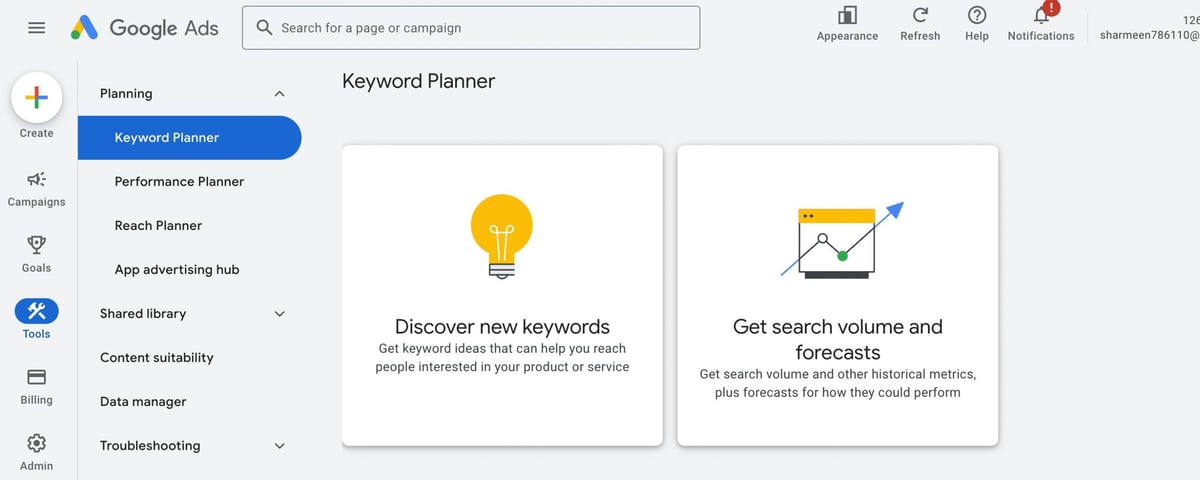
Best for: Free volume data straight from Google | Pricing: Free with a Google Ads account | Platform: Web

Google Keyword Planner is the best value because it gives search-volume ranges, competition, and related keyword ideas directly from Google's own data, free with any Ads account. While volumes are bucketed for non-advertisers, it remains the authoritative free starting point for discovering and validating keywords for a website.
Pros:
- Free Google-sourced keyword data
- Volume ranges and competition
- Related and new keyword ideas
- Forecasts for planning
Cons:
- Volumes bucketed without ad spend
- Built for ads, not organic difficulty
Verdict: The best-value free keyword research tool.
3Semrush Keyword Magic Tool

Best for: Massive keyword ideas with intent | Pricing: From ~$139/month | Platform: Web
Semrush Keyword Magic Tool surfaces millions of keyword ideas grouped by topic, with search intent, difficulty, SERP features, and question filters, plus an AI Copilot that summarizes opportunities. Inside the broader Semrush suite it connects research to rank tracking and content, making it a powerhouse for building keyword strategies at scale.
Pros:
- Millions of grouped keyword ideas
- Intent, difficulty, and SERP features
- Question and filter views
- Tied to a full SEO suite
Cons:
- Requires a Semrush subscription
- Volume of data can overwhelm
Verdict: The best keyword discovery inside a full suite.
4Moz Keyword Explorer


Best for: Prioritized ideas with priority score | Pricing: Free queries; paid from ~$49/month | Platform: Web
Moz Keyword Explorer combines volume, difficulty, organic CTR, and a blended Priority score so you can quickly judge which keywords are worth pursuing, alongside thousands of suggestions and SERP analysis. Its clean interface and free monthly queries make it a friendly, opportunity-focused research tool for smaller teams.
Pros:
- Blended Priority score for picks
- Volume, difficulty, and CTR
- SERP analysis and suggestions
- Free monthly queries
Cons:
- Smaller database than Ahrefs
- Full access needs a plan
Verdict: The best opportunity-scored keyword tool.
5KWFinder (Mangools)

Best for: Affordable long-tail keyword discovery | Pricing: From ~$29/month | Platform: Web
KWFinder by Mangools is built for finding low-competition long-tail keywords, with clear difficulty scores, local data, and a simple interface at a price small businesses can afford. It bundles with the Mangools suite for SERP and rank tracking, making it a popular, budget-friendly choice for finding winnable keywords.
Pros:
- Easy long-tail discovery
- Clear, beginner-friendly difficulty
- Local and language targeting
- Affordable Mangools suite
Cons:
- Smaller database than leaders
- Daily lookup limits by plan
Verdict: The best affordable long-tail keyword finder.

6AnswerThePublic

Best for: Question-based keyword and topic ideas | Pricing: Free limited; paid from ~$11/month | Platform: Web
AnswerThePublic visualizes the questions, prepositions, and comparisons people search around a topic, surfacing the real queries to target for FAQ and content. Its AI-assisted suggestions help build content around search intent and capture featured-snippet and AI-answer opportunities tied to genuine user questions.
Pros:
- Visualizes real search questions
- Great for FAQ and intent content
- Prepositions and comparisons
- Free daily searches
Cons:
- No reliable volume on free tier
- Best paired with a volume tool
Verdict: The best tool for question-based keyword ideas.
7Keyword Tool (keywordtool.io)

Best for: Autocomplete keywords across platforms | Pricing: Free limited; paid from ~$89/month | Platform: Web
Keyword Tool generates hundreds of long-tail suggestions from Google, YouTube, Bing, Amazon, and more by mining autocomplete, useful for finding terms beyond traditional databases. It is handy for multi-platform research and discovering phrasing variations that other tools miss, especially for video and marketplace content.
Pros:
- Autocomplete across many platforms
- Lots of long-tail variations
- Multi-engine and language support
- Free version for ideas
Cons:
- Volume and CPC need a paid plan
- Less analysis than full suites

Verdict: The best autocomplete-based multi-platform tool.
8Google Trends
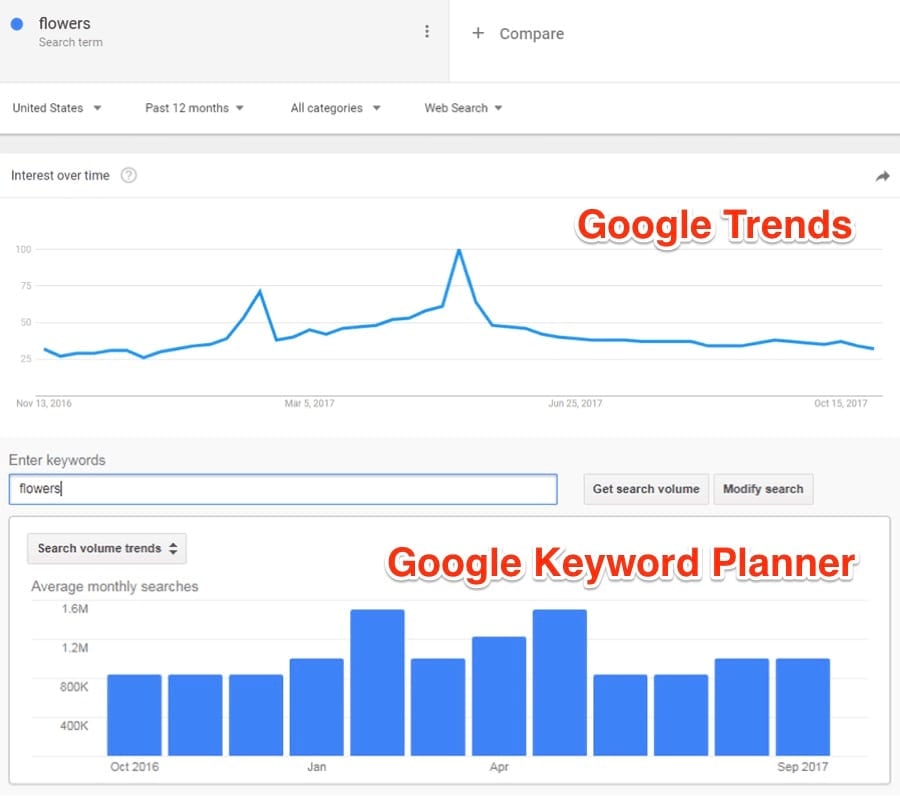
Best for: Trend direction and seasonality | Pricing: Free | Platform: Web
Google Trends shows relative interest over time, regional demand, and rising related queries, helping you catch momentum and seasonality that absolute-volume tools miss. It is free and essential for timing content, comparing terms, and spotting breakout topics before they peak, complementing any volume-based keyword tool.
Pros:
- Free trend and seasonality data
- Rising and breakout queries
- Regional interest comparison
- Great for timing content
Cons:
- Relative, not absolute volume
- No difficulty data
Verdict: The best free tool for trends and seasonality.
9LowFruits
Best for: Finding low-competition keywords fast | Pricing: Pay-as-you-go credits; from ~$25 | Platform: Web
LowFruits analyzes SERPs to flag keywords where weak pages rank, pinpointing low-competition opportunities a new or small site can realistically win. Its credit-based model and clustering make it efficient for quickly building a list of attainable terms without a costly monthly subscription.
Pros:
- Finds genuinely winnable keywords
- SERP weakness analysis
- Keyword clustering
- Pay-as-you-go credits

Cons:
- Niche focus, not a full suite
- Credits run down with heavy use
Verdict: The best tool for low-competition opportunities.
10ChatGPT (OpenAI)

Best for: Brainstorming and clustering keywords | Pricing: Free tier; Plus $20/month | Platform: Web / desktop / API
ChatGPT is a fast keyword copilot for brainstorming seed terms, generating long-tail and question variations, grouping a raw list into topic clusters and intent buckets, and mapping keywords to content. Paired with a tool that supplies real volume and difficulty, it accelerates the ideation and organization side of keyword research.
Pros:
- Brainstorms seed and long-tail terms
- Clusters keywords by topic and intent
- Maps keywords to content briefs
- Fast ideation partner
Cons:
- No real volume or difficulty data
- Needs validation with a data tool
Verdict: The most versatile copilot for keyword ideation.
Decision Tree
Limitations of AI Keyword Tools You Should Know in 2027
Even the best AI keyword tools have blind spots. No tool can perfectly predict search intent — a keyword like “best running shoes” might signal a buyer ready to purchase or a beginner just browsing. AI models in 2027 still struggle to distinguish these nuances without manual review. Additionally, tools relying on Google’s API often sample data, meaning volumes for low-traffic keywords (under 100 monthly searches) can be wildly inaccurate — sometimes off by 50% or more. Another limitation: most tools focus on Google, ignoring emerging search engines like Perplexity, Bing Chat, or TikTok Search, which now drive meaningful traffic for certain niches. Finally, AI-generated keyword clusters can group unrelated terms if your niche uses ambiguous language (e.g., “apple” for fruit vs. tech). Always cross-check tool outputs with your own site analytics and manual searches before committing to a target keyword.
How to Validate AI Keyword Suggestions Without Wasting Budget
Before investing in a paid tool or building content around AI-suggested keywords, run a quick validation process. First, paste the keyword into Google and scan the top 10 results — if the SERP is dominated by big brands or outdated pages, your chance of ranking is low regardless of the tool’s difficulty score. Second, use Google Search Console to check if your site already ranks for similar terms; sometimes the best keywords are ones you’re already partially visible for. Third, plug the keyword into Google Trends and set the timeframe to 12 months — avoid terms with declining interest unless you’re targeting a seasonal spike. Finally, for e-commerce or local sites, check if the keyword appears in product listings or Google Business Profile categories, which often outrank traditional web pages. This manual sanity check takes 5 minutes per keyword but can save you from building content that never sees traffic.
Emerging AI Keyword Trends in 2027 That Change Your Strategy
Three shifts in 2027 are reshaping how keyword research tools work. First, multimodal search means tools now analyze image and video keywords — for example, searching “how to tie a tie” might return YouTube tutorials before text pages. Tools like Ahrefs and Semrush now include video keyword data, but free tools often miss this entirely. Second, zero-click answers are growing: Google’s AI Overviews and featured snippets answer queries directly on the SERP, reducing clicks to websites. This means targeting “how-to” or “what is” keywords may generate brand awareness but little traffic — focus on transactional or comparison keywords instead. Third, personalized search results based on user history make universal keyword difficulty scores less reliable. A keyword that’s “hard” for a new site might be “medium” for a site with strong topical authority in that niche. In 2027, the best strategy is to combine AI tool data with your own site’s authority signals — not blindly follow any tool’s recommendations.
FAQ
What is the best AI tool for website keyword research in 2027? Ahrefs Keywords Explorer is the best overall thanks to its huge, accurate database, reliable difficulty scoring, and AI clustering across search engines. For value, Google Keyword Planner gives real volume data free with an Ads account.
How does AI help with keyword research? AI clusters keywords into topics, labels search intent, brainstorms long-tail and question variations, scores difficulty realistically, and surfaces opportunities where weaker pages rank.
Which keyword research tools are free? Google Keyword Planner, Google Trends, and AnswerThePublic offer free data, Moz gives free monthly queries, and Ahrefs Webmaster Tools includes limited free keyword data.
How do I find low-competition keywords? Use difficulty scores in Ahrefs, Moz, or KWFinder and SERP-weakness analysis in LowFruits to find terms where current ranking pages are beatable for a smaller site.
What is keyword difficulty? A score estimating how hard it is to rank on page one for a term, based on the strength of currently ranking pages; lower scores mean more attainable keywords.
Should I use one tool or several? Most pros combine a premium database (Ahrefs or Semrush) for volume and difficulty with free tools (Trends, AnswerThePublic) for questions and timing, and ChatGPT for clustering.
Related on PULSE
- The 10 Best AI Tools for Market Research in 2027
- The 10 Best AI Tools for Stock Trading Research in 2027
- The 10 Best AI Tools for Research in 2027
- The 10 Best AI Tools for E-commerce Websites in 2027
- The 10 Best AI Tools for Wix Websites in 2027
- The 10 Best AI Tools for Squarespace Websites in 2027
Sources
- https://ahrefs.com/keywords-explorer
- https://ads.google.com/home/tools/keyword-planner/
- https://www.semrush.com/features/keyword-magic-tool/
- https://moz.com/explorer
- https://mangools.com/kwfinder
- https://answerthepublic.com
- https://keywordtool.io
- https://trends.google.com
- https://lowfruits.io
- https://chatgpt.com
People also search for: best ai tools for keyword research for websites 2027 · top ai tools for keyword research for websites 2027 · top rated ai tools for keyword research for websites 2027 · top ranked ai tools for keyword research for websites 2027 · highest rated ai tools for keyword research for websites 2027 · ai tools for keyword research for websites reviews 2027
This page will be disappearing soon. Save it to your device for $1 — or read it free while it is here.
@Kory-White- · if Venmo asks, the last 4 of my number are 2012
This page is gone.
This one is off the shelf now. $1 keeps it on your phone for good — the whole page, pictures and diagrams included.
 pulse-ai-infrastructureHow do you manage secrets and API keys for LLM applications in 2027?
 pulse-ai-infrastructureThe 10 Best AI Tools for SEO in 2027
 pulse-ai-infrastructureThe 10 Best AI Tools for Restaurant Websites in 2027
 pulse-ai-infrastructureThe 10 Best AI Tools for Headless CMS Development in 2027
 pulse-ai-infrastructureThe 10 Best AI Tools for Screenwriting in 2027
 pulse-ai-infrastructureThe 10 Best Distributed Training Frameworks in 2027
 pulse-ai-infrastructureThe 10 Best LLM Gateways in 2027
 pulse-ai-infrastructureThe 10 Best AI Tools for Creating Resumes in 2027
 pulse-ai-infrastructureThe 10 Best AI Observability Tools for RAG Pipelines in 2027
 pulse-ai-infrastructureHow do you scale LLM inference to handle thousands of concurrent users in 2027?