


Should I open or buy a WOW 1 DAY PAINTING franchise in 2027?
Quality
Certified
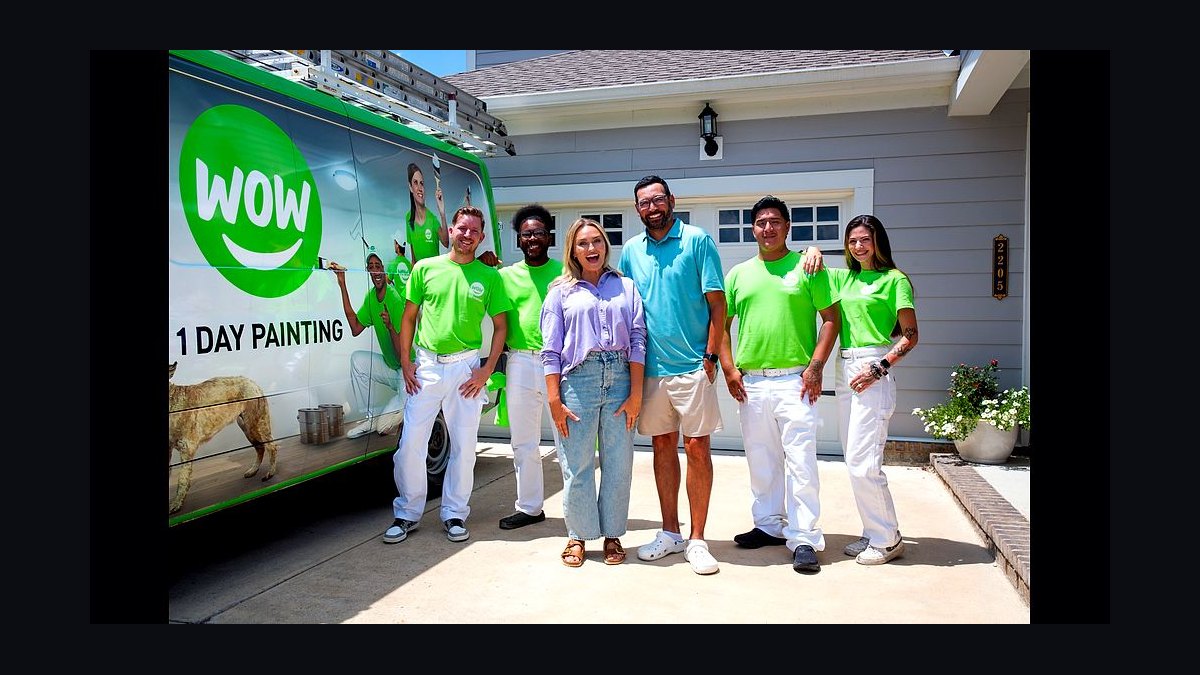
Only if you already run trades crews or sell services for a living. WOW 1 DAY PAINTING costs roughly $92,000–$182,000 to open, requires two subterritories, and carries a stacked royalty, marketing, and branding-cooperative load. U.S. median franchisee revenue trails the system average sharply, so half of owners earn less than the headline number suggests.
What a one-day repaint franchise actually is, and why the model matters
WOW 1 DAY PAINTING is the residential repaint brand inside O2E Brands, the same franchisor family that built 1-800-GOT-JUNK?. That parentage tells you almost everything about the operating philosophy. O2E's core competency is not paint chemistry or surface prep — it is call-center lead handling, brand theatrics, and converting a commodity trade into a scheduled, branded, uniformed appointment. The junk-removal playbook, applied to painting.
The product promise is the entire differentiator: your interior or exterior repaint happens in one day. A crew of four to eight painters arrives in the morning, masks, sprays and rolls, and is gone by evening. Compare that to the independent painter's default — a two-man crew stretching a whole-house interior across five to nine days, with drop cloths living in your dining room the whole time. For a homeowner who works from home, has kids, or is staging a house for listing next Friday, compressing nine days of disruption into one is worth a real premium.
That premium is the business. It is not a paint business; it is a scheduling and labor-density business dressed in paint. Everything that makes an operator money or breaks them traces back to one question: can you reliably put six trained painters on a driveway at 8 a.m. on a Tuesday, hit the promised finish, and do it again Wednesday? The brand supplies demand generation and a script. You supply the labor system.

Understanding this reframes the whole investment decision. Prospective buyers usually evaluate franchises on brand recognition and fee load. Here, those matter less than your answer to a workforce question. In markets with a deep bench of experienced painters, the model prints. In markets where every competent sprayer is already spoken for by new-construction GCs paying steady piece rates, the one-day promise becomes a promise you cannot keep — and a broken one-day promise is worse than never having made it, because you charged a premium for it.
There is a useful adjacent comparison. The same "compress the disruption" wedge powers one-day bath remodelers, same-day garage-floor coating outfits, and one-visit gutter systems. All of them monetize speed rather than craft, and all of them live or die on crew reliability and materials logistics rather than on marketing. If you have studied any of those categories, the diligence transfers almost line for line.
The upstream effect worth naming: because the model sells speed, your average ticket is meaningfully higher than a solo painter's, but your cost of a blown day is also higher. A four-painter crew idle for a day because a customer rescheduled or a sprayer failed is a payroll hole you cannot recover. Independents absorb a slow day; density-model operators bleed on one.
The step-by-step process from inquiry to first booked job
The path from "I'm curious" to "my crew is on a driveway" is more structured than most first-time buyers expect, and each stage has a specific document or verification attached to it. Skipping any of them is how people end up signing a ten-year agreement based on a development rep's enthusiasm.
Stage one: request and actually read the Franchise Disclosure Document. Every U.S. franchisor must give you an FDD at least 14 days before you sign or pay anything. Do not skim it. Item 7 gives the estimated initial investment range. Item 19 gives any financial performance representation the franchisor chooses to make — and franchisors are not required to make one at all, so the presence of a segmented Item 19 is itself a modest positive signal. Item 20 gives outlet counts, transfers, terminations, and non-renewals, plus the contact list for current and former franchisees. Item 21 gives audited financials for the franchisor itself.
Stage two: call franchisees you selected, not the ones handed to you. Item 20's list exists precisely so you can do this. Build a stratified sample — several owners under two years in, several in the three-to-five-year band, several past five years. Ask each the same five questions: trailing-twelve-month gross revenue, current painter headcount, marketing cost per booked job, biggest regret, and whether they would sign again knowing what they know now. The tenure spread matters because a system can look wonderful when you only speak to survivors.
Stage three: build your own pro forma at the median, not the average. This is the step buyers most often fake. Model the conservative case using system median revenue rather than average, then layer in the full ongoing fee stack, painter wages, materials, vehicle and insurance, and general administrative costs. If the conservative case does not cover your debt service plus a real household draw, the deal is dead regardless of how good the stretch case looks.
Stage four: validate the labor pool before you validate anything else. Pull county-level painter employment data from the Bureau of Labor Statistics QCEW series. Then run a live test: post a painter job ad in your target market and count qualified applicants over seven days. A thin response is a hard stop, not a challenge to overcome with better recruiting.

Stage five: attend Discovery Day and interrogate support, not sales. Ask to observe how the franchisor conducts performance reviews with struggling franchisees. Meet operations leadership by name. Development reps are compensated to close you; operations people are the ones you will actually live with.
Stage six: financing and territory definition in writing. Franchises listed in the SBA Franchise Directory move faster through 7(a) underwriting because the loan-eligibility review is already done. Get your subterritory boundaries defined on a map, attached as an exhibit, before signature. Verbal assurances about "we'll protect that adjacent area for you" have no legal weight.
Costs, timelines, and the ranges that actually govern outcomes
The all-in startup range for this brand runs roughly $92,000 to $182,000, and the spread is not noise — it reflects real structural choices. The franchise fee itself covers two subterritories because the brand does not sell single territories; that pairing raises your entry price but also raises your revenue ceiling. Premium metros sit at the top of the fee band.
Inside that total, the line items break down predictably for a mobile home-services business. Initial training and travel to headquarters. A branded, wrapped vehicle — lease it in year one rather than buying, because your crew-count guess will be wrong and you want the option to change. Spray rigs, ladders, drop cloths, and the brand kit. Tablets, CRM seats, and scheduling software. Insurance deposits across general liability, commercial auto, and workers' compensation. Contractor licensing, which varies enormously by state — some states barely regulate residential painting, others require a licensed contractor of record with a bonded application process that takes months. Launch marketing for the first ninety days. And working capital, which is the line people underfund most badly.

Working capital is the line that kills people. Payroll runs weekly or biweekly. Customer collection often runs on completion. Your marketing spend front-runs your bookings by weeks. Three months of working capital is the floor, not the target — six is safer, and if you are financing the build with debt, you should hold household reserves entirely separate from the business's cash.
The ongoing fee stack compounds. A royalty on gross revenue, a system marketing fund contribution, and a regional branding cooperative contribution all assess against top-line, not profit. Add them together and a meaningful slice of every dollar you bill leaves before you have paid a single painter. Critically, the royalty carries a minimum dollar floor per subterritory that escalates with tenure — so a slow year does not get you a fee holiday. With two subterritories, you owe a floor regardless of whether you book work. Model that floor explicitly in your worst case.
Unit economics, honestly. Painter wages and burden are the dominant cost of goods sold in this category, typically consuming the largest single share of revenue. Paint and materials follow. Then vehicle, fuel, and insurance. Then general administration. After the system fee stack, a competently-run unit lands in a low-double-digit operating margin range — respectable for a service business, but not the 30% that franchise brochures imply and not enough to survive a revenue miss.
Timelines. Expect roughly three to six months from first inquiry to signature if you do diligence properly, plus another month or two for licensing, insurance, hiring, and training before first revenue. From first revenue, breakeven for a well-executed launch commonly lands somewhere in the second year, not the first. Payback on the full initial investment is a multi-year proposition for typical performers and a faster one only for operators who arrive with a book of business.
The average-versus-median trap. When a system's average revenue sits well above its median, that gap is arithmetic, not marketing — a small number of large multi-territory operators are pulling the mean upward while the typical owner runs below it. Always underwrite to the median. Better still, ask the franchisor what percentage of units achieved at or above the average, and what the bottom-quartile figure looks like. If they will not disclose the bottom quartile, that silence is information.
Where buyers get this wrong

Mistake one: treating the franchise fee as the investment. The fee is the smallest meaningful number in the deal. Your real exposure is the fee plus vehicle plus working capital plus the eighteen months of household expenses you will fund from savings while the business ramps. Buyers who budget the Item 7 low end and nothing else run out of cash in month eight, which is precisely when the business is starting to work.
Mistake two: underwriting to the average. Covered above, but worth repeating because it is the single most common error across every franchise category, not just painting. The stretch case is a planning tool. The median is your underwriting case.
Mistake three: assuming brand demand replaces sales work. The brand generates inbound. It does not close, it does not estimate, and it does not build the realtor, property-manager, and HOA relationships that produce repeatable volume. The highest-revenue operators in service franchises are almost never the best tradespeople in the system — they are the best salespeople, who hired a production manager early and then spent their weeks on partnership development. If you hate business development, this model will cap you at whatever the brand feeds you.
Mistake four: not solving labor before signing. Painter turnover in residential repaint is notoriously high across the whole industry. If you cannot recruit, onboard, and replace crew members continuously, your one-day promise fails, your reviews suffer, and your marketing spend converts worse — a compounding spiral. Solve recruiting as a permanent function with a named owner, not as a task you handle when someone quits.
Mistake five: buying a territory instead of a market. Two subterritories on a map is not the same as two subterritories with enough owner-occupied housing stock at the right price point, enough turnover, and weak incumbent competition. Study the actual housing inventory, median home value, and the density of established local painters before you accept a territory assignment.
Mistake six: expecting absentee ownership. Home-services franchises in this category generally require the founding owner to be the operator, at least initially. If your plan is to fund it and let a manager run it from day one, you are buying the wrong asset class. Semi-absentee becomes plausible only after you have a proven production manager and a stable crew, which is a year-two-or-later conversation at the earliest.
Mistake seven: ignoring the resale market. A franchise is only a good investment if you can exit it. Ask what units have sold for, how long they took to sell, and whether the franchisor has approved transfers readily. In small systems, a thin resale market means your exit is essentially a shutdown.
Decision framework: when to buy this, when to buy something else, when to buy nothing
The honest framework is a sequence of gates, and most candidates should fail one of them. That is not a knock on the brand — it is what a well-specified opportunity looks like. A franchise that suits everyone suits no one.
Gate one — capital. Do you have the high end of the Item 7 range available, plus separate household reserves for a year and a half? If you need the business to pay you in year one, stop. This is the gate that should eliminate the most people, and it eliminates the fewest, because optimism is free and cash is not.
Gate two — operating background. Have you run a trades crew, or have you sold services professionally at volume? Either qualifies. Neither one plus general business experience does not, in this category. The failure mode for the smart-but-inexperienced buyer is specific and predictable: they underprice, over-promise the schedule, lose crew to a competitor paying fifty cents more an hour, and discover that "manage the labor" was the whole job.

Gate three — market. Enough addressable housing at the right value tier, enough turnover to feed pre-listing work, a recruitable painter labor pool, and incumbent competition you can actually differentiate against. The one-day wedge only commands a premium where the alternative is genuinely slow.
Gate four — brand fit versus alternatives. If you clear the first three gates, then compare. Larger painting franchise systems offer more units, more operating history, and in some cases cross-referral networks spanning sibling home-service brands, which changes lead economics materially. A single-brand system gives you no cross-brand referral flow. Lower-cost painting franchise entries exist with smaller average tickets and lighter fee loads, which fit a part-time-to-full-time ramp. And the independent path — your own painting LLC — skips the entire fee stack for a fraction of the capital, at the cost of building lead generation yourself. For a licensed painter with an existing referral base, independent is frequently the higher-margin path and deserves honest consideration rather than dismissal.
That last comparison deserves weight. The franchise fee stack buys you three things: a demand engine, a playbook, and a brand a stranger will trust. If you already have the first and the third — an established local reputation and phone that rings — you are paying a permanent percentage of revenue for the playbook alone. That is a bad trade for a veteran and a good trade for a newcomer, which is exactly the inversion most buyers get backwards.
Adjacent plays worth modeling before you commit
Because the underlying skill is crew management plus local service sales, your capital has more options than the painting aisle. Running the comparison honestly makes you a better buyer even if you end up choosing paint.

Sibling home-services franchises. Junk removal, exterior house detailing, gutter systems, garage flooring, and one-day bath remodeling all monetize the same speed-and-uniform wedge with different equipment. Some have lighter labor intensity — junk removal needs strong bodies and a truck, not skilled finishers — which materially changes the recruiting problem. If labor supply is your binding constraint, a lower-skill model in the same channel may be the better fit than a higher-skill model with a nicer brand.
Multi-brand ownership within one franchisor family. Owning two complementary brands in the same territory lets you share a back office, a dispatcher, a marketing budget, and sometimes a customer list. Many multi-brand franchisors actively encourage this. It raises capital requirements but improves overhead absorption, and it smooths seasonality — exterior painting is weather-bound in most of the country in a way that interior services are not.
Commercial expansion off a residential base. Residential repaint is transactional and seasonal. Property management companies, HOAs, and small commercial accounts are recurring and schedulable, which is exactly what a density-model crew wants. Some painting systems permit and support commercial work; others are structured purely for residential. If your long-term plan includes commercial, confirm your agreement allows it before signing rather than after.
Buying an existing unit instead of opening a new one. A resale comes with revenue, a crew, a customer list, and a known cost structure — you are buying a demonstrated P&L rather than a projection. It usually costs more upfront than a new open and requires franchisor transfer approval, but it eliminates the ramp risk that kills most first-year owners. If a mature unit in a good market is available, seriously price it against a greenfield launch. Ask why the seller is selling, review three years of tax returns rather than seller-prepared statements, and verify the crew intends to stay through transition.
Related questions
How much liquid capital should I actually have before signing?

Plan for the high end of the disclosed investment range plus twelve to eighteen months of household expenses held entirely separate. Underfunded working capital, not weak demand, is the most common cause of first-year franchise failure in home services.
Can I run this while keeping my current job?
Not in year one. This brand requires owner-operator involvement, and the crew-scheduling function is a daily job. Lower-cost painting franchises are structured for a part-time ramp; this one is not.
Is the one-day promise actually deliverable?
Yes, with adequate crew density and disciplined prep, on typical residential scopes. It fails on heavy repair work, extensive exterior carpentry, or when you are short-staffed. Overcommitting on scope is how operators break the promise they charged a premium for.
What single data point best predicts success?
Local painter labor availability. Capital and marketing problems are solvable; a market with no recruitable skilled painters cannot support a labor-density model no matter how well the brand converts leads.
Should I consider buying an existing franchise unit instead?
Often yes. A resale delivers proven revenue, an existing crew, and a real P&L instead of a projection, eliminating ramp risk. It costs more upfront and requires franchisor transfer approval, but the risk profile is meaningfully better.
FAQ
What is the total investment to open a WOW 1 DAY PAINTING franchise?
The disclosed initial investment runs roughly $92,000 to $182,000, covering the franchise fee for two subterritories, training and travel, a wrapped vehicle, spray equipment, technology setup, insurance deposits, licensing, launch marketing, and working capital. Verify the current figure in Item 7 of the most recent FDD, since ranges are updated annually and vary by metro.

How much revenue should I expect?
Underwrite to the system median disclosed in Item 19, not the average. When average sits well above median in a franchise system, a handful of large multi-territory operators are lifting the mean while the typical owner runs below it. Ask the franchisor directly what share of units hit the average and what the bottom quartile grossed.
What are the ongoing fees?
A royalty on gross revenue, a system marketing fund contribution, and a regional branding cooperative contribution — all assessed on top-line revenue rather than profit. The royalty also carries an escalating minimum dollar floor per subterritory, so a slow year still generates a fee obligation. Confirm current percentages and floors in Items 5 and 6 of the FDD.
Do I need painting experience?
Either trades-crew management experience or professional services-sales experience. Painting skill itself is less predictive than the ability to recruit, schedule, and retain a crew, or to build the realtor, property-manager, and HOA relationships that produce repeatable volume. Candidates with neither background face materially higher failure risk in this category.
When does the business start paying me?
Realistically in year two for a well-executed launch. Year one typically runs from slightly negative to modestly positive owner cash flow while you absorb ramp costs, minimum royalties, and recruiting churn. Hold eighteen months of household reserves outside the business so you are never forced to draw during the ramp.
Would an independent painting company be better?
If you already hold a contractor license and a live referral base, quite possibly — you skip the entire fee stack for far less capital and typically run a higher operating margin. The franchise is the better trade for someone who needs the demand engine, the playbook, and a brand strangers already trust.
Sources
- https://www.ftc.gov/business-guidance/resources/franchise-rule-compliance-guide
- https://www.ftc.gov/business-guidance/industry/franchises
- https://www.sba.gov/document/support-sba-franchise-directory
- https://www.bls.gov/oes/current/oes472141.htm
- https://www.bls.gov/cew/
- https://www.census.gov/construction/c30/c30index.html
- https://www.nar.realtor/research-and-statistics/housing-statistics/existing-home-sales
- https://www.franchise.org/
- https://www.o2ebrands.com/
- https://www.wow1day.com/
Related on PULSE
- Best painting franchises to buy in 2027
- Should I open or buy a Painting with a Twist franchise in 2027?
- Should I open or buy a 3 Day Blinds franchise in 2027?
- Should I open or buy a Wow Bao franchise in 2027?
- Should I open a Spavia Day Spa franchise in 2027?
- Should I open or buy a Camp Bow Wow franchise in 2027?
This page will be disappearing soon. Save it to your device for $1 — or read it free while it is here.
@Kory-White- · if Venmo asks, the last 4 of my number are 2012
This page is gone.
This one is off the shelf now. $1 keeps it on your phone for good — the whole page, pictures and diagrams included.
 franchiseShould I open or buy a Drybar franchise in 2027?
 franchiseShould I open or buy a Jiffy Lube franchise in 2027?
 franchiseShould I open or buy a Smoothie King franchise in 2027?
 franchiseShould I open or buy a Firehouse Subs franchise in 2027?
 franchiseShould I open or buy a Wendy's franchise in 2027?
 franchiseShould I open or buy a Stanley Steemer franchise in 2027?
 franchiseShould I open or buy a Domino's franchise in 2027?
 franchiseShould I open or buy a Dairy Queen franchise in 2027?
 franchiseShould I open or buy a Jeremiah's Italian Ice franchise in 2027?
 franchiseShould I open or buy a Cook Out franchise in 2027?