


MEDDICC Practitioner — Credential Banner
Quality
Certified
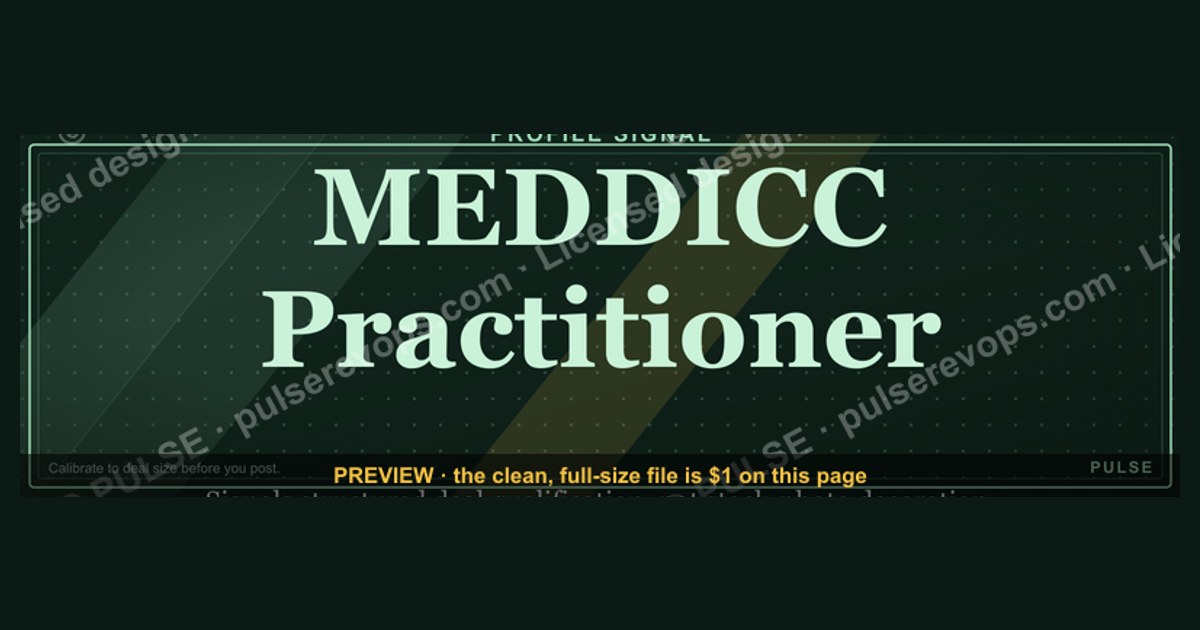

A MEDDICC Practitioner credential banner is a display graphic — typically 1584×396 for LinkedIn — that signals you have completed practitioner-level training in the MEDDICC qualification framework. The banner is artwork only; cost, assessment format, and renewal terms belong to the issuing program, so confirm current details directly with MEDDICC or your authorized training partner.
The outcome you should expect from displaying the credential
The honest outcome of putting a MEDDICC Practitioner banner on your profile is a modest, compounding signaling effect — not a step-change in inbound recruiter volume. What the banner actually does is compress an explanation. A hiring manager, a partner, or a prospect's procurement lead scanning your profile for four seconds does not read your experience bullets closely. They read the header image, the headline, and the first line of your most recent role. A credential banner occupies the single largest visual real-estate block on a LinkedIn profile, and it converts that block from decorative stock photography into a claim: this person qualifies deals with a named, structured method.
That matters more in some contexts than others. If you sell six-figure enterprise software into buying committees of eight to fifteen people, MEDDICC is a language your counterparts already speak, and the banner reads as fluency. If you sell $4,000 annual subscriptions in a two-call cycle, the same banner reads as overhead — process theater applied to a deal that never needed it. Calibrate before you commit the header slot.

Be specific about what you should and should not expect. You should expect the credential to function as a tiebreaker in a shortlist of three to five candidates who all cleared the quota-attainment bar. You should expect it to shorten the "how do you qualify?" portion of an interview, because the interviewer can skip the definition and go straight to application. You should expect it to help in enablement, RevOps, and sales-management searches disproportionately, because those roles are explicitly about installing and coaching a qualification language across a team rather than personally closing.
You should not expect it to substitute for numbers. Every experienced sales leader has interviewed someone who could recite all seven letters — Metrics, Economic Buyer, Decision Criteria, Decision Process, Identify Pain, Champion, Competition — and could not describe a single deal where identifying the economic buyer late had cost them a quarter. The credential creates an expectation of applied depth; if you cannot meet that expectation in the next ten minutes of conversation, the banner has actively hurt you. This is the asymmetry worth internalizing: a credential you can defend is a small positive, and a credential you cannot defend is a meaningful negative.
There is also a downstream effect people underweight. Displaying a methodology credential publicly changes how your own team treats you. Colleagues start routing qualification questions to you. Managers start asking you to review other reps' deal reviews. That is an unpaid coaching load if you are an individual contributor, and it is a promotion pathway if you handle it well. Decide which one you want before you make the claim visible, because the requests arrive either way.
What drives that outcome

The banner's effect is not really about the badge. It is about a chain of inferences the viewer makes, and each link in that chain can break independently. Understanding the chain tells you where to spend effort.
The first link is recognition. The viewer has to know what MEDDICC is. In North American and Western European enterprise SaaS, cybersecurity, data infrastructure, and IT services, recognition is high — MEDDICC or one of its variants (MEDDIC without the second C, MEDDPICC with Paper Process added) is often the installed qualification standard. Outside those segments, recognition drops sharply, and in markets where Challenger, SPIN, or a homegrown stage-gate model dominates, a MEDDICC banner is simply noise. If your target market does not recognize the framework, the banner is spending your most valuable profile real estate on a message nobody decodes.
The second link is credibility of the issuer. MEDDICC as an organization, and its authorized training partners, issue the training and any practitioner-level credential. The framework itself traces to Parametric Technology Corporation's sales practice in the 1990s and was later codified and popularized in book form. A banner that names its issuer clearly and links to a verification page is credible. A banner that just says "MEDDICC Certified" with no issuer, no date, and no verification path invites the reasonable question of who certified you. Include the issuer and, if your program provides one, a credential ID or verification URL.

The third link is applied evidence, and it is the one most people skip. The banner makes a claim; your experience section either substantiates it or leaves it dangling. Substantiation looks like tying the framework to your own outcomes: how many opportunities you ran through a structured qualification pass, what happened to your slipped-deal rate, what your close-rate on stage-3-and-beyond opportunities looked like before and after. Use your real numbers. Fabricated benchmarks are trivially caught in a reference check and end the conversation.
The fourth link is consistency across surfaces. A credential banner on LinkedIn, an email signature line, a slide in your interview deck, and a line in your CV should all say the same thing with the same issuer name and the same credential title. Inconsistency reads as either carelessness or inflation.
Benchmarks and realistic ranges
Published, verifiable numbers on MEDDICC credential pricing, pass rates, and career impact are thin, and you should be suspicious of any page that presents precise figures for them. Issuers set their own pricing and generally bundle practitioner credentials with training, coaching, or enterprise licensing, which means a single published price rarely exists. The useful ranges here are the ones you can derive from your own environment rather than from a vendor page.

Start with time investment, which you can estimate honestly. Foundational MEDDICC training — a masterclass-style course or an equivalent partner program — is typically consumed over days rather than months. Practitioner-level preparation is where the real hours go, because you are assembling evidence rather than absorbing content. Budget time for three distinct workstreams: documenting one or two real deals in full MEDDICC detail, rehearsing how you would talk an evaluator through a complex qualification, and building the competitive and pain analysis you probably never wrote down formally. Practitioners who have run structured deal reviews for a year find this fast. Practitioners who have been filling CRM fields perfunctorily find it slow, because the exercise exposes how little of the framework they were actually using.
For the banner artifact itself, the technical specifications are fixed by platform rather than by issuer. LinkedIn personal profile background images render at 1584×396 pixels, a 4:1 ratio. LinkedIn crops aggressively on mobile and overlays your profile photo on the lower-left region, so any text or logo placed in the left third of a banner will be partially obscured on phones. Design or select accordingly: keep the credential title and issuer mark in the center-right, keep contrast high, and check the result on a phone before you commit. An SVG source scales cleanly to any output size and re-exports to PNG without artifacts, which is why vector banners are worth preferring over raster ones — you can drop the same file into a slide deck, a one-pager, or a conference badge without regenerating it.
On career impact, the range worth stating is directional rather than numeric. The credential's marginal value rises with average contract value, with the number of stakeholders in a typical deal, and with the length of the sales cycle. It falls toward zero in high-velocity, single-decision-maker motions. In enablement and RevOps hiring specifically, methodology credentials tend to matter more than they do for pure closing roles, because the job is literally to standardize how a team qualifies. A reasonable expectation: it helps you get read, it does not get you hired, and it never outweighs a documented record of hitting number.

One more range worth calibrating: how much of your qualification discipline should be visible externally at all. Some sellers put the framework in their headline, the banner in their header, and a MEDDICC reference in every experience bullet. That is overexposure — it signals that the methodology is the product rather than the practice. A banner plus one or two outcome-linked bullets is the right density.
Risks, edge cases, and failure modes
The most common failure mode is the checklist trap. A practitioner fills the CRM fields — Metrics: "increase revenue." Economic Buyer: "VP Sales." Champion: "Dana." — and considers the deal qualified. None of those entries is evidence. "Increase revenue" is not a metric; "reduce support ticket volume from roughly 4,000 per month to under 2,500 within two quarters, worth about 3.5 headcount of deflected cost" is a metric. Naming a VP is not identifying an economic buyer; confirming that this specific person controls the budget line the purchase draws from, and that no committee sits above them for this size of spend, is identifying an economic buyer. Naming a contact is not identifying a champion; a champion has taken a risk on your behalf — got you a meeting they were not required to get you, forwarded your business case internally, told you something inconvenient about a competitor. If you cannot point to an action, you do not have a champion, you have a friendly contact.
The second failure mode is treating Competition as a late-stage concern. Practitioners frequently do deep work on the first several elements and then write "none" or a single competitor name in the last slot. Real competition in enterprise deals is usually not a named rival. It is the status quo, an internal build, a competing budget request from another department, and the possibility that the whole initiative gets deferred a quarter. A qualification pass that does not name and handicap those four is incomplete, and evaluators notice.

Third: underweighting Identify Pain. Surface pain — "our reporting is slow" — is a symptom. The business consequence beneath it — the CFO cannot close the books on schedule, or the board has asked for forecast accuracy the current stack cannot produce — is what funds a purchase. The chain from stated pain to business consequence to the metric that measures it to the executive who owns that metric is the spine of the whole framework. Practitioners who can trace that chain out loud, on a real deal, pass assessments. Practitioners who recite definitions do not.
Fourth: credential inflation and misrepresentation. Do not describe yourself as certified by an organization that did not certify you. Do not use a program's marks in a way its terms do not permit. Do not display a lapsed credential as current. These sound obvious, and they are still the fastest way to turn a small positive into a disqualifying one. If your issuer treats the credential as durable with no expiry, say so accurately; if it recommends periodic recertification, either recertify or state the date you earned it and let the viewer judge.
Fifth, an edge case worth planning for: what happens when you change companies into an org that uses a different methodology. Arriving at a Challenger shop with a MEDDICC banner and evangelizing your old framework in week two is a reliable way to be read as inflexible. The mature move is to treat MEDDICC as a diagnostic lens you apply privately and to speak the house language publicly. The frameworks are not mutually exclusive — MEDDICC tells you whether a deal is real and who controls it, while Challenger and SPIN are largely about how you run the conversation. A practitioner who can hold both is more valuable than one who defends a single acronym.

Sixth: the internal-politics risk. Publicly credentialing yourself in the methodology your manager owns can read as a bid for their coaching authority. Usually it does not, but if your sales leader is territorial about enablement, mention the credential to them before it appears on your profile. The cost of a two-minute heads-up is zero and the cost of the alternative occasionally is not.
A practical rollout plan
Treat the credential and its banner as a small project with a sequence, not a single upload. The order matters because each step makes the next one defensible.
Begin with an honest audit of your own deal hygiene. Pull your last ten to fifteen closed opportunities, won and lost, and write a full MEDDICC pass on three of them from memory and CRM records. You will immediately discover which elements you actually work and which you have been leaving blank. Most practitioners find Decision Process and Competition are the thin ones. This audit is both your assessment preparation and your honest answer to whether you need the credential or already operate at practitioner level.
Next, confirm the program details with the issuer directly rather than from third-party summaries. Prerequisites, assessment format, pricing, retake policy, and renewal terms are all set by the issuing organization and change over time. Ask specifically: what does the assessment consist of, is deal documentation required, is there a live scenario component, what happens if I do not pass, and does the credential expire. Get the answers in writing before you pay.

Then prepare against the actual format. If deal documentation is required, write it on a real opportunity with real figures, redacting the account name if needed. Include the metric with a baseline and a timeframe, the economic buyer with evidence of budget authority, the decision criteria in the customer's words rather than your feature list, the decision process with named steps and dates, the pain traced to a business consequence, the champion with a documented action they took for you, and the competitive field including status quo and internal build. If a scenario or role-play is required, rehearse the trace out loud — someone who has said it three times sounds like a practitioner and someone reading it for the first time does not.
Once the credential is issued, do the display work deliberately. Add it under Licenses and Certifications with the issuer name and issue date. Place the banner in the LinkedIn header, checked on mobile. Add one line to your email signature if your company permits it. Then — the step most people skip — rewrite two experience bullets to substantiate the claim with your own numbers, so the banner and the evidence are visible in the same scroll.
Finally, decide how you will keep it live. Set a calendar reminder at whatever interval your issuer recommends for recertification, or at twelve months if they say the credential does not expire, simply to re-check that your displayed claim still matches their current terms. Programs rebrand, credential titles change, and a banner that names a discontinued credential level is worse than no banner.
Related questions
Where should the credential banner appear besides LinkedIn?
An email signature line, the closing slide of a first-call deck, a conference speaker bio, and a personal site are all reasonable. Keep the issuer name consistent across all of them. Avoid putting it inside customer-facing proposals, where it reads as self-promotion rather than qualification.
Does the banner need to be SVG rather than PNG?

No, but SVG is easier to live with. A vector file scales to any output — profile header, slide, print — without softening, and re-exports to PNG on demand. If you only ever need one 1584×396 raster, a high-quality PNG is fine.
Should a sales manager require the credential for their team?
Rarely as a hiring gate; often as an enablement investment. Requiring a credential filters out capable sellers who learned qualification elsewhere. Funding the training for an existing team, then inspecting deals in that shared language, produces better returns than a hiring requirement.
How is MEDDICC different from MEDDIC and MEDDPICC?
MEDDIC is the original six elements. MEDDICC adds Competition. MEDDPICC adds Paper Process — the contracting, legal, and procurement path — as its own tracked element. Credential titles vary by issuer, so match your banner text to whichever variant you were actually assessed on.
FAQ
What exactly is a MEDDICC Practitioner credential banner? It is a display graphic that signals you have completed practitioner-level training in the MEDDICC qualification framework. The banner is artwork — usually sized 1584×396 for a LinkedIn profile header — and it carries no independent authority. Its meaning comes entirely from the underlying credential issued by MEDDICC or an authorized training partner.
How do I earn the practitioner-level credential?

You generally complete foundational MEDDICC training and then pass a practitioner assessment that goes beyond a quiz — commonly some combination of documented deal analysis, a scenario or role-play, and applied questioning. Requirements are set by the issuing program and vary between providers, so confirm the format with your issuer before enrolling.
Does the MEDDICC Practitioner credential expire? There is no universal rule. Renewal policy is set by the issuer: some treat it as a durable badge with no fixed expiration date, and others recommend periodic recertification so holders stay current as materials evolve. Check your specific program's terms and display your issue date accurately either way.
What does it cost? Pricing is set by the issuer and frequently bundled with training, coaching, or an enterprise agreement, so no single published figure applies across providers. Check the issuer's current pricing directly. The bigger cost for most people is preparation time spent documenting real deals to assessment standard.
Can I display the banner if I am between roles or not in a closing role? Yes. The credential attaches to you rather than to an employer, so it remains yours while it is active — whether you are job searching, in revenue operations, in customer success, or in sales enablement. Enablement and RevOps professionals often get more mileage from it than individual closers do.
Will the credential improve my win rate? Not by itself. The framework can improve qualification consistency, which tends to reduce late-stage slippage and time spent on deals that were never going to close. Actual results depend on your market, your deal complexity, and whether you apply the framework as a diagnostic rather than a form-filling exercise.
Sources
- https://meddicc.com/ — official MEDDICC site covering the framework, training programs, and credentials.
- https://www.linkedin.com/help/linkedin/answer/a563309 — LinkedIn help documentation on profile photo and background image requirements.
- https://blog.hubspot.com/sales/meddic — HubSpot Sales Blog explainer on MEDDIC/MEDDICC qualification.
- https://www.salesforce.com/resources/articles/sales-process/ — Salesforce guidance on structuring an enterprise sales process.
- https://www.gartner.com/en/sales — Gartner research on B2B buying complexity and sales effectiveness.
- https://hbr.org/topic/subject/sales — Harvard Business Review collection on sales management and qualification discipline.
- https://www.linkedin.com/learning/ — LinkedIn Learning courses covering B2B sales methodologies including MEDDIC.
- https://developer.mozilla.org/en-US/docs/Web/SVG — MDN reference on SVG, the vector format used for scalable banner artwork.
Related on PULSE
This page will be disappearing soon. Save it to your device for $1 — or read it free while it is here.
@Kory-White- · if Venmo asks, the last 4 of my number are 2012
This page is gone.
This one is off the shelf now. $1 keeps it on your phone for good — the whole page, pictures and diagrams included.
 graphic“Trust compounds. So does pipeline.” — Quote Card
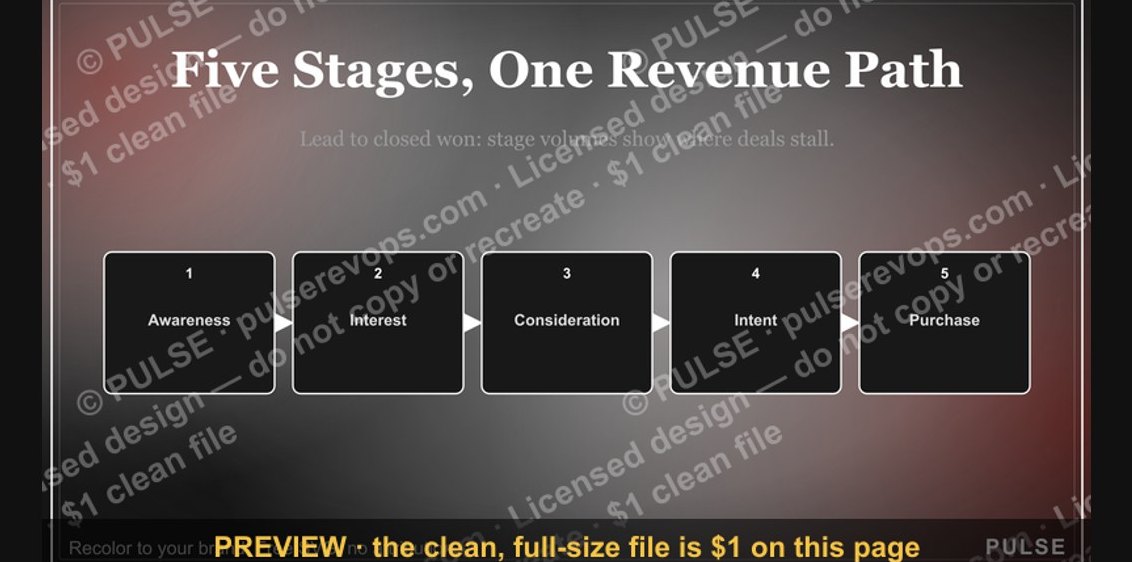 graphicSales Funnel — 5 Stages
 graphicGTM Engineer — LinkedIn Banner
 graphic“TIME TO DO IT AGAIN” — Sales Meme
 graphicIndustrial Robotics CRO — LinkedIn Banner
 graphic“Sell the problem, not the product.” — LinkedIn Banner
 graphic“Every no is closer to a yes.” — Quote Card
 graphicLead Routing Logic Diagram
 graphic"Build, don't chase." — LinkedIn Banner
 graphicDeal Inspection Flow