


The Power of a Positive No by William Ury — Cliff Notes Summary
Quality
Certified
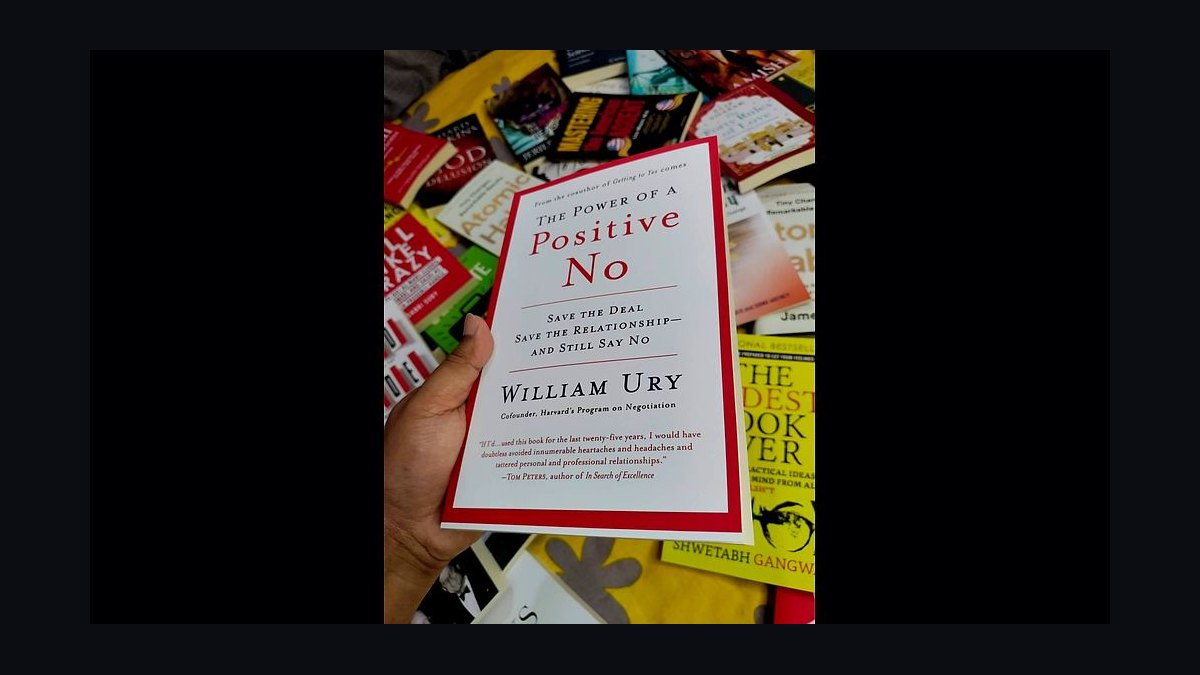
*The Power of a Positive No* by William Ury (Bantam, 2007) teaches a three-step refusal — Yes! (affirm your underlying interest), No. (state the limit plainly), Yes? (offer a workable alternative) — so you protect your economics without burning the counterparty. This Summary maps that Power into a practical negotiation strategy for holding price and walking from bad-fit deals.
The two refusals compared: accommodation-by-default versus the structured Positive No
Most revenue teams already have a de facto answer to hard asks, and it is rarely written down anywhere. Option one is the incumbent: accommodation-by-default. A buyer asks for 25% off, the rep escalates to a manager, the manager escalates to deal desk, and somewhere in that chain the discount lands at 18% with a couple of thrown-in services. Nobody calls this a strategy. Everyone treats it as the cost of doing business in Q4. Option two is the one William Ury is arguing for: a deliberate, rehearsed, structured refusal that names what you are protecting, states the limit without hedging, and hands the buyer a path forward that does not cost you the same money.
The difference is not politeness. Both options can sound perfectly friendly on a call recording. The difference is where the boundary lives. Under accommodation-by-default, the boundary lives at the end of a negotiation — it is wherever the buyer stops pushing. Under the Positive No, the boundary is established before the conversation starts and the negotiation happens in the space *around* it: term length, payment timing, scope, success criteria, reference rights, expansion triggers. The buyer still gets movement. They just get movement on axes that do not gut the unit economics.

Ury names three ways the first option goes wrong, and they are worth memorizing because they are the diagnostic vocabulary for any deal review. Accommodation is the cave — you say Yes when you mean No, believing you are protecting the relationship. Attack is the burn — you finally snap, deliver the No with contempt, and lose the deal, the renewal, and the referral in one sentence. Avoidance is the ghost — you say nothing at all, and the opportunity sits in "Negotiation" stage for ninety days while both sides wait for the other to deliver the hard message. Attack is not the opposite of the cave; it is the cave's shadow. The rep who explodes in week eleven is almost always the rep who accommodated for the first ten.
There is a fourth comparison worth drawing, because it explains why so many teams reach for the wrong tool. Jim Camp's *Start with No* argues that No is the opening move — you invite the counterparty to refuse, because a fast No is more useful than a slow maybe. Ury's Positive No is not that. It is a *closing* move, deployed when a specific ask has landed and you must respond to it. Camp's is a posture for the whole engagement; Ury's is a sentence structure for a single moment. Teams that adopt Camp's language without Ury's structure end up with reps who sound combative early and cave late — the worst of both.
How to decide between them, ask by ask

The choice is not made once at the org level. It is made ask by ask, and the deciding variable is almost always the strength of your alternative. Ury's reframing of BATNA — Best Alternative To a Negotiated Agreement, the concept he built with Roger Fisher in *Getting to Yes* — is the load-bearing idea here: your No is only as strong as what you will do if the deal dies. A rep whose entire quarter depends on this one logo does not have a Positive No available to them. They have theater, and experienced procurement recognizes theater inside one exchange.
So the practical decision rule runs in this order. First, is the ask actually damaging, or does it only feel damaging? A request to move from net-30 to net-45 on a $60K deal costs you roughly fifteen days of float — real, but small. A request for 30% off in perpetuity resets the renewal baseline forever. Those deserve different responses; treating both as existential is how reps burn credibility on the cheap ask and have none left for the expensive one. Second, do you have a live alternative — another deal on the same forecast week, a pipeline that survives this loss, a champion elsewhere in the account? Third, is there a non-price axis you can genuinely move on? If yes, you have a Yes? to offer and the full structure works. If no, you are down to a bare No, and you should know that going in rather than discovering it mid-sentence.
The diagram makes something explicit that most training skips: the weak-BATNA branch is not a failure of nerve, it is a pipeline problem wearing a negotiation costume. No script fixes it. If a rep is carrying a single deal that must close, the intervention belongs eight weeks upstream in prospecting coverage, not in the room. Ury is honest about this — the preparation chapters are longer than the delivery chapters for exactly this reason.

One more decision input that the 2007 text could not have anticipated: the channel. A Positive No delivered by voice carries tone, pacing, and the ability to pause. The same words in an RFP portal field or a procurement platform's structured response box arrive stripped of all of that. Written refusals need the Yes! and the Yes? to do more work, because there is no warmth in the delivery to soften the middle. Practically, that means the written version runs longer, leads with the affirmation more explicitly, and always closes with a dated, concrete alternative rather than an open invitation to discuss.
Concrete numbers behind each option
Put arithmetic on it, because the case for the structured refusal is mostly economic and reps respond to economics more than to philosophy. Take a straightforward software deal: $100,000 annual contract value, 78% gross margin, a three-year expected life with modest expansion. Under accommodation-by-default, the buyer opens at 30% off and lands at 18% after two escalations. That is $18,000 gone in year one. But list price is rarely re-established at renewal, so year two and year three renew off $82,000, and any expansion prices off that same reduced baseline. Across three years the discount compounds to well over $54,000 of contracted revenue, before you count the expansion that would have priced off the higher number.
Now run the Positive No version on the same deal. You hold list, and instead of price you move on axes that cost less: a three-year term with escalators capped at a published index, a 90-day paid pilot at full rate with a defined success metric, quarterly business reviews written into the agreement, and named reference rights. The buyer's procurement contact still walks back to their boss with wins — longer-term price certainty, a de-risked start, contractual accountability. The cost to you is real but bounded: some deferred revenue recognition on the pilot structure, some services time on the QBRs. The revenue base stays at $100,000.
The trade you are making is time, and it is worth naming honestly rather than pretending the structured route is free. A held-price negotiation typically runs longer than a caved one — extra cycles, another meeting or two, occasionally a deal that slips a quarter. Some percentage of deals genuinely die because you would not move on price, and any team adopting this should expect that number to be non-zero. The bet is that the margin held across the deals that close exceeds the margin lost on the deals that walk. That bet is usually favorable at high gross margin and gets worse as margin thins, which is why this framework travels better in software than in distribution or contract manufacturing, where a point of price is a much larger share of the profit and the walk-away math flips.
Two other numbers worth tracking, because they tell you whether the practice is actually taking hold. First, discount dispersion: if two reps selling the same product to similar-sized buyers land at 5% and 22%, the variance is a training gap, not a market signal. Tightening dispersion is usually a bigger margin win than moving the average. Second, stage-age in Negotiation. Ury's Avoidance trap shows up in CRM as deals aging in late stage without activity. A team practicing structured refusal should see late-stage age *fall*, because the hard message gets delivered on week two instead of never. If your average days-in-negotiation is climbing while your win rate holds flat, you have a ghosting problem, and the fix is a script for the conversation people are dreading.
Ury's preparation discipline has a measurable footprint too. He asks for three questions answered in writing before the conversation: What am I saying Yes to? What am I saying No to? What alternative am I prepared to offer? That is maybe ten minutes of work per deal. On a rep carrying twelve late-stage opportunities a quarter, it is two hours. Against a five-figure margin swing on a single deal, the return on those two hours is not a close call — and skipping the writing step is, in Ury's account and in most sales managers' experience, the single most reliable predictor that the refusal collapses under the first push.
Implementation details and sequencing
Rolling this out has a natural order, and teams that skip steps usually fail at the same place: they train the script before they have fixed the authority structure, so reps deliver a confident No that a manager overturns forty minutes later. Do that twice and the framework is dead — the buyer learns that the rep's No is a speed bump and starts routing around it immediately.
Start with the authority map. Write down, explicitly, what each role can concede without approval: rep, manager, deal desk, VP. Publish it. The point is not control for its own sake; it is that a rep who knows precisely where their line sits can say "I can't do that" as a statement of fact rather than a bluff, and buyers hear the difference. Ambiguous authority produces hedged refusals, and hedging is what invites the second push.
Second, build the alternatives menu before anyone needs it. This is the Yes? inventory: term-length swaps, payment timing, pilot structures, ramped commitments, scope trades, reference or case-study rights, and — critically — the price of each in margin terms. When a rep has to invent the alternative live on a call, they invent it badly and usually give away more than the discount would have cost. A pre-priced menu turns the third step from improvisation into selection.

Third, rehearse the bridge statement. Ury's term for the sentence that carries you from the No to the Yes?: *"What I can offer instead is…"* or *"Here's a path that works on both sides…"* It sounds trivial written down. Said out loud, cold, for the first time, under pressure from a buyer who is clearly annoyed, it is not trivial at all. Reps freeze in the gap between the refusal and the alternative, and the freeze is what the buyer reads as weakness. Rehearsing it aloud — actual voice, not silent reading — is the whole intervention.
Fourth, script the hold. The hardest moment in the framework is not the first refusal; it is the third. Ury's prescription is to repeat the Positive No with different words and identical substance, sometimes three or four times in one conversation. Reps interpret repetition as rudeness and drift toward a concession to break the tension. Naming this in advance — "you will say this three times, that is normal, that is the job" — removes most of the drift.
The loop back from review to the menu matters. The alternatives inventory is not static — you learn which trades buyers actually accept and which ones they wave off, and you reprice accordingly. A pilot structure that three consecutive buyers rejected is not an alternative, it is a stalling tactic they can see through.
Sequencing across roles: managers go first. If a manager cannot deliver a Positive No to their own rep — refusing a bad discount request internally, with the same three-step structure — the reps will never believe it works externally. Internal refusal is also lower-stakes practice. The same shape works on the request to take on a doomed pilot, the ask to add unstaffed scope, the peer who wants your engineer for a week: affirm the shared goal, refuse the specific thing, propose the version you can actually deliver.
Where the framework strains, and what has changed since 2007

Ury wrote for face-to-face and telephone negotiation, and the assumptions show. He assumes a counterparty who is a person, who is present, who has a stake in the relationship continuing, and who can hear tone. A meaningful share of modern enterprise procurement satisfies none of those. Structured RFP portals, reverse auctions, and automated bid platforms strip the channel down to fields in a form. There is no warmth to carry the No, no pause to let the alternative land, and often no identified human on the other end to build a relationship with. The three-step structure still applies to the *content* of the response, but the relationship-preservation work has to happen somewhere else in the account — with the economic buyer, the champion, the eventual user — because it cannot happen in the portal.
Product-led growth moves the boundary too. When pricing tiers are published on a website and enforced by the product itself, the Positive No has been pre-delivered by the pricing page. The seller's job shifts from refusing a discount to defending the enterprise-tier line when a buyer with 400 self-serve seats argues they should pay the self-serve rate at scale. That is a different conversation than the one Ury scripts, and the underlying Yes is different as well — you are protecting the coherence of the pricing model across thousands of accounts, not the margin on one deal. Interestingly, that makes the No easier to hold and harder to explain: "our pricing works this way for everyone" is credible but can read as bureaucratic, so the Yes? has to carry more weight than usual.
The framework also strains in genuinely asymmetric relationships. Ury's model presumes both parties have something to lose. A very large buyer negotiating with a small supplier who depends on them for a third of revenue is not in that world. The supplier's BATNA is weak in a way no script repairs, and pretending otherwise produces reps who deliver brave refusals that get overruled the moment the buyer escalates. The honest counsel in that situation is upstream: diversify the revenue base until the No becomes credible. Ury would not disagree — his entire preparation section is an argument that the alternative *is* the power.

What holds up remarkably well is the diagnostic vocabulary. Cave, burn, ghost are the right three categories, and they map cleanly onto what conversation-analysis tooling now surfaces automatically from call recordings. The three preparation questions hold up. The insistence that a refusal be short, specific, and unhedged holds up. And the central claim — that a cowardly Yes is ruder than an honest No, because it sets up a breakdown later when the over-promise comes due — holds up across sales, management, clinical practice, and diplomacy alike. Twenty years on, that is a good survival rate for a business book.
Read alongside it: *Getting to Yes* for the principled-negotiation foundation and BATNA, *Getting Past No* for the hostile counterparty, and Chris Voss's *Never Split the Difference* for the tactical-empathy layer that operationalizes Ury's respect-based posture in modern sales language. They compose rather than compete.
Related questions
Is a Positive No just a softened Yes?
No. The middle step is a genuine refusal of the specific ask. The surrounding affirmation and alternative are strategic context, not softeners. Strip the No and you have accommodation; strip the framing and you have an attack. Both fail, in opposite directions.
When should a seller actually walk away?
When the buyer rejects your alternative and your next-best opportunity beats the proposed terms. Never announce a walk-away you will not execute — procurement identifies bluffs within a cycle and prices accordingly for the rest of the relationship, including at renewal.
How does this fit with MEDDPICC-style qualification?
Qualification frameworks tell you whether the deal is real and who decides. Value frameworks tell you how to frame worth. The Positive No is what you reach for in the negotiation phase specifically, when a damaging ask has landed and you need a response.
Does the framework work internally, not just with buyers?
Yes, and internal practice is the better place to start. Refusing unstaffed scope, doomed pilots, or a peer's resource request uses the identical structure at lower stakes, and managers who can do it internally are far more credible teaching it.
What is the fastest way to start using it this week?
Take every deal in late stage and answer three questions in writing: what you are saying Yes to, what you are saying No to, what alternative you can offer. Ten minutes each. That single habit is most of the book's practical value.
FAQ
**How is this different from *Getting to Yes*?**
*Getting to Yes* (Fisher and Ury, 1981) laid out principled negotiation broadly: separate people from problem, focus on interests over positions, generate options for mutual gain, use objective criteria. *The Power of a Positive No* is narrower and considerably deeper on one moment — the refusal itself. Read the earlier book for the architecture of a negotiation and this one for the operational handbook on the hardest sentence in it.
Does it work against a hostile counterparty?
Yes, with adjustments. Ury's *Getting Past No* addresses the hostile case directly, and the two books are designed to be read together. Practically, the preparation phase grows — more alternative development, more rehearsal — and the delivery slows down. You repeat the substance more times, you stay flatter in tone, and you avoid matching their escalation. Tactical empathy is the modern complement here.

What if my manager overrides my refusal?
Then the problem is the authority map, not your delivery. Fix it before running any training: publish exactly what each role can concede without approval. A refusal that gets overturned an hour later teaches the buyer to route around the rep permanently, which is worse than never having refused at all.
Is the book worth reading, or is a summary enough?
The framework compresses well — three steps, three traps, three preparation questions. What does not compress is the case material drawn from Ury's diplomatic and mediation work, which is what makes the structure stick under pressure. Read the summary to get operational this week; read the book if you want the framework to survive the moment a buyer gets genuinely aggressive.
Does this apply outside sales?
Broadly. Ury wrote it for parents, physicians, managers, and diplomats as much as for negotiators. Any situation where refusing feels like it will damage a relationship you need to keep is in scope. The sales application is just the one with the clearest arithmetic attached, which is why it travels so well in revenue organizations.
How long before a team sees results?
Expect a quarter. The first weeks are usually worse — reps deliver the structure stiffly and some deals stall while everyone adjusts. The signals to watch are narrowing discount dispersion across reps and falling late-stage deal age. Average discount moves last, because the deals already in flight were negotiated under the old assumptions.
Sources
- https://www.williamury.com/books/the-power-of-a-positive-no/
- https://www.pon.harvard.edu/daily/negotiation-skills-daily/the-power-of-a-positive-no/
- https://www.pon.harvard.edu/tag/batna/
- https://www.penguinrandomhouse.com/books/168703/the-power-of-a-positive-no-by-william-ury/
- https://www.ted.com/talks/william_ury_the_walk_from_no_to_yes
- https://hbr.org/2004/04/getting-past-yes-negotiating-as-if-implementation-mattered
- https://www.pon.harvard.edu/daily/batna/translate-your-batna-to-the-current-negotiation/
- https://en.wikipedia.org/wiki/Getting_to_Yes
- https://www.harpercollins.com/products/never-split-the-difference-chris-voss
Related on PULSE
- Start with No by Jim Camp: Summary, Key Lessons, and RevOps Takeaways
- Getting to Yes by Fisher, Ury & Patton — Cliff Notes Summary
- ProActive Selling by William Miller — Cliff Notes Summary
- The Power of Habit by Charles Duhigg — Cliff Notes Summary for Sellers
- Power Listening by Bernard Ferrari — Cliff Notes Summary
- Outbounding by William Miller — Cliff Notes Summary
This page will be disappearing soon. Save it to your device for $1 — or read it free while it is here.
@Kory-White- · if Venmo asks, the last 4 of my number are 2012
This page is gone.
This one is off the shelf now. $1 keeps it on your phone for good — the whole page, pictures and diagrams included.
 pulse-recentStart with No by Jim Camp — Top 10 Key Takeaways for Sales Leaders in 2027
 pulse-recentStrategic Selling by Robert Miller and Stephen Heiman — Top 10 Key Takeaways for Sales Leaders in 2027
 pulse-recent$100M Offers by Alex Hormozi — Top 10 Key Takeaways for Sales Leaders in 2027
 pulse-recentThe Transparency Sale by Todd Caponi — Top 10 Key Takeaways for Sales Leaders in 2027
 pulse-recentMonetizing Innovation by Madhavan Ramanujam — Top 10 Key Takeaways for Sales Leaders in 2027
 pulse-recentWhat are the seven concrete steps to implement the Sandler Submarine technique from The Sandler Rules in 2027?
 pulse-booksTop 10 practical takeaways from Atomic Habits for building a new routine in 2027.
 pulse-recentHow I Raised Myself from Failure to Success in Selling by Frank Bettger — Top 10 Key Takeaways for Sales Leaders in 2027
 pulse-recentWhat is the Blue Sheet from Strategic Selling by Miller Heiman and how do you fill it out in 2027?
 pulse-recentBlueprints for a SaaS Sales Organization by Jacco van der Kooij — Top 10 Key Takeaways for Sales Leaders in 2027