


The ONE Thing by Gary Keller — Cliff Notes Summary for Sellers
Quality
Certified
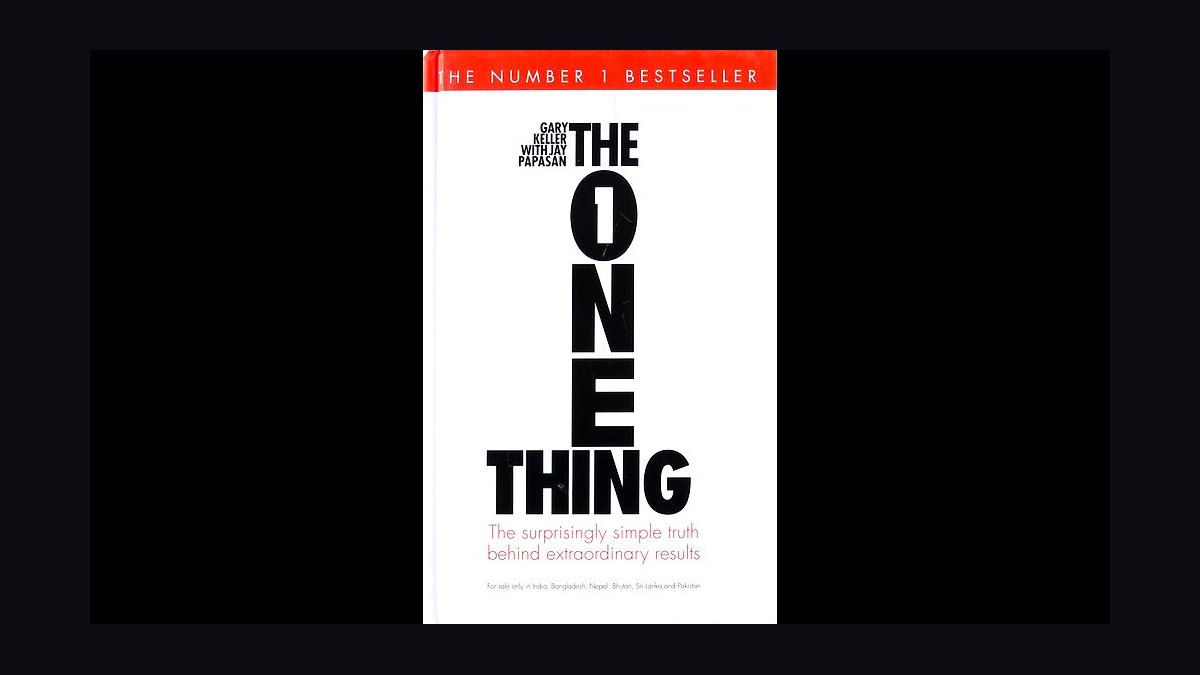
*The ONE Thing* by Gary Keller and Jay Papasan (2013) argues extraordinary results come from ruthlessly answering one question: "What's the ONE Thing I can do such that by doing it everything else will be easier or unnecessary?" For sellers, the operating instruction is concrete — identify today's highest-leverage deal action and protect a four-hour block for it before touching email.
What the book actually is and why sellers keep coming back to it
*The ONE Thing: The Surprisingly Simple Truth Behind Extraordinary Results* runs nineteen chapters across three parts and was published by Bard Press in 2013. Gary Keller wrote it as the founder of Keller Williams Realty — a brokerage that scaled past 200,000 agents — with Jay Papasan, his co-author on *The Millionaire Real Estate Agent* (2004). That lineage matters more than it looks. This is not a book written by a productivity researcher observing knowledge workers from a distance; it is a book written by someone who ran a commission-carrying sales floor and needed a framework that survived contact with people whose income depended on this quarter.
The structural argument is simple enough to state in a sentence and hard enough to live that it fills a book. Part One dismantles six beliefs Keller calls "the lies" — everything matters equally, multitasking works, success requires a disciplined life, willpower is always on call, a balanced life is achievable, and big is bad. Part Two replaces them with a single tool, the Focusing Question. Part Three converts the tool into a daily operating system: goal-setting to the now, four-hour time blocking, three commitments, and four thieves that steal the block.
Why this specific Summary matters for Sellers rather than generic knowledge workers: the seller's day is structurally hostile to focus in ways a marketer's or an engineer's is not. Inbound replies arrive on the prospect's schedule, not yours. Slack pings from solutions engineering, legal, and deal desk all carry implied urgency. The CRM presents 40 open opportunities as a flat list with equal visual weight, which is the "everything matters equally" lie rendered as software. A rep who opens the day inside that interface has already outsourced prioritization to whatever sorted to the top.

Keller's counter is a strategy of pre-decision. You do not decide what matters at 8:45 a.m. with a full inbox in front of you. You decided last quarter, and the quarter decided the month, and the month decided the week, and the week hands you today's answer before you sit down. The Thing you do first is not chosen in the moment — it is inherited from a chain you built when you had perspective.
The book sits inside a recognizable canon. Stephen Covey's Quadrant 2 (*The 7 Habits of Highly Effective People*, 1989) made the same important-versus-urgent distinction two decades earlier. Greg McKeown's *Essentialism* (2014) and Cal Newport's *Deep Work* (2016) arrived after and extended the argument rather than refuting it. What separates Keller's version is the operational specificity: a scripted question with exact wording, a numeric block length, a stated habit horizon, and a named list of failure modes. It is closer to a runbook than an essay, which is why it circulates on sales floors where Covey often does not.
The step-by-step process, from Someday goal to this morning's block
Keller's system is a backward chain he calls Goal Setting to the Now. You start at the horizon and compress until you arrive at a single action available in the next hour. Written out for a quota-carrying seller, the chain runs like this.

Step one — write the Someday goal. Not the quota. The career-scale outcome: run a team, hit a compensation number, move into enterprise, found something. This is Chapter 13's "Live with Purpose," and Keller leans on Viktor Frankl's argument that meaning is chosen rather than discovered. The practical function of the Someday goal is gravity — without it, the daily ONE Thing is arbitrary and dies within two weeks.
Step two — derive the five-year and one-year goals. Ask what would have to be true in five years for the Someday goal to be plausible, then what would have to be true in twelve months for the five-year to be plausible. For a mid-market AE targeting enterprise, the five-year might be "carry a $2M enterprise number" and the one-year "close three deals above $250K to build the résumé."
Step three — compress to the month and the week. The one-year goal names what this month must produce. The month names the week. This is where the chain becomes falsifiable: if your annual goal requires three large deals and it is July with none closed, the weekly goal is not "keep prospecting" — it is a specific gap-closing action.
Step four — ask the Focusing Question for today. The exact wording matters and Keller is insistent about it. "What's the ONE Thing I can do such that by doing it everything else will be easier or unnecessary?" Two halves do two jobs: *easier* is leverage, *unnecessary* is elimination. "What can I do" forces an action rather than an aspiration. "Such that" forces a causal claim, not a coincidence.
Step five — write it down physically and block four hours. Chapter 19 is explicit: post the question where you see it, write today's answer on a sticky note, and put the block on the calendar before opening email. Chapter 15's instruction is four hours daily, scheduled first, defended like a medical appointment.

Step six — let everything else fit around the block. Email, internal meetings, Slack, CRM hygiene, and forecast updates go after. Keller's observation is that most people invert this exactly — they spend the high-willpower morning on reactive work and hunt for ONE Thing time at 4 p.m., when Roy Baumeister's ego-depletion research says the tank is empty.
For most sellers, step four collapses to the same answer nine mornings out of ten: advance the top deal. Not touch every deal — advance the single opportunity whose movement changes the quarter. Keller would call that the correct answer, not a boring one. The Focusing Question is supposed to produce a repetitive answer; repetition is evidence the chain is working, not evidence you stopped thinking.
Costs, timelines, and the numbers the book actually commits to
*The ONE Thing* is unusually willing to state numbers, which makes it testable in a way most productivity books are not. Here is what it commits to and what those commitments cost in practice.
Four hours per day on the block. This is the headline number and the most expensive one. Four hours of a working day is roughly half the available time before meetings, and for a seller with a customer-facing calendar it can be closer to two-thirds of the discretionary time. Reps who try to install it whole usually fail in the first week because standing internal meetings, pipeline reviews, and inbound demos already occupy the morning. The realistic path is staged: start at 90 minutes, hold it for two weeks, then extend to two hours, then three. The book's number is the target state, not the entry point.

Sixty-six days to install the habit. Keller cites Phillippa Lally's 2010 University College London research, which found habit automaticity formed at a median of around 66 days — and, importantly, with a very wide range across individuals and behaviors. The practical read: budget roughly a quarter, not three weeks. The popular 21-day figure has no basis in that research. For a seller on a quarterly cadence, this maps cleanly — the habit installs across one full quarter, which means the first quarter is the investment and the second is where the number moves.
Twenty-five minutes of recovery per interruption. Gloria Mark's work at UC Irvine on interrupted work produced the widely cited figure of roughly 23–25 minutes to return to an original task. Do the arithmetic on a rep who checks Slack every twenty minutes: there is no state in which deep work exists. This is the empirical backbone of Lie 2, multitasking. Keller pairs it with Clifford Nass and Eyal Ophir's Stanford research (PNAS, 2009) showing heavy media multitaskers performed *worse* on filtering and task-switching than light multitaskers — the counterintuitive finding being that practice at multitasking does not produce skill at it.
The 80/20 compression. Keller takes Pareto's distribution and applies it recursively: of the 20% that matters, 20% of that matters most, and you keep compressing until one item remains. On a 40-item to-do list that is eight items, then roughly two, then one. He calls the result a "success list" rather than a to-do list — ranked by impact, with only the top item protected.
The domino ratio. A standing domino can topple one roughly 1.5 times its size, and Keller runs the geometric progression out to make the point that 57 doublings reach the moon. The number is a metaphor, not a claim about your pipeline, but it does the work Keller needs: correctly sequenced small actions compound in a way that scattered large effort does not.
What it costs you. The honest trade-off Keller names in Chapter 17 is that things will go undone. He calls the resulting anxiety "fear of chaos" and tells you to tolerate it. For a seller this is not abstract — protecting a morning block means slower internal Slack response, delayed CRM hygiene, and occasionally missing a same-day inbound. That is the price. The book's position is that the price is worth paying because the undone items were, by construction, the ones that mattered less. Whether your manager agrees is a separate conversation, and one worth having explicitly before you install the block rather than after someone notices you went quiet until 1 p.m.
Where teams get it wrong

The failure modes are consistent enough across sales orgs that they are almost predictable, and most map to something Keller named directly.
Treating the block as flexible. The single most common failure. The block goes on the calendar as tentative, someone books over it, and within ten days it is gone. Keller's framing — defend it like a doctor's appointment — is the fix, but it only works if it is enforced socially. Reps who succeed at this tell their manager and their SE what the block is and why, and mark it busy rather than free. Reps who treat it as private aspiration lose it.
Choosing a doable answer instead of a great one. Chapter 12, "The Path to Great Answers," is the chapter everyone skims and shouldn't. Keller's filter is that a great ONE Thing is specific, measurable, and outside your current comfort zone. "Work my pipeline" is doable and worthless. "Call the three stalled six-figure opportunities and force a yes-or-no by Friday" is uncomfortable, measurable, and actually changes the quarter. Comfortable answers are the way the system fails while appearing to run.

Confusing effort accountability with results accountability. The third of Keller's three commitments, drawn from *The Oz Principle* (Connors, Smith, Hickman, 1994), is the accountability cycle. "I made 60 calls" is effort. "I moved two deals to a mutual action plan" is a result. Sales orgs are structurally biased toward effort metrics because they are easier to instrument, and a rep who reports activity to their manager will start optimizing for activity. Keller's position is that the ONE Thing must be defined as a result, not an input.
Installing several habits at once. Lie 3 says you do not need a disciplined life, you need discipline long enough to build one habit. Teams that roll this out as a program typically bundle it — new block, new CRM discipline, new call cadence, new note-taking system — and none of the four survive 66 days. Sequential beats simultaneous, and the book is explicit about that.
Never running the thieves audit. Chapter 17's four thieves — inability to say no, fear of chaos, poor health habits, and an environment that doesn't support the goal — are meant to be reviewed, not read once. Most readers absorb them as description rather than as a weekly checklist. Fifteen minutes on Friday, four questions, is the entire practice, and skipping it is why blocks decay silently.
Attempting real-time balance. Lie 5's replacement concept is counterbalance: lean hard into work during a compressed window, then lean hard the other direction. Sellers who try to balance every day during a closing week produce a mediocre close and a mediocre week at home. The counterbalance model says close week is lopsided on purpose, and the week after quarter-end is lopsided in the other direction on purpose.
Managers assigning the ONE Thing. A subtle one. When a leader hands a rep their ONE Thing, the derivation chain breaks — the rep has an instruction, not an answer they can reconstruct. The rep then cannot adapt when the situation changes mid-week. Better practice is a manager reviewing the rep's answer and pressure-testing the causal claim in "such that," rather than supplying the answer.
Decision framework: when to reach for this book, and what to reach for instead

*The ONE Thing* is not the right tool for every problem, and being honest about the boundary makes the framework more useful, not less.
Reach for it when the diagnosis is fragmented attention with a clear priority available. The classic profile: a rep with a healthy pipeline who ends every week busy and un-advanced, whose calendar is fully booked and whose top deal has not moved in eleven days. That rep does not have a pipeline problem or a skills problem. They have a sequencing problem, and Keller's chain fixes sequencing.
Reach for something else when the constraint is different. If the problem is that the pipeline is empty, focus does not conjure opportunities — that is a top-of-funnel volume and targeting problem, and the ONE Thing will correctly resolve to "prospect," which you already knew. If the problem is that deals stall at a specific stage, that is a methodology gap and a discovery or multithreading framework serves better. If the problem is that the rep cannot tell which deal is real, that is a qualification problem. Keller's framework assumes you can rank; it does not teach ranking.
If the constraint is that no uninterrupted time exists at all — back-to-back customer calls, no morning available — then Newport's *Deep Work* is the closer fit because it argues for restructuring the job's shape rather than sequencing within an existing shape. If the constraint is that you have agreed to too many commitments, McKeown's *Essentialism* is a more direct treatment of the saying-no problem than Keller's single chapter on it.

What holds up and what has aged. The Focusing Question, time blocking, the 66-day horizon, the four thieves, and counterbalance all survive intact — later books extend them rather than overturn them. Two things date the 2013 text. First, the Keller Williams growth story is presented as proof of the framework, and the brokerage landscape has changed considerably since publication; the framework stands on its own reasoning, but the case study reads as a period piece. Second, the book assumes the reader must introspect to find their ONE Thing. Modern CRM and conversation-intelligence tooling can surface deal-stage stagnation, engagement decay, and single-threading risk automatically — which means the input to the Focusing Question is increasingly available as data rather than requiring a quiet morning to derive. The question survives; the sourcing of the answer has improved.
The Monday-morning version. If you take nothing else from the book: post the Focusing Question where you can see it, write one answer on a sticky note before opening any application, block the first available hours on your calendar, and run a four-thieves audit on Friday. Hold that for a quarter. That is the whole practice, and it is genuinely most of the value.
Related questions
How long is The ONE Thing and how fast can it be read?
Nineteen chapters across three parts, typically issued around 240 pages. The argument is fully contained in Chapters 1, 10, 15, and 17 — roughly an hour of reading covers the Focusing Question, time blocking, and the four thieves, which is the operational core.
Does the four-hour block work for reps with customer-facing calendars?
Rarely at full length. Most sellers land at 90 minutes to two hours of genuinely protected morning time. The book's number is a target; the mechanism — protected time scheduled before reactive work — is what carries the benefit, not the specific duration.
What is the difference between the Focusing Question and a normal priority list?

A priority list ranks many items and lets you work down it. The Focusing Question forces a causal claim: this action makes the others easier or unnecessary. It eliminates rather than orders, which is why it produces one answer instead of a top five.
Is the 66-day habit figure reliable?
It comes from Phillippa Lally's 2010 University College London study, which reported a median around 66 days with wide individual variation. Treat it as a planning horizon of roughly one quarter, not a precise deadline, and expect the range to vary by person and behavior.
Does this replace a sales methodology like MEDDIC or Challenger?
No. Methodologies tell you what to do inside a deal; Keller tells you which deal to touch first and when. They operate at different layers and compose cleanly — the Focusing Question selects the target, the methodology executes against it.
FAQ
Is this book only useful for real estate agents?
No. It was written by a real estate founder and uses brokerage examples, but the framework is domain-neutral. The Focusing Question, goal-setting to the now, time blocking, and the four thieves apply to any role where multiple demands compete for limited attention. B2B sellers, sales leaders, and founders are among the most common readers outside real estate.
How is it different from Deep Work or Essentialism?
All three argue for focus, but they solve different halves of the problem. *Essentialism* is strongest on deciding what to decline. *Deep Work* is strongest on the cognitive case for uninterrupted concentration and how to restructure a job around it. *The ONE Thing* is the most operational of the three — a scripted question, a stated block length, a named habit horizon, and a checklist of failure modes.

Do I really have to block four hours every day?
The book prescribes four; most people in customer-facing roles sustain less. The stronger commitment is placement, not duration — the block goes before reactive work, when willpower is highest, and it is defended rather than negotiable. A protected 90 minutes at 8 a.m. beats an unprotected four hours that anyone can book over.
Can this help if I am already overwhelmed?
That is the situation it targets. The Focusing Question is designed to collapse a long list into a single action by asking which item makes the rest easier or unnecessary. In practice it does not eliminate the other work immediately, but it stops the list from being an undifferentiated mass and gives you a defensible starting point each morning.
Is there hard research behind the four-hour number?
Not specifically. The four-hour figure is Keller's practical prescription, not a research finding. The book does draw on published research for adjacent claims — Lally on habit formation, Nass and Ophir on multitasking, Mark on interruption cost, Baumeister on willpower depletion. Treat the block length as a starting parameter to tune rather than an evidence-backed constant.
How quickly should I expect results?
The habit horizon the book cites is around 66 days, so plan for a quarter before the practice runs without conscious effort. Reps often notice a difference in deal movement sooner than that — within a few weeks — simply because the top opportunity gets deliberate attention every morning rather than whatever attention is left over.
Sources
- https://the1thing.com/
- https://www.gsb.stanford.edu/insights/multitasking-muddles-brains-clarity
- https://www.pnas.org/doi/10.1073/pnas.0903620106
- https://onlinelibrary.wiley.com/doi/10.1002/ejsp.674
- https://www.ics.uci.edu/~gmark/chi08-mark.pdf
- https://calnewport.com/books/deep-work/
- https://gregmckeown.com/books/essentialism/
- https://www.franklincovey.com/the-7-habits/
- https://www.apa.org/topics/research/willpower-limited-resource
Related on PULSE
- Zero to One by Peter Thiel — Cliff Notes Summary
- The Hard Thing About Hard Things by Ben Horowitz — Cliff Notes Summary
- The 12 Week Year by Brian Moran and Michael Lennington — Cliff Notes Summary for Sellers
- Contagious by Jonah Berger — Cliff Notes Summary for Sellers
- The Tipping Point by Malcolm Gladwell — Cliff Notes Summary for Sellers
This page will be disappearing soon. Save it to your device for $1 — or read it free while it is here.
@Kory-White- · if Venmo asks, the last 4 of my number are 2012
This page is gone.
This one is off the shelf now. $1 keeps it on your phone for good — the whole page, pictures and diagrams included.
 pulse-recentThe Sales Acceleration Formula by Mark Roberge — Top 10 Key Takeaways for Sales Leaders in 2027
 pulse-recentTraction by Gabriel Weinberg and Justin Mares — Top 10 Key Takeaways for Sales Leaders in 2027
 pulse-recentWhat is the first concrete step in The Sandler Rules by David Mattson for building a sales plan in 2027?
 pulse-recentThe Closer’s Survival Guide by Grant Cardone — Top 10 Key Takeaways for Sales Leaders in 2027
 pulse-recentProActive Selling by Skip Miller — Top 10 Key Takeaways for Sales Leaders in 2027
 pulse-recentNever Lose a Customer Again by Joey Coleman — Top 10 Key Takeaways for Sales Leaders in 2027
 book-summaryWhat factors drive the price of Book Summaries up or down in 2027?
 pulse-recentSell or Be Sold by Grant Cardone — Top 10 Key Takeaways for Sales Leaders in 2027
 pulse-recentConceptual Selling by Robert Miller and Stephen Heiman — Top 10 Key Takeaways for Sales Leaders in 2027
 pulse-recentThe Sandler Rules by David Sandler — Top 10 Key Takeaways for Sales Leaders in 2027