


Obviously Awesome by April Dunford — Cliff Notes Summary for Sellers
Quality
Certified
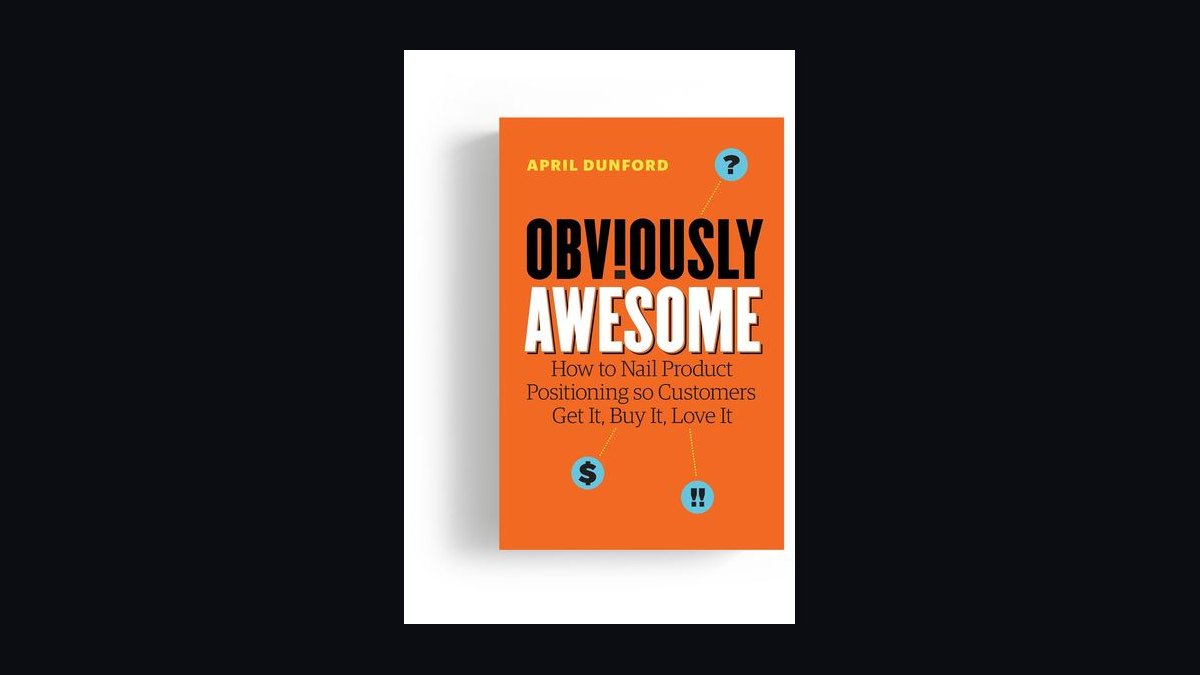
*Obviously Awesome* (April Dunford, 2019) argues positioning is a deliberate choice, not an inheritance: you define what your product is, who it's for, and why it's best inside a market category you pick. Five components — competitive alternatives, unique attributes, value, best-fit customers, market category — drive a ten-step workshop that lifts revenue without changing the product.
What the book is and why sellers should care
April Dunford spent roughly 25 years running positioning and product marketing inside and alongside B2B technology companies before writing this book, and the credential that matters is the repetition: she has run the same repositioning exercise across a very large number of tech products, watched what breaks, and codified the parts that survive contact with a real leadership team. *Obviously Awesome: How to Nail Product Positioning so Customers Get It, Buy It, Love It* came out of Ambient Press in 2019, runs a little under 200 pages, and reads in a single afternoon. That brevity is deliberate. Dunford is not writing marketing theory; she is writing an operating manual for a specific two-day meeting.
The core claim is that most companies never actually decided their positioning. It arrived by accident. A founder built a pitch deck for a seed round, picked the most legible comparison available at the time — "we're like the incumbent, but cheaper" or "we're the modern version of X" — and won the money. That comparison then quietly leaked into the website, the sales scripts, the onboarding deck, the pricing page, and the way every rep opens a call. Three years later the market has moved, the product has grown into something the original frame does not describe, and nobody in the building remembers the frame was ever a choice. The company is now competing on terrain it did not pick, against alternatives it did not select, for buyers whose priorities it never verified.
Dunford's opening chapter runs a personal case: early in her career she inherited a product marketed as an enterprise database, a category owned so completely by the giants that the company was structurally unable to win. The product was not really a transactional database at all — it was built for analytical workloads. Repositioned into a category that matched what it actually did well, sales moved sharply. The engineering team shipped nothing new. Only the frame of reference changed, and with it, what "good" meant to the buyer.
Why this matters to a frontline seller and not just a CMO: every pitch you give is downstream of a positioning decision somebody made, possibly years ago, possibly by accident. When you open a call and the prospect's first question is "so how are you different from [wrong competitor]," that is the positioning failing in real time. You can either absorb the friction on every call for the rest of the year, or you can learn to diagnose the frame the buyer is actually using and steer the conversation onto ground where your differentiation is legible. Dunford's book is the cleanest available manual for doing the second thing, and it doubles as the vocabulary you need to escalate a positioning problem upward without sounding like you're complaining about marketing.

The adjacent value is in the sales-manager and enablement seat. A sales leader who understands the five components can audit onboarding in an afternoon: if new hires can recite the feature list but cannot name the real competitive alternatives or the two or three value themes, ramp will be slow and inconsistent regardless of how good the call coaching is. Positioning is the substrate every downstream enablement asset is built on. Fix the substrate and the battlecards, the discovery questions, and the objection handling all get easier at once.
The five components, in the order Dunford runs them
The sequence is not decorative. Each step consumes the output of the prior one, and skipping ahead corrupts everything downstream — which is exactly what most teams do when they start with "what category are we in?" and reverse-engineer justifications.
Competitive alternatives. The first question is not "who are our competitors?" It is "what would the buyer actually do if we did not exist?" Those are different lists, and the second one is longer. It includes doing nothing at all — the status quo, which is the winning alternative in a large share of B2B deals. It includes building it internally, which is a live option any time the buyer employs engineers. It includes the manual workaround: a spreadsheet, a shared inbox, a contractor, an analyst who runs the report by hand every Monday. And it includes the adjacent category — the tool the buyer already owns and will try to stretch to cover the job. Dunford's argument is that until you name these honestly, your differentiation is aimed at the wrong target. A help desk product that positions against other help desk products, when the real alternative is a shared Gmail inbox plus a cheap ticketing add-on, will spend its whole budget on comparisons the buyer never makes.

Unique attributes. Now list the capabilities you have that those alternatives lack. Dunford's discipline here is brutal and most teams fail it: if a competitor can credibly claim the same attribute, strike it. Not "we do it better" — better is a claim, not an attribute. The surviving list is usually short, often only a handful of items, and short is the point. A long list of unique attributes is evidence you cheated by including table stakes. The exercise is uncomfortable because it forces a leadership team to say out loud that most of what the product does is also what everything else does.
Value. Attributes are features. Value is the outcome those features make possible for a specific buyer. The translation step is mechanical: for each surviving unique attribute, write the sentence "which means the customer can…" and keep pulling until you hit something a budget holder would care about. Then cluster the resulting statements into two or three value themes. Two or three, not eight. A shared API workspace is an attribute; "API teams ship faster because they stop re-explaining the same endpoint to each other" is a value theme. Engineers buy attributes. The person signing the contract buys themes.
Best-fit customers. These are the buyers who care most about your value themes — not the largest addressable market, not the easiest logo, not the segment your board wants on the slide. Dunford's operational test is whether a rep can identify a best-fit account from observable signals in under a minute: firmographics, tech stack, org structure, an observable behavior. "Mid-market SaaS company with a support team of five to fifteen people that has outgrown its first help desk tool" is usable — a rep can check it. "Companies that value customer experience" is not, because every company claims it and nothing in the CRM tells you which ones mean it.
Market category. This is the context that makes your value obvious, and it is the most leveraged decision in the whole exercise. The category the buyer places you in determines the evaluation criteria they apply, the price they expect, the people they invite to the meeting, and the questions they ask. Dunford's best-known examples are category re-frames: a CRM positioned against on-premise software rather than against other cloud CRMs, or a team messaging product positioned against email rather than against other chat apps. In both cases the choice of comparison, not the feature set, determined what "winning" looked like. Most companies sleepwalk past this decision and default to whatever category their loudest competitor already occupies — which is the one category where their unique attributes look least unique.
Chapter eight adds a modifier rather than a sixth component: trends. A genuine, relevant trend amplifies positioning by pre-priming the buyer's attention. A fake one destroys it. If you attach a trend claim your product cannot support, sophisticated buyers detect the gap and then discount every other claim you made, including the true ones. Dunford's test is two-part: the trend must be genuinely connected to your value, and your best-fit customers must already care about it. A trend that only your marketing team cares about is decoration.
The step-by-step process
The back half of the book is the ten-step workshop, and its most underrated feature is that it is a *meeting design*, not a framework diagram. Dunford specifies who is in the room, what order the questions come in, and what artifact you leave with. Roughly one to two days, with the right people locked in, is the shape most teams end up running.
A few practical notes on running it. Step one — talk to customers who already love you — is the step teams skip because they think they already know the answer. They rarely do. The accounts that renew enthusiastically and expand without being asked usually bought for a reason nobody wrote down, and that reason is often a much better positioning input than anything in the win/loss deck. Ten to fifteen focused conversations with delighted customers is enough to see the pattern.
Step two is a staffing problem disguised as a process step. The room needs the CEO or founder, the revenue leader, the head of product, and the head of marketing, and it needs all of them for the duration. Positioning decided by marketing alone does not survive first contact with a sales team that was not consulted, and positioning decided without product cannot be backed by roadmap. If you cannot get those four in a room for two days, you do not have executive commitment, and the output will not stick.

Step three is the one that makes the rest possible. Before anyone argues about categories, the group has to agree that current positioning is broken and name the cost — deals lost to "we decided to build it ourselves," a website that converts badly, reps who each pitch a different story, an ICP definition nobody uses. Without that shared diagnosis you get a two-day debate about taglines.
Steps four through nine run the five components in order, and the facilitator's whole job is preventing the group from jumping to step eight. Everyone in the room has a favorite category and wants to argue for it immediately. The discipline of finishing alternatives and attributes first is what makes the category choice defensible instead of political.
Step ten is the artifact: a one-page positioning canvas capturing all five components, signed off by the leadership team, and distributed to everyone who touches a customer. Then the rollout, which is its own project — updated site copy, a rebuilt sales narrative, revised battlecards, ICP scoring rules in the CRM, and sometimes a roadmap re-sequence to double down on the attributes you just declared unique.
The final chapter draws a line sellers should memorize: stylistic repositioning versus substantive repositioning. A new logo, new colors, a new tagline, same competitive frame — that is stylistic, and it produces roughly zero revenue movement. Substantive repositioning changes the named alternatives, the market category, or the value themes. Dunford's Help Scout narrative is the flagship illustration: repositioned around a specific alternative and a specific buyer who was actively unhappy with the enterprise option, growth changed materially without the product changing. If a "rebrand" lands on your desk and none of the five components moved, expect nothing from it and plan accordingly.
Effort, timelines, and what to expect
Costs here are mostly time and attention rather than cash, which is why positioning is chronically under-invested — it never shows up as a line item, so it never gets scheduled.
The workshop itself. One to two consecutive days with four to six executives. That is roughly forty to eighty person-hours of the most expensive calendar in the company, and the single biggest reason positioning work dies is that nobody is willing to book it. Preparation adds real time on top: customer interviews, a competitive-alternatives audit, and a pull of recent closed-lost reasons. Budget a couple of weeks of part-time prep before the room convenes.
External facilitation. Many teams bring in an outside facilitator, and the reason is structural rather than expertise-based: an internal facilitator cannot referee the CEO. Positioning arguments are status arguments in disguise, and someone with no stake in the outcome can say "that attribute is not unique" to a founder in a way an employee usually cannot. If you hire, expect a specialist consultant's day rate plus prep, which puts it in the same budget band as a serious enablement engagement. If you do not hire, at minimum give the facilitator role to someone who will not be evaluated by anyone else in the room.
Rollout. The workshop is the cheap part. Downstream you are looking at website and messaging rewrites, a rebuilt pitch narrative, updated collateral and battlecards, new ICP definitions in the CRM, revised outbound sequences, and a retraining pass for the whole revenue org. A realistic window from workshop to fully-rolled-out is one to two quarters for a company past the earliest stage, with the sales narrative usually shipping first because it is the cheapest to change and the fastest to test.
Time to signal. Sales-side signals arrive fastest, because reps are running the new frame on live calls within days. Watch for changes in how often prospects volunteer the right competitive alternative, how often "we'll just build it" appears in closed-lost notes, and whether discovery calls get shorter. Marketing signals — organic traffic composition, conversion on the new positioning, inbound lead quality — lag by a quarter or more, because search behavior and content indexing move slowly. Do not judge a repositioning on inbound metrics at week six; you will conclude it failed before it has had a chance to work.
Cadence. Positioning is not a one-time exercise and it is not an annual ritual either. The honest trigger list: a meaningful product expansion that outgrows the current frame, a new competitor that redefines the category, a shift in who the actual buyer is, entry into a new segment or geography, or a persistent pattern in closed-lost where buyers keep comparing you to something you did not expect. Absent a trigger, a light annual review of the canvas is enough. Reopening the full exercise every year churns the field for nothing.
Opportunity cost. The comparison worth making is against whatever else the leadership team would do with two days and a quarter of rollout capacity. Positioning competes with pricing changes, a segment expansion, a product bet. Its advantage is that it requires no engineering and no new spend to test the core hypothesis — you can run the new frame on twenty sales calls and get directional signal in two weeks, long before you commit to a website rewrite.
Where teams get it wrong
Starting at the category. The most common failure by a wide margin. Someone walks in already knowing what category they want to be in — usually the one with the biggest analyst coverage or the best funding multiples — and the exercise degenerates into building a case for a predetermined answer. The five components run in order for a reason: the category is the *conclusion*, derived from which frame makes your genuinely unique attributes look obvious. Choosing it first inverts the logic and produces positioning nobody in the field can defend.
Padding the unique-attributes list. Teams put table stakes on the list because a short list feels like an admission of weakness. It is the opposite. A three-item list you can defend is worth more than a fifteen-item list where twelve items are also true of every rival, because the twelve dilute the three. In the field, a rep who leads with a diluted list forces the buyer to do the filtering, and buyers usually filter by picking the cheapest option.
Confusing positioning with messaging. Positioning is the strategic choice — which alternatives, which category, which themes, which buyer. Messaging is the tactical expression: the actual sentences on the homepage and in the deck. Bad messaging on good positioning is a week of copywriting. Good messaging on bad positioning is money set on fire, because you are making a wrong idea more persuasive. When a team says "our messaging isn't landing" the first diagnostic is whether the underlying frame is wrong.
Defining best-fit customers by size instead of fit. Firmographic segmentation is easy to operationalize and frequently wrong. The best-fit definition should be built from who cares most about your value themes, which often cuts across size bands. A definition that says "enterprise" when the real pattern is "any company whose support volume just outgrew a shared inbox" will send reps chasing accounts that will never feel the pain your product solves.

Faking the trend. Attaching a fashionable trend to a product that does not support it is the fastest way to lose a sophisticated buyer. The buyer probes one layer deep, finds nothing, and then discounts everything else you claimed. This failure mode has gotten more expensive, not less, as buyers have grown more practiced at probing trend claims.
Shipping the canvas without the rollout. The workshop produces a document; the document does nothing on its own. If reps were not in the room and did not get retrained, they will keep pitching the old frame, and within a quarter the new positioning exists only as a slide in a shared drive. Rollout ownership needs a name and a date attached before the workshop ends.
Leaving sellers out of the feedback loop. Repositioning is usually triggered by field evidence, not executive insight. Reps hear the wrong comparison over and over months before anyone at the leadership level notices. If there is no structured path for a rep to report "half my deals are comparing us to an internal build," that signal never reaches the people who can act on it. Building that path — a field on the closed-lost form, a standing agenda item in the forecast call — is cheap and pays repeatedly.
Treating a rebrand as repositioning. Covered above, but worth repeating as a failure mode because it consumes budget that could have funded the real thing. If the five components did not change, neither did the positioning.
Choosing what to do next: a decision framework
Sellers and revenue leaders sit in different seats relative to this book, and the useful question is not "should we reposition" in the abstract but "what is the smallest correct action from where I am standing." The branch below is the one worth running.
Read the branches concretely. If you cannot deliver the thirty-second statement — what it is, who it is for, what makes it best — that is not a personal gap, it is usually evidence the company never wrote one down. Ask for the canvas before assuming it is missing; sometimes it exists and simply never reached enablement.

If the statement exists and buyers routinely arrive with the comparison it anticipates, positioning is doing its job and your leverage is elsewhere: pitch construction, discovery quality, multithreading, commercial negotiation. Do not reopen positioning to avoid working on your close rate.
If buyers keep arriving with a comparison your frame does not anticipate, the next question is whether it is your calls or everyone's. A mismatch that only shows up in one rep's pipeline is usually a targeting or discovery problem in that rep's territory. A mismatch that shows up across the team, in closed-lost notes and in inbound questions, is systemic — and that is the evidence package that gets a workshop scheduled. Bring counts, not anecdotes: how many deals in the last two quarters named an alternative outside the assumed frame.
Two adjacent moves worth knowing. Dunford's 2024 follow-up, *Sales Pitch*, carries the same underlying logic into pitch construction specifically, and is the more directly applicable book for a frontline seller who already has decent positioning and wants a better narrative. And for the classical grounding, Ries and Trout's 1981 *Positioning* invented the discipline of mental categories, while Geoffrey Moore's *Crossing the Chasm* handles the adoption-curve dimension Dunford deliberately leaves alone. Dunford's contribution is the bridge: she took a consumer-brand-era idea and turned it into a B2B workshop with defined inputs and a defined artifact.
The strategy question underneath all of this is which comparison you want the buyer to make. Everything else — the deck, the demo order, the pricing page, the objection handling — is downstream of that one choice. That is the whole argument of *Obviously Awesome*, and the reason a book this short keeps showing up on revenue-team reading lists years after publication.
Related questions
What should I do Monday morning after reading it?
Two things. Write your company's positioning in the thirty-second "what it is, who it is for, what makes it best" format and confirm it with your revenue leader. Then on your next three discovery calls, ask what else the buyer is considering — including doing nothing and building internally — and note how often their frame differs from yours.
Is this book useful for non-SaaS sellers?

Yes, with translation. The five components are category-agnostic: services firms, hardware vendors, and agencies all face the same question of which alternative the buyer is really weighing. The examples skew B2B software, so expect to do the mapping work yourself, but the underlying logic transfers cleanly.
Should a frontline rep run the ten-step process?
No. It is a leadership exercise requiring executive authority to make binding decisions. But every rep should be able to recite the outputs: the named competitive alternatives, the two or three value themes, the best-fit customer definition, and the chosen market category. If you cannot, ask.
How does it compare to Dunford's Sales Pitch?
*Obviously Awesome* sets the strategy — which frame, which category, which buyer. *Sales Pitch* (2024) applies it to the pitch narrative itself and is more immediately actionable for someone carrying a quota. Read *Obviously Awesome* first for the foundation, then *Sales Pitch* for the delivery layer.
What is the fastest way to test new positioning?
Run it on live sales calls before you rewrite anything. Twenty conversations with the new frame gives directional signal in about two weeks, at essentially zero cost, and surfaces objections you can fix before committing to a website rewrite that takes a quarter to undo.
FAQ
Why is "competitive alternatives" broader than "competitors"?
Because buyers do not restrict themselves to your competitive set. They compare you against doing nothing, building it internally, stitching a manual workaround together, or stretching an adjacent tool they already pay for. Those alternatives win a large share of B2B deals. If your positioning only addresses named vendors, it never engages the objection actually forming in the buyer's head, and reps end up improvising a rebuttal on every call.
How is Dunford different from Ries and Trout's original Positioning?
Ries and Trout invented the discipline in 1981 and established that buyers file products into mental categories. Their work was consumer-brand-centric and predates the internet, the subscription model, and the modern B2B buying committee. Dunford translates the same insight into a structured five-component canvas with a defined workshop methodology and named inputs — the operational layer the original never provided.
How does positioning relate to messaging?
Positioning is the strategic choice; messaging is the tactical expression of it. Which alternatives you name, which category you claim, which value themes you lead with — that is positioning. The specific sentences on the homepage are messaging. Bad messaging over good positioning is a week's fix. Good messaging over bad positioning just makes a wrong idea more convincing.
My company's positioning seems wrong and I am a frontline seller. What now?
You have two moves. In the field, diagnose the buyer's actual frame of reference and pitch against what they are really comparing you to, not what the deck assumes. Behind the scenes, log the mismatch systematically in closed-lost data so the pattern becomes visible. Repositioning is almost always triggered by sellers surfacing a pattern, not by executives spotting it independently.
What has aged in the book since 2019?
The five components and the workshop hold up and remain the default vocabulary on B2B revenue teams. What is thinner is product-led growth mechanics — self-serve motions where the product does the positioning work before a human is involved — and community-led or creator-led go-to-market, both of which grew significantly after publication. Neither gap invalidates the framework; they are extensions.
Can AI tools run the positioning exercise for me?
They can accelerate the mechanical parts: drafting attribute-to-value translations, stress-testing a canvas for logical gaps, summarizing customer-interview transcripts to surface patterns. What they cannot do is make the strategic calls. Which frame, which category, which trend — those require judgment grounded in real conversations with real customers, and a leadership team willing to be bound by the answer.
Sources
- https://www.aprildunford.com/
- https://en.wikipedia.org/wiki/Positioning_(marketing)
- https://review.firstround.com/
- https://www.helpscout.com/blog/
- https://blog.postman.com/
- https://www.saastr.com/
- https://hbr.org/topic/subject/marketing
- https://www.mckinsey.com/capabilities/growth-marketing-and-sales/our-insights
Related on PULSE
- Sales Pitch by April Dunford — Cliff Notes Summary for Sellers
- Crossing the Chasm by Geoffrey Moore — Cliff Notes Summary for Sellers
- Contagious by Jonah Berger — Cliff Notes Summary for Sellers
- The Tipping Point by Malcolm Gladwell — Cliff Notes Summary for Sellers
- Exactly What to Say by Phil M. Jones — Cliff Notes Summary for Sellers
- Antifragile by Nassim Taleb — Cliff Notes Summary for Sellers
This page will be disappearing soon. Save it to your device for $1 — or read it free while it is here.
@Kory-White- · if Venmo asks, the last 4 of my number are 2012
This page is gone.
This one is off the shelf now. $1 keeps it on your phone for good — the whole page, pictures and diagrams included.
 book-summarySales Pitch by April Dunford — Cliff Notes Summary for Sellers
 pulse-recentBlue Ocean Strategy by W. Chan Kim and Renee Mauborgne — Top 10 Key Takeaways for Sales Leaders in 2027
 pulse-recentCrossing the Chasm by Geoffrey Moore — Top 10 Key Takeaways for Sales Leaders in 2027
 pulse-recentThe Sandler Rules by David Sandler — Top 10 Key Takeaways for Sales Leaders in 2027
 pulse-recentHigh-Profit Prospecting by Mark Hunter — Top 10 Key Takeaways for Sales Leaders in 2027
 pulse-recentGetting to Yes by Roger Fisher and William Ury — Top 10 Key Takeaways for Sales Leaders in 2027
 pulse-recentWhat is the most actionable step in The Sandler Rules for Sales Leaders by David Mattson to improve discovery in 2027?
 pulse-recentBlueprints for a SaaS Sales Organization by Jacco van der Kooij — Top 10 Key Takeaways for Sales Leaders in 2027
 pulse-recentWhat are the concrete steps in Strategic Selling for building a sales plan in 2027?
 pulse-recentThe Sales Manager’s Guide to Greatness by Kevin Davis — Top 10 Key Takeaways for Sales Leaders in 2027