


Sales Pitch by April Dunford — Cliff Notes Summary for Sellers
Quality
Certified
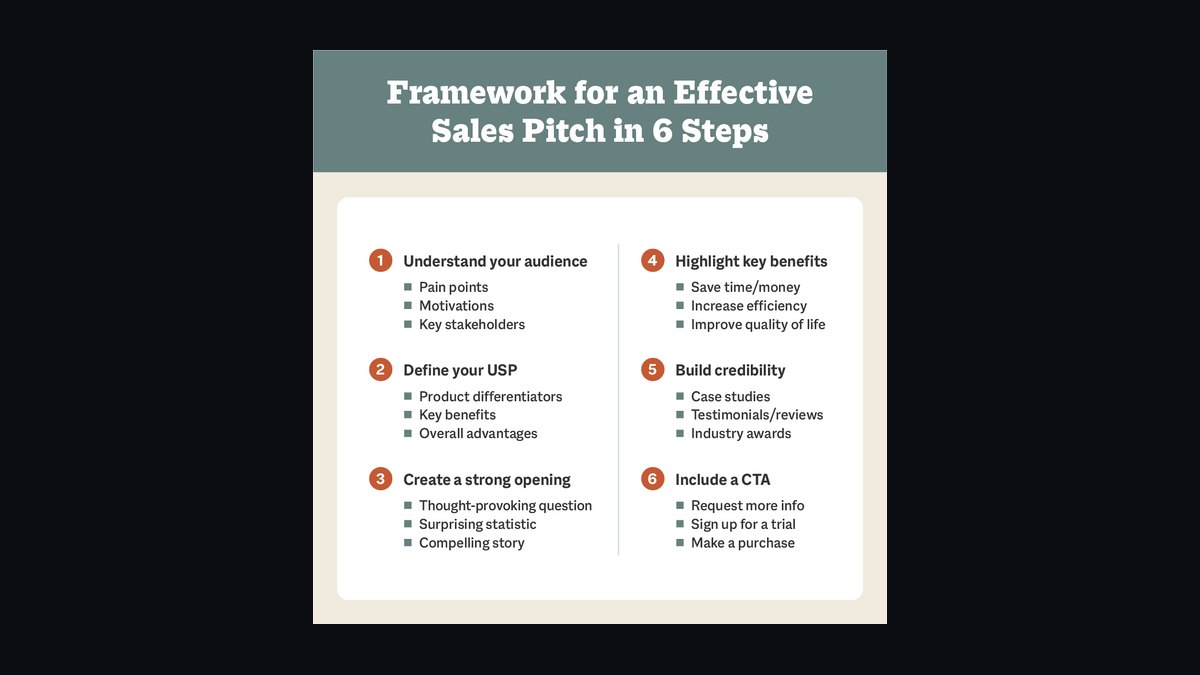
April Dunford's *Sales Pitch* gives sellers an 8-Section structure — Insight, Alternatives, Common Approaches, Killer Insight, Perfect-World Solution, Introducing the Product, Proof, Ask — that replaces the traditional feature-dump pitch. This Cliff Notes Summary for Sellers boils her strategy down to one rule: open with a fresh insight about the buyer's world, not your company, and only introduce your product after the buyer has agreed to the criteria that define it.
Two Ways to Structure a Sales Pitch: Dunford's 8-Section Model vs. the Traditional Approach
Sellers pitching in 2026 are really choosing between two competing architectures, and Dunford's book exists because most reps default to the wrong one without realizing it's a choice at all.
Option one is the traditional "About Us" pitch. It opens with company history, a logo slide, a Gartner or G2 placement, then walks through 15-20 features in a screen-share. The implicit logic is that the more capabilities the buyer sees, the more likely one will land. Dunford calls this the worst possible opening because it burns the first ninety seconds — the window in which a buyer decides whether to lean in or check email — on information that answers "what does the product do" instead of "why does this matter to me." This approach also blurs the line between discovery and pitch: reps ask a clarifying question, get an answer, then pivot into an ad-hoc feature explanation, and the call becomes neither a clean discovery session nor a coherent pitch.

Option two is Dunford's 8-Section Pitch, a seller-led narrative delivered in a tight 12-to-15-minute block, kept structurally separate from discovery. Section one opens with an Insight — a fresh, segment-specific, mildly contrarian observation about the buyer's world that signals competence before a single feature is mentioned. Section two names the Alternatives the buyer is realistically weighing, including status quo and internal build, which Dunford insists you name explicitly rather than dodge. Section three, Common Approaches, describes what similar companies typically do and sets up the tension that makes the buyer's current path feel fragile. Section four is the Killer Insight — the deeper truth explaining why the common approach breaks, delivered only after alternatives have been mapped so it lands as earned rather than engineered. Section five, the Perfect-World Solution, lists the 5-7 capabilities an ideal answer would need, and gets the buyer's tacit agreement before your product is ever named. Section six introduces the product as a 1-to-1 map onto those criteria. Section seven stacks Proof — named customer, similar situation, quantified outcome, timeline. Section eight is a specific, dated Ask.

The trade-off between the two options is not subtle. The traditional approach requires almost no preparation — a generic deck works for every buyer — but it converts poorly because it never builds a case for why the status quo is broken before proposing a replacement. The 8-Section Pitch requires real positioning work upfront (the Killer Insight and Perfect-World criteria have to be built per-segment, sometimes per-account), but it converts a passive audience into one that has already agreed, section by section, to the logic that makes your product the obvious answer. Dunford's strategy is explicitly sequential: you cannot skip to section six without sections one through five doing their work, because the product reveal only lands as inevitable if the buyer has already accepted the problem framing.
How to Decide Between the Two Approaches
The decision of which structure to run is not really about seller preference — it's about deal complexity, buyer sophistication, and how much positioning work has already been done. A rep selling a $2,000/year transactional tool to a buyer who already knows the category does not need the full 15-minute build; a rep selling a $150,000 platform into a committee that has never heard of the category needs every section, in order, with no shortcuts.

Three variables drive the choice: deal size, buyer familiarity with the problem, and whether the seller's company has done real positioning work (per Dunford's earlier book, *Obviously Awesome*) that a Killer Insight and Perfect-World criteria can be built from. If positioning is thin or generic, the 8-Section Pitch will feel hollow in sections four and five — you cannot fake a killer insight, and a buyer notices immediately when the "ideal solution" checklist reads like a copy of your own feature list rather than an honest abstraction. In that case, some reps default back to a features walkthrough simply because it's the only material they have, which is precisely the trap Dunford is writing against.
Buyer sophistication cuts the other way. A buyer who has evaluated five vendors in your category already knows the alternatives and common approaches — spending three minutes re-explaining their own market can read as condescending. Dunford's guidance here is to compress, not skip: acknowledge in one sentence that they know the landscape, then move faster into the Killer Insight, which is the section least likely to be something they've already heard from a competitor.
The diagram above is the practical decision tree most sales-enablement teams build into a pitch playbook after reading Dunford: positioning readiness gates whether the 8-Section model is even usable, and deal size then gates how much of it survives compression.
Concrete Numbers Behind Each Pitch Model
Dunford is unusually specific about timing and proportions, which is part of why this Summary translates so cleanly into a rep-usable script rather than an abstract philosophy.

The full 8-Section Pitch runs 12 to 15 minutes for the seller-led narrative portion, delivered on a call separate from discovery. Within that window, section six — Introducing the Product — should take no more than 3 to 4 minutes, arriving roughly 8 to 9 minutes into the call. That means the first two-thirds of the pitch never mentions the product by name; it's spent entirely on the buyer's problem, their alternatives, and the criteria for a solution. Sections two and three ask reps to name 3 to 4 alternatives the buyer is weighing, because Dunford cites research suggesting the status quo — doing nothing — wins 40 to 60% of B2B deals, making it the single most common competitor and the one most reps forget to address directly.
Section five's Perfect-World Solution should list 5 to 7 capabilities, not more — beyond that range the list stops reading as a tight, memorable criteria set and starts reading as a feature list in disguise, undermining the entire jujitsu of getting agreement before the reveal. Section six should surface 2 to 3 differentiated capabilities — the things only your product does — rather than table-stakes items, because table stakes are assumed by a sophisticated buyer and differentiation is what actually moves a decision. Section seven, Proof, recommends 2 to 3 proof points, each one mapped to a different Perfect-World capability so evidence is distributed across the full criteria set rather than stacked on one strength.

For compressed, SMB-style pitches under roughly $10,000 in annual contract value, Dunford's guidance is to run only sections 1, 4, 5, 6, and 8, compressing the whole pitch into 5 to 6 minutes — the Killer Insight and Perfect-World framing survive the cut because they matter regardless of deal size, while the fuller Alternatives and Common Approaches treatment gets folded into a single sentence. These numbers matter operationally: sales managers coaching reps against this framework are listening for a stopwatch-verifiable structure, not a vibe, and Gong-style call-scoring tools built around Dunford's model check for exactly these proportions — insight in the first 90 seconds, product delayed past the halfway mark, a dated ask in the final minute.
Implementation Details and Sequencing
Rolling the 8-Section Pitch out to an AE team is a strategy exercise before it's a training exercise, because the framework only works if the raw material — positioning, proof points, a defensible Killer Insight — already exists. Teams that skip straight to script-writing end up with reps reciting a structure around an empty center.
The practical build order looks like this: first, confirm the company's positioning work (competitive alternatives, unique attributes, value, target segment) is current — if it's stale or was never done rigorously, that has to be fixed before any pitch deck gets rebuilt, because sections four and five are entirely dependent on it. Second, draft the Insight and Killer Insight per segment, not per company; a single generic insight rarely lands across verticals with different operating realities, so enablement teams typically write two or three segment-specific variants and let reps pick the one matching their buyer. Third, build the Perfect-World criteria list collaboratively with a few senior AEs and validate it against real losses — if the criteria don't explain why past deals were won or lost, they're wrong. Fourth, compile the proof stack: named customer, similar buying situation, quantified outcome, timeline, mapped explicitly to each Perfect-World capability, and refreshed quarterly as new customers close. Fifth, rehearse the Ask separately from the rest of the pitch, since Dunford flags it as the most under-rehearsed section — reps default to "let me know when you want to talk again," and the fix is drilling a specific, dated, mutually-committed next step until it's reflexive.
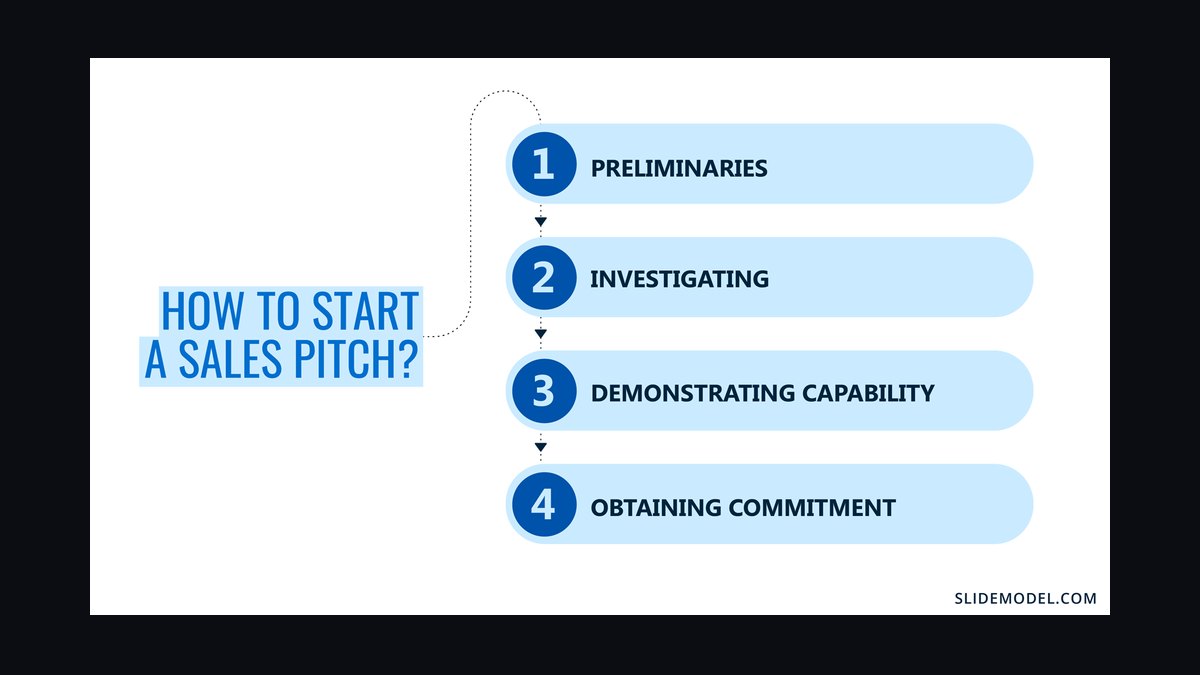
Sequencing matters as much as content: the Killer Insight must never be delivered before the Alternatives section, because a buyer who hears the deeper insight first assumes the seller reverse-engineered it to fit the product, while a buyer who hears it after the alternatives have been honestly mapped experiences it as earned. Similarly, the product can never appear before the Perfect-World criteria are set, or the entire rhetorical structure — agree to criteria, then reveal the product that embodies them — collapses.
Rollout typically takes a full sales cycle to validate — reps need to run the new structure against live buyers, track which sections stall, and adjust the Insight and Killer Insight variants based on where buyers push back. Teams that treat this as a one-time deck refresh rather than an ongoing strategy tend to see the structure decay back into a feature list within a quarter, because nothing forces continued discipline once the initial training session ends.
Related questions

What's the difference between the 8-Section Pitch and Challenger Selling?
Challenger Selling (Dixon & Adamson) introduced the "commercial insight" concept but never gave reps a delivery structure. Dunford's model borrows the insight concept and builds the full script — including alternatives, criteria, and proof — around it.
Can the 8-Section Pitch work without strong positioning?
No. Sections four and five depend entirely on differentiated positioning work; without it, the Killer Insight and Perfect-World criteria will sound generic or copied, and the pitch collapses back into a feature list.
How does this differ from MEDDPICC?
MEDDPICC is a qualification framework for assessing deal health; the 8-Section Pitch is a delivery framework for presenting once discovery and qualification are done. They're complementary, not competing.
Should discovery and pitch happen on the same call?
Dunford recommends separating them wherever deal size allows — discovery is buyer-talking, pitch is seller-talking, and blurring the two weakens both.
Does deal size change the structure?
Yes — for deals under roughly $10K ACV, Dunford recommends compressing to sections 1, 4, 5, 6, and 8, run in about 5-6 minutes rather than the full 12-15.
FAQ

Who is April Dunford and why does her opinion carry weight here? Dunford is a positioning consultant and author of *Obviously Awesome* (2019), the widely cited product-positioning book; *Sales Pitch* (2024) is her follow-up applying that positioning work to frontline pitch delivery.
Is the 8-Section Pitch only for enterprise SaaS? No — Dunford designed it as a general B2B pitch strategy, and explicitly gives a compressed version for SMB and transactional deals under $10K ACV.
What happens if a buyer interrupts the structure? Dunford advises acknowledging the question briefly, then explicitly returning to the sequence — naming where you'll circle back — rather than abandoning the structure entirely.
Do I need slides to run this, or can I whiteboard it? Dunford generally prefers slides because they keep the structure visible and keep newer reps on-script; whiteboarding can work for experienced AEs who don't need the scaffolding.
What if my proof points are just happy-customer quotes? Dunford is explicit that testimonials alone aren't proof — a real proof point needs a named customer, a similar buying situation, a quantified outcome, and a timeline.
How is this book positioned relative to older sales classics like SPIN Selling? SPIN is a discovery framework for asking questions; the 8-Section Pitch is a delivery framework for the presentation that follows discovery — Dunford treats them as sequential steps in the same sales motion, not rivals.
Sources
- https://www.aprildunford.com
- https://www.amazon.com/Sales-Pitch-Craft-Story-Stand/dp/1999023183
- https://hbr.org
- https://www.gartner.com
- https://www.gong.io
- https://www.saastr.com
- https://joinpavilion.com
- https://www.showpad.com
Related on PULSE
- Obviously Awesome by April Dunford — Cliff Notes Summary for Sellers
- Pitch Anything — Cliff Notes Summary
- Pitch Perfect by Bill McGowan — Cliff Notes Summary
- Pitch Anything by Oren Klaff — Cliff Notes Summary & Key Takeaways
- The 12 Week Year by Brian Moran and Michael Lennington — Cliff Notes Summary for Sellers
- Contagious by Jonah Berger — Cliff Notes Summary for Sellers
This page will be disappearing soon. Save it to your device for $1 — or read it free while it is here.
@Kory-White- · if Venmo asks, the last 4 of my number are 2012
This page is gone.
This one is off the shelf now. $1 keeps it on your phone for good — the whole page, pictures and diagrams included.
 book-summaryObviously Awesome by April Dunford — Cliff Notes Summary for Sellers
 pulse-booksRework by Jason Fried and David Heinemeier Hansson — Cliff Notes Summary
 pulse-recentTraction by Gabriel Weinberg and Justin Mares — Top 10 Key Takeaways for Sales Leaders in 2027
 pulse-recentProActive Selling by Skip Miller — Top 10 Key Takeaways for Sales Leaders in 2027
 pulse-recentThe Closer’s Survival Guide by Grant Cardone — Top 10 Key Takeaways for Sales Leaders in 2027
 pulse-recentThe Sales Manager’s Guide to Greatness by Kevin Davis — Top 10 Key Takeaways for Sales Leaders in 2027
 pulse-recentWhat is the first concrete step in SPIN Selling by Neil Rackham for structuring a discovery call in 2027?
 pulse-recentHow to Apply Strategic Selling — Step-by-Step Playbook in 2027
 pulse-recentGetting to Yes by Roger Fisher and William Ury — Top 10 Key Takeaways for Sales Leaders in 2027
 pulse-recentNever Lose a Customer Again by Joey Coleman — Top 10 Key Takeaways for Sales Leaders in 2027