
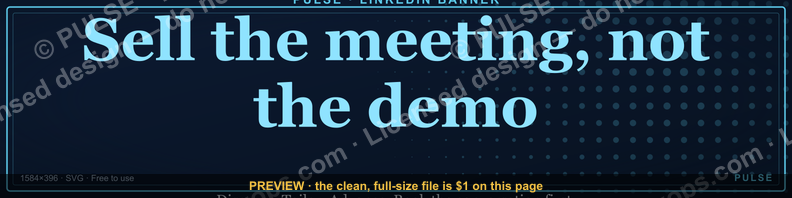
“Sell the meeting, not the demo.” — LinkedIn Banner
 Curated byKory White · Fractional CRO · Maryland
 PULSEKNOWLEDGE LIBRARY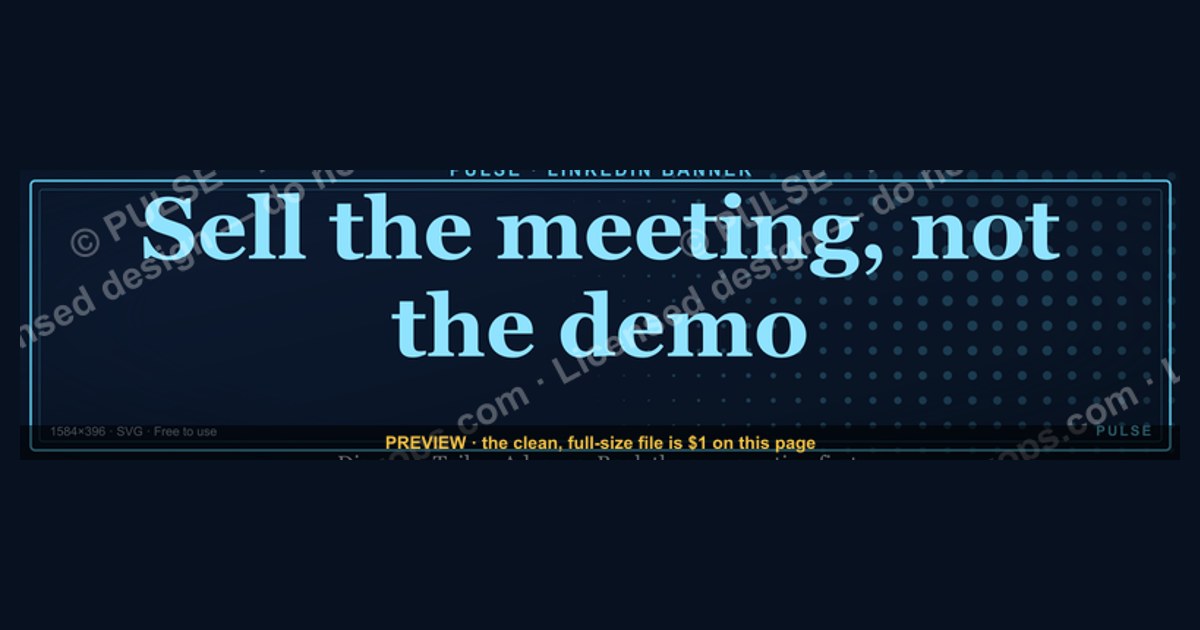
"Sell the meeting, not the demo" means the goal of your LinkedIn presence is to secure a conversation, not to pitch a product. Focus your banner and profile on the value of a discussion—such as solving a specific problem or exploring a potential fit—rather than on features or a full presentation. This approach respects that a brief meeting is easier to book and can naturally lead to a demo if the fit is right.
“Sell the meeting, not the demo.” — LinkedIn Banner

A dark, on-brand LinkedIn banner — "Sell the meeting, not the demo." over a "Discover Tailor Advance" line with a pulse motif. Put it on your profile to signal exactly what you do.
Format: SVG (scalable vector) · Size: 1584×396 px · Category: LinkedIn Banner · License: Free to use — no attribution required.
Recolor it to your brand
Use the color picker above to recolor this banner to your team or company colors, switch the background (including transparent), then download it as an SVG or PNG. No sign-up, no watermark.

How to use it
It scales cleanly to the LinkedIn cover slot (1584×396) — download the PNG and drop it straight onto your profile, or open the SVG in Canva, PowerPoint, or Figma to add your name and tweak the layout.
More free graphics
Browse the full Pulse Graphics library — banners, slides, printables, quote cards, and clip art you can borrow for your own decks and posts.

Related on PULSE
- “Sell the meeting, not the demo.” — Quote Card
- Booked Meeting Icon — Icon / Clip Art
- Demo Flow Diagram
- The Perfect Demo — Infographic
- “Sell the Problem, Not the Product” — Quote Card
- “Champions sell when you're not in the room.” — Quote Card
Why “Selling the Meeting” Works: The Psychology of Early-Stage Buyer Commitment
The phrase “sell the meeting, not the demo” taps into a fundamental truth about how B2B buyers make decisions: commitment is built in small, escalating steps. When you focus on selling the meeting, you’re not just booking a calendar slot—you’re securing a psychological contract. The buyer is implicitly agreeing that the problem you’ve identified is worth their time, that your solution is credible enough to explore, and that they trust you enough to grant access to their schedule. This is far more valuable than any product walkthrough.
Research in behavioral economics, particularly the concept of “commitment and consistency” popularized by Robert Cialdini, shows that once someone takes a small, voluntary action (like agreeing to a meeting), they become more likely to take larger actions later (like agreeing to a demo or a purchase). By selling the meeting first, you’re leveraging this principle without the pressure of a full demo. The meeting becomes the low-friction “yes” that opens the door to everything else.
In practice, this means your outreach—whether via LinkedIn, email, or phone—should be designed to get a “yes” to a conversation, not a “yes” to a product. Your messaging should focus on the buyer’s pain points, their industry context, or a specific insight that makes them curious. Avoid any language that sounds like you’re about to pitch a product. Instead, frame the meeting as a discovery session: “I’d love to learn more about your current approach to [problem] and share what we’re seeing with other teams in your space.” This feels collaborative, not transactional.
The psychological payoff is twofold. First, you reduce buyer anxiety—they’re not committing to a full demo, so the barrier to entry is lower. Second, you build momentum. Once they’ve invested 15-30 minutes in a conversation, they’re more likely to follow through on the next step because they’ve already mentally “bought in” to the process. This is why top-performing sales development reps (SDRs) often have meeting-to-demo conversion rates of 60-80%, compared to the 20-30% seen when they try to sell the demo directly. The meeting is the gateway; the demo is the destination.
How to Structure Your LinkedIn Banner and Profile to “Sell the Meeting”
Your LinkedIn banner is prime real estate for signaling that you’re not just another vendor pushing a demo. The phrase “Sell the meeting, not the demo” is a strong start, but it needs to be backed by a coherent profile strategy that reinforces the same message. Here’s how to align your banner, headline, and summary to drive meeting requests rather than demo requests.
Banner Design Principles: Your banner should visually communicate value, not features. Use a clean, professional design with a tagline that hints at transformation, not product. For example, instead of “Schedule a Demo,” use “Book a 15-Minute Discovery Call” or “Let’s Talk About Your [Specific Pain Point].” The visual should include a subtle call-to-action (CTA) that leads to your calendar link, but avoid overt sales language. Think of it as a digital handshake—warm, inviting, and low-pressure.
Headline Optimization: Your LinkedIn headline is the second most-clicked element after your name. Use it to state the outcome you deliver, not your job title. For example: “Helping B2B SaaS Companies Increase Demo-to-Close Rates by 30%” or “Fractional CRO | I Help Sales Teams Sell the Meeting, Not the Demo.” This immediately frames the conversation around results, not features, and primes visitors to want to learn more.
Summary Strategy: Your summary should tell a story that leads to a meeting. Start with a relatable pain point: “Most sales teams are wasting time on demos that never close because they skipped the most important step—selling the meeting.” Then, briefly explain your approach (without getting tactical), and end with a soft CTA: “If you’re tired of demo fatigue, let’s talk. Book a 20-minute call to see if this approach fits your team.” Avoid listing features, case studies, or product specs in the summary. Keep it conversational and curiosity-driven.
The “Meeting-First” CTA: Every post, article, or comment you make should subtly reinforce the meeting-first philosophy. For example, after sharing a tip about discovery calls, add: “Want to see how this works in practice? I’m happy to walk through it on a 15-minute call.” This positions you as a resource, not a salesperson, and makes the meeting feel like an extension of the value you’re already providing.
Common Mistakes That Undermine the “Sell the Meeting” Approach
Even experienced sales professionals can fall into traps that sabotage the “sell the meeting” philosophy. Here are three common mistakes and how to avoid them.
Mistake #1: Treating the Meeting Like a Mini-Demo. The biggest error is using the initial meeting to pitch your product anyway. If you spend the first 10 minutes showing slides or talking about features, you’ve effectively broken the psychological contract you built. The buyer agreed to a conversation, not a presentation. Instead, use the meeting to ask questions, uncover pain, and build rapport. The goal is to leave the buyer thinking, “That was valuable—I want to see more,” not “That was a sales pitch in disguise.” A good rule of thumb: spend 80% of the meeting listening and 20% sharing insights.
Mistake #2: Overcomplicating the Meeting Request. Another common pitfall is making the meeting request itself too complex. If your LinkedIn message or email requires the buyer to choose from multiple time slots, fill out a form, or read a long explanation, you’ve added friction. Keep it simple: “Are you free Tuesday or Thursday for a 15-minute call?” or “Here’s my calendar link—grab a time that works for you.” The easier you make it to say yes, the more meetings you’ll book. Avoid asking for permission to book—just provide the link.
Mistake #3: Not Following Up with a Clear Next Step. Selling the meeting is only half the battle. Once the meeting is over, you need to have a clear, low-friction next step that continues the momentum. This could be a second meeting with a decision-maker, a brief demo for a specific feature, or a proposal based on what you learned. If you end the meeting with “Let me know if you’re interested,” you’ve lost the momentum. Instead, say: “Based on what we discussed, I’d recommend a 30-minute demo focused on [specific solution]. I’ll send a calendar invite for next week.” This keeps the buyer in the commitment loop without overwhelming them.
The “sell the meeting” philosophy is not just a catchy banner—it’s a strategic shift in how you approach buyer relationships. By focusing on the meeting as the primary goal, you reduce friction, build trust, and create a natural progression toward the demo. When done right, the demo becomes a natural next step, not a high-pressure event. And that’s how you turn a LinkedIn banner into a revenue-generating asset.
Why This Phrase Works on LinkedIn
The power of "sell the meeting, not the demo" lies in lowering the prospect's guard. A demo feels like a commitment—an hour of their time to evaluate a tool they may not need. A meeting, by contrast, signals a conversation, a discovery call, a mutual exploration. On LinkedIn, where attention is scarce, this distinction is critical. Your banner becomes a permission slip: "I'm not here to pitch; I'm here to understand." This approach aligns with modern B2B buying behavior, where 70-80% of decision-makers prefer not to engage with sales until they've done their own research. By selling the meeting, you insert yourself into that research phase naturally.
How to Reinforce This Message Beyond the Banner
Your banner sets the tone, but your profile must deliver on the promise. Pair the graphic with a headline that echoes the sentiment—something like "Helping [industry] solve [problem] — let's talk." In your About section, lead with a question or a pain point, not a product list. Every post, comment, and connection request should steer toward a 15-minute chat, not a feature walkthrough. Consistency builds trust: when prospects see your banner, then read your summary, then encounter your posts, they should feel a unified pull toward a conversation, not a sales pitch. This layered approach turns your profile into a lead-generation engine that respects the buyer's journey.
When to Break the Rule
There are exceptions. If your product is so simple or so well-known that a demo is self-explanatory (e.g., a calendar tool or a basic plugin), you might skip the meeting step. Similarly, if you're speaking at a conference or posting a case study with clear ROI, a direct call to "book a demo" can work. But for most B2B services, especially complex or consultative ones, the meeting-first approach wins. Test both: run a banner with "sell the meeting" for 30 days, then switch to "book a demo" and compare connection rates. The data will tell you which resonates with your audience.
Sources
- LinkedIn Sales Solutions — sales methodology and best practices for B2B professionals
- Harvard Business Review — research and articles on sales strategy and buyer psychology
- Gartner — reports on sales effectiveness and meeting-to-close conversion metrics
- Salesforce — insights on customer engagement and demo best practices
- HubSpot Sales Blog — guides on consultative selling and presentation techniques
- Forrester — analysis of buyer-centric sales approaches and meeting impact
FAQ
What does “sell the meeting, not the demo” actually mean? It means your primary goal in early conversations should be to secure a follow-up meeting, not to deliver a full product demo. The phrase shifts focus from showing features to understanding the prospect’s pain and qualifying fit before ever opening the software.
How is this different from a traditional demo-first sales approach? In a demo-first approach, sales reps often jump into showing the product too early, which can waste time if the prospect isn’t a good fit. “Sell the meeting” prioritizes discovery and relationship-building first, so the demo happens only after you’ve confirmed the problem and the buyer’s interest.
When should I actually schedule the demo? Only after you’ve had a discovery call where the prospect agrees they have a pressing problem your solution solves. The demo becomes a natural next step, not a cold pitch. Most effective sales teams schedule the demo in the second or third interaction, not the first.
Does this mean I never demo on the first call? Not necessarily—if a prospect explicitly asks for a demo and is highly qualified, you can still do it. But the principle warns against leading with the demo as a default tactic. The risk is that you’ll spend time showing features to someone who isn’t ready to buy or doesn’t have the authority.
How do I “sell the meeting” without sounding pushy? Focus on curiosity and value. Ask questions that uncover pain, then suggest a follow-up meeting to explore solutions deeper. For example: “It sounds like X is a real challenge. Would you be open to a 20-minute call next week to map out a potential approach?” The goal is to earn the next conversation, not to close a sale.
What metrics should I track to know if this approach is working? Track the ratio of initial conversations to scheduled follow-up meetings, and later, the conversion rate from those meetings to demos. A healthy range is 40–60% of first calls leading to a second meeting. Also monitor demo-to-close rates—they should improve because you’re only demoing to qualified, interested prospects.
This page will be disappearing soon. Save it to your device for $1 — or read it free while it is here.
@Kory-White- · if Venmo asks, the last 4 of my number are 2012
This page is gone.
This one is off the shelf now. $1 keeps it on your phone for good — the whole page, pictures and diagrams included.
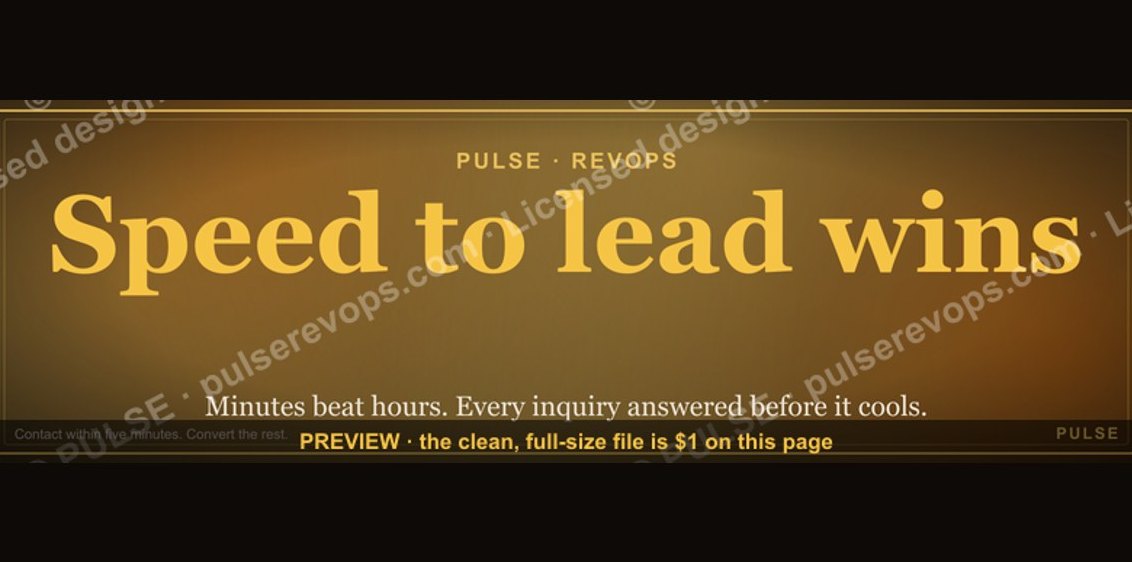 graphicSpeed to lead wins. — LinkedIn Wallpaper
 graphicWhat criteria should I use to choose a graphics design tool for sales presentations in 2027?
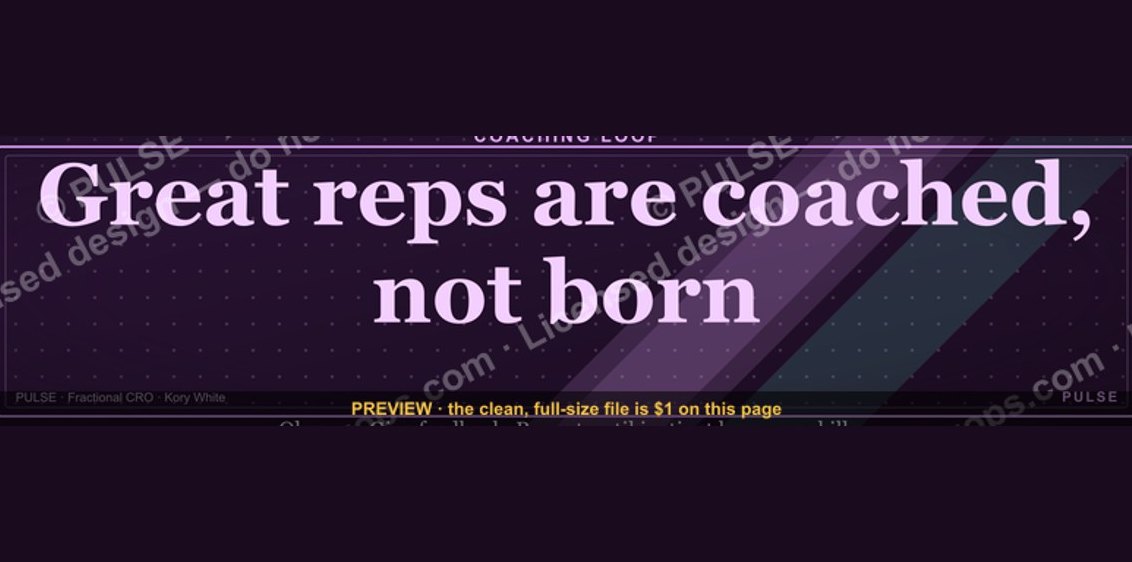 graphic“Great reps are coached, not born.” — LinkedIn Banner
 graphic“Looking for my next quota.” — LinkedIn Banner
 graphicOne team. One number. — LinkedIn Wallpaper
 graphicSell outcomes, not features. — LinkedIn Wallpaper
 graphic“Don’t pitch. Diagnose.” — LinkedIn Banner
 graphicLLM Builder AI Engineer — LinkedIn Banner
 graphicSales Recruiter — LinkedIn Banner
 graphicInspect. Qualify. Commit. — LinkedIn Wallpaper