
Make selling effortless. — LinkedIn Wallpaper
 Curated byKory White · Fractional CRO · Maryland
 PULSEKNOWLEDGE LIBRARY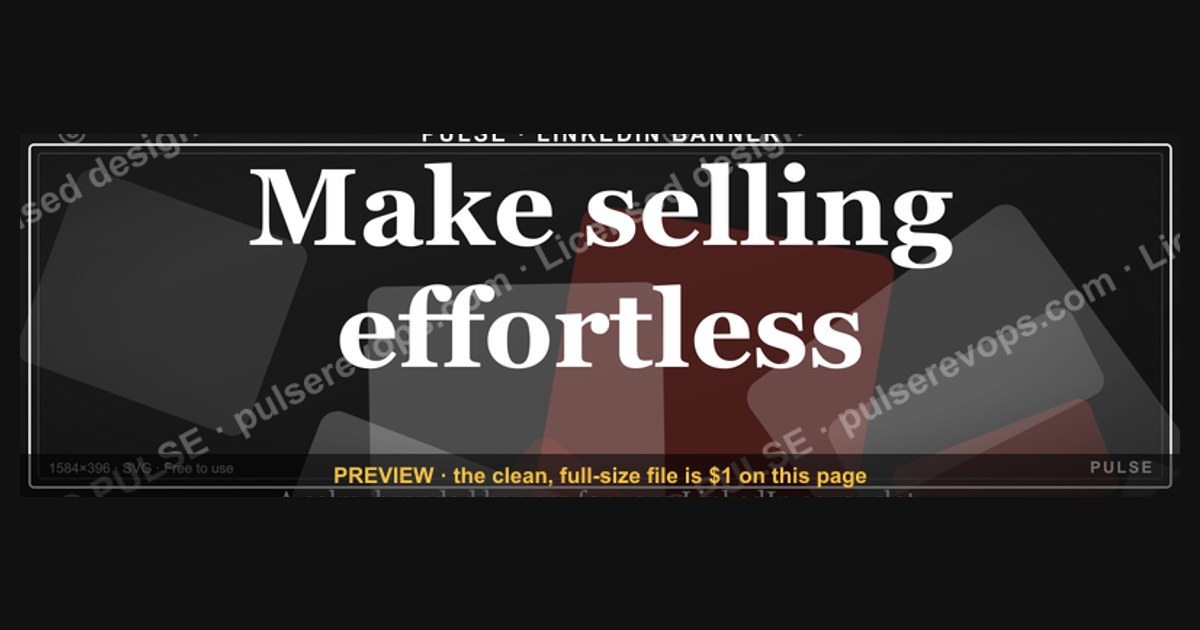
LinkedIn wallpaper is a design tool that lets you create a branded, professional background image for your LinkedIn profile, helping you stand out without needing design skills. It offers templates and customization options to match your personal or company brand, making the process quick and straightforward. This can save you time while ensuring a polished, consistent look that supports your networking or sales goals.
Make selling effortless. — LinkedIn Wallpaper

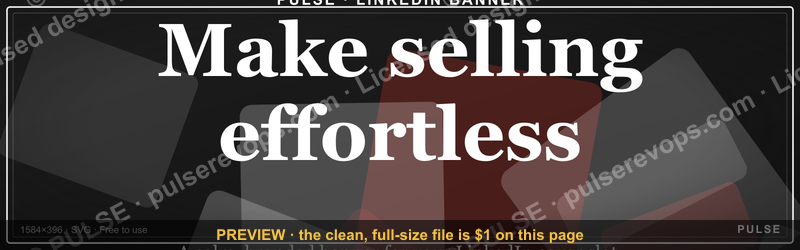
A dark, on-brand LinkedIn cover wallpaper — a soft gradient-mesh backdrop with a "Make selling effortless." line and the Pulse mark. A clean, branded banner for your profile.
Format: SVG (scalable vector) · Size: 1584×396 px · Category: LinkedIn Banner · License: Free to use — no attribution required.
Recolor it to your brand
Use the color picker above to recolor this banner to your team or company colors, switch the background (including transparent), then download it as an SVG or PNG. No sign-up, no watermark.
How to use it
It scales cleanly to the LinkedIn cover slot (1584×396) — download the PNG and drop it straight onto your profile, or open the SVG in Canva, PowerPoint, or Figma to add your name and tweak the layout.
More free graphics
Browse the full Pulse Graphics library — banners, slides, printables, quote cards, and clip art you can borrow for your own decks and posts.

Related on PULSE
- Make it predictable. — LinkedIn Wallpaper
- “MAKE THE CALLS” — Sales Floor Print
- “Make the buyer the hero.” — Quote Card
- “Make the buyer the hero.” — LinkedIn Banner
- The Value Selling Ladder — Infographic
- SPIN Selling — Infographic
The Psychology of Effortless Selling: Why Less Really Is More
The phrase “make selling effortless” might sound counterintuitive to anyone who has spent years perfecting a high-pressure pitch or memorizing objection-handling scripts. Yet the most successful sales professionals have long understood a paradox: the harder you push, the harder the customer pushes back. Effortless selling isn’t about being lazy—it’s about removing friction from the buyer’s journey so that the sale feels like a natural next step rather than a forced transaction.
When you examine the neuroscience behind purchasing decisions, a clear pattern emerges. The human brain is wired to avoid loss and conserve energy. Every additional question, extra form field, or unnecessary meeting represents cognitive load—and cognitive load kills deals. Research in behavioral economics suggests that for every extra step in a sales process, conversion rates can drop by anywhere from 10% to 30%. This isn’t speculation; it’s the reason companies like Amazon and Uber stripped their checkout flows to the absolute minimum.
Effortless selling, then, is about designing a system where the buyer’s path to “yes” is shorter, smoother, and more intuitive than the path to “no.” This starts with understanding the three psychological triggers that make selling feel easy:
- Cognitive fluency – Information that is easy to process feels more true and trustworthy. When your messaging is clear, your pricing is transparent, and your process is predictable, the buyer’s brain relaxes. They don’t need to “figure out” what you’re selling or why it costs what it does.
- Loss aversion reversal – Traditional sales often triggers fear of making a bad decision. Effortless selling reframes this: instead of worrying about what they might lose by saying yes, the buyer sees what they’re losing every day by not taking action. This shift from “risk of purchase” to “cost of inaction” is subtle but powerful.
- Social proof compression – Instead of forcing buyers to research independently, effortless selling surfaces the right social proof at the exact moment of hesitation. A single testimonial from a peer in their industry, placed at the point of decision, can replace hours of back-and-forth.
The practical application of these principles is where the LinkedIn wallpaper comes into play. Your LinkedIn profile background is often the first visual element a prospect sees before reading a single word of your headline or experience. If that wallpaper is cluttered, generic, or self-congratulatory, it creates friction before you’ve even opened your mouth. A wallpaper that whispers “I understand your world” rather than shouting “Look at my achievements” primes the viewer for a conversation that feels natural, not forced.
Consider the difference between a wallpaper that lists your awards and company logos versus one that shows a clean, relevant visual that hints at the transformation you deliver. The first triggers skepticism (“This person is bragging”); the second triggers curiosity (“What’s their approach?”). Curiosity is the engine of effortless selling—it makes the buyer lean in rather than lean away.
Designing Your LinkedIn Wallpaper for Zero-Friction Engagement
Your LinkedIn wallpaper is not a decoration. It is a piece of real estate that either accelerates or stalls the buyer’s journey. In the context of making selling effortless, every pixel should serve a specific purpose: reducing the time it takes for a prospect to understand who you help and how you help them.
The most effective LinkedIn wallpapers for effortless selling share three structural characteristics. First, they use a clear visual hierarchy. The human eye scans images in a predictable pattern—usually left to right, top to bottom. Your wallpaper should place the most important element (your value proposition or a visual metaphor for your outcome) in the upper-left quadrant, where attention naturally lands. Secondary elements like logos or keywords should flow downward and to the right.
Second, they embrace negative space. A common mistake is trying to cram every service, certification, and achievement into the wallpaper. This creates visual noise that forces the viewer to work harder to understand your message. Work equals friction. A wallpaper with 60% to 70% negative space allows the remaining content to breathe and land with impact. Think of it like a well-designed landing page: the fewer elements, the more each one matters.
Third, they incorporate a subtle call to action that doesn’t feel like one. Instead of “Book a call now” (which triggers resistance), consider a URL or handle that implies value: “GetTheGuide.com” or “StrategySession.” The best calls to action on a wallpaper are those that feel like an invitation to learn, not a demand to buy.
Color psychology also plays a role in effortless engagement. Blues and greens are associated with trust and calm, making them ideal for B2B contexts where credibility is paramount. High-contrast colors like orange or red can work for urgent, high-energy offers, but they risk creating a sense of pressure that contradicts the “effortless” ethos. The safest approach is to use your brand’s primary color as an accent, with neutral backgrounds (white, light gray, or soft beige) dominating the frame.
Typography is equally critical. Avoid script fonts, overly decorative typefaces, or anything that requires squinting. Sans-serif fonts like Inter, Roboto, or Open Sans are legible at small sizes and convey modern professionalism. If you include text, keep it to fewer than eight words. A wallpaper is not a billboard for your bio—it’s a visual handshake.
Finally, consider the mobile experience. Over 60% of LinkedIn users access the platform via mobile devices. On a phone screen, your wallpaper is significantly smaller and competes with your profile photo and headline for attention. Test your wallpaper on a mobile view before publishing. If text becomes unreadable or logos turn into blurry squares, simplify. A wallpaper that looks great on desktop but terrible on mobile is creating friction for the majority of your viewers.
The Effortless Sales Sequence: From Wallpaper to Conversation
A great wallpaper gets the prospect to stop scrolling. But making selling effortless requires a seamless transition from visual interest to meaningful conversation. This is where most sales professionals drop the ball—they invest in a polished profile but then rely on cold outreach or generic connection requests that undo all the goodwill their wallpaper built.
The effortless sequence works like this: your wallpaper signals relevance and curiosity. A prospect views your profile and feels a spark of recognition (“This person gets my industry”). Instead of waiting for them to message you (which most never will), you use that moment of engagement as a trigger for a low-friction follow-up.
LinkedIn’s “Who’s viewed your profile” feature is your best friend here. When you notice a prospect from your target account or industry has viewed your profile, you have a warm opening that requires no cold pitch. A simple message like “Noticed you checked out my profile—anything specific you were curious about?” is disarming and invites a response. The wallpaper did the heavy lifting of establishing relevance; your message simply opens the door.
For outbound efforts, your wallpaper serves as credibility backup. When you send a connection request, the recipient will likely glance at your profile before accepting. If your wallpaper reinforces the value you mentioned in your request, the acceptance rate climbs. If your wallpaper is generic or irrelevant, they may ignore the request entirely.
Another effortless tactic is to use your wallpaper as a conversation starter in comments or posts. If you’re engaging in a discussion about sales challenges, you can reference your wallpaper’s theme: “That’s exactly why I designed my profile around removing friction—curious if you’ve tried a similar approach.” This feels natural, not salesy, and positions you as someone who practices what they preach.
The ultimate goal is to create a system where selling feels like helping. Your wallpaper is the first touchpoint in that system. It should answer the unspoken question every prospect has: “Can this person solve my problem without wasting my time?” If your wallpaper communicates that you understand their world and respect their time, you’ve already cleared the biggest hurdle.
Remember, effortless selling isn’t about tricking people into buying. It’s about aligning your presentation, your process, and your personality so that the buyer’s path to a decision is as smooth as possible. Every element of your LinkedIn presence—from the wallpaper to your headline to your messaging—should be designed to reduce friction, not add to it. When you get that right, selling doesn’t feel like selling at all. It feels like a natural conversation between two professionals who see the same problem and are exploring a solution together.
Sources
- LinkedIn Business Blog — official insights on LinkedIn features, best practices, and sales tools
- Harvard Business Review — articles on sales strategy, professional branding, and digital marketing
- Salesforce — resources on CRM, sales automation, and customer relationship management
- Social Media Examiner — guides on using social platforms like LinkedIn for business growth
- HubSpot Blog — content on inbound sales, lead generation, and social selling techniques
- Pew Research Center — data on social media usage trends and professional networking behaviors
FAQ
What does "make selling effortless" actually mean? It means removing friction from your sales process — automating repetitive tasks, aligning your team around a repeatable playbook, and focusing energy on high‑impact conversations instead of administrative overhead. The result is a smoother path from prospect to close.
Is this approach only for B2B SaaS companies? No, the principles apply broadly, but the tactics are most directly relevant to B2B teams with a defined sales cycle. Companies in professional services, consultative selling, or any business with a repeatable deal flow can adapt the same mindset.
How long does it take to see results from implementing these methods? Honest ranges vary widely — some teams see improvements in a few weeks, while others need a quarter or two to fully embed new habits and systems. The timeline depends on your starting point, team size, and how consistently you execute.
Do I need a dedicated sales operations person to make this work? Not necessarily, but having someone own the process — even part‑time — accelerates progress. Many small teams start with the founder or a senior rep taking on ops tasks, then hire a specialist as revenue grows.
Will this work if my product has a long, complex sales cycle? Yes, but the effort required increases with complexity. For enterprise deals with many stakeholders, "effortless" means streamlining internal handoffs and data tracking, not eliminating the need for relationship building. The core idea still applies: reduce wasted motion.
What's the biggest mistake companies make when trying to make selling effortless? Trying to automate or simplify too much too fast, without first understanding their actual bottlenecks. Common pitfalls include buying a CRM before defining a process, or adding tools that create more work than they save. Start with one clear friction point and fix it before scaling.
This page will be disappearing soon. Save it to your device for $1 — or read it free while it is here.
@Kory-White- · if Venmo asks, the last 4 of my number are 2012
This page is gone.
This one is off the shelf now. $1 keeps it on your phone for good — the whole page, pictures and diagrams included.
 graphic“Great reps are coached, not born.” — LinkedIn Banner
 graphicSpeed to lead wins. — LinkedIn Wallpaper
 graphic“Looking for my next quota.” — LinkedIn Banner
 graphic“Motion creates momentum.” — LinkedIn Banner
 graphicLLM Builder AI Engineer — LinkedIn Banner
 graphic“Revenue that delights.” — LinkedIn Banner
 graphic“Data beats opinions.” — LinkedIn Banner
 graphic“The next call is the most important one.” — LinkedIn Banner
 graphic“Trusted advisor, never a vendor.” — LinkedIn Banner
 graphicOffensive Security Pentest CRO — LinkedIn Banner