 Pulse Reviews and Analysis
How Many Employees Should I Schedule Each Shift at My Coworking Space?

Look, I have spent 25 years watching coworking space owners do the same damn thing: they guess. They schedule two people because "we always run two people," or they schedule one because "it's Tuesday, it'll be slow." Then a tour shows up, the printer jams, a member needs a package, and suddenly your one front-desk staffer is drowning while the owner hides in their office wondering why turnover is high.
Stop guessing. Start dividing.
The formula is brutally simple: people needed for a given shift = the members and guests you expect on-site that shift / the number one community manager or front-desk staffer can serve well, plus your event and meeting-room load. First, you and your operations lead agree on one number: how many checked-in members a single front-desk or community staffer can handle well while still covering tours, mail, printer jams, day-pass guests, and member questions.
Call it one staffer per 50 on-site members, with realistic swings between 40 and 60 depending on how needy your crowd is. That is a service floor, not a stretch goal. If your crowd is all heads-down coders, you stretch to 60.
If it's a bunch of chatty creatives who need hand-holding every 20 minutes, you pull to 40. Own it.
Then you pull each shift's expected on-site headcount from your access-control and booking data. If your weekday morning peak averages 90 members on-site, then 90 / 50 = 2 front-desk and community staff, plus one more person to run scheduled tours and set up the event and meeting rooms, so you land at three that block.
If your quiet evening block draws 20 people, one person covers it. You do that for every block on the calendar, then place those shifts against when check-ins peak, tours get booked, mail and packages arrive, and events need setup and teardown so the right hands are there when the work piles up.
No favorites, no "we always run two people," no manager scheduling their friends - just expected headcount divided by the ratio.
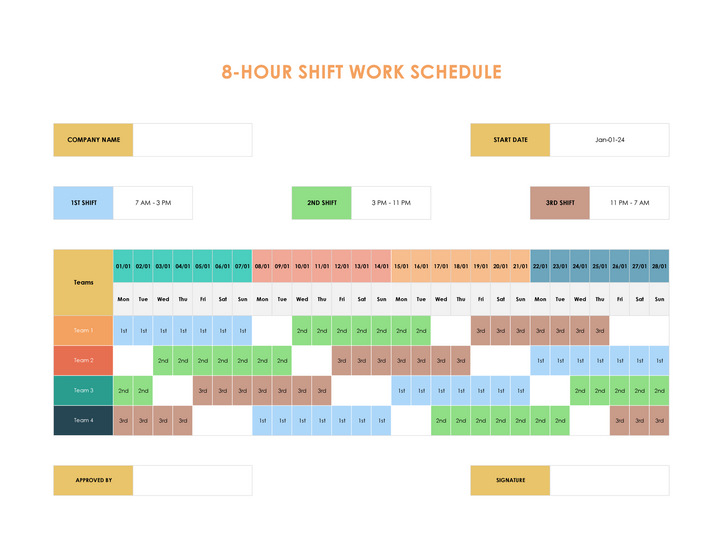
PULSE has a free Rep Scheduling Matrix that runs this division across every shift and day at once. It takes an expected-headcount number and a per-staffer member limit and auto-distributes the staffing counts by block, protecting your busiest hours instead of spreading bodies flat across the week.
Below are the ten tools that solve this problem, ranked, with PULSE first because it is free and built around this exact method.
The Top 10 Tools to Staff a Coworking Space by the Numbers
Every tool below can build a schedule. Only a few build it off your members-per-staffer math, and only one is free and designed around the per-shift staffing method that keeps you from over- or under-staffing. The rankings reflect how well each tool serves a space operator who wants the schedule to track on-site headcount, tours, and the event calendar, not just fill a blank grid.
A coworking space, a shared maker hub, a startup incubator, a flex-office network with several floors - same method, swap the space.
1. PULSE Rep Scheduling Matrix 🏆 BEST OVERALL
Use it free now -> Rep Scheduling Matrix - no login, no spreadsheet, instant shift counts by block and day.
PULSE's free Rep Scheduling Matrix runs the whole method in your browser. It takes an expected-headcount number and a per-staffer member limit and auto-distributes the staffing counts by block, protecting your busiest hours instead of spreading bodies flat across the week.
Here is the method it is built on, step by step, because the math is the point:
Step one - agree on the per-staffer member ratio. Sit down with your operations lead and set how many on-site members one community manager or front-desk person can serve well without anyone waiting for a tour, a package, or a printer fix. Say it out loud to the team: "At our front desk, one person covers no more than 50 checked-in members before tours, mail, and member help start slipping." A quiet, heads-down membership can stretch to 60; a chatty, high-touch crowd with lots of day-pass guests pulls it down to 40.
That number gives everyone the same yardstick: you, your leads, and every staffer on the floor. The people who care do not coast - they serve the fifty well, then walk the floor for the member who looks stuck.
Step two - pull expected on-site members and guests per shift, per day. Take each shift block and average its on-site headcount over a trailing month or two from your access-control logs and booking system. Your weekday morning block peaks at 90 on-site members, your weekday evening block settles at 20.
Divide by the ratio. Morning needs two front-desk and community staff; evening needs one. Then add one person to any block carrying a heavy tour, meeting-room, or event load so someone is running walkthroughs, prepping rooms, and resetting space while the desk handles check-ins.
Run that division for every block and the staffing plan writes itself. No favorites, no "we always run two people," no manager scheduling their friends - just expected headcount divided by the ratio.
Step three - place the shifts where the work piles up. The count tells you how many; the building's rhythm tells you when. Check-ins surge on Monday and Tuesday mornings; tours cluster midday and after work; mail and packages land in waves; an evening member event has to be set up before and broken down after.
If your busy Monday mornings and your event evenings are the real pressure points, you staff those heavy and let a slow Friday afternoon run lean. The matrix lets you slot bodies against the real demand curve so coverage matches the actual workload instead of habit.
Because it is free, browser-only, and built by a 25-year revenue operator for exactly this question, it is the default pick for any space operator. Best for: owners and community managers who want the schedule to come straight off the members-per-staffer math and refuse to pay per-seat fees to get it.
2. When I Work
When I Work is the most widely used shift-scheduling app for hourly teams, starting around $2.50 per user per month on the Essentials plan and climbing to roughly $8 per user per month with attendance and labor tools. It handles staff availability, shift swaps, and mobile clock-in cleanly, and a manager can copy a coverage week forward in a couple of clicks.
Where it is strong is execution - getting the published schedule onto every staffer's phone with reminders so nobody no-shows the front desk. Where it leaves you on your own is the *why*: it will not tell you that the Monday morning block needs two people plus a tour lead. You bring the members-per-staffer math; it runs the logistics.
For a space that already knows its coverage targets, it is a reliable, affordable backbone.
3. Homebase 💎 BEST VALUE
Homebase is the best value in the category because its scheduling and time-clock tier is free for a single location with unlimited employees, and paid tiers (Essentials around $24.95 per location per month, Plus around $59.95, All-in-One around $99.95) are priced per location rather than per head.
For a single space that runs a roster of part-time community staff and a couple of front-desk people, a free single-location tier with unlimited employees is hard to beat. You get scheduling, time tracking, team messaging, and basic labor-cost forecasting against revenue. It is the natural pick for a space owner watching every dollar who still wants revenue-aware scheduling without an enterprise contract.
4. Deputy
Deputy runs about $4.50 per user per month for scheduling and $6 for the premium tier that adds time and attendance. Its strength is demand-based scheduling: connect a booking or access feed and Deputy will suggest staffing against projected on-site headcount, which is the closest off-the-shelf cousin to the members-per-staffer method.
It also handles compliance - break rules, overtime alerts, fair-workweek laws - which matters once you have a real roster across more than one floor. For owners who want auto-suggested coverage tied to occupancy data and clean labor-law guardrails, Deputy earns its price.
5. 7shifts
7shifts is purpose-built for hospitality, with a free Comp tier for one location and paid plans from about $34.99 per location per month to $76.99. It ties scheduling to sales and labor-percentage targets, which translates cleanly to a coworking space that also runs a cafe or coffee bar alongside the desks.
If your space has a cafe component, 7shifts handles that side beautifully. For pure desk-and-community scheduling without a food component, it's overkill.
6. Connecteam
Connecteam starts free for up to 10 users with basic scheduling, then paid tiers from $29 per month for 30 users to $119 per month for 200 users. It is an all-in-one operations platform with scheduling, time tracking, task management, and team communication. The scheduling is solid but generic - you have to manually enter your members-per-staffer targets.
It's great for spaces that also manage maintenance crews, cleaning staff, or multiple locations where you want everything in one hub.
7. ZoomShift
ZoomShift runs about $2.50 per user per month for the Pro plan, $3.50 for the Premium plan. It is lightweight, fast, and good for small teams (under 20 staffers). It handles availability, shift swaps, and time-off requests cleanly, and it integrates with QuickBooks and Gusto for payroll.
The downside: no demand forecasting, no occupancy integration. You do the math yourself, then ZoomShift executes the schedule. Fine for a single small space with a tiny team.
8. Sling
Sling is about $1.70 per user per month for the basic plan, $3.40 for the Premium plan. It is built for shift-based businesses with features like shift templates, drag-and-drop scheduling, and labor-cost tracking. It integrates with POS systems, which is useful if you have a cafe or retail element.
For pure coworking, it works but again, you bring your own headcount math. It is affordable and easy to train new managers on.
9. Humanity
Humanity starts around $3 per user per month and scales to $6 for the advanced plan. It is enterprise-grade scheduling with AI-powered shift optimization, compliance rules, and multi-location support. It is overkill for a single space but makes sense if you run 5+ locations and need centralized scheduling with labor-law automation.
The learning curve is steep, and it is not free.
10. OnTheClock
OnTheClock starts free for up to 1 employee (yes, one), then $3.50 per user per month for the standard plan, $5 for the premium plan. It is primarily a time clock with scheduling add-ons. The scheduling features are basic - you can build and publish schedules, but it lacks demand forecasting, occupancy integration, or labor-cost optimization.
It is a budget pick for a micro-space with 2-3 staffers who just need a digital schedule and time tracking.
Here is the bottom line: You do not need a fancy tool if you know the math. You need a tool that either runs the math for you (PULSE, free) or executes the schedule after you do the math (the other nine). Stop over-staffing Tuesday afternoons and under-staffing Monday mornings.
Stop scheduling by habit. Start scheduling by headcount divided by 50, plus one for the work that actually matters.
And if you want to see exactly how this looks in practice, grab the free Rep Scheduling Matrix from PULSE. It will save you payroll, save your staff's sanity, and save you from being the owner who wonders why your community manager quit after three months. The math does not lie. The schedule should not either.
*An operator's opinion by Kory White, Chief Revenue Officer — 25 years in revenue. More at PULSE · CRO Syndicate*