


High-Profit Prospecting by Mark Hunter — Cliff Notes Summary & Key Takeaways
Quality
Certified
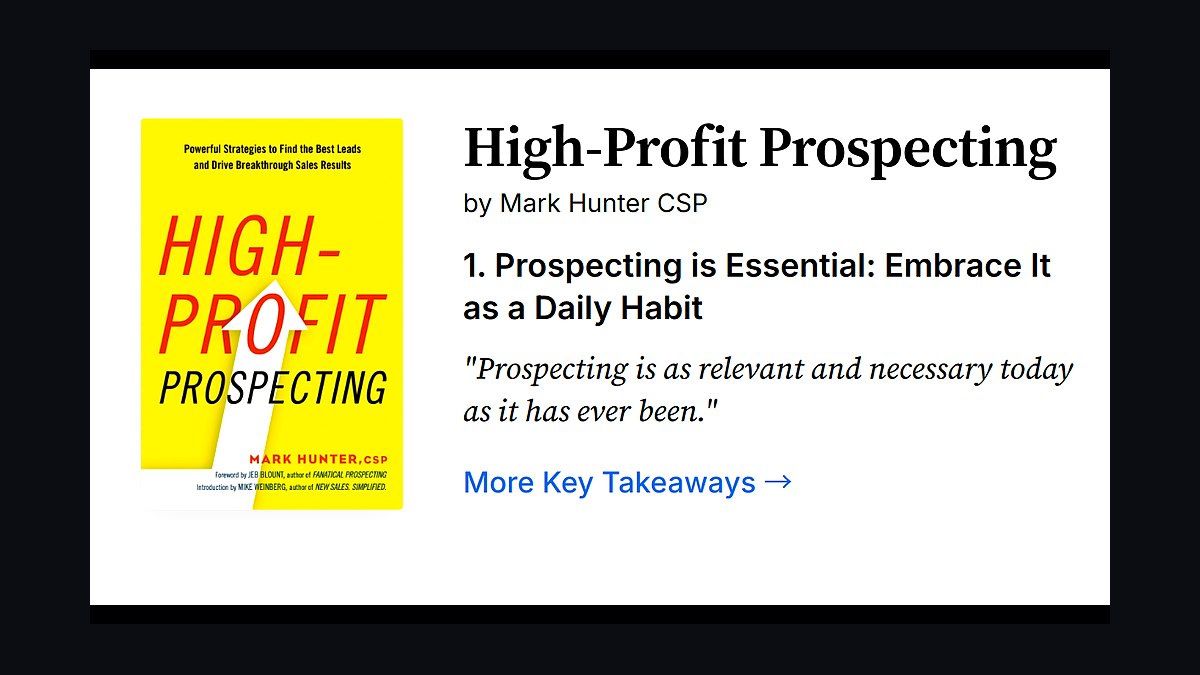
High-Profit Prospecting (Mark Hunter, AMACOM, 2016) argues prospecting is the single biggest determinant of sales success — and that it is a precision exercise, not a volume one. The strategy: a tight ideal customer profile, time-blocked mornings, a four-part 30-second commercial, coordinated multi-channel touches, and absolute refusal to discount.
The rep who has a pipeline problem and calls it a closing problem
Picture a mid-market AE carrying a $1.2M quota against a territory of 2,000 accounts. She dials hard — 60 calls a week, a decent connect rate, plenty of "send me some info." Her calendar looks busy. Her forecast looks fine in month one and collapses in month three. Her manager's diagnosis is that she needs closing training. Hunter's diagnosis, delivered in the first ten pages of the book, is the opposite: she does not have a closing problem, she has a pipeline problem wearing a closing costume. The deals she is trying to close were badly chosen before the first call ever happened.
This is the scenario the whole book is built to dismantle, and it's worth sitting with because it generalizes far past B2B software. A commercial insurance producer working every business in a zip code, a staffing agency recruiter calling every hiring manager on a job board, an equipment distributor quoting anyone who asks — all of them face the same failure mode. Broad targeting produces a pipeline full of people who will only ever buy on price, because price is the only variable they can evaluate. When your pipeline is stocked with price-shoppers, the close rate goes down and the discount rate goes up simultaneously, and no amount of objection-handling coaching fixes either.
Hunter's second move is to attack the three excuses reps use to avoid the real work. The first is that inbound marketing has replaced outbound — his counter is that inbound builds a minority of pipeline in most B2B orgs and that the accounts you most want are rarely the ones filling out a form. The second is that prospecting belongs to the SDR, not the AE — his counter is that an AE who never prospects becomes a coin-operated order-taker, entirely dependent on whatever pipeline someone else hands them, and structurally unable to influence the quality of their own book. The third is that prospecting is a numbers game — his counter is that dialing more without targeting better is the fastest way to burn through your list and your own motivation at the same time.

The reframe that follows is the book's spine: the prospects you bring in determine the deals you close, and the deals you close determine the margin you earn. Prospecting is therefore a margin-defense activity that happens months before anyone talks about price. Bring in fit prospects with real, urgent pain in your sweet spot, budget authority, and no procurement-led RFP, and you close near list. Bring in tire-kickers, and you close at a discount or not at all. Hunter's most-quoted line lands here: if your only differentiator is price, you have no differentiator.
How the mechanism actually works, step by step
The book is not a collection of tips; it's a closed loop where each stage sets up the next, and skipping a stage shows up as damage two stages later. Understanding the sequencing is what separates people who "read Hunter" from people who run Hunter.
Stage one — narrow the ideal customer profile. Hunter runs a six-filter worksheet: industry, revenue band, employee count, tech-stack or operational signal, pain trigger, and buying-process shape. That last filter is the one most teams skip and the one that most directly protects margin — an account that buys through a procurement-led competitive RFP is structurally a discount deal regardless of how good your discovery is. The output is deliberately small. Hunter pushes reps toward roughly 200 named accounts rather than "every mid-market manufacturer in North America," on the logic that depth on a small list beats shallow coverage of a huge one by a wide multiple.

Stage two — qualify multiplicatively, not additively. Hunter's stack is Pain × Need × Budget × Authority × Time. The multiplication is the whole point. A prospect with budget, authority, and timeline but no pain is not a prospect; they are a courtesy meeting that will die in the forecast. A prospect with screaming pain and no authority is not a prospect either; they are a coach, valuable but not a buyer. Score each axis 0–5, and treat anything under roughly 15 out of 25 as a disqualification rather than a nurture. The chapter's warning about the "happy ear" — hearing "interesting" as "interested," and "send me info" as "I'll buy" — is the most useful sentence in the book for anyone building a forecast.
Stage three — earn the conversation with a 30-second commercial. Four parts: who you specifically help (industry plus role, not "companies like yours"), the specific outcome you create with a number attached, one concrete proof point, and a diagnostic question that earns the next five minutes. The question is never "are you interested?" — it's something the prospect has to think about, which is what converts a pitch into a conversation. The commercial signals expertise without asking for anything, which is precisely why it works.
Stage four — open on the trigger, not the product. Hunter rejects the build-rapport-first school. State your name, your company, why you are calling this specific person, and ask permission for thirty seconds. The "why this person" clause is the load-bearing one: a hiring pattern, an earnings-call comment, a facility expansion, a leadership change. Openers that name a specific observable trigger convert dramatically better than generic ones, because they prove you did work before you dialed.

Stage five — close the loop with referrals. Every closed deal should produce two or three named referrals, and the reason most reps get none is that they either don't ask or ask badly. Hunter's script anchors on the delivered win, names the exact role and industry he wants introduced to, and — the part that actually makes it work — offers to draft the intro email for the customer to forward. Removing the drafting friction is worth more than any amount of rapport.
The downstream effect is what makes the loop worth running: referral-sourced accounts arrive pre-qualified on authority and trust, which means they land higher in the qualification stack on day one, which means they close closer to list. The loop feeds itself.
Real numbers, ranges, and benchmarks
Hunter is more numerate than most sales authors, and the figures he leans on are the reason the book survives re-reading. A few are worth holding onto as planning constants — with the caveat that these are the book's own claims and directional guidance, not universal law, and any team should validate them against its own CRM before betting a comp plan on them.
Account list size. Roughly 200 named accounts per rep. That is the number that lets a rep actually know each account's trigger events, org chart, and buying-process shape. At 2,000 accounts you are running a mail-merge; at 200 you are running a territory. If your average deal cycle is six to nine months and you need 20 closed deals a year, 200 accounts is a plausible working set. If you sell a $5k product with a two-week cycle, the number scales up — the principle is depth per account, not the literal figure.

Touch counts. Most decision-makers require something in the range of seven to twelve coordinated touches across at least three channels before they respond. The word doing the work is *coordinated* — twelve identical voicemails is one touch repeated twelve times. Hunter's contrast: reps who work a single channel plateau in the high single digits to low teens on response rate, while reps running true multi-channel cadences roughly double or triple that. Whatever your absolute numbers, the relative gap between one-channel and three-channel outreach is the durable finding.
Cadence window. Fourteen to twenty-one days per account for a full cycle, with at least one touch per channel. Compressed cadences that fire five emails in four days read as automation and get filtered; cadences stretched over three months lose the trigger event that justified the outreach in the first place.
Email geometry. Subject lines under five words. Bodies under ninety words. One ask, not three. Trigger event in the first line, proof point in the second, single question to close. Hunter bans four openers outright — "just checking in," "touching base," "following up," and "I wanted to reach out" — on the grounds that each announces you have nothing new to say.
Voicemail. Under eighteen seconds, name and company stated twice (open and close), one trigger, one question, callback number said slowly. Hunter's own testing put long voicemails in the low single digits for callbacks and short ones several times higher. This is the chapter that has aged the hardest — B2B voicemail callback rates have fallen far enough that many teams skip the leave entirely and treat the dial as a channel-touch that sets up the email.
Time blocking. Three hours, 8–11 AM, every weekday, protected like surgery. No email, no internal meetings, no Slack. Hunter's claim is that reps who hold the block for roughly 90 consecutive days move their pipeline coverage from around 2x quota to around 4x. The 90-day framing matters more than the specific ratio: prospecting has a lag equal to your sales cycle, so any rep who evaluates the discipline after two weeks will conclude it doesn't work.

Pricing. The number Hunter builds his most distinctive chapter on is the classic pricing-leverage finding that a 1% price improvement can translate to roughly an 11% improvement in operating profit for a typical company — and symmetrically, that a 1% discount destroys a comparable share of profit. The exact multiplier depends entirely on your cost structure; the direction and the magnitude do not. A rep who "just" gives 10% to close faster is not giving away 10% of anything — they are giving away a large fraction of the deal's contribution.
Close-rate spread by prospecting quality. Hunter's summary claim: a well-prospected deal — fit ICP, quantified pain, confirmed authority, validated budget — closes at list price the large majority of the time. A poorly prospected deal closes only when you attach a meaningful discount, if it closes at all. The premium close, in other words, is upstream work. Nothing you say on the closing call recovers a deal that was badly sourced.
Trade-offs, alternatives, and where this sits in the canon
No framework is free, and Hunter's has real costs worth naming before you adopt it wholesale.
The narrow-ICP trade-off. Cutting to 200 named accounts means deliberately ignoring revenue you could have won. In a down market, or for a rep in a small territory, the tight list can starve the top of funnel before the depth strategy pays off. The honest version of this trade is: narrow ICP raises average deal quality and margin, but lengthens time-to-first-deal for a new rep. Ramping AEs often need a wider list for two quarters and a narrower one after. Teams that force day-one narrowness on new hires tend to churn them.

The never-discount trade-off. Absolute pricing discipline costs you deals — sometimes good ones, on timing rather than value. Hunter's answer is that the right move is to reduce scope or add value rather than cut price, which preserves the price-per-unit-of-value signal. That works cleanly for modular offerings and poorly for monolithic ones. If your product cannot be scoped down, "never discount" becomes "sometimes walk away," and that requires management air cover the average rep does not have. The discipline is a org-level commitment or it is nothing.
The multi-channel trade-off. Running five channels per account is expensive in rep-hours. At 200 accounts with 7–12 touches each, you are looking at well over a thousand deliberate actions per cycle. This is precisely why the modern stack exists — and why blindly automating Hunter's cadence produces spam. The channels multiply reach; they also multiply the blast radius of a bad ICP.
Where it sits against the neighbors. The prospecting canon runs roughly Konrath's *Selling to Big Companies* (2005) → Sobczak's *Smart Calling* (2010) → Weinberg's *New Sales. Simplified.* (2012) → Blount's *Fanatical Prospecting* (2015) → Hunter's *High-Profit Prospecting* (2016). Blount is about volume and emotional discipline — the grind, and the psychology of doing hard things daily. Weinberg is about the operating system: target list, weapons, story. Sobczak is about killing the "cold" in cold calling through research. Konrath is about getting into large, slow organizations. Hunter's distinct contribution is the pricing thread woven through every chapter — he is the only one in that lineup who treats prospecting primarily as margin defense. If you read only one for motivation, read Blount. For targeting and price integrity, read Hunter.
Against modern qualification frameworks. Pain × Need × Budget × Authority × Time is simpler than MEDDPICC and better suited to the top of funnel, where you have partial information and need a fast disqualify. MEDDPICC earns its complexity later, once you're inside a deal and need to map champions, economic buyers, and decision criteria. Using MEDDPICC as a prospecting filter is over-engineering; using Hunter's stack as a late-stage deal review is under-engineering. Run both, at different altitudes.
Common pitfalls and how to avoid them

Pitfall: adopting the tactics and skipping the ICP. The most common failure is copying the 30-second commercial and the email rules while leaving the account list untouched. A perfect commercial delivered to the wrong 2,000 people is a well-crafted waste. Fix: do the ICP cut first, in writing, and get a manager to sign off on the named list before any new cadence goes live.
Pitfall: treating the morning block as aspirational. The 8–11 AM block dies the first week unless it's defended structurally. Fix: put it on the calendar as a recurring busy block, move internal standups and one-on-ones to afternoons at the team level, and measure block adherence rather than dial counts. If the manager books an 8:30 pipeline review, the discipline is dead and the manager killed it.
Pitfall: measuring the block too early. Prospecting pays out one sales cycle later. A rep who blocks mornings for three weeks and sees no closed revenue will conclude the system failed. Fix: measure leading indicators during the lag — meetings booked, accounts with a live trigger, coverage ratio — and hold the strategy for at least one full cycle before judging it.
Pitfall: automating the cadence before validating the message. The modern stack makes it trivial to send a thousand versions of a bad email. Fix: run a cadence manually against twenty accounts, measure reply rate and reply *quality*, and only then load it into a sequencer. AI-generated personalization on top of an unvalidated message just produces better-written spam at higher volume.

Pitfall: the happy ear in the forecast. Reps score their own deals generously because the pipeline number is socially rewarded. Fix: make the Pain × Need × Budget × Authority × Time score a required CRM field with the axis-level numbers visible, and have a second person score any deal above a revenue threshold. Multiplication makes the zeros obvious in a way a checkbox stage never does.
Pitfall: discounting quietly at the rep level. Even in orgs that formally forbid discounting, reps invent workarounds — extra seats thrown in, a free implementation, a longer pilot. These are discounts with better manners. Fix: price every concession internally and put it on the deal record, so the true realized price is visible. You cannot enforce a pricing strategy you cannot measure.
Pitfall: asking for referrals at the wrong moment. The referral ask fails when it comes at signature, before the customer has any results to point to. Fix: schedule the ask against a delivered outcome — the first quarterly review where the numbers hit — and bring the specific role and industry you want, plus a drafted email.
Pitfall: outsourcing all prospecting to SDRs and calling it done. Splitting prospecting off entirely gives AEs a pipeline they didn't choose and can't defend on price. Fix: even in a heavily specialized org, keep a slice of AE-sourced prospecting on the top accounts. The accounts the AE sources personally are usually the ones that close nearest list.
Related questions
Is High-Profit Prospecting worth reading if I already read Fanatical Prospecting?
Yes — they solve different problems. Blount gives you the discipline to prospect daily; Hunter gives you the targeting and pricing rules that decide whether that daily effort produces margin or noise. Read Hunter second, as the precision layer on top of the volume layer.
What should a sales manager implement first from the book?

The named-account cut. Force every rep to reduce their working list to roughly 200 accounts with a written six-filter rationale. It costs one afternoon, requires no tooling, and changes every downstream metric — connect rate, close rate, and realized price.
Does the never-discount rule work in usage-based or consumption pricing?
Arguably better. Consumption models let you reduce committed volume instead of unit price, which is exactly Hunter's "reduce scope, not price" move made native to the pricing model. The list rate stays intact and the customer still gets a smaller first bill.
How much of the book has been automated away?
Most of the execution, little of the judgment. List building, intent signals, and cadence orchestration are now tooling problems. Choosing the ICP filters, deciding what counts as a real trigger, and holding the price line remain human calls no sequencer makes for you.
What if my company has no proof point for the 30-second commercial?
Use a directional one and be honest about it — a range from a pilot, an industry benchmark you can source, or a specific operational problem you can describe better than the prospect expects. Never invent a customer result; a fabricated proof point ends the relationship the moment it's checked.
FAQ
Who is the book actually written for?
Primarily AEs and founder-sellers who own both the prospecting and the price. Sales managers get value from the ICP and time-block chapters as an operating rhythm to install. Pure SDR teams get less from the pricing thread, since they rarely control the discount, though the commercial and cadence material transfers directly.

What is the single most useful framework in it?
The 30-second commercial — four parts, deployable the morning you read it, and portable across phone, email, LinkedIn, and in-person. It forces you to state who you help, what changes, what proves it, and what you want to know, which is most of a sales conversation compressed into a paragraph.
How does Hunter's qualification stack compare to BANT?
BANT is a checklist; Hunter's is a product. BANT lets a rep count three of four and move forward. Multiplying Pain, Need, Budget, Authority, and Time means a zero anywhere zeroes the deal, which is a far more honest reflection of how deals actually die.
Is the "never discount" position realistic for a rep without authority?
Only if leadership backs it. An individual rep holding price in an org where the VP approves discounts on request will lose deals to their own colleagues. The rule is an organizational commitment — approval thresholds, visible concession tracking, and managers who don't rescue quarters with price cuts.
What are the key takeaways if I only have thirty minutes?
Cut the list to 200 named accounts, write the four-part commercial, block 8–11 AM every weekday, and read the pricing chapter. Those four moves carry most of the book's value and can all be started the same week.
Has anything in the book aged badly?
The voicemail chapter, mainly — callback rates have fallen far enough that the leave is often a formality rather than a channel. The manual list-building and cadence-tracking work has also been largely absorbed by modern tooling. The strategy, the qualification math, and the pricing discipline have aged well.
Sources
- https://www.amacombooks.org/
- https://www.harpercollinsleadership.com/
- https://thesaleshunter.com/
- https://hbr.org/2010/09/how-to-stop-customers-from-fixating-on-price
- https://www.mckinsey.com/capabilities/growth-marketing-and-sales/our-insights/the-power-of-pricing
- https://www.gartner.com/en/sales/insights/b2b-buying-journey
- https://www.wiley.com/en-us/Fanatical+Prospecting-p-9781119144755
- https://www.penguinrandomhouse.com/books/207603/the-challenger-sale-by-matthew-dixon-and-brent-adamson/
- https://www.jillkonrath.com/
- https://www.linkedin.com/business/sales/blog
Related on PULSE
- High-Profit Selling — Cliff Notes Summary
- Fanatical Prospecting by Jeb Blount — Cliff Notes Summary & Key Takeaways
- The Sales Acceleration Formula by Mark Roberge — Cliff Notes Summary
- Selling Disruption by Mark S.A. Smith — Cliff Notes Summary
- Fanatical Prospecting by Jeb Blount: Summary, Key Lessons, and RevOps Takeaways
This page will be disappearing soon. Save it to your device for $1 — or read it free while it is here.
@Kory-White- · if Venmo asks, the last 4 of my number are 2012
This page is gone.
This one is off the shelf now. $1 keeps it on your phone for good — the whole page, pictures and diagrams included.
 pulse-recentWhat is the first concrete step in The Sandler Rules by David Mattson for a sales leader to implement the system in 2027?
 pulse-recentWhat is the second concrete step in Strategic Selling by Miller Heiman for identifying a sales coach in 2027?
 pulse-recentThe Closer’s Survival Guide by Grant Cardone — Top 10 Key Takeaways for Sales Leaders in 2027
 pulse-recentWhat is the first concrete step in Sandler Rule #4 for a sales leader to implement in 2027?
 pulse-recent$100M Offers by Alex Hormozi — Top 10 Key Takeaways for Sales Leaders in 2027
 pulse-recentMonetizing Innovation by Madhavan Ramanujam — Top 10 Key Takeaways for Sales Leaders in 2027
 pulse-recentHow does *The New Strategic Selling* define the first step in qualifying an opportunity in 2027?
 pulse-recentWhat is the most actionable step in The Sandler Rules for Sales Leaders by David Mattson to improve discovery in 2027?
 pulse-booksRework by Jason Fried and David Heinemeier Hansson — Cliff Notes Summary
 pulse-recentBlue Ocean Strategy by W. Chan Kim and Renee Mauborgne — Top 10 Key Takeaways for Sales Leaders in 2027