
What’s the core strategy in *Fanatic Prospecting* for building a pipeline from scratch in 2027?
 Curated byKory White · Fractional CRO · Maryland
 PULSEKNOWLEDGE LIBRARY
The core strategy is disciplined, protected daily prospecting volume across blended channels. Jeb Blount argues pipeline gets built by treating outreach as a non-negotiable calendar block, running systematic multi-touch cadences by phone, email, and social, and detaching self-worth from any single "no" — consistency, not cleverness, fills a pipeline from zero.
The rep who starts Monday with an empty CRM
Picture a rep — call her the new mid-market AE at a 40-person software company — who inherits a territory on the first Monday of the quarter with zero open opportunities, zero inherited accounts, and a number that assumes a full funnel by day 60. Her manager hands her a list of 600 target accounts pulled from a firmographic filter and says "go build a pipeline." This is the exact scenario *Fanatic Prospecting* was written for, and it is the scenario where most reps quietly fail.
What actually happens in week one is instructive. She spends Monday "researching." Tuesday she builds a spreadsheet to organize the research. Wednesday she drafts email templates and asks marketing for a one-pager. Thursday she has a territory-planning call. By Friday she has made eleven dials and booked nothing, and she genuinely believes she had a productive week — because every one of those activities felt like work. Blount's name for this gap between knowing you should prospect and actually prospecting is the prospecting crisis, and his diagnosis is unsentimental: the avoidance is emotional, dressed up as strategy. Research, list-building, and template-polishing are the socially acceptable ways to not pick up the phone.
The counter-move in the book is almost aggressively simple. Before optimizing anything, put a fixed block on the calendar and fill it with contact attempts. Blount's argument is that you cannot message-test your way to product-market fit in your territory without conversations, and you cannot get conversations without dials. The rep who makes 100 imperfect attempts in week one learns more about which objection recurs, which title actually answers, and which trigger event opens a door than the rep who spends the same week perfecting a sequence she has never sent.

There is a downstream effect worth naming, because it's where the strategy earns its keep. Pipeline is a lagging indicator with a long fuse. If a deal cycle runs 60 to 90 days, the prospecting a rep does — or skips — in January determines whether March closes. Blount calls the resulting pattern the "prospecting rollercoaster": a rep prospects hard when the pipeline is empty, gets busy working the deals that result, stops prospecting, closes those deals, and finds herself empty again 60 days later. The rollercoaster isn't a motivation problem. It's a scheduling problem. The whole architecture of daily blocks exists to break that cycle by decoupling prospecting volume from how full the pipeline currently feels.
Adjacent to the individual rep, the same failure shows up at the org level. A sales team that leans on inbound during a strong marketing quarter loses outbound muscle memory, and when demand-gen budget gets cut or a channel dries up, there is no team-level habit to fall back on. Blount's framing applies to leaders as directly as to individual contributors: the discipline has to be maintained during the good quarters, when it feels unnecessary, precisely so it exists during the bad ones.
How the mechanism actually works
Strip the motivational language out of *Fanatic Prospecting* and what remains is a plumbing diagram. Blount's system has four moving parts that feed each other, and understanding the mechanism matters more than memorizing the tactics.

Part one: the protected block. Prospecting time is scheduled as an appointment with yourself, defended with the same rigor you'd defend a customer meeting. Notifications off, email closed, door shut, CRM open only for logging. Blount calls the morning window "the golden hours" and treats anything that intrudes on it — an internal sync, a proposal edit, a "quick question" from a colleague — as a deferrable task by default. The mechanism here isn't willpower; it's precommitment. You decide once, in advance, so you don't spend the daily decision budget relitigating it.
Part two: the blended cadence. No single channel is reliable on its own, so a target account gets a designed sequence of touches: dial, voicemail, email referencing the voicemail, LinkedIn connection with context, second dial at a different hour, a value-add share, a final dial, then a breakup note. Blount's specific rules are pairwise — never leave a voicemail without sending an email that references it, never send a LinkedIn message without a follow-up call. The pairing matters because it converts an unanswered touch into a *recognized* touch. A voicemail alone may never be listened to; a voicemail plus an email with a subject line naming it gives the prospect a second chance to connect the two.
Part three: the emotional reset. After a rejection, the immediate next action is the next dial. No pause, no post-mortem, no "let me tighten this line first." Blount's reasoning is that rumination is what converts a single no into a lost hour. The reset loop — experience rejection, acknowledge the feeling, reframe it as information, act immediately — is what keeps the volume in part one from collapsing on a bad morning.

Part four: the weekly audit. At a fixed time each week you count what's in the pipeline against what the number requires. If coverage is short, next week's touch target goes up. This is the feedback loop that makes the system self-correcting instead of merely busy.
The reason the loop matters more than any individual tactic: every arrow that returns to the block is a place where an undisciplined rep exits the system entirely. Rejection sends them to the break room. An exhausted sequence sends them back to list-building. A booked meeting sends them into deal-work and off the phone for a week. Blount's system is essentially a set of guardrails at each of those exits.
An adjacent point worth making, because it's where modern practice extends the book: the same loop describes an SDR team's sequencing tooling almost exactly. What Blount asked a rep to hold in a spreadsheet in 2015, sales engagement platforms now automate — task queues, cadence steps, auto-logged activity. The tooling changes who remembers the next step. It does not change whether the human shows up for the block, which is still the only variable that matters.

Real numbers, ranges, and benchmarks
Blount deliberately avoids publishing a universal magic number, and it's worth being honest about why: the right daily touch count is a function of your average deal size, cycle length, and conversion rates, not a constant. What he does insist on is that you *have* a number, that it's specific, and that it's derived from your own math rather than borrowed from a blog post.
The derivation runs backward from quota, and it's worth doing explicitly because most reps have never done it. Start with the annual number and the average deal size to get deals needed. Divide by your historical win rate to get opportunities needed. Divide by your meeting-to-opportunity rate to get meetings needed. Divide by your connect-to-meeting rate to get connects needed. Divide by your contact rate to get attempts needed. Then divide by working days.
Run it with plausible mid-market figures. Say the number is $600,000 with a $40,000 average deal — 15 closed deals. At a 25% win rate that's 60 opportunities. If roughly half of first meetings become qualified opportunities, that's 120 meetings. If one in five real conversations produces a meeting, that's 600 conversations. If you reach a live human on roughly one in ten dial attempts, that's 6,000 dials — about 25 per working day, before accounting for the email and social touches running alongside them. Change any input and the daily number moves substantially: a 15% win rate nearly doubles the required top-of-funnel; a $100,000 average deal cuts deal count but usually lengthens the cycle and raises the touches-per-account requirement.
A few widely used planning ranges are worth stating carefully, with the caveat that they vary enormously by segment and should be replaced with your own data the moment you have three months of it. Pipeline coverage is commonly planned at roughly 3x to 4x the quota for a period, on the reasoning that if you win about one in three or four qualified opportunities, you need that many in flight. Coverage is a diagnostic, not a target — 4x coverage made of stale, unadvanced deals is worse than 2.5x of recently-touched ones, which is exactly the self-deception Blount's weekly audit is designed to catch.
Cadence length is the other number people ask about. Blount's guidance is directional rather than prescriptive: enough touches over enough days that you're not quitting after two attempts, and a hard stop so you're not burning a month on someone who will never respond. Common practice lands somewhere in the range of five to a dozen touches spread over two to four weeks, then a breakup and a move to long-term nurture. The specific count matters less than the two behaviors it enforces — persistence past the point where most reps quit, and disqualification before sunk cost takes over.

Two timing notes that come up constantly. First, connect rates are not uniform across the day; early morning and late afternoon typically outperform midday, which is why Blount's golden hours are placed where they are. Second, a rep who blocks two 90-minute windows rather than one three-hour window usually sustains higher quality per attempt, because focus decays and voice quality with it. Test both against your own logged data rather than trusting either claim.
The metric Blount cares most about is the one you fully control: attempts completed. Meetings booked is a lagging, partially-luck-driven outcome. Attempts is a leading, fully-controllable input. Managers who coach on the lagging metric produce anxious reps who game it; managers who coach on the leading metric produce reps who improve.
Trade-offs, alternatives, and when this strategy is the wrong tool
Being fair to the book means naming what it costs and where other approaches beat it. *Fanatic Prospecting* is a high-activity strategy, and high activity has real trade-offs.

Volume versus personalization. Every minute spent researching an account is a minute not spent contacting one. Blount's position leans hard toward activity, and for a rep with an empty pipeline and a large addressable market, that's usually correct — you learn the message by testing it live. But it inverts in enterprise. If you have 30 named accounts and a $500,000 average deal, 25 dials a day is not just unnecessary, it's actively damaging: you will burn your only shot at a limited set of executives with a generic opener. Account-based selling, with deep research and multi-threaded, highly tailored outreach, is the better fit there. The honest rule of thumb is that volume-first suits large-list, shorter-cycle, transactional-to-mid-market motions; research-first suits small-list, long-cycle, high-ACV motions. Most reps are somewhere in between and should run a hybrid: a tiered list where the top 20 accounts get research-heavy treatment and the remaining hundreds get high-volume cadence.
Outbound versus inbound and partner sourcing. Cold prospecting is not the only way to build a pipeline from scratch, and pretending otherwise is a weakness in how the book is often applied. Inbound scales better once it works but has a long ramp and depends on content and budget you may not control. Partner and referral sourcing converts far better than cold outreach and costs less per opportunity, but it's supply-constrained — you can't decide to receive more referrals today. Cold outbound's actual advantage is that it's the only channel where a rep with no brand, no budget, and no network can unilaterally decide to create pipeline this afternoon. That's why it's the right first move from zero, and why it should be complemented, not replaced, as the other channels come online.
Burnout risk. Sustained high-rejection activity has a real psychological cost, and the book's answer — build emotional calluses — is not a complete one. The practical mitigations are structural: cap the block rather than letting it sprawl, measure inputs so a zero-meeting day isn't experienced as a failure, and rotate channel types within the block so the whole session isn't cold dials.

One more alternative deserves mention because it's the most common 2027-era substitution: automated sequencing at scale in place of human dialing. It's cheaper per touch and genuinely useful for the long tail. Its failure mode is that it optimizes for touches sent rather than conversations had, and reply rates on high-volume automated email have been under sustained pressure from both filtering and buyer fatigue. Blount's insistence that voice carries information text cannot — hesitation, warmth, the pause that reveals a real objection — is the durable part of his argument, and it's the part automation hasn't closed.
Common pitfalls and how to avoid them
Confusing motion with prospecting. Logging into the CRM, cleaning lists, and reading LinkedIn posts about a target account all feel like prospecting and are not. The fix is a definitional discipline: only a contact attempt counts. Research and list-building happen outside the block, ideally the afternoon before, so the block starts with a queue already loaded and zero setup friction.
Quitting the cadence at touch two or three. The most common cause of an empty pipeline isn't bad messaging, it's abandonment. A prospect who ignores the first two attempts is statistically likely to be the same person who responds to the sixth. The fix is to make the cadence a system rather than a judgment call — the next step is scheduled, so continuing requires no decision and quitting requires an active one.

Never quitting the cadence. The inverse pitfall, and just as costly. Reps get attached to a logo and keep touching an account for months with no engagement, because working a familiar name feels safer than starting on a cold one. The breakup message solves this by giving the exit a defined, dignified shape and freeing the slot for a fresh account.
Hope-based follow-up. "I'll circle back next week" written nowhere but in a rep's memory is where most warm leads die. Every follow-up gets a dated task at the moment of the conversation, not later. Blount's related rule: when a prospect responds positively, book the meeting on that contact, in that moment. Sending a link and waiting reintroduces all the friction you just overcame.
Coaching only outcomes. Managers who review only meetings booked teach reps that a controllable process is a lottery. The remedy is to coach the inputs in a fixed weekly rhythm — attempts, connects, conversation quality on a recorded call — and let outcomes be the scoreboard, not the coaching subject.

Leaders who exempt themselves. Blount is direct about this: a sales leader who talks about prospecting culture while never making a call has no credibility, and the team reads it instantly. Leaders should be visibly on the phone during the team block, and should celebrate effort publicly, not just closed revenue, particularly in a build-from-scratch quarter where the prospectors carry the load months before anyone's commission reflects it.
Over-delegating judgment to AI tooling. Research automation and draft generation are genuine time savers, and using them for account context and first-draft copy is sensible. The pitfall is letting generated personalization replace actual understanding — a message that names a prospect's recent funding round without connecting it to a real problem reads as automated to anyone who's received a hundred of them. Use the tooling upstream of the conversation, never inside it.
Treating a full pipeline as permission to stop. This is the rollercoaster again, and it's the single most expensive habit in the profession. The block survives the good weeks or the system doesn't work. That's the whole strategy, honestly stated: prospecting is not something you do until the pipeline is full. It's something you do because it's Tuesday.
Related questions
Does the phone still outperform email for cold outreach?
For booking meetings, a connected call still converts far better per interaction than a cold email, because voice carries tone and allows real-time objection handling. Email wins on reach per hour. Neither replaces the other — the cadence pairs them deliberately.
How long before daily prospecting shows up as closed revenue?
Roughly one full sales cycle plus ramp — commonly 60 to 120 days in mid-market. Meetings appear within weeks, pipeline within a month, closed revenue only after the cycle completes. Judging the system on week-two revenue is the classic mistake.
Is this strategy still relevant with AI-assisted selling?
Yes, and arguably more so. Automation has driven the cost of a generic touch to near zero, which has raised buyer resistance to generic touches. The scarce, differentiated asset is a human who reliably shows up and has real conversations.
What should a manager measure in the first 30 days?
Leading inputs only: attempts per day, connect rate, conversations per week, meetings booked. Revenue and win rate are meaningless at 30 days. Add call recordings for quality coaching so volume doesn't degrade into speed-dialing.
FAQ
**What is the single core idea of *Fanatic Prospecting*?**
That pipeline is built by a protected, non-negotiable daily prospecting habit executed at real volume across blended channels, and that consistency beats cleverness. Blount's argument is that the constraint is almost never the script or the tool — it's whether the rep reliably does the activity on days when they don't feel like it.
How many touches should a cadence contain?
Enough to persist past the point where most reps quit, with a defined stop. Common practice runs roughly five to a dozen touches over two to four weeks, mixing dials, voicemails, emails, and social, then a breakup message. Derive your own number from your logged connect and response data rather than importing someone else's.
How do I stop taking rejection personally?
Change what you're scoring. Measure attempts completed rather than meetings booked, so a rejection is a completed rep rather than a loss. Then use the reset: acknowledge the feeling, name it as information about fit or timing, and dial the next number immediately. Rumination is what turns one no into a lost morning.
Can I skip cold outreach if inbound is working?
You can, and it's a risk. Inbound depends on budget, algorithms, and content velocity you may not control, and outbound skill atrophies when unused. Keep a smaller standing block during strong inbound quarters so the muscle and the account list stay warm when a channel softens.
Should SDRs and full-cycle AEs run this differently?
The mechanics are the same; the volume and account depth differ. SDRs typically run higher attempt counts against a broader list. Full-cycle AEs have less available block time because deals compete for it, so they need a protected block that is smaller but genuinely inviolable, and a tighter target list.
What's the fastest way to start from a truly empty pipeline?
Build one clean list of a few hundred plausible-fit accounts, load tomorrow's queue tonight, block the first 90 minutes of every morning, run a fixed cadence, and log every attempt. Do not redesign messaging for two weeks — you need volume first to know what to change.
Sources
- https://www.wiley.com/en-us/Fanatical+Prospecting-p-9781119144755
- https://jebblount.com/
- https://www.salesgravy.com/
- https://hbr.org/2017/09/what-salespeople-need-to-know-about-the-new-b2b-landscape
- https://www.gartner.com/en/sales
- https://business.linkedin.com/sales-solutions/resources
- https://blog.hubspot.com/sales/sales-prospecting
- https://www.salesforce.com/resources/articles/sales-pipeline/
- https://www.mckinsey.com/capabilities/growth-marketing-and-sales/our-insights
Related on PULSE
- [What's the key strategy from *Fanatic Prospecting* for staying motivated during a slump?](/knowledge/bs0370)
- [How can *Fanatical Prospecting* help you maintain a full pipeline without burning out in 2027?](/knowledge/bs0395)
- [What's the biggest mistake *Fanatical Prospecting* warns against when following up with a warm lead in 2027?](/knowledge/bs0416)
- [How can *The Sales Acceleration Formula* help you forecast revenue more accurately for a new product launch in 2027?](/knowledge/bs0415)
@Kory-White- · if Venmo asks, the last 4 of my number are 2012
 bsWhat are the key lessons from *Never Split the Difference* for negotiating a raise in 2027?
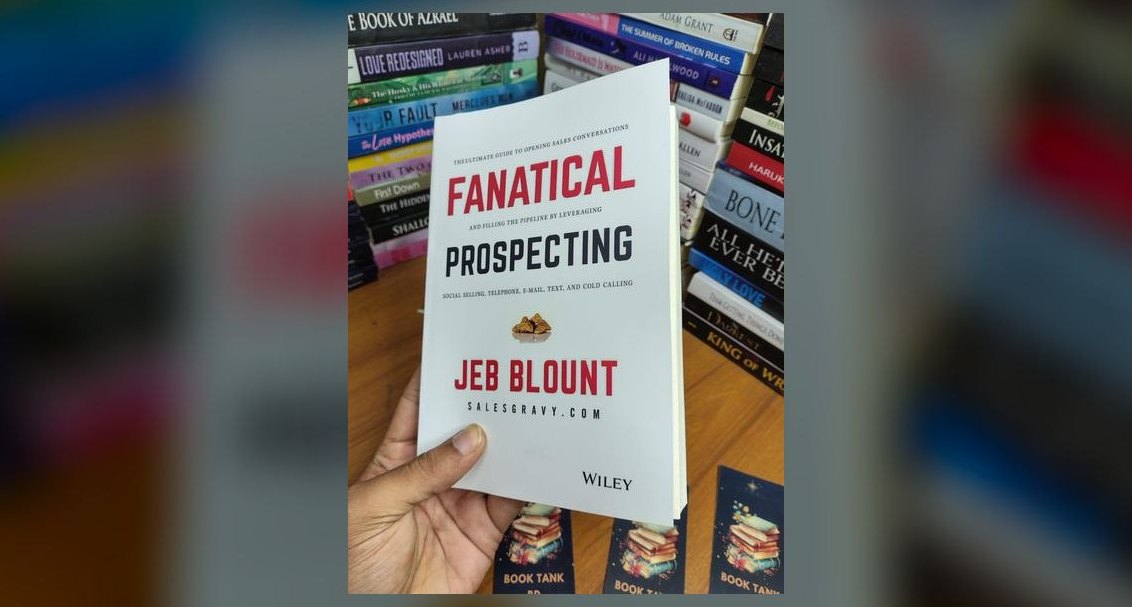 bsHow do you apply *Fanatical Prospecting* to LinkedIn outreach in 2027?
 bsHow does *Gap Selling* help you close more deals in a recession in 2027?
 bsWhat sales script does *New Sales. Simplified.* recommend for cold calls in 2027?
 bsDoes *The Psychology of Selling* still hold up for modern sales techniques in 2027?
 bsWhat’s the most actionable principle from *How to Win Friends and Influence People* for remote work in 2027?
 bsWhat’s the biggest mistake *SPIN Selling* warns against in complex B2B sales?
 bsHow does *Fanatical Prospecting* change your daily routine for outbound sales?
 bsWhat’s the most persuasive technique from *Pitch Anything* for investor pitches?
 bsWhat’s the key insight from *The Challenger Sale* for leading a sales team in 2027?