
What’s the core message of *The Psychology of Selling* for handling rejection in sales?
 Curated byKory White · Fractional CRO · Maryland
 PULSEKNOWLEDGE LIBRARY
Brian Tracy's core message is that rejection is not personal — it is a statistical cost of doing business. The prospect declines an offer, a price, or a moment in time, never your worth. Control your activity volume and your self-talk, and rejection loses its power to stop you.
The Tuesday afternoon that breaks most reps
Picture a mid-market SDR three weeks into the job. Monday went fine — twelve dials, two conversations, one meeting booked. Tuesday she picks up the phone at 1:40 p.m. and the first prospect cuts her off at "Hi, this is—" with a flat "Not interested," then hangs up. The second call goes to voicemail. The third prospect listens for eleven seconds, says "We already have someone for this," and hangs up. The fourth is a gatekeeper who will not transfer. By 2:15 she has stopped dialing. She opens Salesforce and starts "cleaning up her list." At 2:40 she is researching a company on LinkedIn that she already researched yesterday. At 3:10 she moves to email because email does not say no out loud.
This is the exact failure mode *The Psychology of Selling* is built to interrupt. Nothing in that hour was unusual. A 25% connect rate and a 10% conversation-to-meeting rate — perfectly ordinary numbers for cold outbound — mathematically guarantee long stretches of nothing. Four rejections in thirty-five minutes is not a bad day; it is a Tuesday. What went wrong was not the dials. It was that she treated a run of statistically expected outcomes as evidence about herself, and then she quietly reduced her activity to stop the evidence from accumulating.
Tracy's framing names this precisely. He argues that fear of rejection is the single largest obstacle to sales performance, and that it operates upstream of skill. A rep with weak discovery questions who makes sixty dials will out-produce a rep with excellent discovery who makes twelve, because the second rep's calendar is empty. The fear does not announce itself as fear — it disguises itself as list hygiene, as research, as "warming up the account first," as a rewritten email sequence. Call reluctance is the symptom; the diagnosis is that the brain has read social rejection as a threat and is routing around it.

The reason the disguise works is that every avoidance behavior is defensible in isolation. Cleaning a list is real work. Researching an account is real work. Nobody's manager walks past and says "stop doing CRM hygiene." The behavior only looks like avoidance in aggregate, across a week of activity logs, which is exactly why Tracy pushes so hard on counting. The count is what makes the invisible visible. And notice the downstream damage: a rep who fills Tuesday afternoon with research produces a pipeline that looks thin four weeks later, gets coached on "quality of conversations," and concludes the problem is her talk track. She rewrites the script, the script was never broken, and the real cause — thirty-five minutes of unprocessed rejection on a Tuesday — never surfaces in a single pipeline review.
Adjacent roles hit the same wall in different clothing. A customer success manager pushing a renewal that gets deferred, a partner manager whose co-sell request goes unanswered for six weeks, a founder hearing "we'll pass" from investor eleven of forty — same nervous system, same avoidance, same quiet reduction in attempts. The vocabulary changes and the mechanism does not.
What is actually happening between the "no" and the next dial
Tracy's explanation is unglamorous and useful: humans are wired to avoid social exclusion because, for most of our history, exclusion was dangerous. A stranger saying "not interested" registers in the same rough neighborhood as being pushed out of the group. The body responds before the mind reasons — heart rate up, attention narrowed, a strong pull toward whatever ends the discomfort fastest. Ending the discomfort fastest means not dialing.
The intervention point is not the rejection itself, which you do not control, and not the emotion, which arrives whether you approve it or not. The intervention point is the sentence you say to yourself in the ninety seconds afterward. Left alone, that sentence is usually a verdict about identity: *I'm not good at this. I'm bothering people. This list is garbage and so am I.* Verdicts about identity generalize — if I am bad at this, I will be bad at the next one too, so why place it. Tracy's replacement is a sentence that stays local: *that was a mismatch, next.*
The loop on the left is self-sealing, which is why it is so hard to argue someone out of it. Thin pipeline four weeks after a bad Tuesday genuinely looks like proof that the rep is bad at the job. It is not proof. It is the arithmetic of reduced attempts, arriving on a delay long enough that nobody connects it to the Tuesday.
Two mechanical details make the right-hand path work. First, speed. Tracy's recovery sequence is deliberately short: acknowledge without argument ("Understood — thanks for the straight answer"), ask one calibrating question if the moment allows it ("Out of curiosity, is it timing or is it that you're already covered?"), log the answer, dial. The whole thing should fit inside a minute. Rumination is the enemy, and rumination needs runway. Give it three minutes of staring at the screen and it will build a case.
Second, the question converts an emotional event into a data point. "Is it timing or are you already covered?" is not a save attempt — a save attempt after a hard no reads as pressure and burns the account. It is a taxonomy exercise. Across forty rejections, the split between *wrong time*, *already vendored*, *no budget authority*, and *wrong problem entirely* tells you whether your issue is targeting, timing, or message. That distinction is the difference between rewriting a script that was fine and fixing a list that was not.
There is a management layer here too, and it is where most teams get it backwards. If a manager's only response to a bad Tuesday is "keep your head up," the rep learns that rejection is something to be endured privately. If the manager instead asks "what were the four no-reasons?" the rep learns that rejection produces output. Same event, completely different conditioning. The strongest outbound floors treat the objection log as a shared artifact reviewed weekly, which quietly removes the shame from the whole category — everyone's log has forty entries in it.
The numbers that make the argument stick
Tracy's Law of Averages only calms anyone down if the averages are real, and this is where most reps skip the work. Vague awareness that "sales is a numbers game" does nothing at 2:15 on Tuesday. Knowing your own ratios does, because it converts a bad hour into an expected line item.
You need four numbers, all of which sit in any CRM or dialer:
Dial-to-connect. In cold B2B outbound, mobile-heavy lists commonly land in the 8–20% range and office-line lists run lower. If you connect on 12% of dials, then 88 out of 100 dials produce no human at all — and a "no answer" is not a rejection, though the nervous system files it as one.
Connect-to-conversation. Of the humans who pick up, a meaningful share end the call in under fifteen seconds. Somewhere between a third and two-thirds reaching an actual exchange is normal depending on segment and list quality.
Conversation-to-meeting. Single digits to low teens is typical for cold. If yours is 10%, nine conversations end in some flavor of no for every one that ends in a calendar invite.
Meeting-to-close. Varies enormously by deal size and cycle length; 15–30% is a common band for mid-market.
Chain those together and the picture changes character. At 12% connect, 50% conversation, and 10% conversation-to-meeting, you need roughly 170 dials for one meeting. At a 20% meeting-to-close rate, you need about five meetings — call it 850 dials — for one closed deal. If your average deal is worth $12,000 in first-year revenue, each dial is worth roughly $14 whether the person on the other end is delightful or hangs up mid-sentence. Each *rejection* is worth about $14. That is not a motivational reframe; it is division.
Run the same math on your own numbers and keep the result somewhere visible. The point is not precision — your ratios will drift by segment, season, and list. The point is that a specific number is arguable with and a vague feeling is not. When the fourth no lands, "that's $14, next" is a sentence with a source. "Stay positive" is not.
Three cautions on the arithmetic. It assumes constant quality, which is false — dial 300 times in a day and calls 200 through 300 are worse than calls 1 through 100, so raw volume past a point buys diminishing returns and a hoarse rep. It assumes stable list quality, so a 170-dials-per-meeting figure from a well-researched ICP list will not survive being applied to a scraped one. And it is a *lagging* description: the ratios describe what happened, so if you change your opener on Monday, Monday's numbers are still mostly a report on last month's skill level. Give any change two weeks of volume before you judge it.
The activity-goal reframe follows directly. "Close three deals this week" is a goal whose achievement depends on other people's budget cycles. "Place 250 dials and send 400 emails this week" is a goal you can hit through pure decision. Tracy's version of this goes further into deliberate paradox — set a rejection quota. Aim to collect twenty-five no's today. It sounds like a gimmick and it works for one structural reason: it inverts the reward. Under a rejection quota, the outcome you were flinching from becomes the outcome that scores, and the only failing move is not asking. Reps who run this for a week routinely report that the fear does not vanish so much as become irrelevant, because it is no longer attached to anything they are trying to avoid.
Track a fifth number too, and this one is not in the CRM: time-to-next-dial after a hard no. Thirty seconds is healthy. Six minutes means the rejection is being processed emotionally rather than administratively, and it is the earliest available warning that a rep is drifting toward the left-hand loop — visible weeks before the pipeline shows it.
Where Tracy's model holds, where it strains, and what else is on the table
*The Psychology of Selling* was written for an era of phones, doors, and territory maps. Some of it transfers intact and some of it needs translation, and pretending otherwise makes the advice easier to dismiss than it should be.
What holds up without amendment: separating identity from outcome, controlling inputs rather than outcomes, deliberately rehearsing responses to expected objections, and treating persistence as a trainable capacity rather than a personality trait. None of that is medium-dependent. It applies equally to a cold call, a LinkedIn message, a renewal conversation, a fundraise, or an internal pitch to a skeptical VP of Finance.

What strains: the volume assumption. Tracy's world had no spam filters, no domain reputation, no "this number is likely spam" carrier labels, and no buying committee of nine people who all Google you before replying. Applying pure Law-of-Averages logic to modern email will get your sending domain throttled and your sequences filtered, which is a failure mode where more activity produces strictly less pipeline. The correct translation is that the Law of Averages governs *conversations*, not *sends*. Volume in channels with reputation systems has a hard ceiling that raw persistence cannot push through.
What is genuinely contested: the affirmations. Repeating "I am a rejection-proof salesperson" to a mirror works for some people and produces eye-rolling in others, and the eye-rollers are not wrong to notice that a self-statement you do not believe can land flat. A pragmatic middle path keeps the mechanism and drops the theater. The mechanism is interrupting a spiraling internal narrative with a pre-written alternative. That can be an affirmation, or it can be a physical reset — stand up, walk to the window, come back — or a checklist item ("log reason, next"), or simply reading your dials-per-meeting number off a sticky note. Pick the version you will actually execute at 2:15 on Tuesday.
The bottleneck question at the center is the one worth asking before adopting any of this. A rep making 30 dials a week does not have a message problem, and no amount of script polish will fix it. A rep making 400 dials a week with a 2% conversation-to-meeting rate does not have a courage problem, and telling them to push through more rejection is close to cruel — the humane and effective move is to fix the list. Precision-first has a real hidden cost, incidentally: when you make eight highly-researched touches a week instead of eighty, each rejection carries far more weight, and reps in enterprise motions often have *worse* rejection resilience than SDRs precisely because they get so little practice at it.

One adjacent comparison sharpens the whole thing. Fundraising founders face a rejection structure almost identical to cold outbound — a long list, a low hit rate, and a socially loaded no delivered by a person with status. The founders who survive it are the ones who treat forty investor conversations as one process with an expected yield rather than forty separate verdicts. Same medicine. The dosage is the only thing that changes, and the fact that it transfers cleanly across such different contexts is decent evidence that Tracy identified something structural rather than something about selling.
The failure modes that quietly undo all of it
Most people who read this book and get nothing from it fail in one of a small number of predictable ways.
Reframing as suppression. "Rejection isn't personal" turns into "I'm not allowed to feel bad about rejection," and the rep spends energy performing composure instead of processing the moment. The feeling is not the problem; the interpretation is. Feel the sting, name it, run the log, dial. Suppression costs more energy than acknowledgment and it accumulates — the reps who blow up in month five are usually the ones who never admitted month two was hard.

Volume as an anxiety ritual. Dialing frantically to avoid thinking is not persistence, it is a different avoidance. The signal is call quality collapsing while dial counts climb: no discovery questions, no pauses, a pitch delivered at speed to get to the hang-up. If your dials are up 40% and your conversation-to-meeting rate is halved, you are not being resilient. You are hiding inside the activity.
Skipping the log. The recovery process is three steps and everyone drops the middle one, because writing down the objection reason takes eight seconds and feels pointless in the moment. It is the only step that produces compounding returns. Without it you have persistence with no learning — the same forty rejections next month, for the same four reasons, none of which you can name. Keep it stupid: a spreadsheet column with a dropdown of five reasons is enough. If it takes more than ten seconds, you will stop.
Treating a targeting failure as a resilience failure. If 80% of your no-reasons are "we're not the right size for that" or "that's not a problem we have," the fix is the list, not your mindset. Grinding harder against a bad ICP is the most demoralizing thing in sales and it wears the costume of discipline. This is exactly what the log is for — it makes the distinction visible in a week instead of a quarter.
No recovery ritual, so a bad hour eats the afternoon. The rep who has decided in advance what happens after three consecutive hard no's — stand up, two minutes away from the desk, one recorded win replayed, back to the phone — survives Tuesday. The rep improvising a response while the cortisol is still up does not. Decide the ritual on a calm Monday morning, not in the middle of the bad hour.
Isolation. Rejection that stays private grows. Teams that surface it — a Slack channel where reps post the day's most brutal no, a standup item where the objection log is read aloud — normalize the base rate. When you learn that the top rep on the floor collected nineteen no's yesterday, the story that you are uniquely bad at this dies quickly. This is the highest-leverage manager move available and it costs nothing.
Confusing objections with rejections. Tracy is emphatic on this and it is the most commonly missed distinction in the book. "It's too expensive" is engagement — the prospect is doing the work of evaluating. Treating a price objection as a no ends deals that were live. The tell is whether the person is still asking questions. If they are, you are in a negotiation, not a rejection, and the emotional response appropriate to a rejection will make you fold or overcorrect at exactly the wrong moment.
Expecting a fast timeline. Rejection tolerance is built over weeks of repeated exposure, not read into existence over a weekend. A rep four weeks into deliberate practice is usually still flinching, and the ones who quit the method at week two conclude it does not work. The honest expectation is that the first month feels like nothing is changing and the difference becomes obvious somewhere around week six, mostly as an absence — you notice you did not stop dialing after the bad hour, and you notice it a day later.
Related questions
Does the numbers-game framing work if I only make five calls a week?
Poorly. Enterprise motions with tiny call volumes get almost no exposure reps, so each no lands harder. Substitute deliberate rehearsal — role-play the three hardest objections weekly — and lean on written accounts of the process rather than raw activity to build tolerance.
Is a rejection quota actually a good idea or is it a gimmick?
It works because it inverts the reward: the thing you were avoiding becomes the thing that scores. Run it for one week as an experiment, not a permanent system. Its job is breaking call reluctance, and once dialing feels normal, revert to conversation-based goals.
How do I tell call reluctance from a genuinely bad list?
Check the no-reasons in your log. Concentrated "not the right fit" or "we don't have that problem" points at targeting. Scattered reasons plus dial counts that sag after every hard call points at reluctance. The log answers this in a week; guessing takes a quarter.
Does any of this transfer to email and LinkedIn outbound?
The mindset does; the volume math does not. Silence is not the same event as a spoken no — it is less painful and far less informative. Channels with reputation systems punish raw volume, so persistence there means better targeting and sequencing, not more sends.
What should a manager do differently after a rep's bad day?
Ask for the four no-reasons instead of offering encouragement. It converts a private emotional event into shared, reviewable output, teaches the rep that rejection produces something usable, and gives you real targeting data. Encouragement alone teaches that rejection is to be endured quietly.
FAQ
Does Tracy claim rejection is a good thing?
No — his framing is that rejection is neutral, and that your interpretation of it determines what it costs you. A no is information about fit, timing, or budget. It becomes destructive only when you convert it into a claim about your own competence, which is the conversion the book is entirely built to prevent.
How long before rejection resilience actually shows up?
Expect weeks, not days. The mechanism is repeated exposure paired with a consistent recovery routine, and there is no shortcut around the repetition. Most people notice the shift as an absence — you had a bad hour and it did not eat the afternoon — and typically notice it retroactively, somewhere in the second month of consistent practice.
I'm naturally thin-skinned. Is this method wrong for me?
Sensitivity reads prospects well; it just needs a firewall between the outcome and your self-assessment. The tactical version is decoupling: score yourself on attempts made and objections logged, never on yeses received. You keep the empathy that makes you good in conversations and stop paying for it after every no.
What's the single biggest mistake reps make with rejection?
Reducing activity without noticing. Nobody decides to quit; they decide to clean the list, research one more account, rewrite the sequence. Every one of those is defensible work, which is why the reduction is invisible until pipeline thins a month later and the wrong root cause gets diagnosed.
Is a price objection a rejection?
No, and confusing the two ends live deals. Objections are engagement — the prospect is still evaluating and still asking questions. Rejection is disengagement. Reacting to a price objection with the emotional response you would have to a hang-up makes you either fold on price or overcorrect defensively, both at the worst possible moment.
Do these ideas hold up outside cold calling?
Yes, with translation. The structure — long list, low hit rate, socially loaded no — is identical in fundraising, partner development, renewals, recruiting, and internal pitching. What changes is the dosage: fewer attempts per week means fewer exposure reps, so low-volume motions need deliberate rehearsal to substitute for the practice that volume provides for free.
Sources
- https://www.briantracy.com/blog/sales-success/
- https://hbr.org/2018/03/how-to-handle-rejection-at-work
- https://www.apa.org/monitor/2012/04/rejection
- https://www.ncbi.nlm.nih.gov/pmc/articles/PMC3059081/
- https://hbr.org/2011/07/the-short-life-of-online-sales-leads
- https://www.rainsalestraining.com/blog/top-performing-sales-organizations-research
- https://www.gartner.com/en/sales/insights/b2b-buying-journey
- https://www.simonandschuster.com/books/The-Psychology-of-Selling/Brian-Tracy/9780785288060
- https://www.salesforce.com/resources/research-reports/state-of-sales/
Related on PULSE
- [What's the core principle from *The Psychology of Selling* for turning a rejection into a future opportunity?](/knowledge/bs0398)
- [What's the biggest mindset shift *The Psychology of Selling* recommends for handling a no-decision close?](/knowledge/bs0382)
- [Does *The Psychology of Selling* still hold up for modern sales techniques in 2027?](/knowledge/bs0333)
- [What's the most practical technique from *New Sales. Simplified.* for handling a "send me info" objection?](/knowledge/bs0400)
- [How does *Influence: The Psychology of Persuasion* explain why "free" offers actually work in B2B sales?](/knowledge/bs0397)
- [How does *SNAP Selling* help you shorten a six-month sales cycle into three months in 2027?](/knowledge/bs0389)
@Kory-White- · if Venmo asks, the last 4 of my number are 2012
 bsWhat are the key lessons from *Never Split the Difference* for negotiating a raise in 2027?
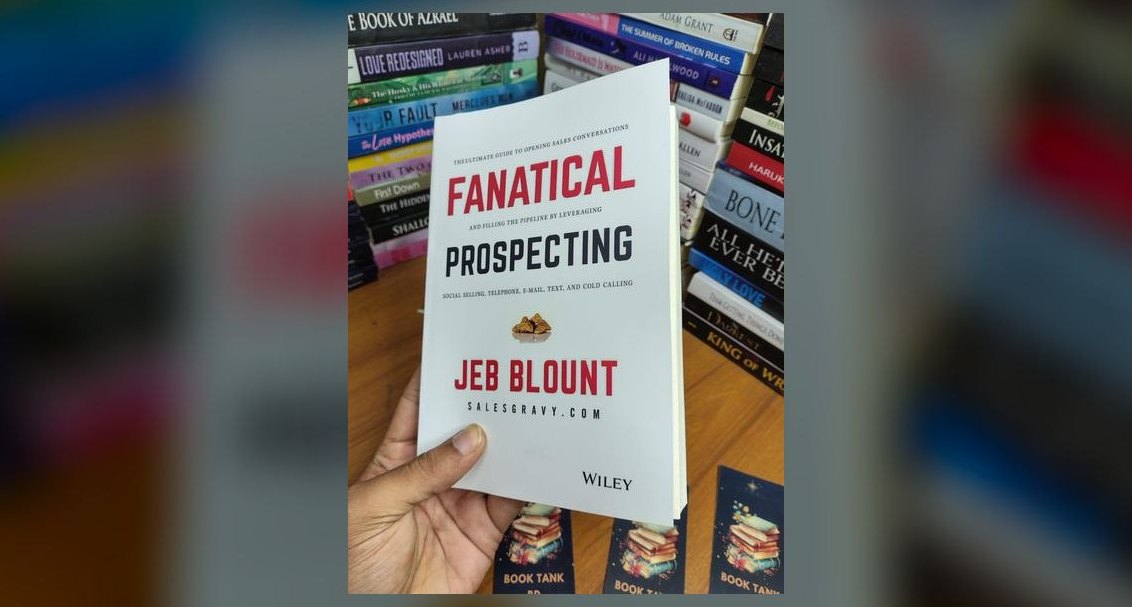 bsHow do you apply *Fanatical Prospecting* to LinkedIn outreach in 2027?
 bsHow does *Gap Selling* help you close more deals in a recession in 2027?
 bsWhat sales script does *New Sales. Simplified.* recommend for cold calls in 2027?
 bsDoes *The Psychology of Selling* still hold up for modern sales techniques in 2027?
 bsWhat’s the most actionable principle from *How to Win Friends and Influence People* for remote work in 2027?
 bsWhat’s the biggest mistake *SPIN Selling* warns against in complex B2B sales?
 bsHow does *Fanatical Prospecting* change your daily routine for outbound sales?
 bsWhat’s the most persuasive technique from *Pitch Anything* for investor pitches?
 bsWhat’s the key insight from *The Challenger Sale* for leading a sales team in 2027?